
7 Growth Mindset Examples vs. Fixed Mindset in Real Life
You’ve told your students to "have a growth mindset" a hundred times, but the phrase means nothing until you can point to what it actually looks like in action. Saying "just try harder" isn’t it. Real examples of growth mindset show up in specific words, specific reactions to failure, and specific choices about effort, and that’s exactly what most explanations skip over.
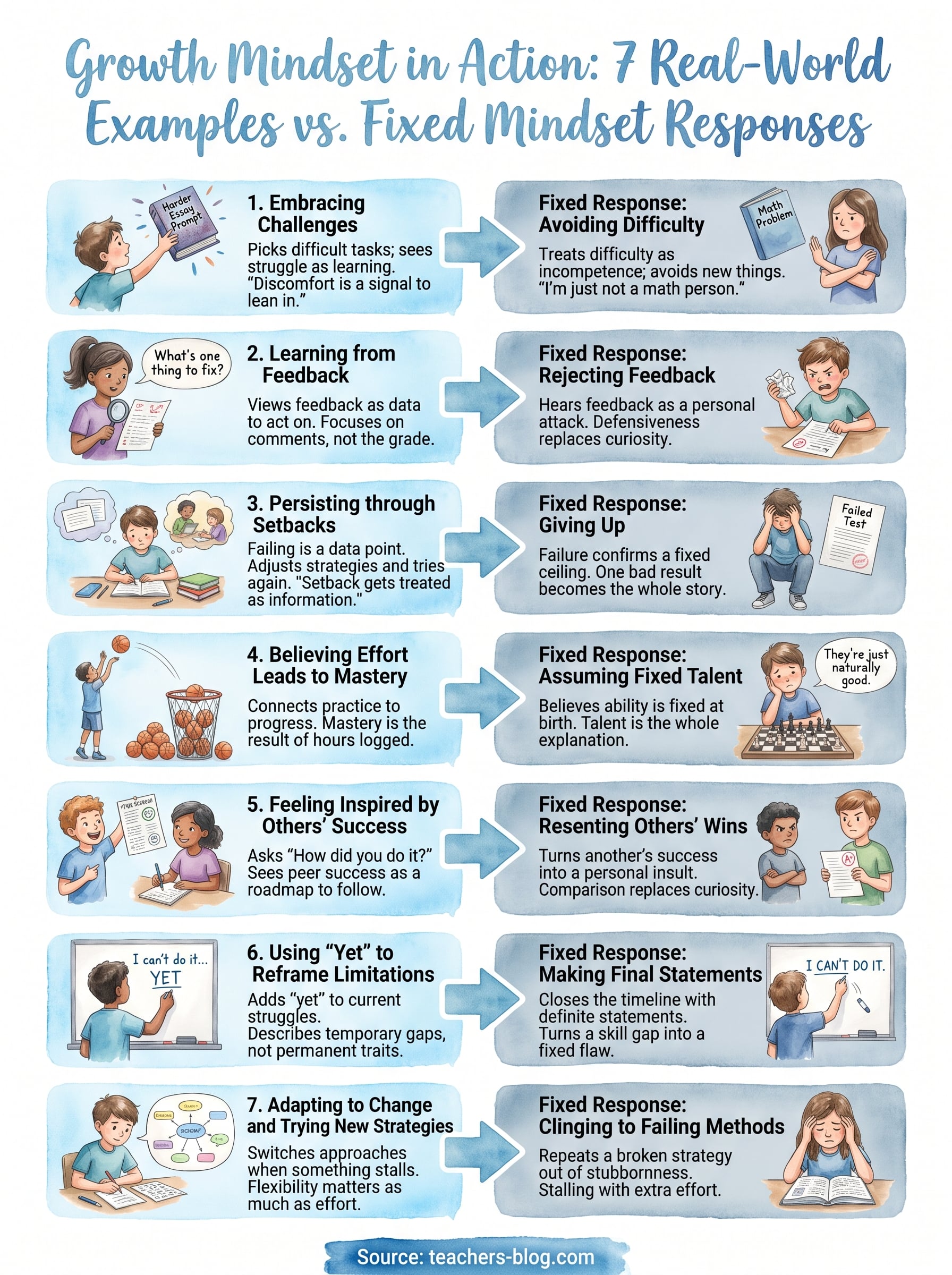
This article gives you those specifics. Instead of another definition, you’ll get seven side-by-side comparisons of growth mindset vs fixed mindset examples, drawn from classroom moments, feedback conversations, and everyday challenges your students already face. Each pair shows the fixed response first, then the growth mindset version, so the difference is obvious rather than abstract.
Why this matters for your teaching: kids copy language before they internalize belief. When you can model an example of a growth mindset in real time, students start borrowing that script for their own setbacks. By the end, you’ll have ready-to-use phrases and scenarios you can bring into class tomorrow, whether you’re handling a failed quiz, a frustrated group project, or your own professional growth.
1. Embracing challenges instead of avoiding them
A student with a growth mindset picks the harder essay prompt on purpose. Not because it’s easier to brag about, but because they’ve learned that struggle is where the actual learning happens. This is one of the clearest examples of a growth mindset you’ll see in any classroom, and it’s also the easiest to miss if you’re not watching for it directly.

What it looks like in real life
Watch for the kid who raises their hand to try the problem nobody else attempted, or the one who signs up for AP Chemistry despite a rocky start in regular Chem. In your classroom, this shows up as a student choosing the differentiated worksheet tier above their usual level, or a colleague volunteering to pilot a new curriculum instead of waiting for someone else to test it first. The common thread: discomfort gets read as a signal to lean in, not a signal to retreat.
The fixed mindset contrast
A fixed mindset treats difficulty as proof of incompetence. The student who says "I’m just not a math person" before attempting a single problem is protecting their self-image, not describing their ability. You’ll see this in adults too: a teacher who sticks to the same lesson plans for a decade because trying something new risks looking incompetent in front of colleagues. Avoidance becomes the strategy, and it quietly caps how much anyone in the room can grow.
Growth mindset isn’t about liking hard things. It’s about choosing them anyway because you trust the struggle will pay off.
How to strengthen it
You build challenge-seeking behavior with small, repeated permission-giving, not one big pep talk. Try these moves in your own classroom:
- Normalize the productive struggle: Say out loud, "This is supposed to feel hard right now," before a tough task starts.
- Offer stretch options without penalty: Let students attempt a harder tier and revert without grade consequences.
- Praise the attempt, not just the score: Comment on the strategy a student tried, even if the answer was wrong.
- Model it yourself: Tell your class about a lesson you tried that flopped, and what you changed.
Stanford’s research on mindset, led by psychologist Carol Dweck, backs this up directly: students praised for effort and strategy outperform those praised only for intelligence over time, according to findings summarized by the American Psychological Association.
2. Learning from feedback rather than rejecting it
One of the sharpest growth mindset examples shows up the second you hand back a graded essay. Some students flip straight to the grade and stop reading. Others dig into the margin notes first, because they know the comments matter more than the number at the top. That single choice tells you almost everything about how a student will improve over the next month.
What it looks like in real life
A student with a growth mindset example worth noting will ask, "What’s one thing I should fix before the next draft?" instead of "What did I get?" You’ll see the same pattern in a colleague who asks for a peer observation and actually takes notes during the debrief. In both cases, feedback gets treated as data to act on, not a verdict to argue with.
The fixed mindset contrast
A fixed mindset hears feedback as an attack on identity. The student who argues over every point deduction, or the one who tosses the paper without reading a single comment, is protecting their sense of being "smart" rather than trying to get smarter. Defensiveness replaces curiosity, and the same mistakes repeat draft after draft.
If a student can’t hear feedback without feeling attacked, the feedback never had a chance to work.
How to strengthen it
Teach students to separate the comment from the self:
- Require one written response to feedback before resubmission, no exceptions.
- Ask "what will you try differently" instead of "how do you feel about this grade."
- Share your own feedback story, like a manuscript rejection or a rough evaluation you learned from.
3. Persisting through setbacks and failure
Failing a test, bombing an audition, or watching a science experiment collapse doesn’t end the story for a student with a growth mindset. It’s just one data point. This is where examples of growth mindset get tested in real conditions, because anyone can talk about resilience until an actual setback shows up on a report card.
What it looks like in real life
Picture the student who fails the first unit test, then reworks their study method instead of giving up on the subject entirely. They might switch from re-reading notes to practice-testing themselves, or start a study group because solo review clearly wasn’t working. You’ll see the adult version in a teacher whose first year was rough but who stays in the profession, adjusting classroom management each semester rather than assuming teaching "isn’t for them." The setback gets treated as information, not as a final verdict on ability.
The fixed mindset contrast
A fixed mindset reads failure as confirmation of a fixed ceiling. The student who fails once and drops the class, or the colleague who tries a new seating chart, watches it flop, and never experiments again, has decided the setback proves something permanent. One bad result becomes the whole story, and persistence never gets a chance to prove otherwise.
A setback only becomes a fixed mindset problem when you let it write the ending instead of the next chapter.
How to strengthen it
Build recovery into your routines, not just your pep talks:
- Require a redo plan after any failing grade, due within a week.
- Track attempts, not just outcomes, so students see progress across drafts.
- Tell recovery stories from your own teaching career, including the year you almost quit.
4. Believing effort leads to mastery
Ask a student why someone got good at chess, coding, or free-throw shooting, and you’ll hear their mindset before they even realize it. A growth mindset example treats mastery as the direct result of hours logged, not a trait someone was handed at birth. This belief changes how much effort a student is willing to spend, because effort only feels worthwhile if you think it actually leads somewhere.
What it looks like in real life
A student who says "I got faster at essays because I’ve written twenty of them this year" is connecting practice to progress out loud. You’ll see the same logic in a teacher who credits classroom management skills to five years of trial and error, not natural talent. Both are drawing a straight line from repetition to competence, and that line is exactly what keeps them practicing.
The fixed mindset contrast
A fixed mindset assumes ability is mostly fixed at birth. "She’s just naturally good at writing" sounds like a compliment, but it quietly tells the listener that effort barely matters. Talent gets treated as the whole explanation, which discourages anyone without an obvious head start from putting in the work.
Mastery isn’t proof of talent. It’s proof of hours nobody saw.
How to strengthen it
Make the effort-to-skill link visible in class:
- Show growth timelines, comparing a student’s first draft to their fifth.
- Name the specific practice behind a skill, not just the result.
- Avoid "natural talent" language, even when praising strong work.
5. Feeling inspired by other people’s success
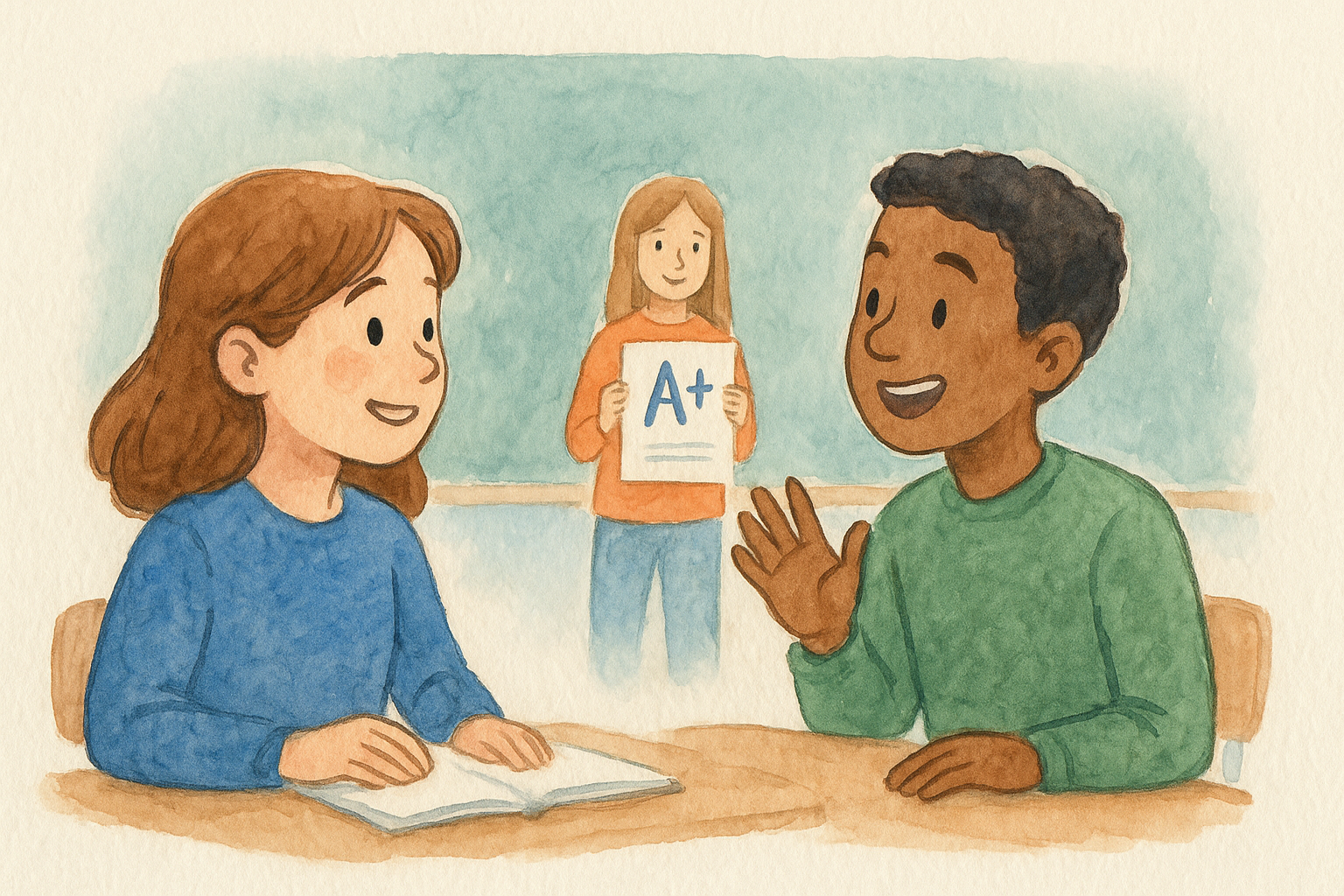
How a student reacts to a classmate’s A+ tells you almost as much as how they react to their own grade. A growth mindset example worth watching for is the kid who sees a peer’s success and asks how they did it, treating another person’s win as proof that the goal is reachable, not as a threat. That reaction alone can shift an entire classroom dynamic, because success stops feeling scarce and starts feeling contagious.
What it looks like in real life
Listen for the student who says, "How did you structure your thesis?" after seeing a strong essay, or the teacher who visits a colleague’s classroom specifically to steal a routine that’s working. Award ceremonies and honor roll assemblies become useful information sessions instead of comparison exercises. In both cases, someone else’s win becomes a roadmap, not a source of resentment.
The fixed mindset contrast
A fixed mindset turns another person’s success into a personal insult. "Of course she got the highest score, she’s just smarter than me" shuts down curiosity before it starts. You’ll see the adult version in a teacher who avoids a colleague’s high-performing classroom rather than learning from it. Comparison replaces curiosity, and the lesson available in someone else’s success goes untaken.
Someone else’s success is either a threat to your ego or a map to your next step. Growth mindset always chooses the map.
How to strengthen it
Redirect envy toward information:
- Ask students to interview a peer about their process after a strong project.
- Publicly credit strategies, not just outcomes, when praising top work.
- Model curiosity by naming a colleague whose approach you’ve borrowed.
6. Using the word yet to reframe limitations
One word separates a closed statement from an open one: "yet." A student who says "I can’t solve quadratic equations yet" is describing a temporary gap, not a permanent trait. This small linguistic habit is one of the most teachable growth mindset examples because you can start using it in your own classroom language this week, no curriculum change required.
What it looks like in real life
Listen for the student who catches themselves mid-complaint and adds "yet" to the end of a sentence, almost like a correction. You’ll hear it in phrases like "I haven’t figured out how to organize my essay yet" or "I’m not fast at mental math yet." A colleague might say the same thing about a new grading system: "I haven’t found a rhythm with this yet." The word keeps the door open for a future version of the same skill.
The fixed mindset contrast
Drop the "yet" and the sentence hardens into a permanent identity claim. "I can’t do fractions" and "I can’t do fractions yet" describe the same skill level, but only one of them leaves room for change. The missing word closes the timeline, turning a skill gap into a fixed trait.
Add one word to a limitation, and you turn a dead end into a work in progress.
How to strengthen it
Make the correction automatic and public:
- Model the swap out loud whenever a student says "I can’t."
- Post it visibly as a classroom norm, not just a poster slogan.
- Ask a follow-up question after "yet," like "what would help you get there?"
7. Adapting to change and trying new strategies
Switching approaches when the first one stalls is a growth mindset example that shows up constantly outside the classroom, but teachers rarely name it as such. A student who tries three different note-taking methods before finding one that sticks is running the same experiment a scientist runs, just with lower stakes. This kind of flexibility matters as much as effort, because sticking with a broken strategy out of stubbornness isn’t persistence, it’s just wasted time.
What it looks like in real life
Notice the student who abandons highlighting for flashcards after a bad quiz grade, or the group project team that reshuffles roles halfway through when the original plan clearly isn’t working. You’ll spot it in a teacher who swaps a lecture-heavy unit for stations after low engagement scores. New information changes the plan, and nobody treats the original approach as sacred just because it was the first one tried.
The fixed mindset contrast
A fixed mindset clings to a failing method because switching feels like admitting the first attempt was wrong. The student who rereads the same textbook chapter for the fourth time, expecting a different result, is confusing effort with strategy. Repetition without adjustment isn’t growth, it’s just stalling in place.
If a strategy isn’t working, changing it is growth. Repeating it harder is just stalling with extra effort.
How to strengthen it
Build strategy-switching into your routines directly:
- Ask "what else could you try" after any failed attempt, before offering a solution yourself.
- Share a menu of methods for common tasks like studying or drafting, so switching feels normal.
- Debrief group projects by naming what got adjusted mid-process, not just the final result.
Putting these examples into daily practice
None of these seven shifts require a new curriculum or a training day. You just need to notice which script a student reaches for and nudge them toward the other one, out loud, in the moment. Growth mindset examples become real the second you name them as they happen, whether that’s a kid adding "yet" to a complaint or a colleague swapping a failing lesson plan for something new.
Start small. Pick one of the seven this week, maybe feedback or effort, and watch for it in your own classroom until the language becomes automatic for both you and your students. That repetition is what turns a growth mindset example into an actual classroom habit instead of a poster on the wall.
If you want ready-made scripts, worksheets, and lesson tools to back this up, browse the resources at The Cautiously Optimistic Teacher and start building the habit tomorrow.