
11 Instructional Strategies for Teaching Every Classroom Needs
You’ve probably sat through a professional development session that promised to transform your teaching, only to walk away with one vague idea and a stack of handouts you’ll never open again. Solid instructional strategies teaching actually works from aren’t secret. They’re proven, repeatable moves that get students thinking instead of just sitting.
This article gives you exactly that: eleven instructional teaching strategies you can start using tomorrow, whether you’re planning a unit on To Kill a Mockingbird or trying to keep 8th graders focused during a Friday afternoon lesson. Each one comes with a clear explanation of when to use it and why it works, so you’re not guessing which approach fits your content or your students.
We pulled these from real classroom practice, the kind that shows up again and again in effective instructional strategies for teaching across grade levels and subjects. Some will sharpen how you differentiate for mixed-ability groups. Others will help you build stronger discussions or make abstract concepts stick. By the end, you’ll have a practical toolkit, not just theory, ready to plug into your next lesson plan.
1. Differentiate instruction to reach every learner
Differentiation means adjusting your content, process, or product so students at different readiness levels can access the same learning goal. It’s not about writing three separate lesson plans every night. It’s about building flexibility into the one you already have, so a struggling reader and an advanced one can both engage with To Kill a Mockingbird without one of them checking out.
How it works
Start with the standard or objective, then ask how students might reach it through different paths. Tiered assignments let you keep the same rigor while adjusting the scaffolding, maybe one group analyzes a passage with guided questions while another tackles it independently and extends into a comparative essay. Flexible grouping matters just as much: mix students by readiness for some tasks and by interest for others, so nobody gets permanently labeled as the
2. Use direct instruction to teach new skills clearly
Direct instruction gets a bad reputation as "boring lecture," but done well it’s one of the most efficient teaching instructional strategies you have for introducing something students have never seen before. Think of teaching MLA citation format or the rules of a new grammar concept. Students need clear modeling before they can practice independently, and direct instruction delivers that structure without wasting time.
How it works
Good direct instruction follows a predictable rhythm: state the objective, model the skill, guide practice together, then release students to work independently. The "I do, we do, you do" framework keeps this simple. You demonstrate a skill step by step, work through a similar problem with the class, then hand over an example for students to try solo while you circulate and check for errors.
Direct instruction works best as a launchpad, not a destination.
Who it’s best for
This approach suits brand-new content where students have no prior framework to build on, like introducing thesis statements before an opinion essay unit. It also works well for concrete, sequential skills such as math procedures or lab safety protocols where ambiguity leads to mistakes rather than creative discovery.
A simple way to try it this week
Pick one skill you’re about to teach and script the "I do" portion in advance. Write out exactly what you’ll say and show, keep it under five minutes, then plan a guided practice problem before students try one independently. Tight modeling beats a long, meandering explanation every time.
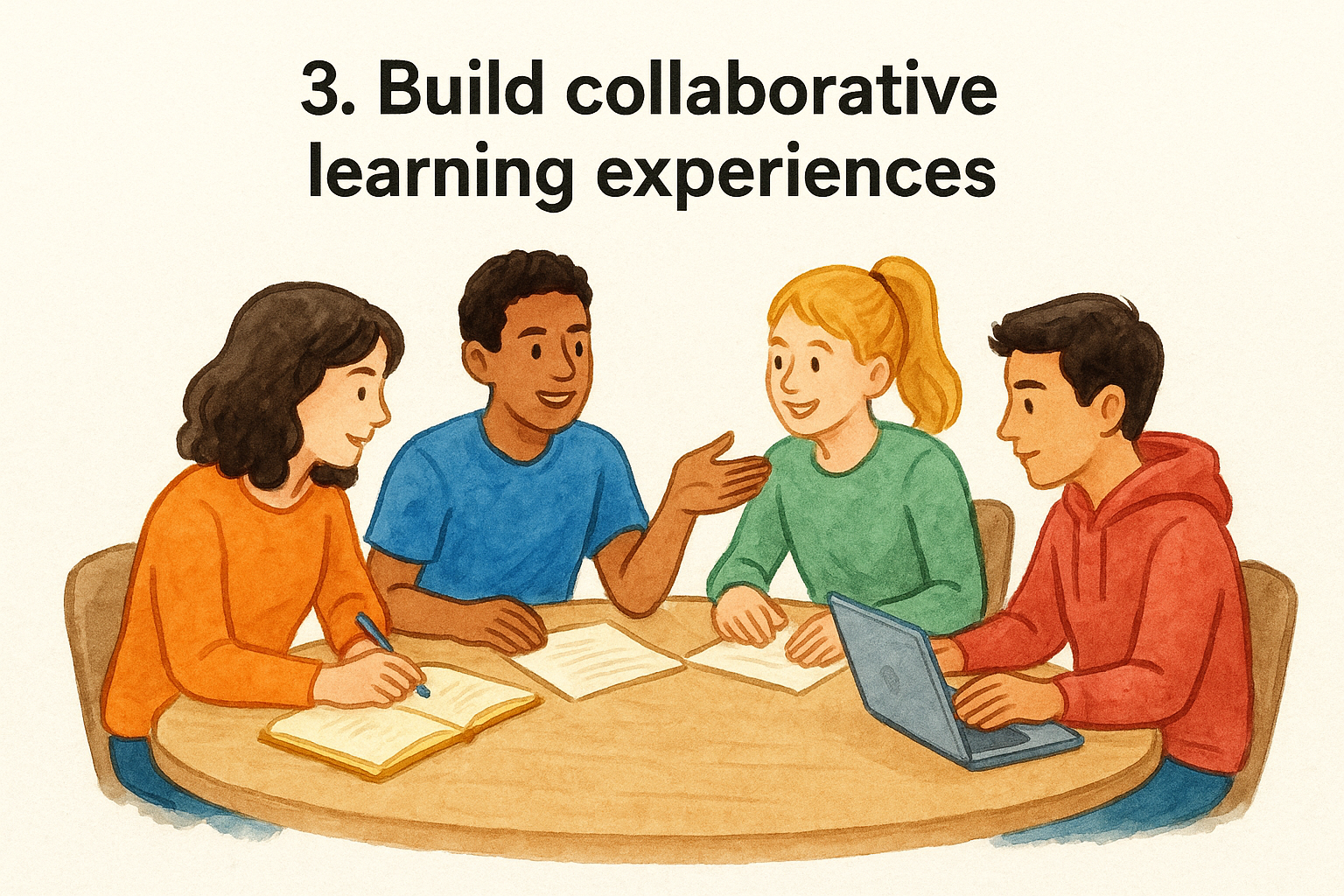
3. Build collaborative learning experiences
Collaborative learning puts students in small groups to solve a problem, discuss a text, or produce something together, and the payoff goes beyond the finished product. Talking through ideas with peers forces students to articulate their thinking, defend a position, and hear perspectives they’d never generate alone. Done right, this is one of the most reliable instructional strategies for teaching discussion-heavy content like Lord of the Flies, where multiple interpretations are the point, not a problem.
How it works
Effective group work needs structure, or you’ll just get one student doing the work while three others scroll their phones. Assign clear roles (facilitator, note-taker, timekeeper, presenter), give a specific task with a time limit, and hold individuals accountable through a written product or a quick share-out. Structures like think-pair-share or jigsaw reading work well because every student has a defined job before the group even starts talking.
Group work without accountability just teaches kids how to hide.
Who it’s best for
This strategy shines with discussion-based content: literature analysis, debate topics, or open-ended problems in science and social studies where multiple valid answers exist. It’s less useful for teaching a brand-new procedural skill, since students without a shared foundation tend to spread misconceptions instead of catching them.
A simple way to try it this week
Try a jigsaw activity with your next reading assignment. Split the text into four sections, put students in expert groups to master one section, then reshuffle so each new group has one expert per part who teaches the rest.
4. Spark curiosity with inquiry-based learning
Inquiry-based learning flips the usual order of a lesson. Instead of telling students the answer first, you hand them a question or a puzzling scenario and let them investigate before you fill in the gaps. This approach works because curiosity, once triggered, does more to drive retention than any explanation you could give up front.
How it works
Good inquiry starts with a genuinely open question, something like "why did the Greek myths keep repeating the same warnings about pride?" rather than a question with one obvious answer. Students research, form hypotheses, and test their thinking against evidence before you step in to clarify or correct. Your job shifts from lecturer to facilitator, asking follow-up questions that push students deeper instead of handing them conclusions.
Curiosity fades fast when you answer the question before students get to chase it.
Who it’s best for
This strategy fits topics with genuine ambiguity or multiple valid explanations, like historical causation, scientific phenomena, or thematic analysis in literature. Skip it for procedural skills or safety-critical content where guessing leads to bad habits instead of insight. Students who already have some background knowledge tend to get the most out of open investigation, since they have material to reason from.
A simple way to try it this week
Before your next mythology unit, open with a question instead of a definition: "why do so many cultures invent gods for the same natural events?" Let students brainstorm answers in pairs before you introduce any content, then compare their guesses to what they discover.
5. Deepen learning through project-based tasks
Project-based learning asks students to spend an extended stretch of time, days or even weeks, building something real in response to a complex question. Instead of a quiz at the end of a unit, students produce a public product: a documentary, a proposal, a working prototype, or a presentation to an actual audience. The depth comes from sustained effort on one problem rather than jumping between disconnected assignments.
How it works
Start with a driving question that has no single right answer, something like "how would you redesign our school cafeteria to cut food waste in half?" Students research, draft, get feedback, and revise across multiple checkpoints rather than turning in one final product cold. Build in structured milestones, an outline due Monday, a rough draft by Thursday, so the project doesn’t collapse into a last-minute scramble.
A project without checkpoints turns into a fire drill the night before it’s due.
Who it’s best for
This strategy suits units with room to breathe, where you have two or more weeks and content that connects to real-world application, like persuasive writing tied to a genuine community issue. It struggles in tightly packed pacing guides or with skills that need quick, repeated practice rather than one deep dive.
A simple way to try it this week
Take an upcoming essay assignment and reframe it as a project with a real audience, students write their opinion essays as letters to an actual local official instead of just you, and mail a few of the strongest ones.
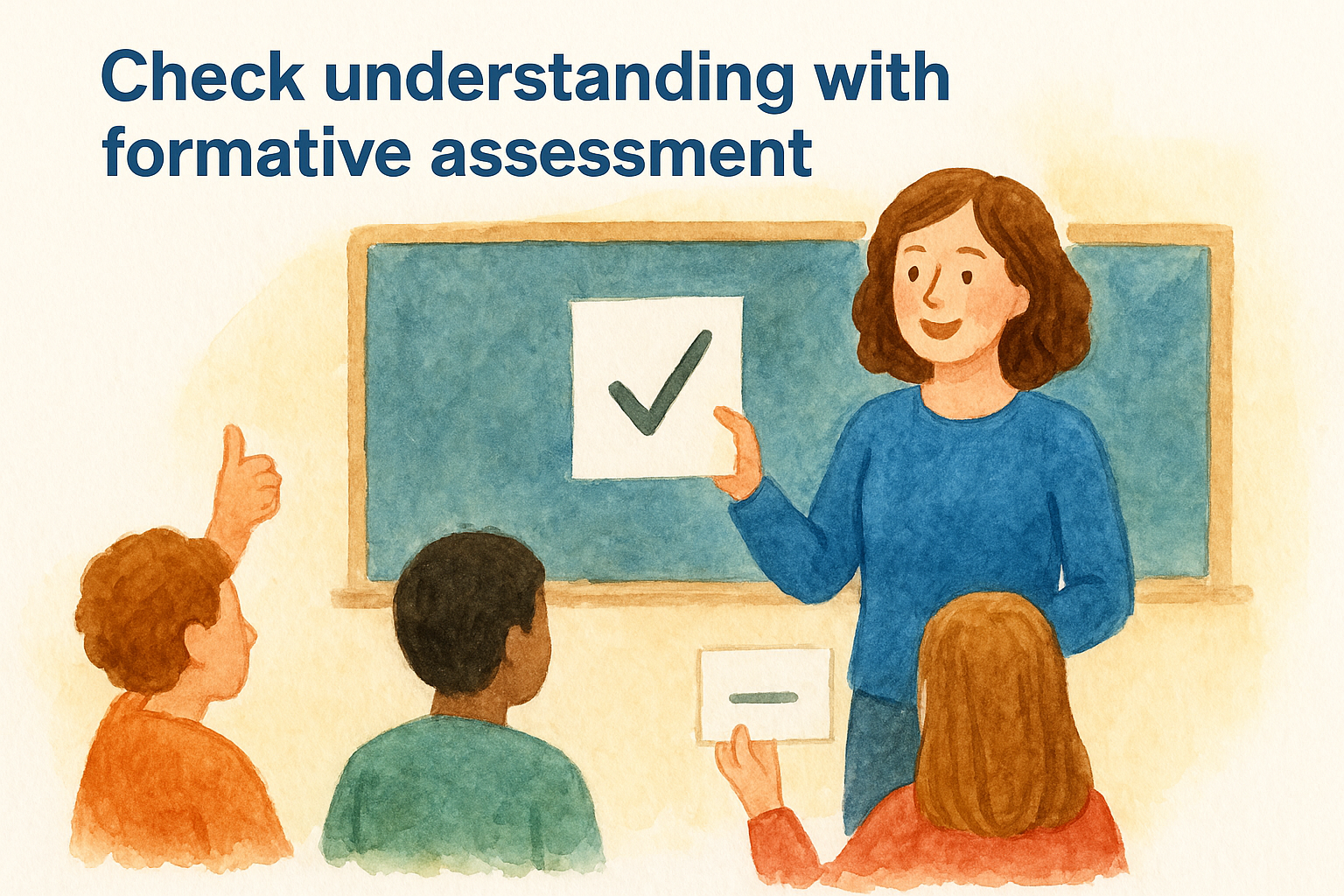
6. Check understanding with formative assessment
Formative assessment means checking what students actually know before, during, and after a lesson, rather than waiting for a unit test to find out who got lost. These are low-stakes, frequent checks, exit tickets, quick polls, thumbs-up signals, that tell you whether to move forward or reteach right now. Skipping this step is how you end up three weeks into a unit realizing half the class never understood the foundation.
How it works
Quick checks work best when they’re specific and fast to grade. Try tools like:
- Exit tickets: one question students answer on their way out the door
- Whiteboard checks: students hold up short answers so you scan the room in seconds
- Cold-call questioning: random name pulls that keep everyone accountable
- One-minute papers: "what’s still confusing?" at the end of class
Each one gives you real-time data instead of a guess about how the lesson landed.
If you can’t tell who’s confused before the test, the test came too late to help them.
Who it’s best for
This strategy belongs in every classroom, but it matters most in fast-moving units where misconceptions compound quickly, like math sequences or grammar rules that build on each other. It also helps enormously with mixed-ability groups, since it flags exactly which students need the reteach and which are ready to extend.
A simple way to try it this week
End tomorrow’s lesson with a single exit ticket question tied directly to your objective, then sort the responses into three quick piles: got it, close, and not yet. Use that sort to plan Thursday’s warm-up.
7. Flip your classroom for more active learning time
A flipped classroom moves direct instruction outside class time, usually through a short video or reading, so class periods open up for practice, discussion, and application. Instead of watching you lecture live, students absorb the basics at home, then walk in ready to do the harder cognitive work with you right there to help. This is one of the more practical instructional strategies teaching teams adopt when they feel like class time keeps getting eaten up by content delivery instead of actual learning.
How it works
Record or curate a short video, five to ten minutes, covering the material students would otherwise hear in a lecture. Students watch it for homework and answer a few comprehension questions. Class time then shifts entirely to guided practice, problem sets, discussion, or small-group application, with you circulating to catch confusion in real time instead of finding out about it on a test.
Flipping the classroom doesn’t remove direct instruction, it just moves it where it wastes less class time.
Who it’s best for
This strategy works well when students have reliable access to devices and internet at home, and when the content lends itself to video explanation, like math procedures, grammar rules, or scientific processes. It’s a tougher fit for students without consistent tech access or for content that depends on live discussion to unfold.
A simple way to try it this week
Record a quick five-minute video walking through one concept you’d normally lecture on, assign it as homework, then spend the entire next class period on practice problems and small-group troubleshooting.
8. Boost engagement with gamification and technology
Gamification borrows the structure of games, points, levels, badges, leaderboards, to make ordinary classwork feel like a challenge worth chasing. Layer in the right classroom technology and you’ve got one of the more flexible instructional strategies for teaching content that would otherwise feel repetitive, like vocabulary drills or grammar review. The goal isn’t flashy tech for its own sake. It’s tapping into competition and progress tracking to keep students grinding through practice they’d normally rush or skip.
How it works
Most gamified systems run on three ingredients: clear goals, visible progress, and some form of reward. Tools like Kahoot for quick review games, Classcraft for ongoing point systems, or a simple homemade point chart on your whiteboard all work the same way, students see exactly where they stand and what the next milestone requires. Instant feedback matters most here. Students need to know immediately whether they got something right, which is why digital quiz platforms outperform paper worksheets for this specific purpose.
A leaderboard only motivates students who believe they can still climb it.
Who it’s best for
This strategy fits repetitive practice that needs to happen often, vocabulary, math facts, citation formatting, where drilling alone would bore students into disengagement. It works less well for deep analytical writing, where competition can rush thinking that actually needs slowing down.
A simple way to try it this week
Run your next vocabulary review as a Kahoot instead of a worksheet, and track weekly point totals on a visible classroom chart to build momentum toward a small reward.
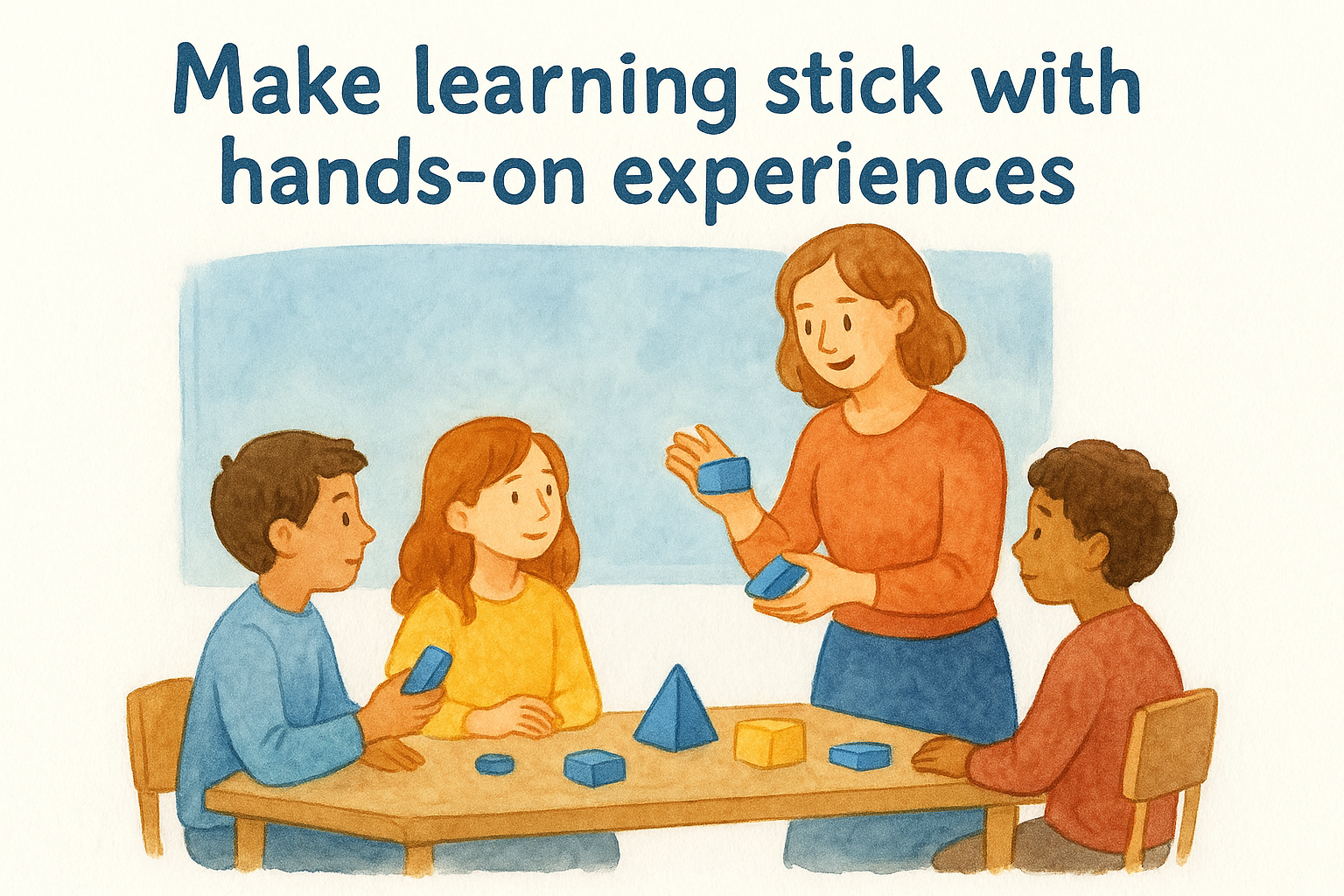
9. Make learning stick with hands-on experiences
Hands-on learning puts real materials, models, or physical movement into a lesson instead of asking students to absorb everything through reading or listening. Building a diorama of a myth’s setting, running a simple lab, or acting out a scene from Lord of the Flies gives abstract ideas a physical anchor. Students remember what they built or moved through far longer than what they only heard described.
How it works
Manipulatives, models, and movement all count here, so the strategy scales from elementary math blocks to high school chemistry labs. Give students a concrete task tied directly to the concept, then let them manipulate materials before you introduce the abstract vocabulary or formula. Debrief afterward so they connect the physical experience back to the academic language you need them to use on an assessment.
A concept students can touch is a concept they won’t forget by Friday.
Who it’s best for
This approach helps kinesthetic learners and younger students especially, but it also works for abstract high school content that resists explanation alone, like teaching character motivation through a physical tableau. It’s less efficient for content you can cover faster through direct explanation, so save it for ideas that genuinely benefit from a physical form.
A simple way to try it this week
Give students five minutes to physically arrange desks or act out a conflict from your current novel before discussing it. The physical staging forces them to notice details they’d skim past on the page.
10. Stretch advanced learners with independent study
Independent study lets a student who’s already mastered your grade-level content pursue a related question in depth, on their own timeline, with you acting as a coach rather than a lecturer. It’s one of the more overlooked instructional strategies for teaching kids who finish early and then sit bored while classmates catch up. Instead of more worksheets at the same difficulty, they get to go deeper into something that actually interests them.
How it works
You and the student agree on a learning contract: a specific question or project, a rough timeline, and how they’ll show what they learned, a paper, a presentation, a prototype. Check in on a set schedule, weekly works well, so the project doesn’t drift or stall. Give them access to resources you wouldn’t normally hand a whole class, primary sources, higher-level texts, or an expert contact, since the point is depth they can’t get from the regular curriculum.
Independent study only works when the checkpoints are real, not optional.
Who it’s best for
This strategy fits advanced or highly motivated students who’ve already demonstrated mastery of the core material and can manage their own time with light supervision. It’s a poor fit for students who need more scaffolding, not less, since unstructured freedom without strong self-direction usually produces a stalled project rather than deeper learning.
A simple way to try it this week
Identify one student who finishes assignments early and consistently nails the content. Offer them a choice of extension questions tied to your current unit, on mythology archetypes across cultures, say, and set a single check-in date to review their progress.
11. Strengthen memory with retrieval practice
Retrieval practice means asking students to pull information out of memory instead of just reviewing it again. Rereading notes or highlighting a textbook feels productive, but it barely touches long-term retention. Forcing a brain dump on a blank page, no notes allowed, builds the kind of durable memory that survives past Friday’s quiz and shows up months later on a final exam.
How it works
Give students a quick, low-stakes prompt and ask them to recall everything they remember without looking anything up. A blank-page quiz works well here: hand out a sheet with just the unit title and let students write for three minutes before checking their notes. Space these retrievals out over days and weeks rather than cramming them into one review session, since spaced repetition strengthens memory far more than a single intense study block.
Struggling to remember something is exactly what makes the memory stick.
Who it’s best for
This works for any content students need to retain long-term: vocabulary, historical dates, formulas, plot details from a novel you’ll revisit later in the year. It’s less useful the day you introduce brand-new material, since students need something in memory before they can practice pulling it back out.
A simple way to try it this week
Open tomorrow’s class with a two-minute blank-page recall on yesterday’s lesson before students open their notebooks. Compare what they wrote to their actual notes and discuss the gaps together.
Building your own strategy toolkit
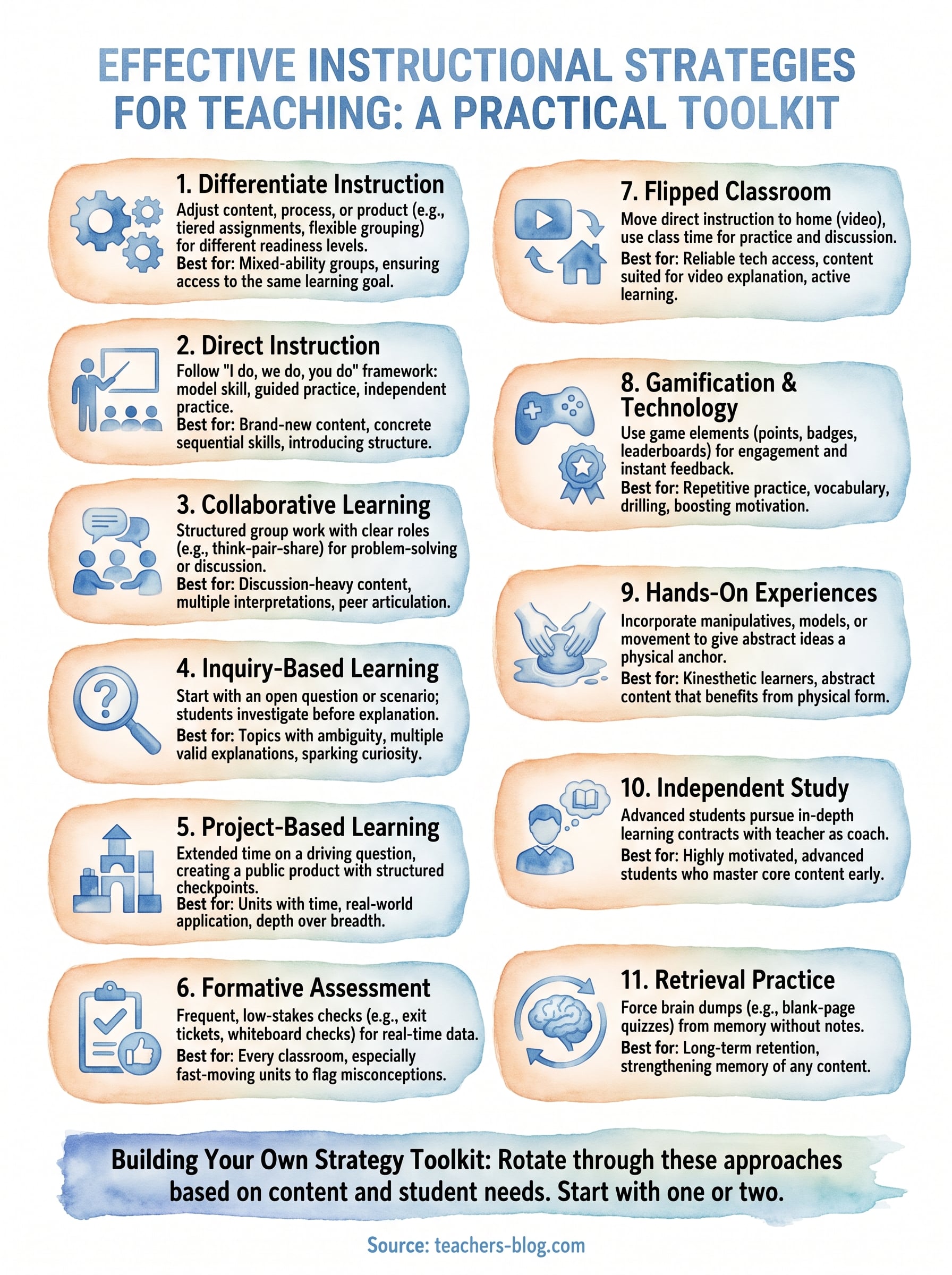
None of these eleven approaches works alone forever. The strongest teachers rotate through direct instruction, inquiry, retrieval practice, and the rest depending on what the content and the moment demand. Instructional strategies for teaching aren’t a checklist you complete once; they’re a toolkit you keep reaching into, swapping tools as your students and units change.
Pick two or three strategies from this list that feel most relevant to what you’re teaching right now, not all eleven at once. Try one this week, notice what worked and what fell flat, then layer in another. That’s how real classroom skill builds, one deliberate attempt at a time, not through a single overhauled lesson plan.
Want more ready-to-use resources like this? Browse the teaching strategies and tools on The Cautiously Optimistic Teacher for unit plans, AI-powered classroom tools, and practical strategies you can put to work tomorrow.