How to Write Learning Objectives Students Can Actually Meet
You’ve written objectives that sound good on paper but fall apart the moment you try to assess them. "Students will understand theme" looks fine in a lesson plan, until you realize you have no idea how to measure whether they actually got it. Learning how to write learning objectives that hold up in real classrooms means moving past vague verbs and building statements you can actually test.
This guide gives you a step-by-step process for writing objectives students can meet and you can measure, using Bloom’s Taxonomy and SMART criteria as your working framework, not just a poster on the wall. You’ll see exactly which verbs to use, which ones to cut, and how to match the objective to the assessment you’re already planning.
We’ll walk through concrete examples across grade levels and subjects, from a middle school science lab to a high school essay unit, so you can see the difference between a fuzzy goal and a measurable target. By the end, you’ll have a repeatable method for writing objectives that guide your instruction instead of just filling space at the top of your lesson plan.
What makes a learning objective actually work
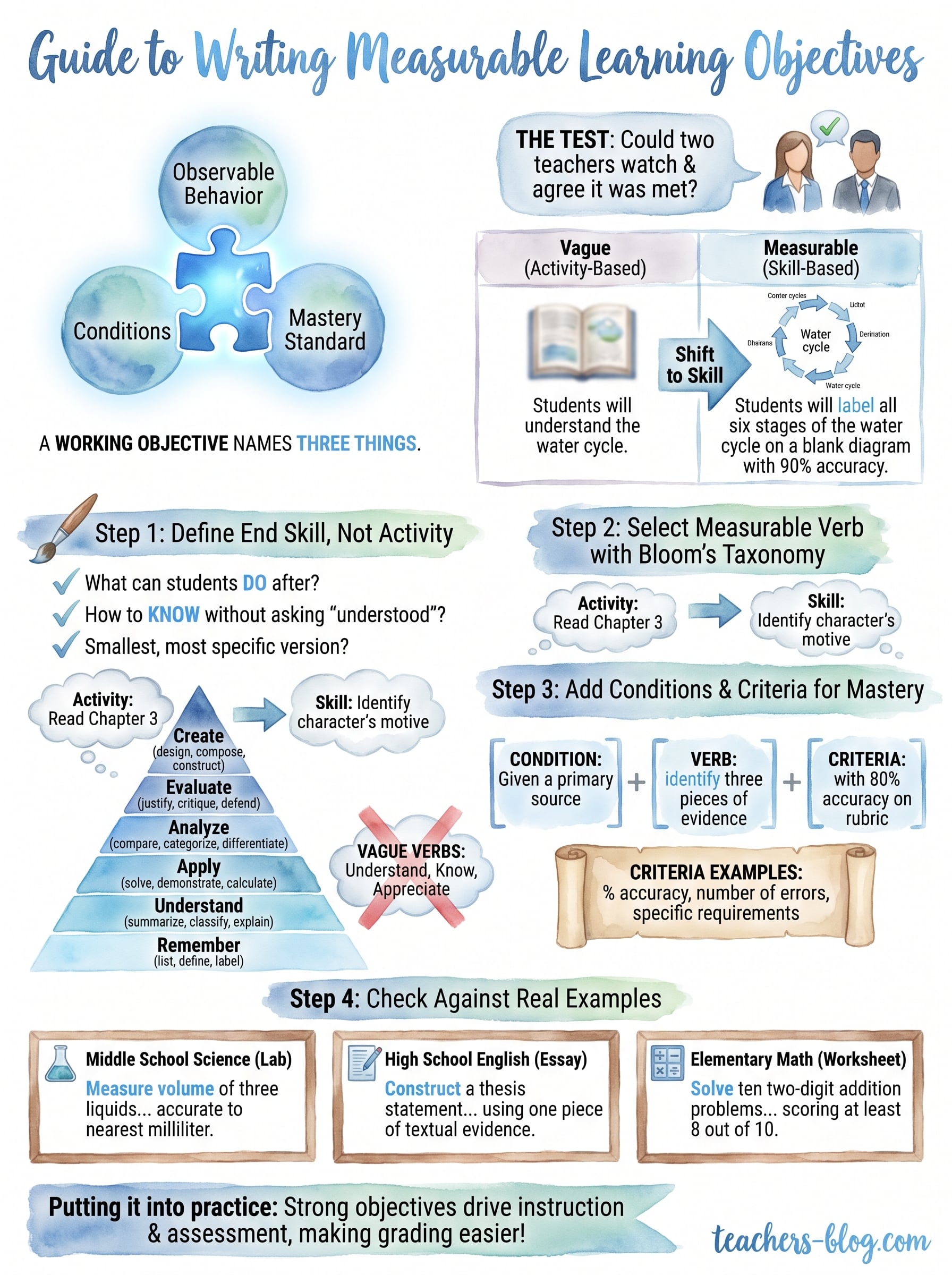
A working objective names three things: the observable behavior, the conditions students perform it under, and the standard that counts as mastery. Skip any one of those and you’re left with a hope, not an objective. "Students will appreciate poetry" tells you nothing about what appreciation looks like on a Tuesday afternoon quiz. "Students will identify three examples of imagery in a given poem and explain their effect in one paragraph" tells you exactly what to look for when you grade.
The test every objective must pass
Run your draft through one question: could two different teachers watch the same class and agree on whether students met it? If the answer is no, the verb or the criteria need work. This is the same logic behind SMART goals, borrowed from project management but perfectly suited to lesson planning, because it forces specificity instead of good intentions.
If two teachers can’t agree on whether a student met the objective, the objective isn’t finished yet.
Vague vs. measurable, side by side
| Vague objective | Measurable objective |
|---|---|
| Students will understand the water cycle | Students will label all six stages of the water cycle on a blank diagram with 90% accuracy |
| Students will know how to write an essay | Students will draft a five-paragraph opinion essay with a clear thesis and two supporting reasons |
| Students will appreciate historical context | Students will explain how two primary source documents reflect the political climate of their time |
Notice the pattern: the right column always has a verb you can watch someone perform, plus a condition or standard attached to it. That’s the whole game. Once you see it, you can’t unsee it in your own lesson plans, and rewriting old objectives gets a lot faster. The next four steps break down exactly how to build one from scratch, starting with the part most teachers skip: deciding what students should actually be able to do, not just know.
Step 1. Define what students will be able to do
Start every objective by naming the end skill, not the activity that leads to it. "Students will read Chapter 3" describes what happens in class, not what a student walks away able to do. Ask yourself what a student should be able to demonstrate once the reading is finished, whether that’s summarizing the plot, identifying a character’s motive, or comparing two arguments. That distinction between activity and outcome is where most objectives go wrong before you even pick a verb.
Separate the task from the goal
Before drafting any wording, answer three questions about the lesson you’re planning:
- What should students be able to do that they couldn’t do before?
- How would you know it happened, without asking them if they "understood"?
- What’s the smallest, most specific version of that skill you can name?
An objective built around an activity tells you what happened in class. An objective built around a skill tells you what a student can now do.
Once you’ve written down a plain-language answer, like "pull out the main claim in a persuasive text," you have the raw material for a real objective. Learning to write learning objectives starts here, at the skill level, before Bloom’s Taxonomy or grading criteria enter the picture at all.
Step 2. Choose a measurable verb with Bloom’s taxonomy
Once you know the skill, pick a verb that names something you can actually observe. Bloom’s Taxonomy organizes cognitive skills from simple recall to complex creation, and each level has verbs attached to it that hold up under scrutiny. Skip "understand," "know," and "appreciate" entirely. They describe internal states, not actions, so no assessment can confirm them.
Match the verb to the cognitive level
Grab a verb from the level that matches the thinking you actually want students doing:
| Bloom’s Level | Usable Verbs |
|---|---|
| Remember | list, define, label |
| Understand | summarize, classify, explain |
| Apply | solve, demonstrate, calculate |
| Analyze | compare, categorize, differentiate |
| Evaluate | justify, critique, defend |
| Create | design, compose, construct |
Lower levels aren’t lesser goals. A vocabulary quiz genuinely calls for "define," while a persuasive essay calls for "justify" or "compose." Choosing a verb one level too high just sets students up to miss a target they were never taught to reach.
A verb you can’t watch someone perform isn’t a learning objective, it’s a wish.
Getting comfortable with measurable learning objectives at this stage makes every later step, from conditions to assessment, fall into place almost automatically.
Step 3. Add the conditions and criteria for mastery
A verb alone still leaves room for argument. Conditions and criteria turn "students will summarize" into something you can grade without a debate. The condition names the circumstances: what tools, texts, or supports students have access to. The criteria name the standard: how many, how accurately, or how well. Together they answer the question every rubric eventually asks anyway, so you might as well answer it up front.
Build the sentence in three parts
Write your objective in this order and the wording almost writes itself:
[Condition] + [Verb] + [Criteria for mastery]
Given a primary source document, students will identify three pieces of evidence that support a claim, with at least 80% accuracy on a class rubric.
Swap in your own content and the formula holds for a math worksheet, a lab report, or a persuasive speech.
A verb tells you what to look for. Conditions and criteria tell you when you’ve seen enough of it.
Criteria don’t need to be a percentage every time. "With no more than two grammatical errors" or "using at least two textual citations" both work fine, as long as writing learning objectives this way gives you a clear line between met and not met before a single paper hits your desk.
Step 4. Check your objective against real examples
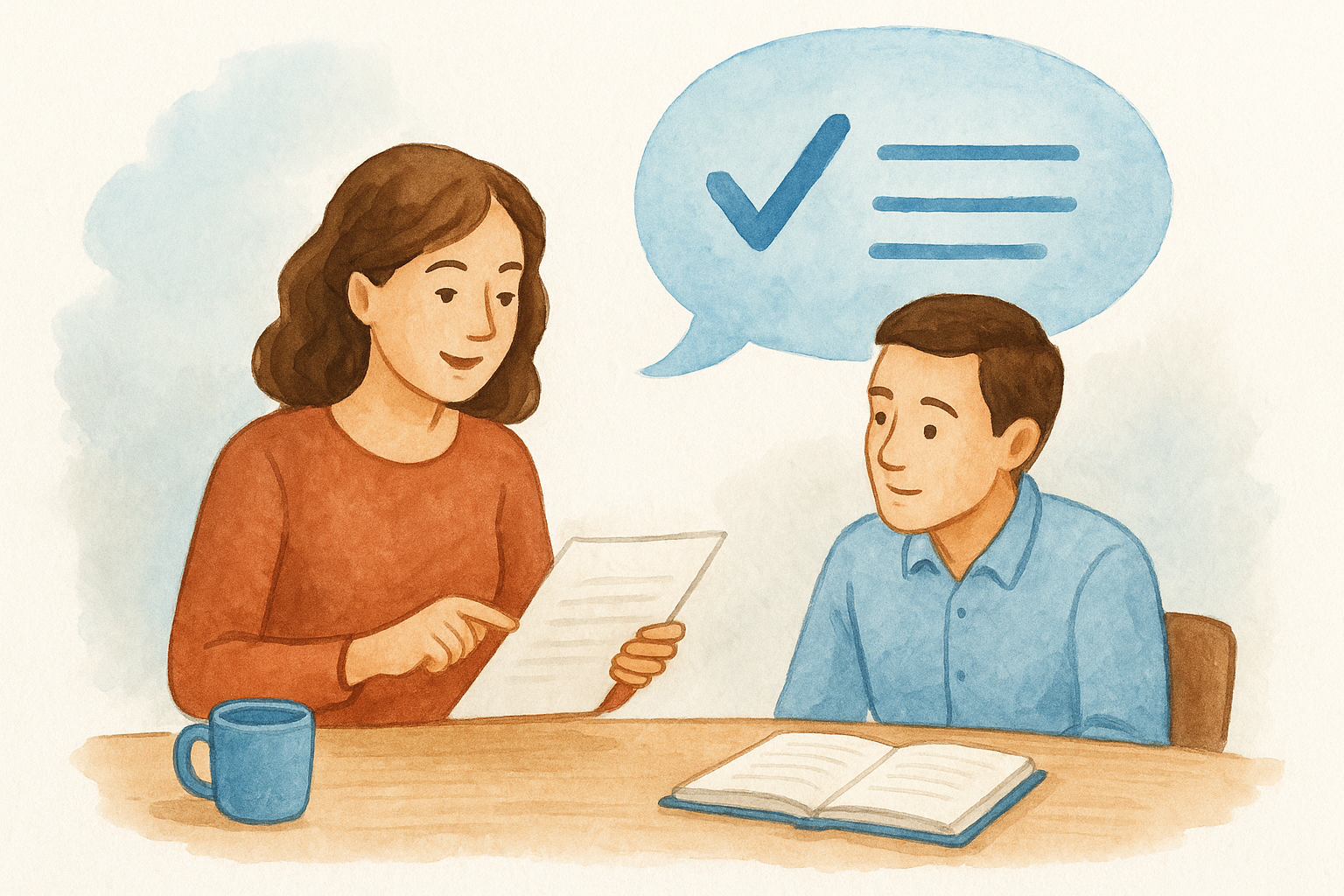
Now test your draft against real classroom examples before you commit it to a lesson plan. Pull up an objective from last year and run it through the same lens: does it name a verb you can watch, a condition, and a criterion? Grab a colleague if you can, since a second set of eyes catches vague wording faster than you will on your own draft.
Sample objectives across subjects
Compare these finished objectives to see the pattern hold across grade levels and content areas:
| Subject | Finished Objective |
|---|---|
| Middle school science | Given a lab worksheet, students will measure the volume of three liquids using a graduated cylinder, accurate to the nearest milliliter |
| High school English | Students will construct a thesis statement that takes a clear position on a given prompt, using one piece of textual evidence |
| Elementary math | Students will solve ten two-digit addition problems with regrouping, scoring at least 8 out of 10 |
If you can picture a student doing it and grading it the same day, your objective is ready.
Each row follows the same skeleton from Step 3: condition, verb, criteria. That consistency is what separates effective learning objectives from ones that just sound thoughtful. Once your draft matches this pattern, you’re done, no more revising for vagueness.
Putting your objectives into practice
Writing learning objectives isn’t a one-time exercise you finish before the school year starts. It’s a habit you build into every lesson plan, one draft at a time. Start small: pick three objectives from an upcoming unit and run them through the four steps here. Name the skill, choose a Bloom’s verb, add conditions and criteria, then check the result against a real example. You’ll notice your assessments get easier to grade almost immediately, because the objective already told you what counts as mastery.
Strong objectives don’t just describe a lesson, they drive it, shaping what you teach, how you assess, and what students walk away able to do. If you want more ready-to-use frameworks, worksheet generators, and planning tools that make this kind of instructional design faster, The Cautiously Optimistic Teacher has the resources built for exactly that.