Universal Design for Learning Principles: What They Are
You’ve got a student who lights up during discussion but shuts down during independent reading. Another one who can explain a concept perfectly out loud but freezes when asked to write it down. That’s not a motivation problem. It’s a design problem, and it’s exactly what universal design for learning principles were built to solve. UDL doesn’t ask you to write thirty versions of the same lesson. It asks you to build flexibility into the lesson from the start, so fewer students fall through the cracks in the first place.
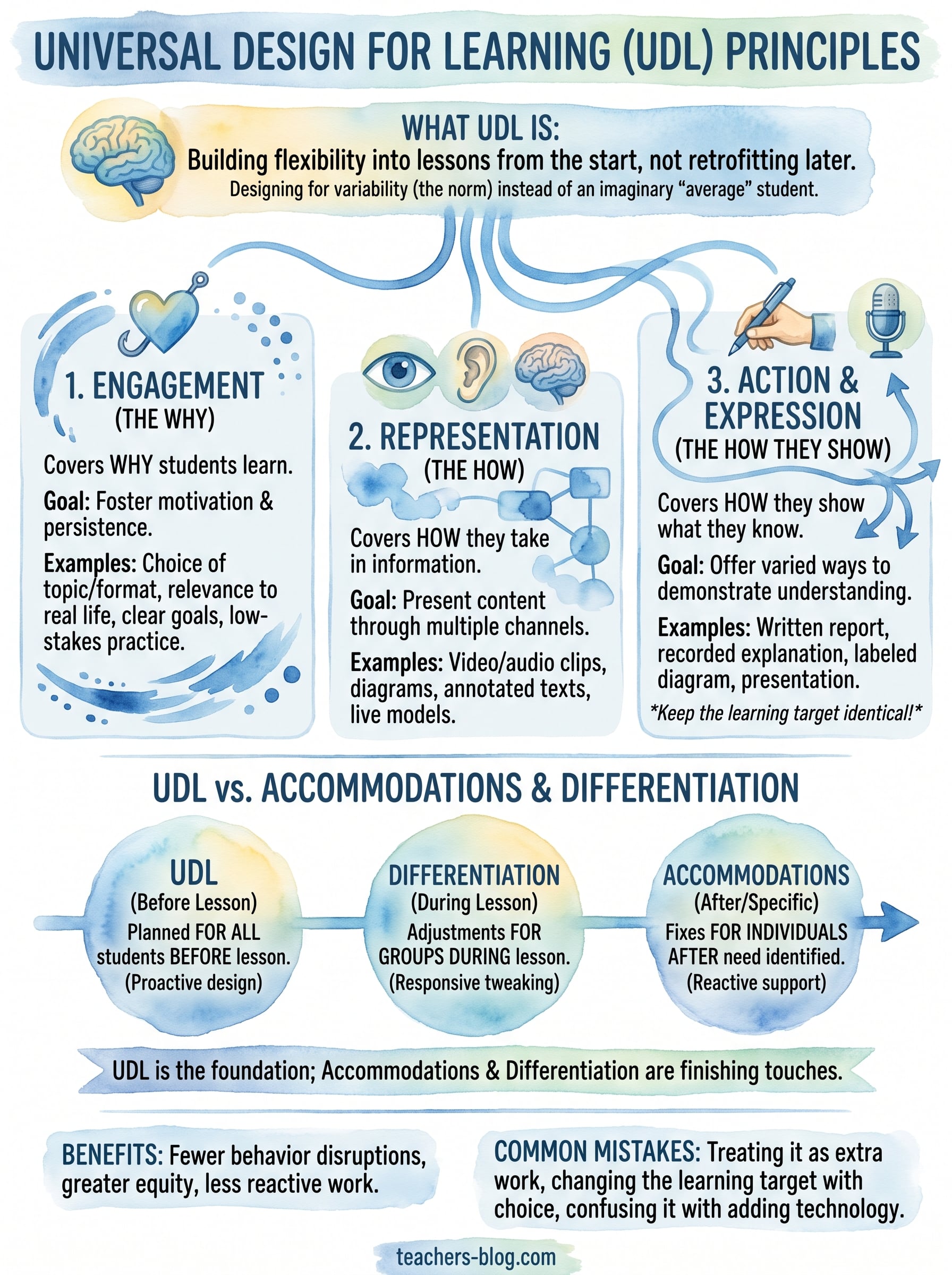
At its core, UDL rests on three principles: engagement, representation, and action and expression. Engagement covers why students learn, representation covers how they take in information, and action and expression covers how they show what they know. Each principle breaks down into practical checkpoints you can apply to a single worksheet or a full unit plan.
This article walks through each principle in plain terms, explains where they came from, and shows what they actually look like in a middle or high school classroom. You’ll leave with a clear picture of how UDL principles work together, not just a definition to memorize.
Why the UDL principles matter for your classroom
Every classroom already has more variety in it than a single lesson plan can handle. You’ve got students reading four grade levels apart, students with IEPs, English language learners, kids who process language slowly but think in complex ways, and kids who need to move while they think. Universal design for learning principles exist because a one-size-fits-all lesson was never actually reaching all of those students. It was reaching the ones who happened to match the format you picked.
The research behind UDL
UDL comes out of neuroscience research on how different brains handle motivation, information processing, and output. The framework was developed by CAST, a nonprofit education research organization, after decades of studying how learner variability shows up in real classrooms rather than in theory. Their findings back up something most teachers already sense: variability is the norm, not the exception. A lesson designed for an imaginary "average" student ends up excluding far more kids than it includes, because no student is average across every dimension of learning at once.
Build the lesson for variability from the start, and you stop reteaching it five different ways later.
What happens when classrooms skip it
Without UDL, teachers end up doing damage control instead of design work. You notice three kids failing a reading comprehension quiz, so you pull them for a small group after the fact. You notice a student can’t finish a five-paragraph essay in class, so you send it home as extra homework. Those fixes work, but they’re reactive, and they pile up fast. Retrofitting a lesson after it fails takes more time than building flexibility into it from the beginning, and it usually means the struggling student experiences failure first and support second.
Who benefits, and how much
The honest answer is everyone, but not equally. Some groups feel the absence of UDL more sharply than others.
| Student group | What breaks without UDL | What UDL principles fix |
|---|---|---|
| Students with learning disabilities | Rigid formats penalize processing differences | Multiple ways to access and show content |
| English language learners | Language-heavy instruction blocks comprehension | Visual, verbal, and text-based representation |
| Gifted or advanced students | Pace and depth are capped by the group | Flexible extension and choice built in |
| Students with attention or executive function challenges | Long, single-format tasks lose them | Chunked tasks with built-in engagement hooks |
| Anxious or reluctant students | High-stakes, single-attempt tasks raise stress | Low-stakes practice and varied expression options |
That table isn’t a list of separate accommodation plans. It’s the same three principles, engagement, representation, and action and expression, showing up differently depending on what’s getting in a given student’s way.
The classroom-management payoff
Beyond the equity argument, there’s a practical one you’ll notice within a few weeks of applying UDL: fewer behavior disruptions. A lot of what looks like off-task behavior is actually a student hitting a wall the lesson design put in front of them. Give that student a second way into the material, and the disruption often disappears on its own. Teachers who build UDL into their planning routine report spending less time managing frustration and more time actually teaching, because the lesson stopped generating the frustration in the first place.
The U.S. Department of Education has also pushed UDL into policy conversations around IDEA and inclusive instruction, which tells you this isn’t a fringe teaching trend. It’s becoming the expected baseline for how lessons should be designed, not an optional add-on for students who need extra help.
How to apply the three UDL principles in lessons
Applying universal design for learning principles doesn’t mean redesigning your entire curriculum overnight. It means checking each lesson against three questions: why would a student want to engage with this, how are they taking in the information, and how will they show what they learned. Run those three checks on a single lesson before you touch a full unit, and you’ll see how fast the framework becomes second nature.
Start with engagement
Before you plan content, plan the hook. Engagement is about giving students a reason to care, and that reason looks different for different kids. Some need choice, some need relevance, some need a clear goal they can track.
- Offer a choice of topic, format, or partner for the same task
- Connect the content to something happening outside your classroom
- Post a visible goal or rubric so students know what success looks like
- Build in low-stakes practice before anything graded
A lesson that hooks students before it teaches them needs far less classroom management later.
Build in multiple ways to represent information
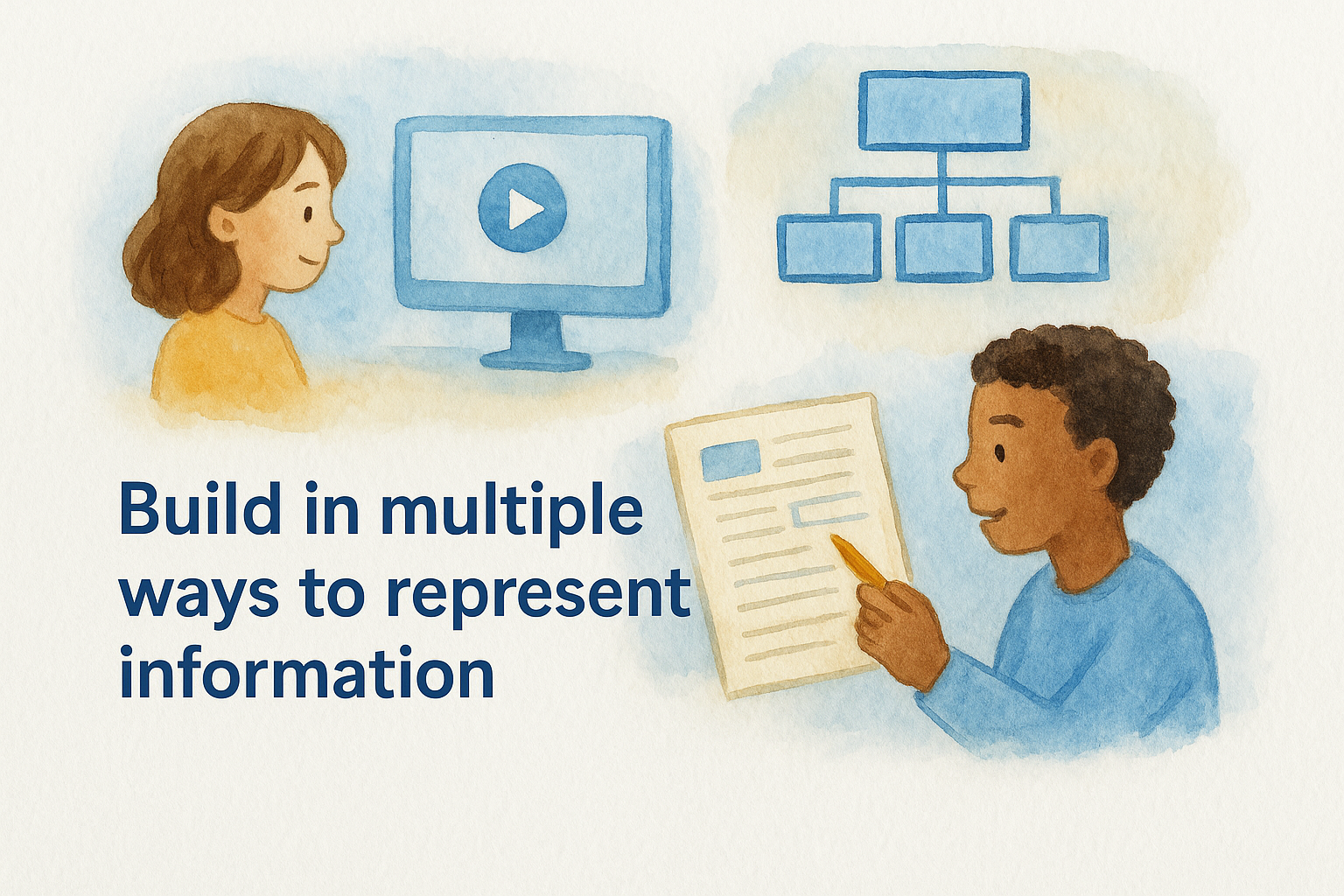
Representation means the same content reaches students through more than one channel. If your lesson only lives in a paragraph of text, you’ve already excluded students who process language slowly, English language learners, and anyone who thinks better in pictures or sound. Multiple representation formats don’t need to be fancy. A five-minute video, a diagram on the board, and a printed handout covering the same concept costs you almost nothing extra to prepare but opens the material to far more students.
| Representation format | Best for | Prep time |
|---|---|---|
| Short video or audio clip | Auditory learners, ELLs | Low |
| Diagram or graphic organizer | Visual learners, sequencing tasks | Medium |
| Annotated text with vocabulary support | Struggling readers | Medium |
| Live demonstration or model | Kinesthetic learners | Low |
Give students options for action and expression
Action and expression covers how students prove they understood the lesson. Locking every assessment into a five-paragraph essay tells you who writes well, not who learned the material. Swap in options like a recorded explanation, a labeled diagram, a short presentation, or a written response, and let students pick the format that lets them actually show their thinking. Keep the learning target identical across every option; only the output changes.
The goal across all three principles is flexibility built in advance, not extra work bolted on after a student struggles. Plan the choices before you teach the lesson, and you’ll spend less time reworking it once it’s already underway.
Examples of UDL principles in real classrooms
Theory only gets you so far. Seeing universal design for learning principles applied to an actual lesson makes the framework click in a way a checklist never quite does. Below are three quick classroom scenarios, one per principle, followed by a longer example showing all three working together in a single unit.
Engagement in an 8th-grade novel unit
A teacher assigning To Kill a Mockingbird skips the standard "read chapter, answer questions" routine and instead opens with a current news clip about a wrongful conviction case. Students discuss it in small groups before opening the book. That five-minute hook gives reluctant readers a reason to care about a courtroom drama set in 1930s Alabama, and it costs the teacher almost nothing to set up.
Representation in a mythology unit
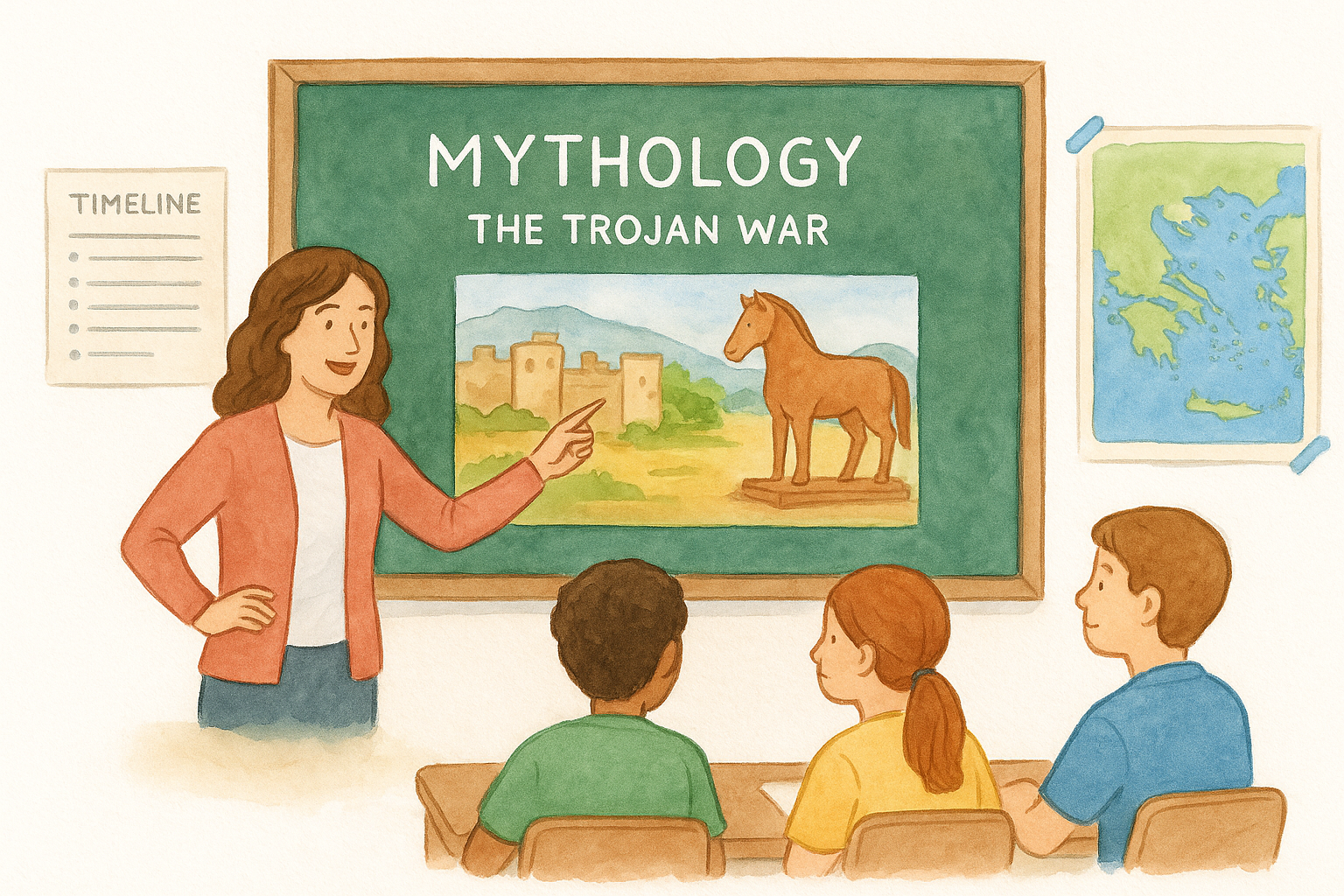
Instead of handing out a text-only summary of the Trojan War, a teacher pairs a short animated retelling with a printed timeline and a labeled map of ancient Greece. Students who struggle with dense text still grasp the plot, and visual learners get a format that actually sticks. Layered representation like this takes maybe fifteen extra minutes of prep and reaches students the text alone never would have.
Action and expression in a science lab
Rather than requiring a formal lab report from every student, a biology teacher offers three ways to show understanding of an experiment: a written report, a labeled diagram with captions, or a two-minute recorded explanation. The content standard stays identical. Only the format changes, and suddenly the student who freezes on formal writing has a real path to demonstrate mastery.
The lesson didn’t get easier. It got more accessible, which isn’t the same thing.
A full unit combining all three
Here’s what it looks like when a teacher builds all three principles into one persuasive essay unit rather than treating them as separate add-ons:
- Engagement: Students choose their own persuasive topic from a list of five current issues, and progress is tracked on a visible class rubric
- Representation: The teacher models the essay structure through a short video, a color-coded graphic organizer, and a live think-aloud on the board
- Action and expression: Students submit either a traditional written essay, a recorded persuasive speech, or a slide deck with voiceover, all graded against the same argument and evidence criteria
Notice that the standard never moved. What moved was the path students took to reach it, which is the entire point of designing for variability instead of designing for an average student who doesn’t actually exist in your roster.
UDL principles vs. accommodations and differentiation
Teachers often lump UDL, accommodations, and differentiation together, but they solve different problems and happen at different points in the planning process. Confusing them leads to a lot of wasted effort, like designing individual accommodation plans for problems a well-built lesson would have prevented in the first place.
What separates the three approaches
Accommodations are changes made for one student after a need has been identified, usually documented in an IEP or 504 plan. Differentiation is a teacher adjusting content, pace, or grouping for different students during a lesson, often on the fly. Universal design for learning principles work earlier than both. UDL is built into the lesson before you teach it, so the flexibility is already there for every student instead of layered on afterward for a few.
| Approach | When it happens | Who it’s for | Example |
|—|—|—|
| Accommodations | After a need is identified | One specific student | Extended time on a test for a student with an IEP |
| Differentiation | During lesson delivery | Groups within a class | Assigning a shorter reading to a struggling group |
| UDL | Before the lesson is taught | Every student in the room | Offering three response formats to all students from the start |
Why the order matters
Sequencing changes everything here. A classroom that relies only on accommodations and differentiation is still built around a single default lesson, with patches added for whoever doesn’t fit it. A classroom built on UDL principles doesn’t need as many patches, because the flexibility was already baked into the plan.
Accommodations fix a lesson for one student. UDL builds a lesson that never needed fixing for most of them.
They still work together
None of this makes accommodations or differentiation obsolete. A student with a documented processing disorder may still need extended time even inside a fully UDL-designed unit, and you’ll still group students strategically for certain tasks. What changes is the volume of individual fixes you need. Fewer individual patches means less paperwork, less improvising mid-lesson, and more time actually teaching instead of managing exceptions to a plan that wasn’t built with variability in mind to begin with. Think of UDL as the foundation, and accommodations and differentiation as the finishing touches you still apply on top of it when a specific student needs something a well-designed lesson alone can’t cover.
Common mistakes when applying UDL principles
Teachers new to the framework tend to make the same handful of missteps, and most of them come from treating UDL as an extra task rather than a design shift. Spotting these early saves you from burning out on a framework that’s supposed to reduce your workload, not add to it.
Treating UDL as more work instead of smarter work
Some teachers hear "three principles" and picture three times the lesson planning. That’s backwards. Universal design for learning principles are meant to replace the reactive fixes you’re already doing, the pull-out groups, the modified homework, the last-minute reteach, not stack on top of them. If your UDL lesson takes longer to build than your old one plus all its patches combined, you’re overcomplicating it.
UDL replaces your patchwork fixes. It doesn’t sit next to them.
Offering choice without keeping the standard fixed
A common error is letting the learning target drift along with the format. If a student choosing a slide deck over an essay ends up being graded on design instead of argument quality, you’ve lost the standard in the shuffle. Keep the rubric identical across every option students can pick. Choice belongs to the format, never to the rigor or the target itself.
Confusing UDL with adding technology
A video clip or an app doesn’t automatically make a lesson UDL-aligned. Plenty of tech-heavy lessons still offer only one path in, one format out, just delivered on a screen instead of paper. The three principles are about flexibility, not devices. A whiteboard drawing and a class discussion can satisfy representation and engagement just as well as any app.
Skipping the planning stage and improvising instead
UDL works best when the flexibility is built in before you teach, not invented on the spot when a student struggles. Improvising accommodations mid-lesson is still valuable, but it’s differentiation, not UDL, and it puts the burden back on you in real time.
A quick self-check before you teach
Run through this list before finalizing any lesson:
- Does every student have more than one way to engage, take in content, and show learning?
- Does the learning target stay identical across every option offered?
- Did you plan the flexibility in advance, rather than adding it after a student struggled?
- Would this lesson still work if your highest-need student and your most advanced student were both in the room?
If you answer no to any of those, the fix usually isn’t more effort. It’s rethinking where the flexibility needs to sit.
Putting UDL principles into practice
You don’t need a curriculum overhaul to start using universal design for learning principles. Pick one lesson this week and run it through the three questions: why would a student want to engage, how will they take in the content, and how will they show what they learned. Build in one option for each before you teach it, not after a student struggles.
Small changes compound fast. A choice of topic here, a diagram alongside the text there, an alternate way to demonstrate mastery next week. Within a month, flexible lesson design stops feeling like extra planning and starts feeling like how you naturally build lessons now.
If you want more ready-to-use tools for building lessons this way, from differentiation helpers to worksheet generators, browse the resources at The Cautiously Optimistic Teacher and start applying UDL to your next lesson today.