13 Active Learning Strategies for Teachers That Work
You know the look. Half your class is nodding along while their eyes glaze over, and by the time you ask a question, nobody remembers what you just covered. Passive listening doesn’t stick, and you already know it. That’s why active learning strategies for teachers matter so much right now: they turn students from note-taking spectators into people who actually wrestle with the material.
This list skips the theory and gets straight to what you can use tomorrow morning. Each strategy below has been tested in real classrooms, from quick think-pair-share routines you can drop into any lesson to more structured project-based activities that carry a whole unit. You’ll find options that work whether you’ve got fifteen minutes left in a period or a full block to fill.
We’ve organized these 13 strategies by how much prep they require, so you can start with something low-lift today and build toward bigger shifts over the semester. Grab whichever fits your next lesson, adapt it to your subject, and watch what happens when students stop watching and start doing.
1. Personalize instruction with AI-powered tools
Differentiation sounds great in theory and takes forever in practice, at least when you’re doing it by hand for 30 students across three or four ability levels. This is where AI-powered tools earn their keep. Instead of writing five versions of the same worksheet at midnight, you feed one piece of content into a tool and get back tiered versions in minutes. That time savings is the whole point: it’s active learning that starts with you working smarter, so students spend more time doing and less time waiting for materials that fit them.
How it works
A Differentiated Instruction Helper takes a single text, lesson, or concept and reshapes it for different reading levels, language needs, or learning styles without you retyping a thing. Pair that with a Worksheet Maker that generates practice sets from a handful of keywords, and a Question Generator that pulls critical thinking prompts straight from whatever your class is reading. You upload or paste your source material, tell the tool what you need (lower reading level, ELL support, extension questions for advanced students), and it hands you a draft you can tweak in five minutes instead of building from scratch.
Why it boosts engagement
Students disengage fastest when work is either too easy or completely out of reach. When every kid gets a version of the task that sits right at their level, they stay in what researchers call the zone of proximal development, challenged but not defeated. That’s the difference between a student who gives up after one wrong answer and one who keeps pushing because the next question actually feels doable.
Personalized materials keep students in the difficulty sweet spot where effort actually pays off.
How to try it tomorrow
Pick your next reading assignment and run it through a differentiation tool before you photocopy anything.
- Generate two reading levels of the same text for your struggling readers and your advanced group.
- Create a quick worksheet from three or four keywords tied to tomorrow’s lesson.
- Pull five discussion questions from the material to use for small-group or whole-class talk.
- Save the output as a template you can reuse and adjust for the next unit.
Start with one class period. Once you see how little time it takes, you’ll wonder why you spent so many years building tiered materials from scratch.
2. Use think-pair-share for quick peer discussion
Sometimes you don’t need a whole class period, you just need thirty seconds of silence followed by real talk. Think-pair-share is the strategy every teacher already knows about but rarely uses enough. It costs nothing to set up, fits into any lesson, and gets more voices into the room than a hand-raising Q&A ever will.
How it works
Pose a question, then give students silent time to think before anyone speaks. That pause matters more than most teachers realize; skip it and you’ll only hear from the same three kids every time. After thirty seconds to a minute, have students turn to a partner and compare answers for a minute or two. Then open it up and call on a few pairs to share what they discussed, not just what one person thought.
Why it boosts engagement
This structure works because it removes the fear factor. Talking to one classmate feels safer than answering in front of thirty people, so quiet students who never raise their hands suddenly have something to say. It also forces every student to form an answer before hearing anyone else’s, which means nobody’s just coasting on the smart kid’s response.
Give students a partner before an audience, and even your quietest kids start talking.
How to try it tomorrow
Try this checklist during your next lesson:
- Write one open-ended question tied to your lesson’s key concept.
- Give 30 to 60 seconds of silent think time, no talking allowed.
- Pair students with a neighbor for two minutes of comparison.
- Call on three pairs, not individuals, to report back.
3. Try jigsaw learning for collaborative mastery
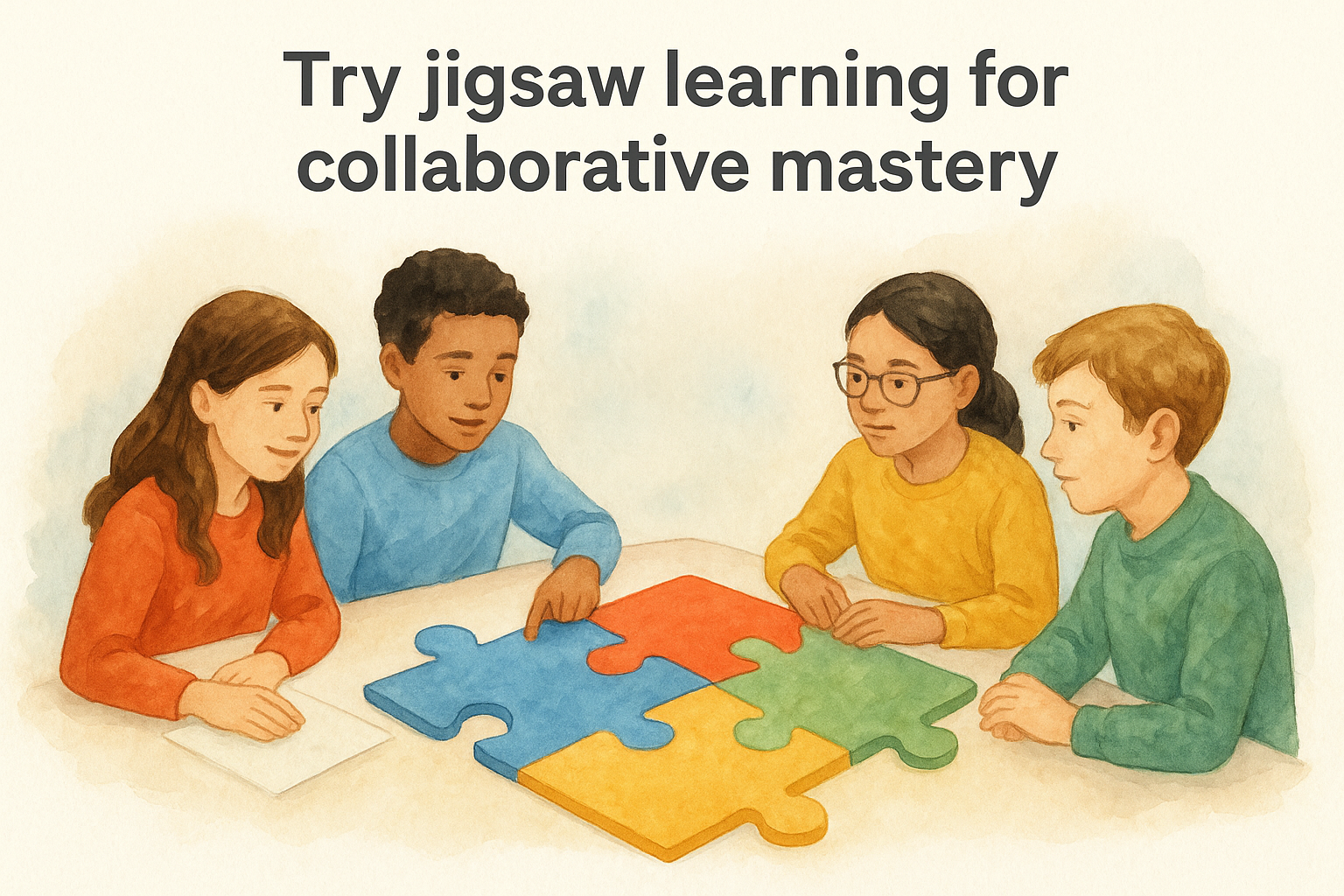
Some content is too big for one lesson but too important to skip. Jigsaw learning solves that by splitting the material into chunks, handing each chunk to a small group, then rebuilding the whole picture through teaching. It works especially well for dense chapters, multi-part historical events, or any topic with four or five distinct pieces that fit together.
How it works
Divide your class into home groups of four or five, then split the material into that same number of parts. Each student leaves their home group to join an expert group focused on just one part, where they research, discuss, and become the resident expert on that piece. Once everyone understands their slice, students return to their home group and teach it, one at a time, until the full topic is covered.
Why it boosts engagement
Students can’t hide in a jigsaw. Every person holds a piece nobody else has, so their group depends on them showing up prepared. That accountability pushes even reluctant students to actually read the material, because skipping it means letting their whole group down.
When every student holds a piece the group needs, nobody gets to sit back and coast.
How to try it tomorrow
Pick a text or topic with four natural sections and try this:
- Split the class into home groups of four or five.
- Assign one section of the material to each student.
- Regroup by section so experts can dig in together for 10 to 15 minutes.
- Send everyone back to teach their home group what they learned.
4. Apply problem-based learning to real scenarios
Textbook problems have neat answers and clear instructions, which is exactly why they don’t prepare students for anything real. Problem-based learning flips that by handing students a messy, open-ended scenario with no obvious solution and letting them figure out what they even need to know before they can solve it. This is one of the most effective active learning strategies for teachers who want students applying content instead of just memorizing it.
How it works
Start with a real or realistic problem tied to your subject: a town deciding whether to build a dam, a budget a small business owner has to balance, a disease outbreak students need to trace. Students work in small groups to identify what information they’re missing, research it, and propose a solution backed by evidence. You act as a guide, not the answer key, nudging groups when they stall but resisting the urge to hand over conclusions.
Why it boosts engagement
Real stakes change how students show up. When a problem has no single right answer printed in the back of a book, students argue, revise, and defend their thinking instead of just writing down whatever the teacher wants to hear.
A problem without a clean answer forces students to think instead of just recall.
How to try it tomorrow
- Write one open-ended scenario connected to your current unit.
- List what students need to research before proposing a solution.
- Group students in threes or fours to divide the research load.
- Have each group present their solution with evidence, not just an opinion.
5. Let students teach through peer instruction
Nothing exposes a shaky understanding faster than trying to explain it to someone else. Peer instruction puts that pressure to good use: instead of you delivering every explanation, students take turns teaching concepts to each other, catching gaps in their own knowledge along the way. It works in any subject where students land on different answers to the same question, which is most subjects most days.
How it works
Pose a conceptual question with multiple plausible answers, then have students vote individually before any discussion happens. Group students who picked different answers together and give them five minutes to convince each other, using reasoning instead of guessing. Vote again afterward, then have a few students explain how their thinking shifted. You’re not lecturing here; you’re watching students talk each other into the right answer.
Why it boosts engagement
Explaining a concept takes more mental work than just hearing it, so the student doing the teaching learns as much as the one being taught. It also surfaces misconceptions you’d never catch from a silent classroom, since wrong answers get argued out loud instead of buried in a test.
Teaching a concept to a classmate reveals gaps that listening to a lecture never will.
How to try it tomorrow
- Write a multiple-choice question with one right answer and two believable wrong ones.
- Have students vote silently before any talking starts.
- Group by differing answers and give them five minutes to debate.
- Revote and discuss how or why answers changed.
6. Gamify lessons with challenges and simulations
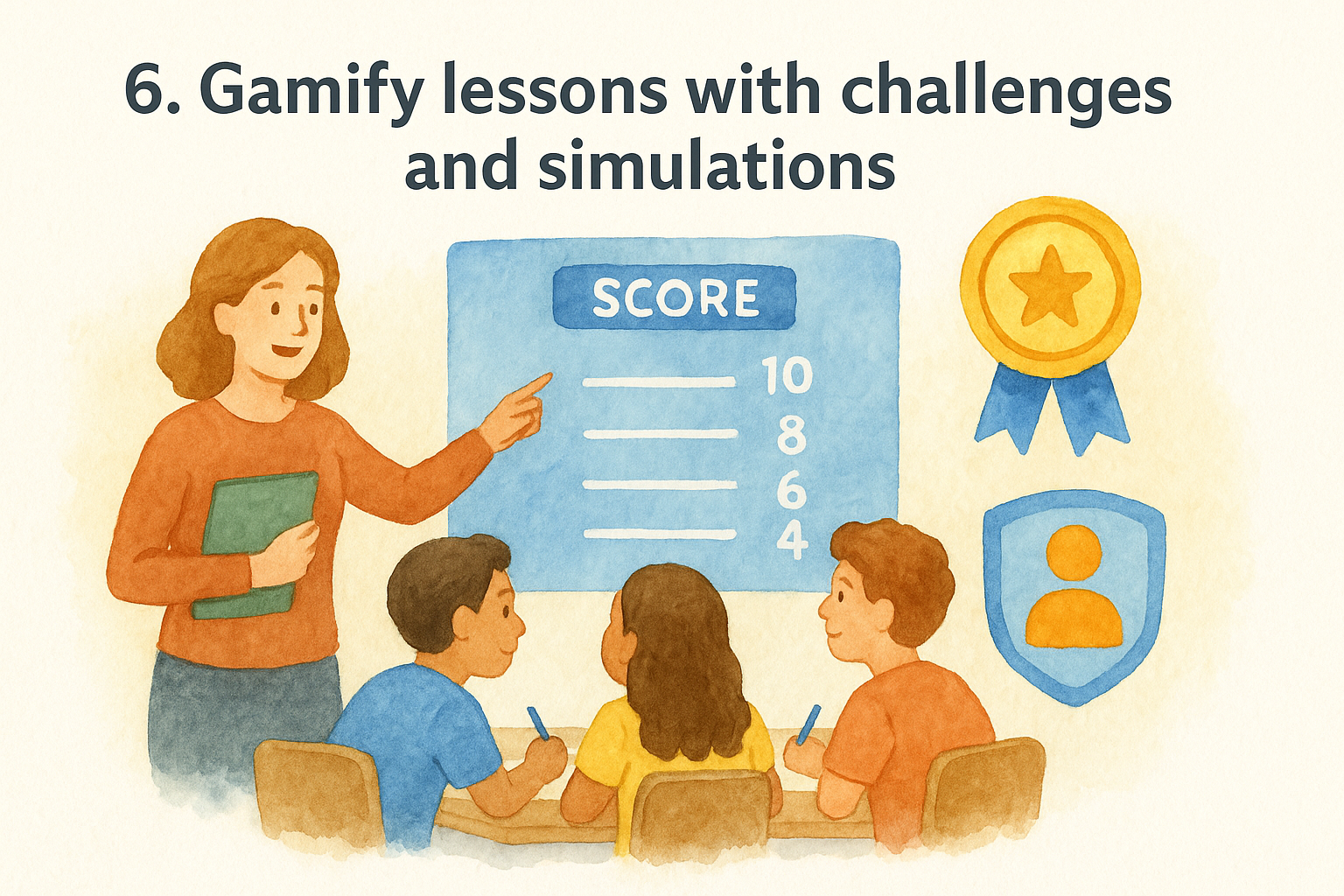
A pop quiz and a game show cover the same content, but only one gets students leaning forward in their seats. Gamification borrows the mechanics that make games addictive, points, levels, competition, immediate feedback, and applies them to whatever you’re already teaching. You don’t need an app or a budget to pull this off, just a willingness to turn a worksheet into a challenge.
How it works
Take an existing lesson and add game structure on top of it: points for correct answers, badges for mastering a skill, team leaderboards that update in real time. Simulations work similarly but go deeper, putting students inside a scenario like running a mock stock portfolio, managing a simulated ecosystem, or negotiating a treaty as assigned countries. Either approach turns a static task into something with stakes, progress, and a clear win condition students can track.
Why it boosts engagement
Immediate feedback is the engine here. Students find out instantly whether they’re right, which keeps them in the loop instead of waiting three days for a graded quiz to tell them how they did. Competition adds a layer most students respond to without you forcing it, since nobody wants their team stuck at the bottom of the leaderboard.
Instant feedback and a scoreboard turn a worksheet into something students actually want to finish.
How to try it tomorrow
- Turn your next review into a team point competition with a visible leaderboard.
- Assign roles for a quick simulation tied to your current unit.
- Award badges or points for specific skills, not just correct answers.
- Keep score visible throughout the lesson so students track progress in real time.
7. Host Socratic seminars and structured debates
Some topics deserve more than a quick discussion. Socratic seminars and structured debates give students the floor for an entire period, forcing them to build arguments, back them with evidence, and respond to pushback in real time. This strategy suits literature discussions, ethical dilemmas, and any historical decision where reasonable people land on different sides.
How it works
Arrange desks in a circle so every student can see everyone else, then pose an open question tied to a shared text or issue. In a Socratic seminar, students drive the conversation themselves, referencing the text to support claims while you stay mostly silent, stepping in only to redirect or ask a clarifying question. A structured debate works similarly but assigns sides in advance, giving teams prep time to research and build a case before facing off with formal rebuttals.
Why it boosts engagement
Handing the conversation to students changes the energy in the room. Ownership of the discussion means kids stop performing for the teacher and start actually listening to classmates, because they need that information to respond. Debates add a competitive edge that pushes even reluctant readers to dig through the text for evidence they can use.
When students run the discussion, they stop waiting for you to call on them and start arguing to win.
How to try it tomorrow
- Pick a question with no single correct answer from your current text or unit.
- Arrange desks in a circle and step back from leading the talk.
- Assign debate sides in advance if you want a more structured format.
- Require textual evidence for every claim students make.
Choosing the right strategy for your classroom
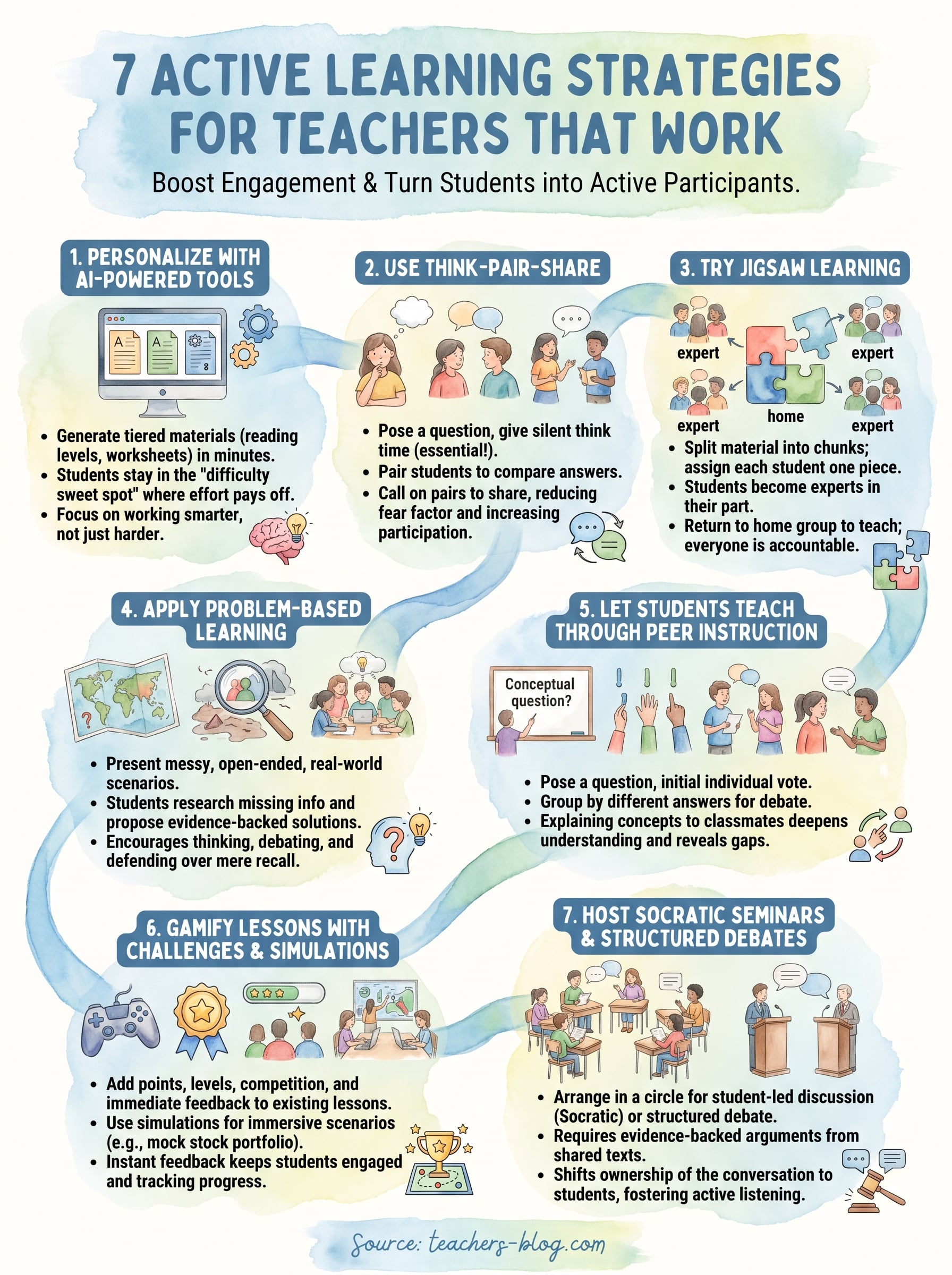
You don’t need to run all seven strategies next week. Pick one that matches your next lesson, whether that’s a quick think-pair-share during a lecture-heavy day or a full jigsaw for a chapter that’s too dense to skip. Start small, watch how your students respond, and let that reaction guide what you try next. Active learning isn’t a single technique you master once; it’s a habit of handing more of the thinking back to your students, one lesson at a time.
Some weeks you’ll have time to build a simulation. Other weeks, thirty seconds of silent think time is all you can manage, and that’s fine too. Progress beats perfection here. If you want more ready-to-use classroom tools alongside these strategies, from AI-powered worksheet makers to full unit plans, explore more resources on The Cautiously Optimistic Teacher and keep building the kind of classroom where students actually do the work.