How to Teach Reading Comprehension: 7 Proven Strategies
You can watch a student decode every word on a page and still miss the point entirely. That gap between reading words and understanding them is where most comprehension struggles actually live, and it’s exactly what you need to close if you’re wondering how to teach reading comprehension in a way that actually sticks. Decoding gets a lot of classroom attention, but comprehension is the skill that determines whether students can use what they read.
The good news is that comprehension isn’t a mystery skill some kids have and others don’t. It’s teachable, and research points to specific, repeatable techniques that build understanding step by step, from asking better questions to teaching students how their own thinking works. These aren’t vague tips; they’re classroom-tested moves you can start using tomorrow, whether you’re working with a novel study or a short nonfiction passage.
Below you’ll find seven strategies grounded in how reading comprehension actually develops, drawn from real classroom practice rather than theory alone. Each one includes practical ways to introduce it, so you can pick what fits your students and start seeing stronger, more confident readers this semester.
1. Monitor comprehension while reading
Most struggling readers don’t know they’re struggling until it’s too late. They finish a page, realize they can’t remember a thing, and have no strategy for fixing it. Comprehension monitoring teaches students to check their own understanding in real time, catching confusion while there’s still something to do about it. This is arguably the foundation skill for how to teach reading comprehension, because every other strategy on this list depends on students first noticing when meaning breaks down.
If students can’t tell when they’re confused, no comprehension strategy will help them, because they won’t know when to use it.
How it works
You teach monitoring by making the invisible process of reading visible. Model your own thinking out loud while reading a passage, pausing at points of confusion and narrating what you notice: "Wait, that doesn’t match what I read earlier" or "I’m not picturing this clearly, let me reread." Students then practice the same habit using simple fix-up strategies when they hit a snag:
- Reread the confusing sentence or paragraph
- Read ahead a bit to see if context clears things up
- Slow down and read word by word through tricky sections
- Ask what a confusing word might mean based on context
- Picture what’s happening in the text
The goal isn’t perfection. It’s building the automatic habit of pausing and asking, "Does this make sense?"
Who it works best for
This approach helps nearly every reader, but it’s especially powerful for students who read fluently yet still miss meaning, the kids who sound great out loud but can’t answer a basic question afterward. It also works well for younger or emerging readers once they’ve got basic decoding under control, since monitoring gives them a next step beyond just sounding out words. Students learning English as a second language benefit too, since it gives them concrete tools instead of just telling them to "try harder" when a passage feels murky.
Classroom example
Try this with any grade-level text, fiction or nonfiction:
1. Read a paragraph aloud to the class.
2. Stop and say: "I got confused right there. Here's what I did about it..."
3. Hand students a bookmark with the fix-up strategies listed above.
4. Have them read silently, placing a sticky note or check mark
   every time they notice confusion.
5. Pair students up to compare where they got stuck and which
   fix-up strategy they used.
6. Debrief as a class: which strategies worked, and why?
Run this two or three times a week for a month, and you’ll notice students start pausing on their own, without prompting, when something doesn’t add up. That shift, from passive word-calling to active checking, is the real marker of comprehension growth. The National Institute for Literacy has documented this kind of self-monitoring as a core component of skilled reading, and it costs you nothing but a few minutes of modeling to get started.
2. Teach metacognition and self-questioning
Metacognition sounds academic, but it’s really just thinking about your own thinking. When students learn to ask themselves questions before, during, and after reading, they stop being passive receivers of text and start actively hunting for meaning. This strategy builds directly on comprehension monitoring, but pushes it further by giving students a specific set of questions to run through their heads, turning a vague sense of confusion into a targeted investigation.
A reader who asks their own questions has already started solving the problem before the teacher even notices there’s one.
How it works
You introduce self-questioning by giving students a bank of prompts tied to each stage of reading, then modeling how to use them out loud. Before reading, students ask what they already know about the topic and what they expect to learn. During reading, they check predictions and ask why a character or event matters. After reading, they ask what the main point was and how it connects to something else they’ve read. Self-questioning prompts work best as a physical reference students can glance at until the habit sticks:
- Before: What do I already know about this? What do I predict will happen?
- During: Does this confirm or change my prediction? Why did that happen?
- After: What was the main idea? What questions do I still have?
Who it works best for
This strategy suits students who can decode fine but read passively, gliding through text without engaging with it. It’s also strong for advanced readers who need a push toward deeper analysis rather than surface recall, and for middle and high schoolers tackling denser texts like novels or historical documents, where metacognitive strategies help them track complex plots or arguments across many pages.
Classroom example
Give students sticky notes labeled "predict," "connect," and "question" before a chapter of a class novel. Have them place a note wherever they naturally pause to think one of those thoughts. Afterward, students share one note with a partner and explain their thinking. Over a unit, you’ll see students placing notes without prompting, a clear sign the questioning habit has taken root.
3. Use graphic and semantic organizers
Some students understand a text perfectly well but can’t hold all the pieces together in their heads at once. Graphic organizers solve that problem by giving abstract relationships a visual shape, turning a tangle of ideas into something students can see and manipulate. This matters for anyone thinking through how to teach reading comprehension, because comprehension isn’t just about grasping individual sentences, it’s about seeing how those sentences connect into a bigger structure.
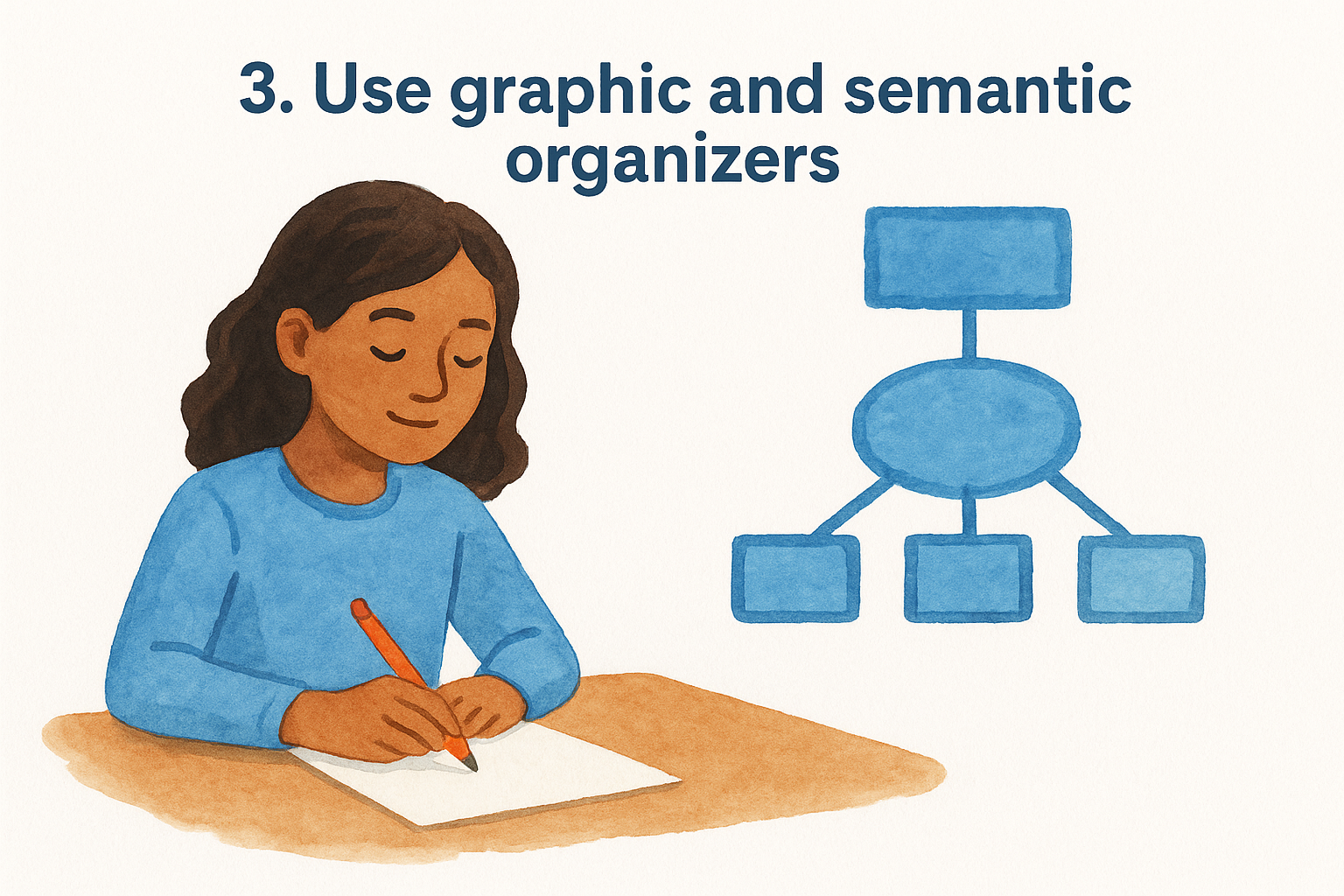
A visual map of a text does what a student’s working memory can’t: hold every idea in view at the same time.
How it works
You pick an organizer that matches the text’s structure, not the other way around. A story map fits narratives, showing setting, characters, conflict, and resolution in one glance. A Venn diagram fits comparisons. A cause-and-effect chain fits historical or scientific texts. Model filling one out together as a class before asking students to complete their own, and keep a few blank templates on hand:
- Story map (setting, characters, problem, events, resolution)
- Venn diagram for comparing two characters, texts, or ideas
- Cause-and-effect chain for nonfiction or historical events
- Main idea web with supporting details branching outward
Who it works best for
Organizers help visual learners the most, but they’re just as valuable for students who struggle to separate main ideas from supporting details, since the format forces that distinction. Younger readers benefit from the concrete structure, while English language learners often find organizers easier to work with than paragraphs of academic language, because the visual layout carries meaning that words alone might not.
Classroom example
After reading a short story, hand out a blank story map and have students fill it in with a partner, then use it to retell the plot to another pair without looking at the text. The retelling step matters most: it proves whether the organizer actually helped them internalize the structure, or whether they just copied words onto a page without real understanding.
4. Guide students to answer questions well
Asking students questions after they read is standard practice, but few teachers ever show students how to answer well. Most kids either scan for a matching word or freeze up entirely when the answer isn’t sitting right there in one sentence. Teaching students to recognize where answers actually live in a text, and how to combine information to construct one, is a distinct skill that belongs in any plan for how to teach reading comprehension.
A student who knows where an answer lives in a text will find it faster than one who’s just told to "read more carefully."
How it works
The Question-Answer Relationships (QAR) framework, developed by researcher Taffy Raphael, gives students a simple map for locating answers. It breaks questions into four types, and you teach students to identify which type they’re facing before they even start searching:
- Right There: the answer sits in one sentence, word for word
- Think and Search: the answer requires piecing together several parts of the text
- Author and You: the answer blends text information with the reader’s own knowledge
- On My Own: the answer draws entirely on the reader’s background knowledge
Model this by pulling a question from a recent reading, labeling its type out loud, then showing students exactly where you looked to answer it.
Who it works best for
This strategy helps students who consistently give one-word or off-target answers, since it forces them to slow down and match their search strategy to the question type. It’s also useful for students prepping for standardized tests, where question stems often signal a QAR category, and for younger readers who need concrete categories rather than abstract instructions like "support your answer."
Classroom example
After a nonfiction article, hand out five questions labeled with blank QAR categories. Have students work in pairs to label each question type first, then answer it, citing where in the text they found their evidence or which prior knowledge they used. Compare labels as a class; disagreements about category almost always lead to the richest discussions about how meaning is actually built.
5. Have students generate their own questions
Asking questions is usually the teacher’s job, but flipping that responsibility onto students changes how they engage with a text entirely. When a student has to write a question about a passage, they can’t skim past it, they have to understand it well enough to know what’s worth asking. This strategy pairs naturally with anything covered so far on how to teach reading comprehension, since a student who can generate a strong question has already done the hard work of identifying what matters in a text.
Students who write their own questions have to understand a text well enough to know what’s worth asking, which is a deeper task than answering someone else’s question.
How it works
Start by modeling the difference between a shallow question ("What color was the dog?") and one that pushes into meaning ("Why did the author mention the dog three times in one chapter?"). Give students a simple starter list to work from as they build the habit:
- Who, what, when, where questions for basic recall
- Why and how questions for reasoning and cause
- "What if" questions for predicting or extending the text
- Questions connecting the text to something else they’ve read or experienced
Have students write two or three questions per section of reading, then trade with a partner to answer each other’s.
Who it works best for
This works especially well for advanced readers who finish assigned questions early and need a genuine challenge, since writing a strong question is harder than answering one. It also suits students who resist teacher-directed tasks but respond better when they have ownership over the process, and it gives quieter students a low-pressure way to show understanding without speaking up first.
Classroom example
After a chapter of a class novel, have each student write one "Right There" question and one "Author and You" question using the QAR categories from earlier. Collect them, shuffle, and redistribute so students answer questions written by a classmate. The mismatched questions and answers that surface almost always reveal exactly where comprehension broke down.
6. Teach story and text structure recognition
Every text follows a pattern, and students who can spot that pattern before they finish reading have a built-in map for where the ideas are headed. Text structure recognition teaches students to identify whether they’re reading a narrative, a comparison, a sequence of causes and effects, or a problem-and-solution piece, then use that structure to predict what kind of information comes next. This matters enormously for anyone working out how to teach reading comprehension in content-area classes, since science and social studies texts rarely follow a story arc, yet many students try to read them that way and end up lost.
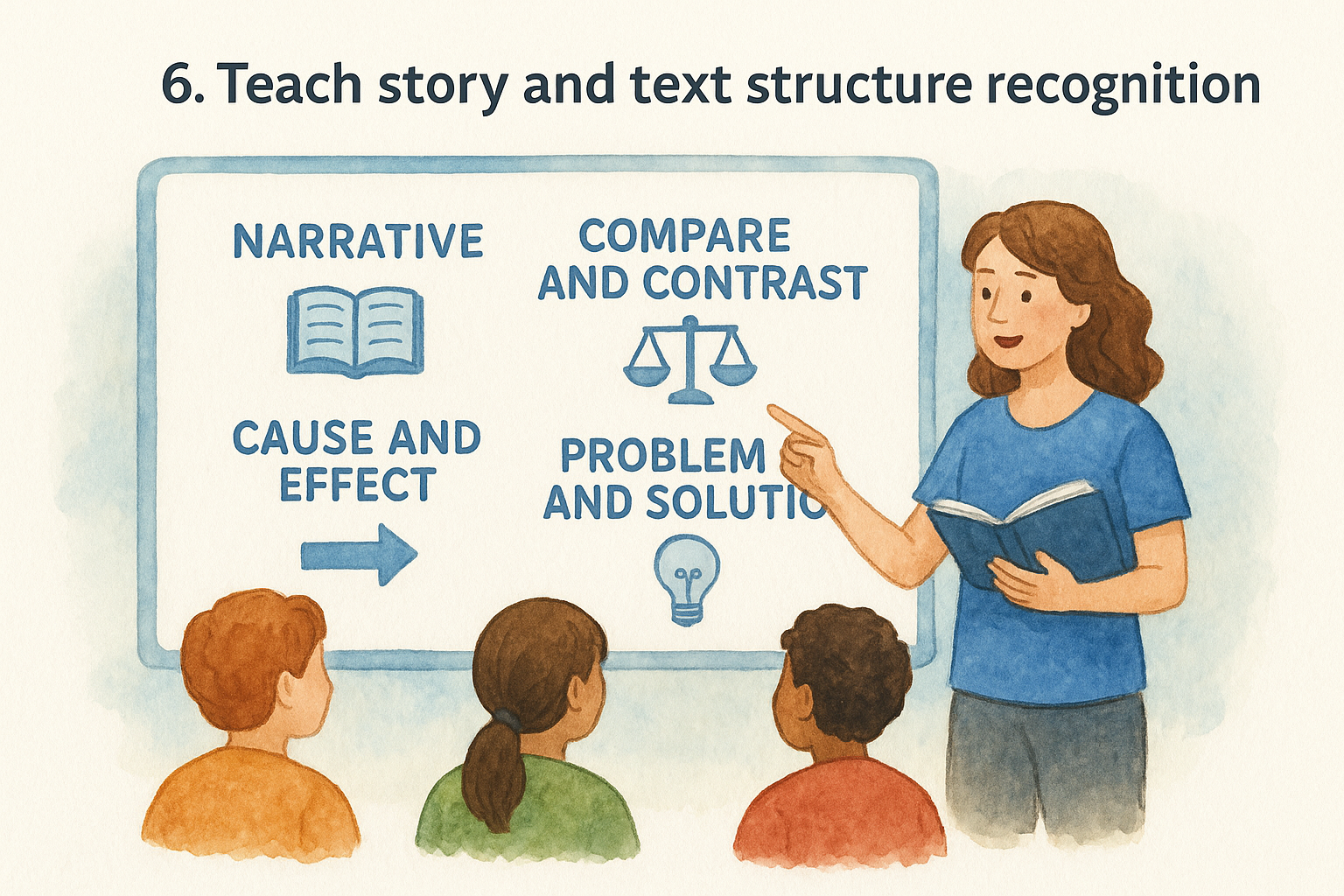
A student who knows the shape of a text before they finish it is never reading blind.
How it works
You teach structure recognition by naming the common patterns explicitly, then having students hunt for signal words that reveal which pattern is in play:
- Narrative: setting, characters, problem, events, resolution
- Compare and contrast: signal words like "however," "similarly," "unlike"
- Cause and effect: signal words like "because," "therefore," "as a result"
- Problem and solution: a challenge presented, followed by an attempted fix
- Sequence: signal words like "first," "next," "finally"
Model this by previewing a text’s headings, topic sentences, and transition words before reading, then predicting the structure out loud before students dig in themselves.
Who it works best for
This strategy helps students moving from fiction-heavy elementary reading into the denser nonfiction of middle and high school, where unfamiliar structures often trip up otherwise capable readers. It’s also valuable for students in science and social studies classes, since content-area texts rely on structures rarely taught during standard reading instruction.
Classroom example
Give students three short paragraphs, each built around a different structure, and have them label which pattern each one follows using only the signal words as clues. Afterward, ask them to rewrite one paragraph using a different structure, which forces them to understand the original well enough to reshape it entirely.
7. Practice summarizing in students’ own words
Summarizing forces students to sort what matters from what doesn’t, and that sorting is where real comprehension shows up. A student who can only echo the text back word for word hasn’t proven they understood it. But a student who can compress a passage into their own sentences, keeping the main ideas and dropping the rest, has done the actual cognitive work that reading comprehension demands. This is often the last skill to click, but once it does, it ties every other strategy on this list together.
If a student can’t say it in their own words, they haven’t actually understood it yet.
How it works
Teach summarizing with a simple rule students can memorize: name the topic, state the main idea, list two or three supporting details, and drop anything that’s just extra description. The GIST strategy works well here, where students write a summary in 20 words or fewer after each section of text. Model this by summarizing a paragraph aloud, then deliberately cutting your own summary down further, showing students what counts as essential versus what’s just interesting.
Who it works best for
This strategy helps students who tend to retell everything instead of identifying what matters, since the word limit forces hard choices. It also suits students preparing for essay writing or research projects, where condensing source material into their own words is a skill they’ll need constantly. Younger readers benefit from shorter texts and looser word limits, while older students can handle denser nonfiction with tighter constraints.
Classroom example
After a nonfiction article, have students write a 20-word summary on an index card, then trade cards with a partner who tries to guess the original topic without seeing the text. If the guess misses the mark, the summary probably buried the main idea under details that didn’t need to be there, which gives you an easy, visible way to check whether the skill is actually sticking.
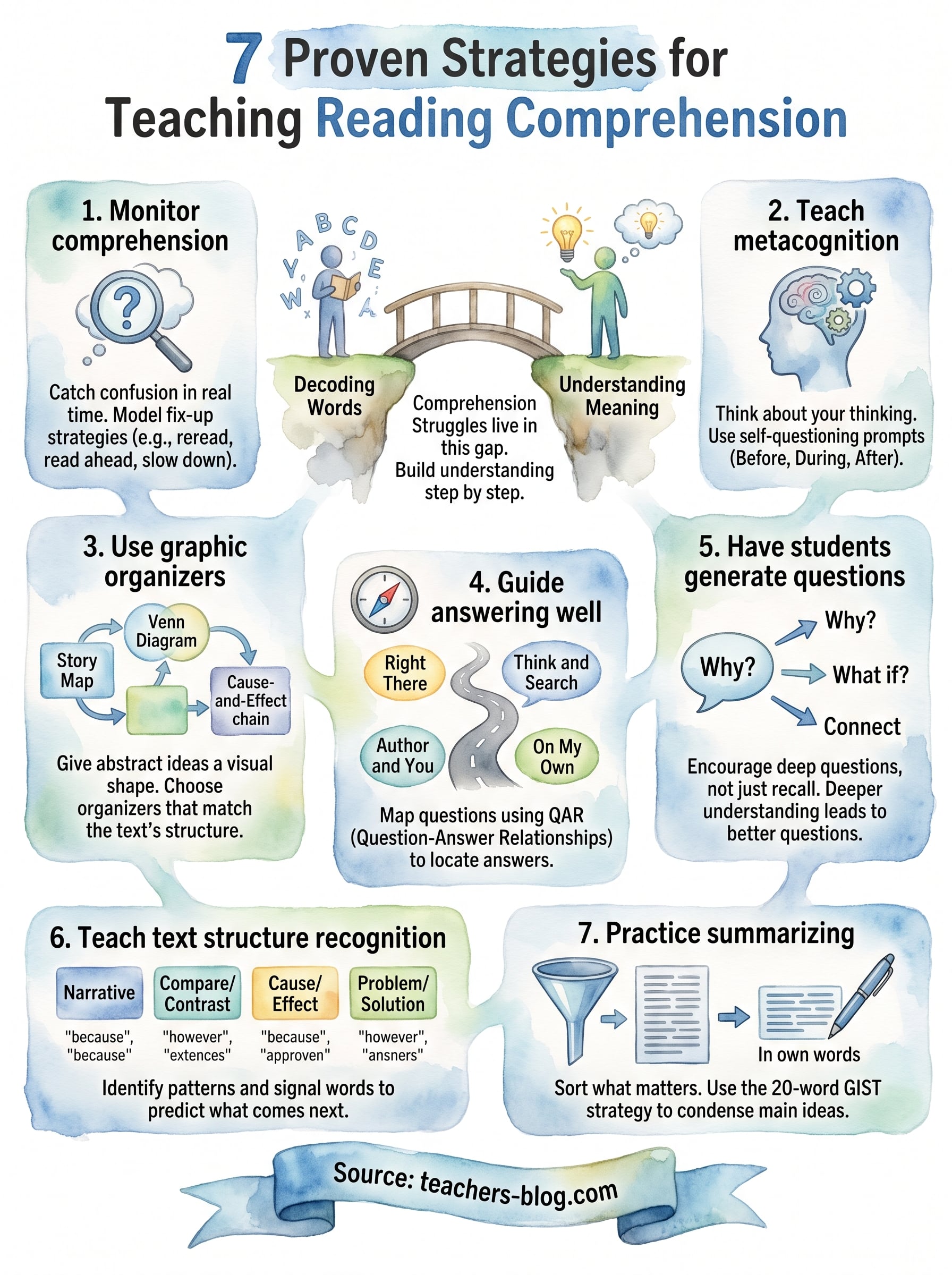
Putting these strategies into practice
You don’t need to roll out all seven strategies next Monday. Pick one, maybe comprehension monitoring or self-questioning, and give it two weeks of consistent practice before layering in another. Reading comprehension grows through repetition, not novelty, so the teacher who models fix-up strategies daily for a month will see more progress than one who tries every technique once and moves on.
Watch for the real marker of growth: students pausing, rereading, or asking their own questions without being told to. That’s the shift from decoding words to actually thinking about them, and it’s the whole point of everything covered here. Classroom-tested strategies like these work because they hand students tools they can use on any text, not just the one in front of them today.
If you want more ready-to-use lesson ideas, worksheets, and AI tools built for exactly this kind of classroom work, visit The Cautiously Optimistic Teacher and start building your next unit today.