
9 Goal Setting Activities for Students That Actually Stick
You’ve handed out the vision board template. You’ve done the SMART goals worksheet. Three weeks later, half your students can’t remember what they wrote, let alone track their progress toward it. That’s the real problem with most goal setting activities for students: they generate a nice poster, not a habit.
Goals stick when students revisit them, adjust them, and see small wins along the way. That means you need activities built around regular check-ins and honest reflection, not a one-time worksheet stuffed in a folder. The exercises below focus on habit formation and self-monitoring, so students actually notice when they’re drifting and course-correct before a grading period ends.
Below you’ll find nine classroom-tested activities, ranging from quick five-minute warm-ups to a full unit you can run alongside your existing curriculum. Each one includes setup steps and a way to measure whether it’s actually working. Pull one for tomorrow’s lesson, or build a semester-long system that pairs with the growth mindset work in our Brain Builders Workshop.
1. Create a personalized worksheet with an AI worksheet maker
Most goal setting activities for students fail because the worksheet is generic. A template built for a whole grade level doesn’t speak to the kid who wants to make varsity soccer or the one who just wants to stop losing their homework. An AI worksheet maker solves this by letting you generate a custom sheet in minutes instead of hours, tailored to the exact goals your class is working on this week.
How it works
Start by typing in keywords that describe what you want students to reflect on, things like "academic goals," "study habits," or "friendship goals for middle schoolers." The tool builds a worksheet around those prompts, complete with guided questions and space for students to write. You can regenerate it in seconds if the first draft feels too advanced or too simple. This is where our own Worksheet Maker comes in handy: plug in your grade level and topic, and it spits out a ready-to-print sheet without you having to design anything from scratch.
A worksheet built from your students’ actual words beats a generic template every time.
Best for
Busy teachers who don’t have prep time to design a new goal-setting handout every quarter will get the most value here. It also suits classrooms with a wide range of reading levels, since you can generate a simpler version for struggling readers and a more detailed one for advanced students without redoing the whole lesson. If you’re differentiating instruction anyway, pairing this with a Differentiated Instruction Helper keeps everything consistent across groups.
What you’ll need
You only need a device with internet access and about five minutes before class. Here’s the quick setup:
- A laptop or tablet to run the worksheet maker
- A short list of keywords tied to your current unit or goal focus
- A printer, or a way to push the PDF into Google Classroom
- A few sample student goals ready, in case anyone freezes on a blank page
Run this once at the start of a unit, then again at the midpoint so students compare their first draft goals to where they’ve actually landed. The comparison alone teaches more about goal setting than any lecture on SMART criteria, because students see their own handwriting change from vague wishes to specific plans.
2. Turn SMART goals into a mapping activity
SMART goals get taught as an acronym, then forgotten the moment the quiz is over. A mapping activity fixes that by turning the letters into a visual trail students can actually follow, instead of five abstract criteria they memorize and never apply. This is one of the simplest goal setting activities for students to run because it needs no software, just paper and a clear structure.
How it works
Give each student a large sheet divided into five connected boxes, one per SMART letter. They write their goal in plain language first, then work backward, filling in how they’ll measure it, what makes it realistic, and the date they’ll check progress. Arrows connect each box to the next, so the goal reads like a path rather than a list. Walk the room while they draw, since most students need a nudge to make their "specific" box actually specific.
A goal only sticks once a student can trace the line from today’s action to the finish date.
Best for
Visual learners and students who freeze up when asked to just "write a goal" benefit most, since the boxes give them a starting point. It also works well for classes just learning the SMART framework, because the map forces them to slow down on each criterion instead of skimming past it.
What you’ll need
- Large paper or a printed template with five connected boxes
- Colored pencils or markers for the path lines
- A sample map on the board to model the process
- Sticky notes for midpoint progress updates
3. Build a vision board for the school year
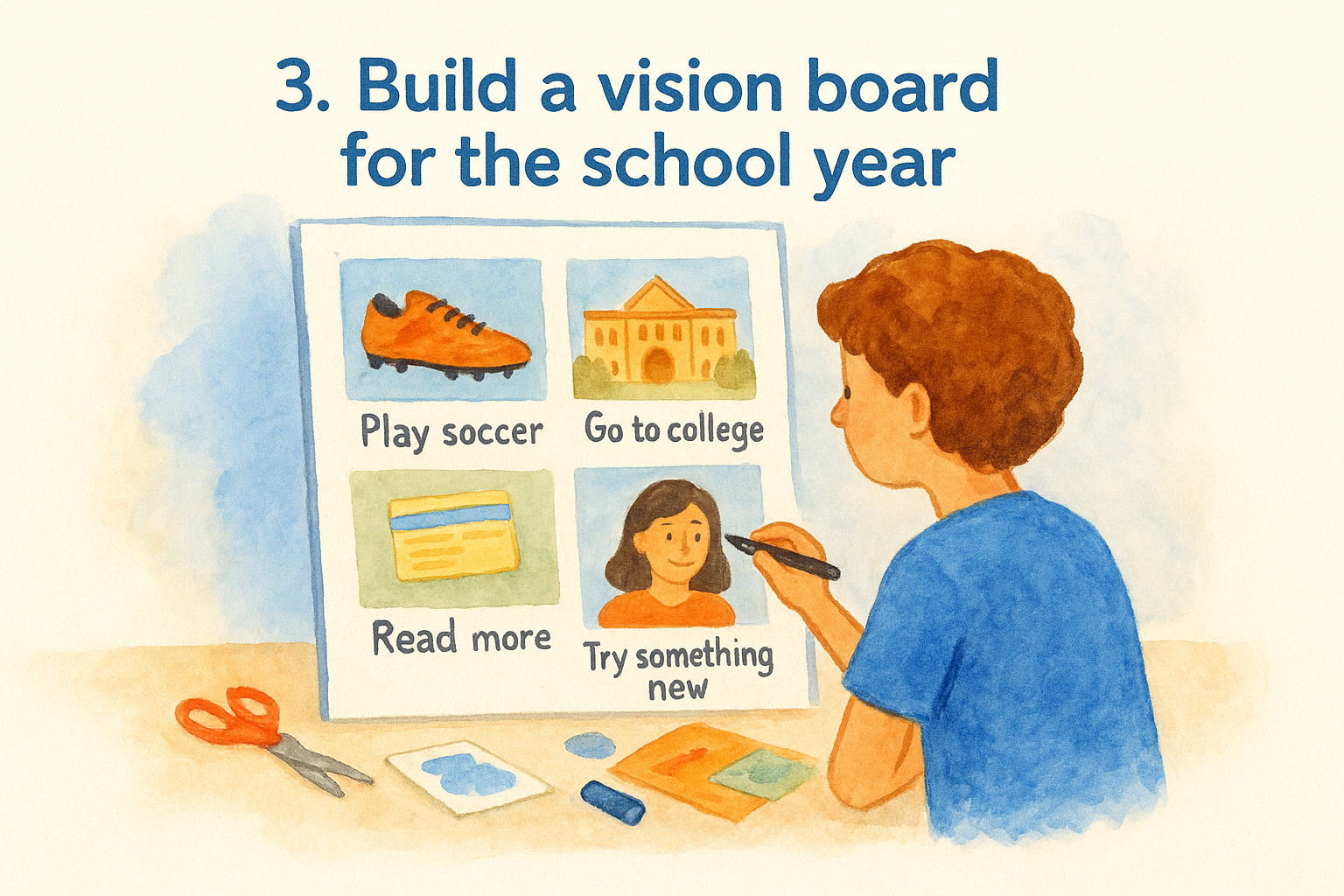
Vision boards get dismissed as craft time, but done right, they’re one of the more durable goal setting activities for students because the image stays visible long after the worksheet gets lost in a backpack. Pinning a photo of a soccer cleat or a college campus next to a written goal gives students a daily visual cue that words alone don’t provide.
How it works
Hand out poster board, magazines, and markers, then ask students to pick three to five goals for the year, one academic, one personal, one that scares them a little. They cut or draw images representing each goal and arrange them with short captions naming the specific action tied to it, not just the outcome. Skip the vague "be happy" images; push students toward pictures that connect to a concrete step, like a library card for a reading goal. Hang finished boards somewhere students see them weekly, whether that’s a classroom wall or a photo saved as their phone lock screen.
A goal you see every day is a goal you’re less likely to abandon by October.
Best for
Creative students and younger grades respond strongly to this format, since the visual element does a lot of the motivational work that a text-only worksheet can’t. It also works as a back-to-school activity for any age when you want something low-pressure to open the year.
What you’ll need
- Poster board or cardstock
- Old magazines, scissors, and glue sticks
- Markers for captions
- A wall or bulletin board for display, or a phone camera for a digital version
4. Draw a wheel of life to explore different goals
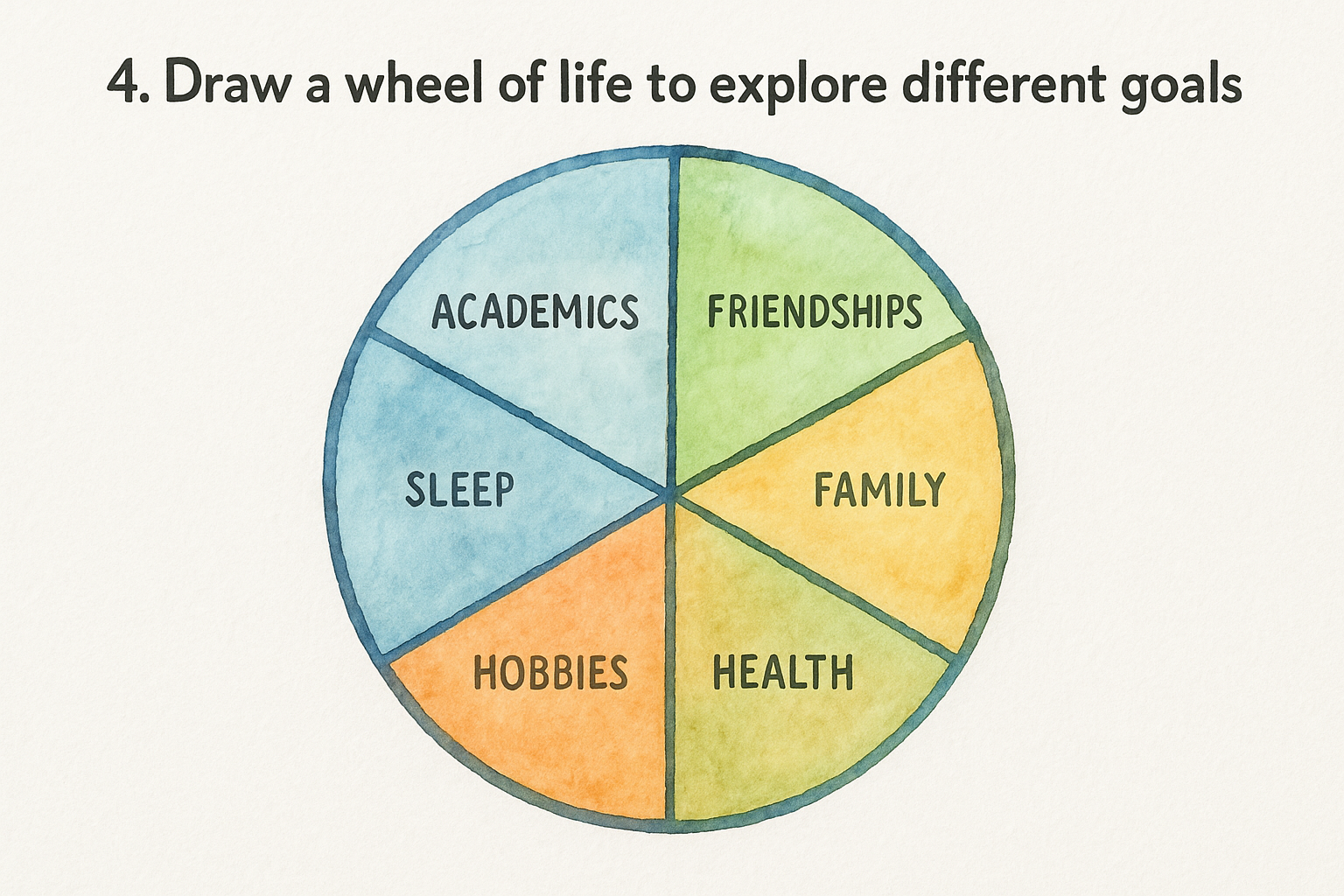
Students tend to fixate on one goal, usually grades, and ignore the other parts of their life that affect whether they can actually hit it. A wheel of life activity pulls back the lens, showing students that academics, friendships, health, and family all feed into each other. It’s one of the more eye-opening goal setting activities for students because it exposes blind spots a single-topic worksheet never touches.
How it works
Draw a circle divided into six or eight slices, each labeled with a life area: academics, friendships, family, health, hobbies, and sleep work well for most age groups. Students rate their current satisfaction in each slice from one to ten, shading it in like a pie chart. Wherever the shading is lowest, that’s where they set a small, specific goal for the next two weeks. This keeps kids from pouring all their energy into one area while ignoring the ones quietly dragging them down.
The lowest slice on the wheel usually points to the goal a student actually needs, not the one they’d pick first.
Best for
Older students, especially middle and high schoolers juggling sports, jobs, and family responsibilities, get the most out of this exercise since it validates that grades aren’t their only pressure. It also works well early in a semester when you want a baseline before setting any formal goals.
What you’ll need
- A printed circle template divided into slices
- Pencils or markers for shading
- A short list of life-area labels to guide discussion
- Ten minutes for students to rate and shade before writing goals
5. Climb a goal ladder toward a bigger dream
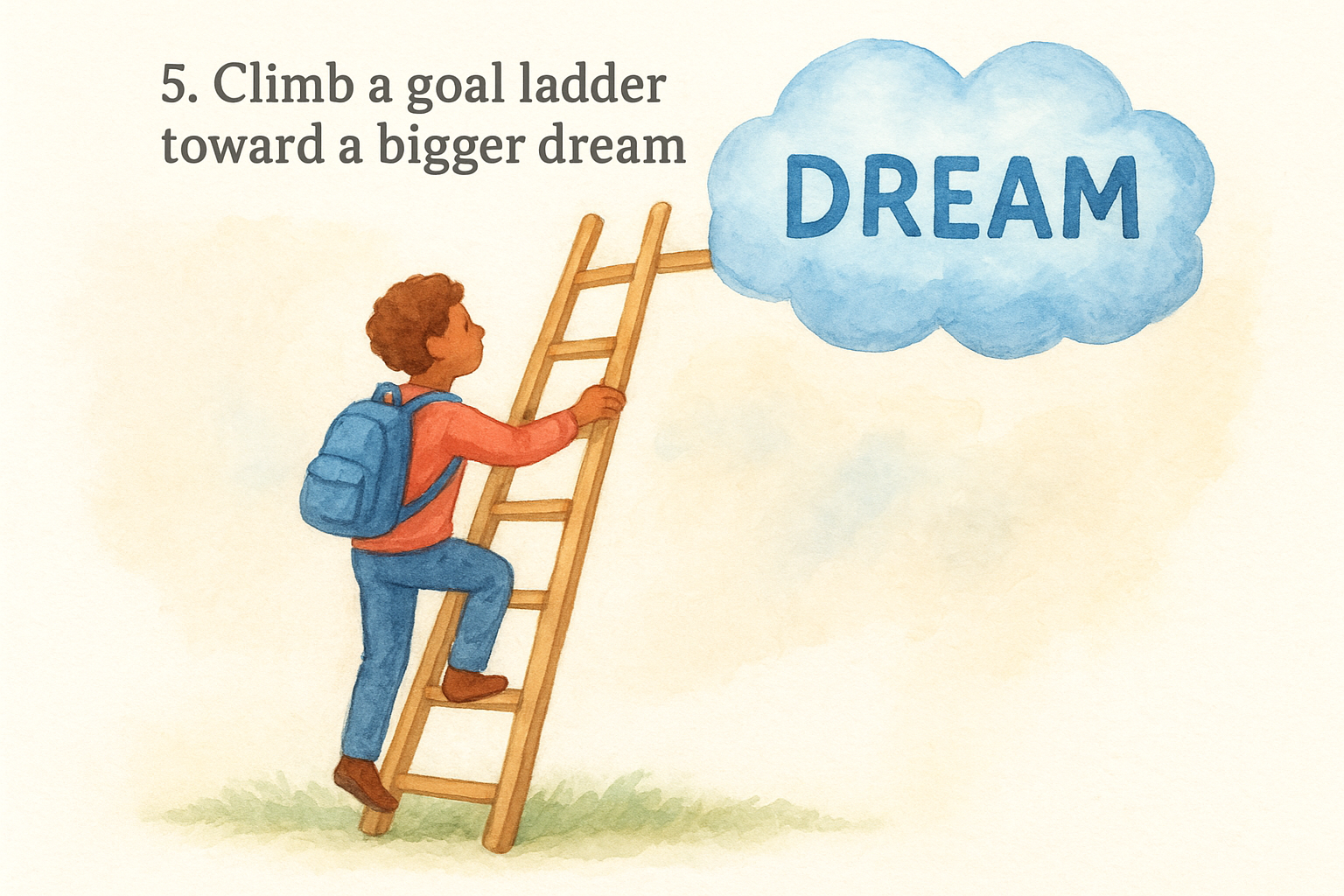
Big dreams collapse under their own weight when students have no idea what step one looks like. A goal ladder breaks a distant ambition, becoming a vet, making the varsity team, getting into a specific college, into rungs students can actually climb this month. It’s one of the most practical goal setting activities for students because it forces the conversation away from "what do you want" and toward "what do you do Tuesday."
How it works
Draw a ladder with six or seven rungs on paper or the whiteboard. The top rung holds the big dream, written in the student’s own words. Working downward, students fill in each rung with a smaller milestone that has to happen before the one above it, ending with the bottom rung as something they can start this week. Have students date each rung so the ladder doubles as a rough timeline, then check in monthly to see which rungs they’ve actually climbed.
A dream only becomes a goal once it has a bottom rung a student can reach this week.
Best for
Ambitious students with a clear long-term goal but no roadmap benefit most, since the ladder forces them to name concrete steps instead of just repeating the dream. It also works well for students who feel stuck, because starting at the bottom rung makes the whole thing feel achievable rather than overwhelming.
What you’ll need
- A ladder template or blank paper for freehand drawing
- A marker for dating each rung
- A folder or binder to store ladders for monthly review
- A few real-world examples of broken-down goals to model the process
6. Play three stars and a wish
Goal reflection often stalls because students either brag too much or trash their own effort completely. Three stars and a wish fixes that imbalance by forcing a fixed ratio: three specific wins, one specific area to improve. It’s a quick format, but it’s one of the most repeatable goal setting activities for students because you can run it weekly without it ever feeling stale.
How it works
Give each student a card with three star outlines and one wish outline. In each star, they write a concrete win from the week, not "I did good" but "I finished my lab report a day early." In the wish, they name one thing to improve next week, phrased as an action rather than a complaint. Pair students to read their cards aloud to a partner before turning them in, since saying the wish out loud makes students more likely to actually chase it.
Three wins and one wish keeps reflection honest without letting it turn into self-criticism.
Best for
Younger students and kids who struggle with open-ended reflection do well here, since the fixed structure removes the blank-page problem. It also suits teachers who want a fast weekly ritual, because the whole activity runs in under ten minutes including partner sharing.
What you’ll need
- Printed star-and-wish cards, or a simple template drawn on notebook paper
- A consistent day each week to run it, like Friday afternoons
- A folder for storing cards so students can compare weeks later
- A partner-sharing routine already established in your classroom
7. Start a class or family bucket list
Some goals feel too small to write down, but a bucket list gives them permission to exist alongside the big ones. A class or family bucket list works because it mixes fun, low-stakes items with real ambitions, so students stay engaged even on weeks when their academic goals feel stalled. It’s one of the lighter goal setting activities for students, but that lightness is exactly why it works as a bridge into more serious goal work.
How it works
Post a large sheet of butcher paper or a shared Google Doc titled "Things We Want to Do This Year." Students add items anytime, from "read 20 books" to "have a picnic outside for a lesson." Once a week, pull three items and ask who’s willing to make them happen, then assign a simple next step. For a family version, send the same idea home as a one-page handout so parents and kids build a list together over dinner. Check items off publicly, since crossing something out matters more to motivation than adding new items ever will.
A list only motivates once students see items actually getting crossed off, not just added.
Best for
Whole classes needing a shared sense of momentum benefit most, especially groups that feel disconnected from each other early in the year. It also suits families looking for a low-pressure way to talk about goals at home without turning dinner into a lecture.
What you’ll need
- Butcher paper, a poster, or a shared digital doc
- Markers for crossing off completed items
- A weekly five-minute check-in slot
- A printable take-home version for the family variant
8. Keep a goal-tracking journal
Worksheets and posters capture a goal once. A goal-tracking journal captures the whole story, the setbacks, the small wins, the days a student almost gave up. Of all the goal setting activities for students on this list, the journal is the one that builds the habit of checking in with yourself, which matters more long-term than any single worksheet ever will.
How it works
Give each student a simple notebook or a few stapled pages, and set a fixed rhythm, three entries a week works better than daily since daily writing turns into a chore fast. Each entry answers three quick prompts: what did I do toward my goal, what got in the way, and what will I try differently. Keep entries short, five sentences is plenty, since the goal is consistency, not a personal essay. Collect journals every two weeks to skim for patterns, not to grade the writing itself.
A journal doesn’t just record a goal, it shows a student the shape of their own effort over time.
Best for
Reflective students who already like writing will take to this naturally, but it also works surprisingly well for students who resist reflection out loud, since the page is a lower-pressure audience than a classmate or teacher. It suits longer-term goals especially, the kind that take a full semester to show real movement.
What you’ll need
- A notebook or stapled packet per student
- A fixed three-prompt template posted where students can see it
- A consistent weekly writing slot, even just ten minutes
- A simple folder system for collecting and returning journals on schedule
9. Hold one-on-one goal-setting conferences
Every activity so far runs on paper, but paper can’t ask a follow-up question. A one-on-one conference catches what worksheets miss, the student who wrote a solid goal but has no real plan, or the one who’s quietly given up but never said so. Of all the goal setting activities for students here, this is the only one that lets you adjust in real time instead of waiting for the next check-in.
How it works
Block five minutes per student during independent work time, spread across a week rather than one long day. Bring whatever artifact that student made, the ladder, the wheel, the journal, and ask three questions: what’s working, what’s stuck, what do you need from me. Write down one action step together before they leave your desk, and set the date for the next conference right then so it’s already on the calendar. Keep a running log per student so you can spot patterns across the year instead of relying on memory.
A five-minute conversation catches what a worksheet never will: whether a student actually believes in their own goal.
Best for
Struggling students and quietly disengaged ones benefit most, since a private conversation surfaces problems they’d never admit in front of classmates. It also works well right before report cards, when a quick recalibration can change how the next quarter goes.
What you’ll need
- A simple tracking sheet or spreadsheet, one row per student
- A rotating schedule so every student gets a slot within two weeks
- A copy of each student’s most recent goal artifact on hand
- A few minutes after school to log notes while they’re fresh
Making goal setting part of everyday classroom life
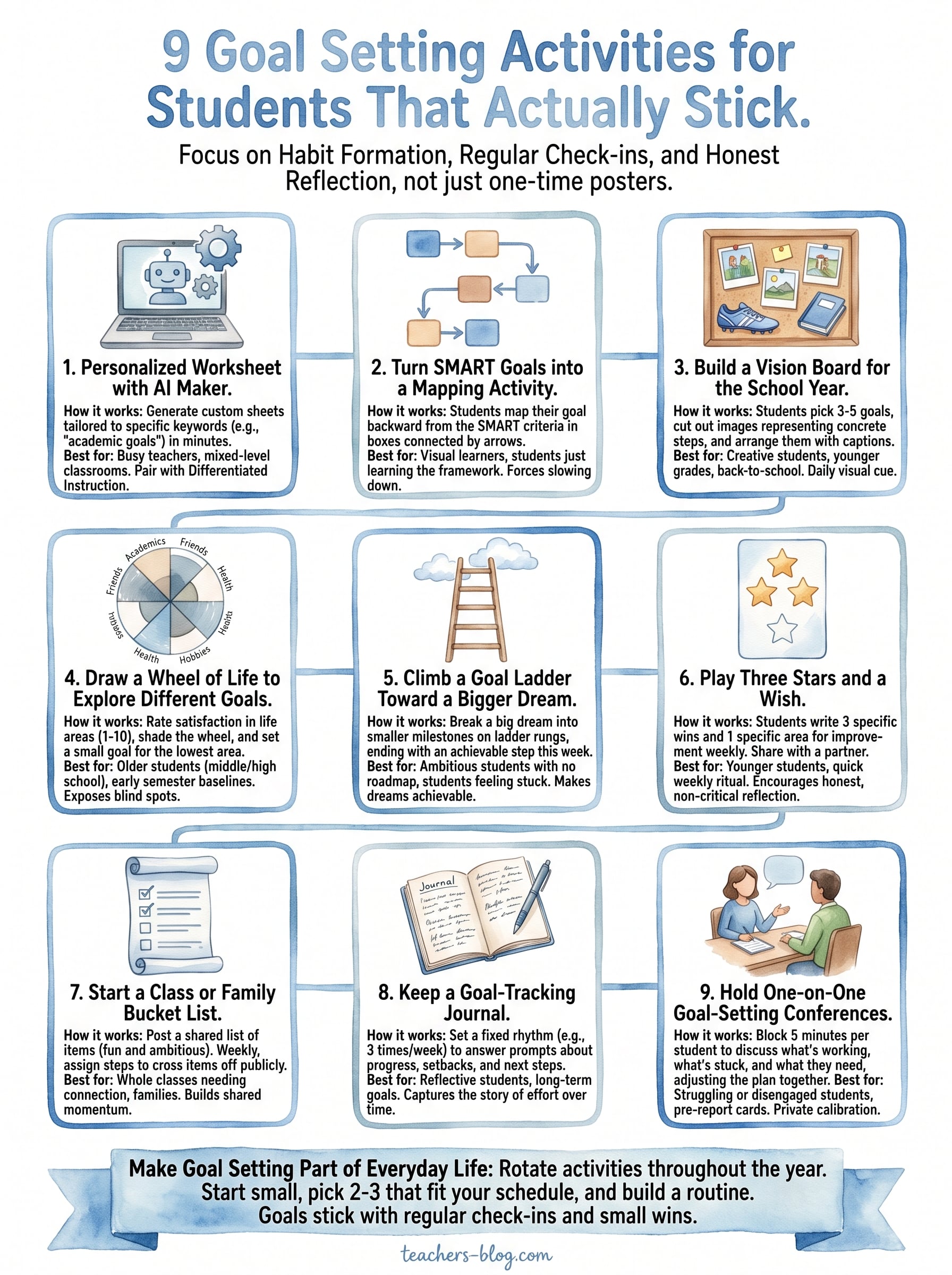
None of these nine activities work as a one-time event. Goal setting activities for students only build real habits when you rotate them through the year: a wheel of life in September, weekly stars and wishes through the fall, conferences before each report card. Pick two or three that fit your schedule and commit to running them on a fixed rhythm, rather than trying all nine at once and abandoning the effort by October.
Start small. Grab the ladder or the SMART map for next week’s lesson, then layer in a journal or conference cycle once that first activity feels routine. Your students won’t remember the poster they made in September, but they’ll remember the teacher who kept asking how the plan was going. If you want a head start on tomorrow’s lesson, build your first worksheet with our free Worksheet Maker and see how quickly a custom goal-setting sheet comes together.