12 Common Teacher Interview Questions & Sample Answers
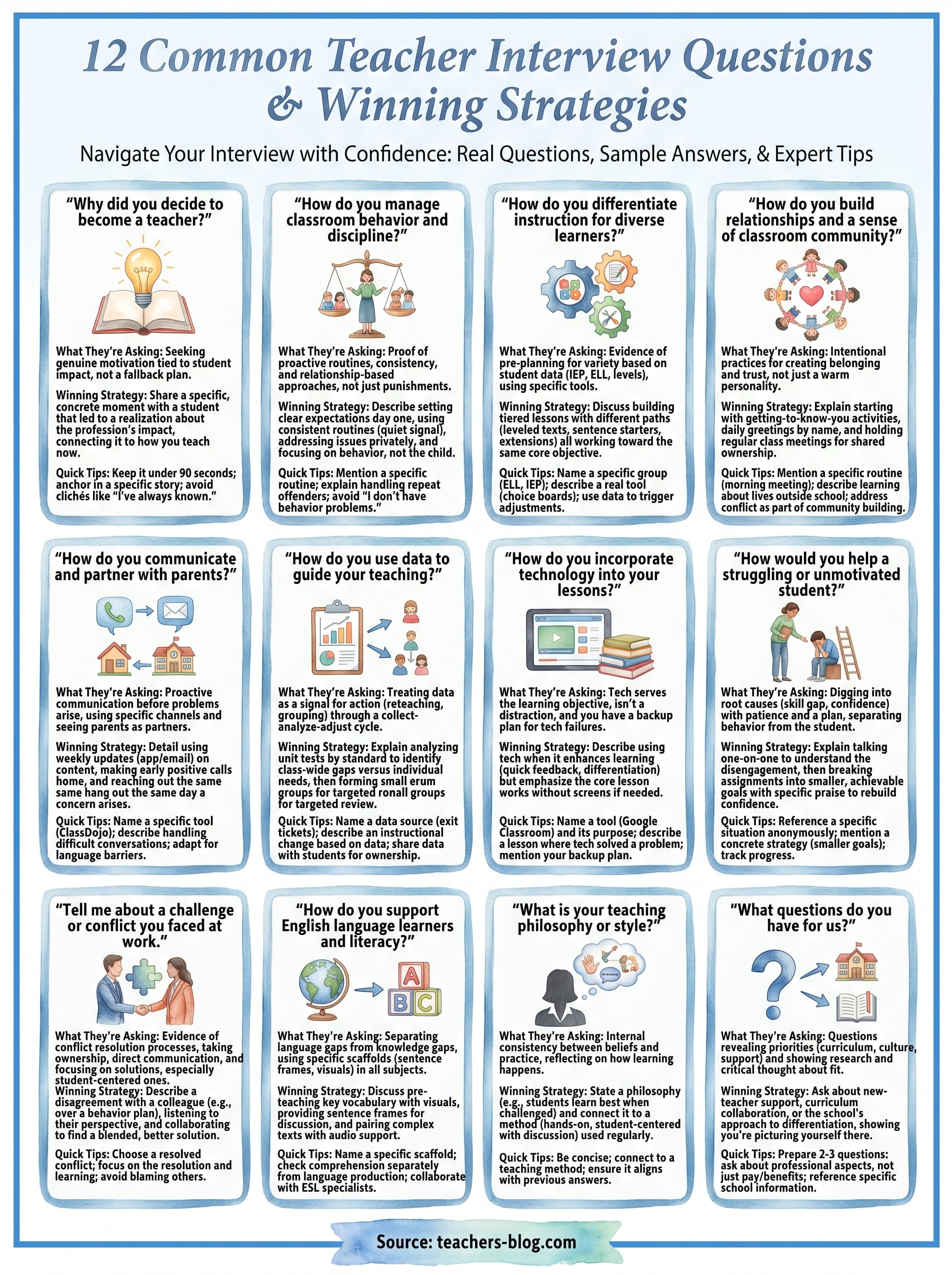
You’ve got a teaching interview on the calendar, and now the nerves are setting in. What if they ask something you haven’t prepared for? What if you freeze up when the principal asks you to describe your classroom management style? These worries are normal, and the best fix is simple: know the questions before you walk in. This list of common teacher interview questions covers exactly what hiring committees actually ask.
Below you’ll find 12 questions that show up again and again in real teacher interviews, from "Why do you want to teach here?" to "How do you handle a struggling student?" Each one comes with a sample answer you can adapt, so you’re not starting from a blank page the night before your interview.
This isn’t a generic list pulled from a corporate hiring guide. Every question and answer here reflects what actually gets asked in school interviews, whether you’re applying for your first classroom or moving to a new district. Read through them, practice out loud, and adjust the sample answers to fit your own teaching experience and philosophy before your big interview day arrives.
1. Why did you decide to become a teacher
This question almost always opens the interview, and it sets the tone for everything after it. Committees ask it first because they want to see if you can talk about your work with genuine energy, not because they’re curious about your childhood. If your answer sounds rehearsed or vague, it signals that the rest of the interview might feel the same way. Treat this as your chance to establish credibility fast, before anyone asks about classroom management or lesson planning.
What the interviewer is really asking
Underneath the surface question, the panel wants to know if teaching is a calling or a fallback plan for you. They’re listening for specific motivation tied to student impact, not a generic love of the subject matter. A hiring committee has sat through dozens of answers like "I’ve always loved kids" or "I wanted to make a difference," and those lines don’t tell them anything useful. What convinces them is a story that shows you understand what the job actually requires day to day.
A sample answer you can adapt
"I decided to become a teacher after tutoring a middle schooler who struggled with reading comprehension. Watching her go from avoiding books to asking for more helped me realize I wanted that kind of impact as a career, not just a volunteer hour. Since then, I’ve focused on building classrooms where students who think they’re ‘bad at’ a subject discover they’re capable of more than they thought."
This works because it names a concrete moment, connects it to a real outcome, and links directly to how the candidate teaches now.
Tips to make it your own
Swap in your own turning point, whether that’s a mentor teacher, a personal learning struggle, or a specific classroom experience during student teaching.
- Keep your answer under 90 seconds; this is an opener, not your whole interview.
- Anchor your story in a specific student, moment, or class period rather than a broad statement.
- End by connecting your "why" to how you teach today, not just how you felt years ago.
- Avoid clichés like "I’ve always known" or "kids are the future," since panels hear these constantly.
Practice this answer out loud a few times before your interview so it sounds natural, not memorized word for word.
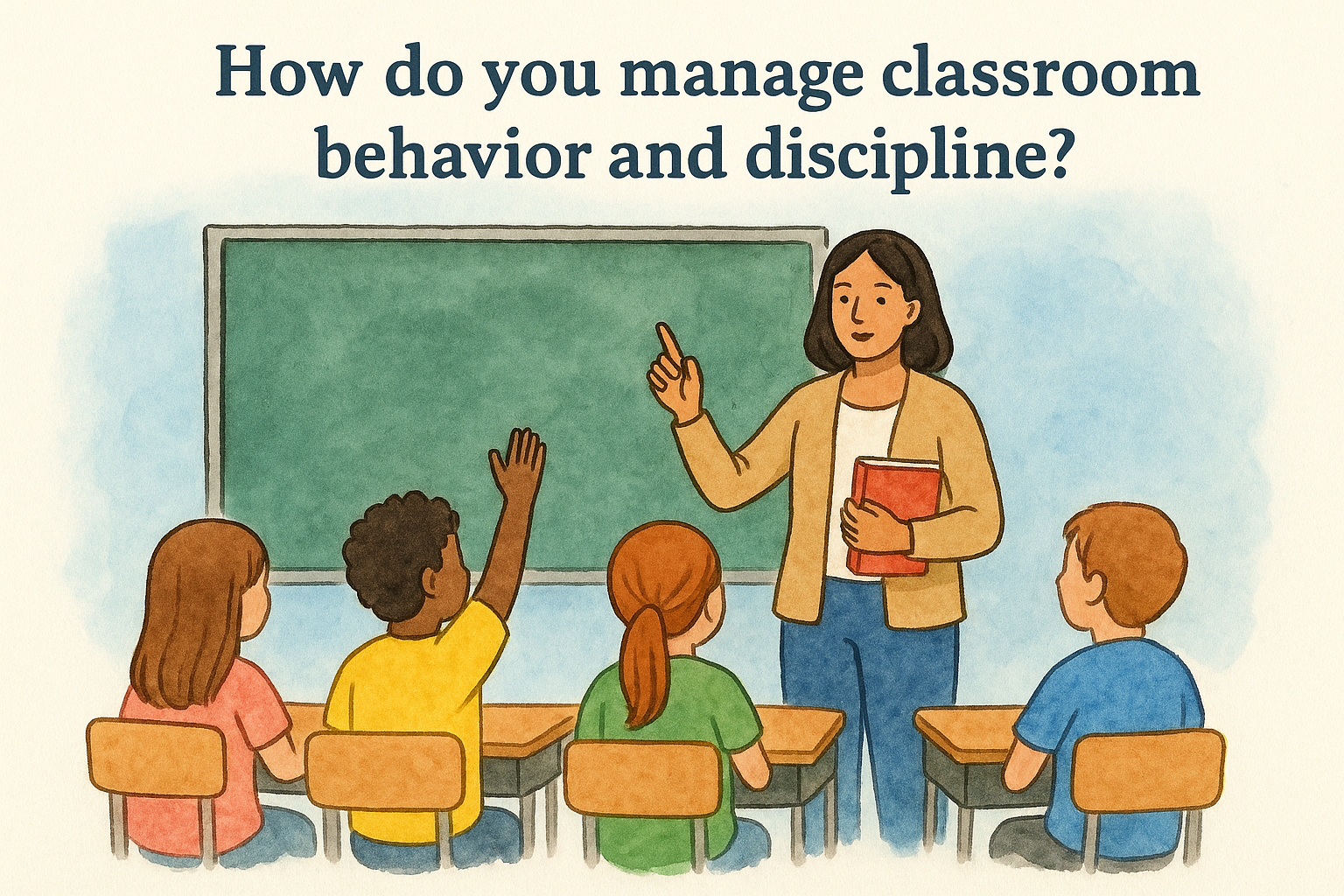
2. How do you manage classroom behavior and discipline
Every hiring committee asks some version of this question because classroom management makes or breaks a teacher’s first year. A room full of engaged students doesn’t happen by accident, and principals know that weak management skills lead to burnout, parent complaints, and disrupted learning. Expect this question early in almost any interview, especially for elementary or middle school positions.
What the interviewer is really asking
Beneath the surface, the panel wants proof that you have a proactive system, not just a list of punishments you hand out after things go wrong. They’re checking whether you build routines that prevent disruption in the first place, and whether you can stay calm and consistent when a student tests limits. Interviewers also listen for whether your approach relies on connection and clear expectations rather than fear or constant power struggles.
A sample answer you can adapt
"I set clear expectations on day one, post them visibly, and reinforce them with consistent routines like a quiet signal and a warm greeting at the door. When a student acts out, I address it privately and calmly, focusing on the behavior instead of the child, and I follow up with a quick check-in later that day."
Tips to make it your own
- Mention one specific routine you use, like a call-and-response signal or a visual behavior chart.
- Describe how you handle a repeat offender, not just a first-time issue.
- Reference restorative practices if your target school emphasizes relationship-based discipline over suspensions.
- Avoid saying you "don’t have behavior problems," since experienced interviewers know every classroom does.
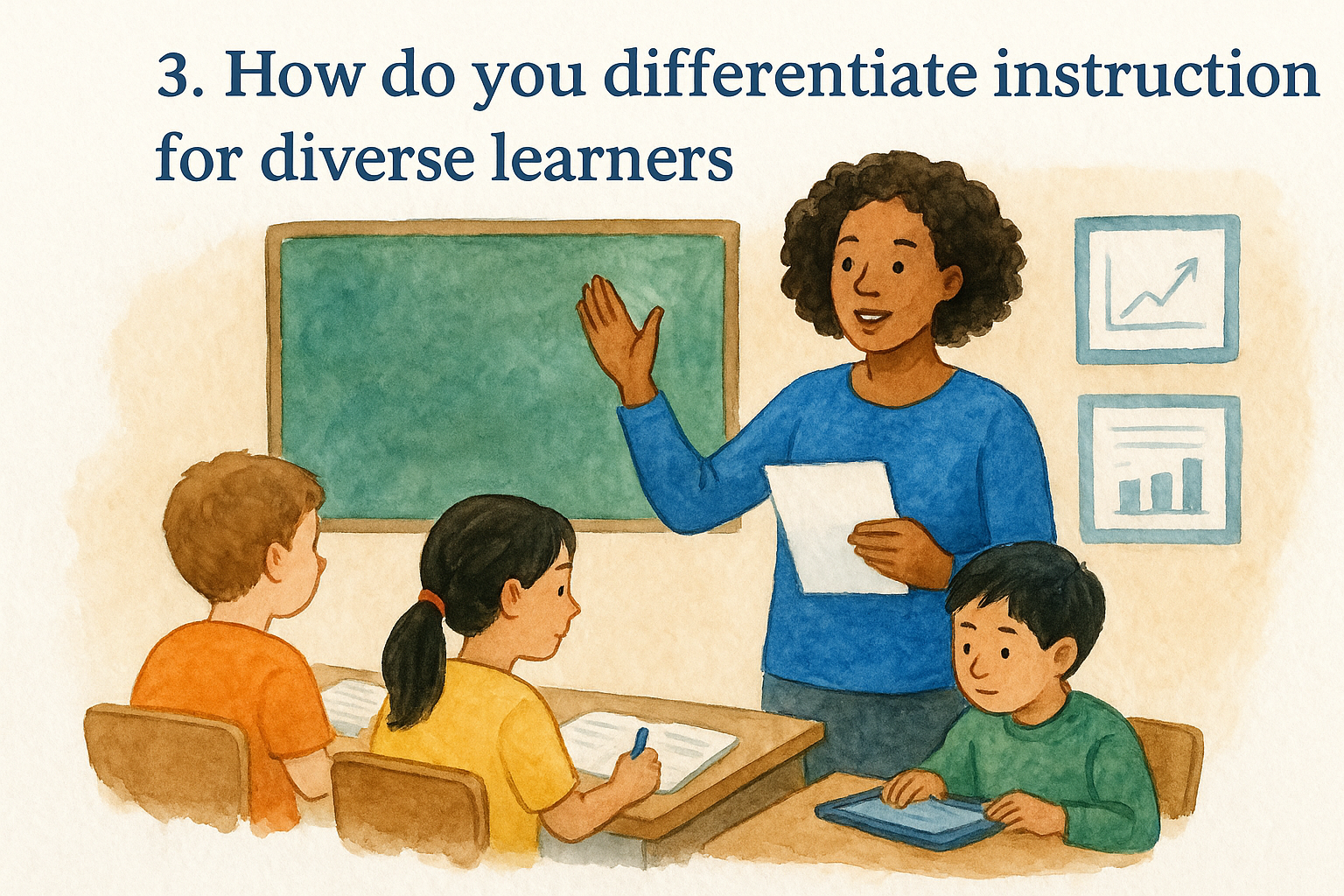
3. How do you differentiate instruction for diverse learners
Modern classrooms mix students reading three grade levels apart, English language learners, and kids with IEPs, all in the same 50 minutes. Schools ask this question because differentiated instruction separates teachers who can reach every learner from those who only teach to the middle of the room.
What the interviewer is really asking
Panels want evidence that you plan for variety before the lesson starts, not scramble to adjust once a student falls behind. They’re listening for specific strategies tied to student data, whether that’s reading levels, IEP goals, or language proficiency, and whether you can name tools you actually use for this, like the Differentiated Instruction Helper many teachers rely on to build tiered lessons faster.
A sample answer you can adapt
"I build lessons with tiered tasks so every student works toward the same objective through a path that fits them. For a reading unit, that might mean leveled texts, sentence starters for ELL students, and an extension option for advanced readers, all built around the same core question."
Differentiation isn’t extra work bolted onto a lesson; it’s the lesson.
Tips to make it your own
- Name one specific group you’ve differentiated for: IEP students, ELLs, or gifted learners.
- Describe a real tool or method, such as choice boards, flexible grouping, or scaffolded worksheets.
- Mention formative assessment as the trigger that tells you when to adjust.
- Skip vague claims like "I meet all learners where they are" without a concrete example backing it up.
4. How do you build relationships and a sense of classroom community
Students learn more when they feel safe, seen, and connected to their teacher and peers, and hiring committees know it. This question comes up because classroom community directly affects attendance, participation, and how students treat each other when things get hard. Interviewers ask it to see whether relationship-building is intentional for you or something you hope happens naturally.
What the interviewer is really asking
Panels want to know if you have actual practices for creating belonging, not just a warm personality. They’re listening for routines that build trust over the school year, like morning check-ins or class meetings, and whether you notice students who tend to slip through the cracks. A candidate who can name specific structures signals they’ll create a classroom culture on purpose, not by accident.
A sample answer you can adapt
"I start each year with a getting-to-know-you unit and keep a simple tracker so I greet every student by name at the door daily. We hold short class meetings weekly to discuss what’s working and what isn’t, which gives students ownership over our classroom culture."
A classroom feels safe when students know someone is paying attention to them specifically.
Tips to make it your own
- Mention a specific relationship-building routine, like a morning meeting, shout-out board, or one-on-one check-ins.
- Describe how you learn about students’ lives outside the classroom to inform your teaching.
- Reference how you handle conflict between students as part of building community, not separate from it.
- Avoid generic claims like "I treat all my students like family" without backing it up with a real practice.
5. How do you communicate and partner with parents
Parent communication makes or breaks how smoothly a school year runs, and hiring committees know that a teacher who avoids it creates headaches for administrators down the line. Schools ask this question because they want teachers who treat parent partnership as part of the job, not an inconvenience that pulls them away from lesson planning. Expect this question in nearly every interview, but especially at schools serving diverse or high-need communities where trust between home and classroom matters even more.
What the interviewer is really asking
Beneath the surface, panels want to know if you communicate proactively, before problems escalate, rather than only when a grade drops or behavior spirals. They’re listening for specific channels you use, like weekly newsletters, apps, or phone calls, and whether you can describe reaching families who don’t always respond right away. A strong answer also shows you see parents as partners in a student’s growth, not obstacles to manage.
A sample answer you can adapt
"I send a short weekly update through an app like ClassDojo highlighting what we covered and any upcoming deadlines, and I call home with good news early in the year so parents hear from me before there’s ever a problem. When a concern comes up, I reach out the same day rather than waiting for a conference."
Tips to make it your own
- Name a specific tool or method you use for regular updates.
- Describe how you handle a difficult conversation with a frustrated parent.
- Mention how you adapt communication for language barriers or work schedules.
- Avoid saying communication "isn’t your strong suit," even if it’s true right now.
6. How do you use data to guide your teaching
Schools run on assessment results now, from unit quizzes to state testing, and administrators want teachers who actually use that information instead of filing it away. This question shows up because data-driven instruction has become a buzzword in hiring, but interviewers can quickly tell who’s practiced it and who’s just repeating the phrase. Expect it in almost any interview tied to a school with a strong testing culture or an active improvement plan.
What the interviewer is really asking
Panels want to know if you treat data as a signal for action, not just a number on a spreadsheet. They’re checking whether you can describe a specific cycle: collect, analyze, adjust, and reassess, rather than a vague nod to "tracking progress." Interviewers also listen for whether you use data to group students, reteach concepts, or flag kids who need extra support before they fall too far behind.
A sample answer you can adapt
"After every unit test, I break down results by standard to see which concepts the whole class missed versus which students need individual reteaching. I use that breakdown to form small groups for targeted review the following week, and I track growth over time so I can show parents and students concrete progress, not just a letter grade."
Data only matters once it changes what happens in your classroom the next day.
Tips to make it your own
- Name a specific data source: exit tickets, benchmark tests, or IEP progress monitoring.
- Describe one instructional change you made because of what the numbers showed.
- Mention how you share data with students to build their own ownership of growth.
- Skip claims like "I’m very data-driven" without a real example attached.
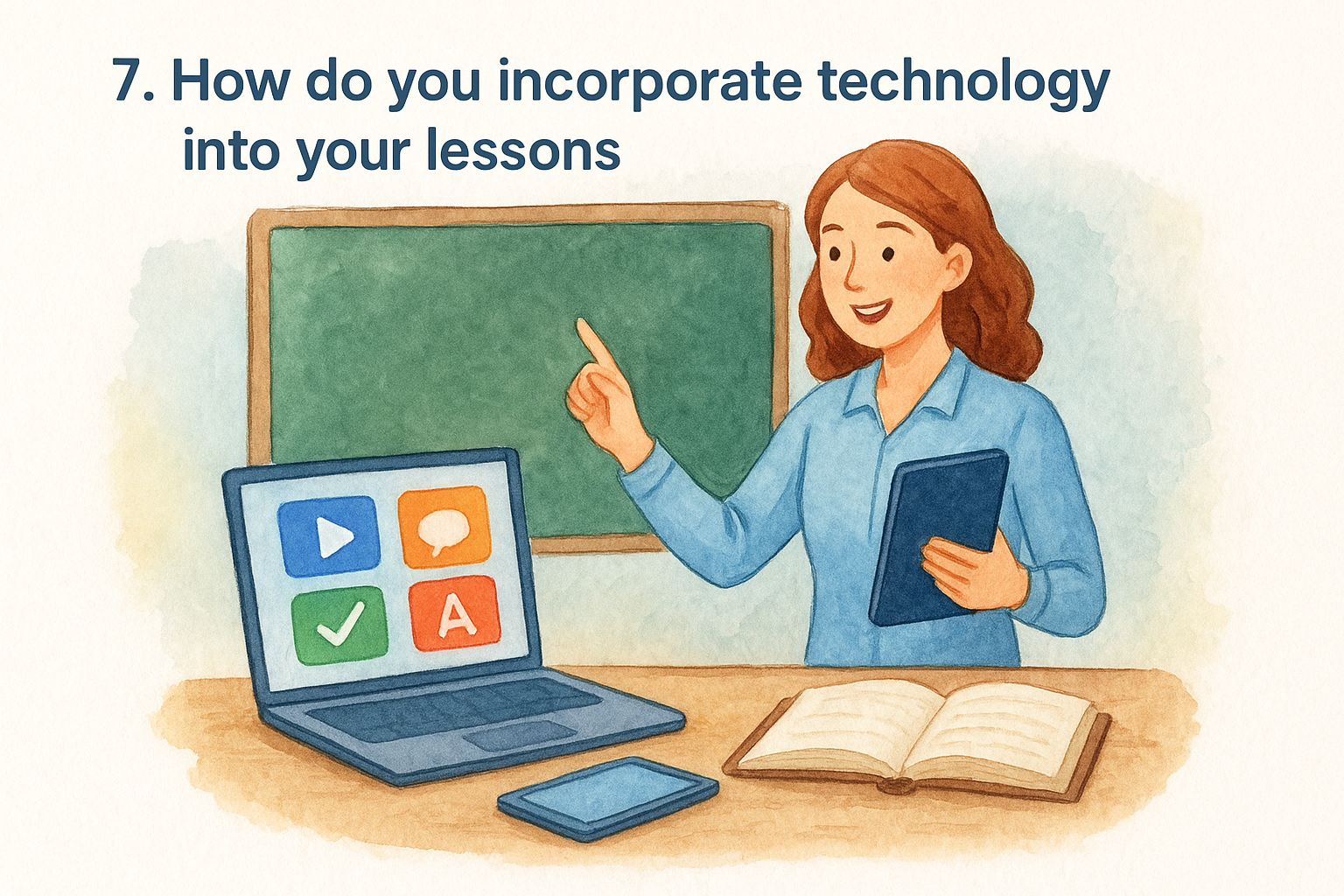
7. How do you incorporate technology into your lessons
Classrooms now run on a mix of laptops, tablets, and apps, and schools want to know you can use that toolkit without letting it become a distraction. This question appears often in common teacher interview questions because administrators have watched technology adoption go both ways: some teachers use it to deepen learning, others let it replace real teaching. Committees ask this to figure out which kind of teacher you’ll be.
What the interviewer is really asking
Underneath the question, panels want proof that technology serves your objective, not the other way around. They’re listening for whether you pick tools based on what a lesson needs, like a quick formative check or a way to differentiate practice, rather than adding an app for novelty. Interviewers also want to hear that you can teach a lesson just as well without the tech if the wifi goes down.
A sample answer you can adapt
"I use technology when it saves time or opens a door I couldn’t otherwise, like a quick digital quiz for instant feedback or an AI worksheet generator to build tiered practice sets fast. But the core lesson always works on paper too, since I’ve taught through internet outages and know not to build a lesson that collapses without a screen."
Good technology use makes a lesson stronger, not just shinier.
Tips to make it your own
- Name a specific tool you’ve used, like Google Classroom, Kahoot, or an AI-powered worksheet generator.
- Describe a lesson where tech solved a real problem, such as differentiation or fast feedback.
- Mention your backup plan for tech failures.
- Avoid listing apps without explaining how they improved student learning.
8. How would you help a struggling or unmotivated student
Every school has students who’ve checked out, whether from repeated failure, a rough home life, or just boredom with the material. This question comes up because hiring committees want to know you won’t write these kids off. Motivated teaching starts with figuring out why a student disengaged, not just pushing harder on the same approach that already lost them.
What the interviewer is really asking
Panels want to see if you separate the behavior from the cause. They’re checking whether you dig into root issues, like a skill gap, low confidence, or something happening outside school, instead of labeling a kid lazy. A strong answer shows patience paired with a plan, not just sympathy.
A sample answer you can adapt
"I start by talking with the student one-on-one to understand what’s behind the disengagement, whether it’s a skill gap or something unrelated to the classroom. For a student who felt behind in math, I broke assignments into smaller wins and gave specific praise as he hit them, which slowly rebuilt his confidence and effort."
A struggling student usually needs a reason to try again, not another lecture about trying harder.
Tips to make it your own
- Reference one specific student situation, changing identifying details as needed.
- Mention a concrete strategy: smaller goals, choice in assignments, or a check-in routine.
- Describe how you tracked whether your approach actually worked over time.
- Avoid vague answers like "I just believe in them," since panels want a method, not a mindset.
9. Tell me about a challenge or conflict you faced at work
This behavioral question shows up because past behavior predicts future behavior, and hiring committees know a smooth interview doesn’t guarantee a smooth staff room. They’re testing whether you can handle workplace conflict without drama, whether that’s a disagreement with a coworker, a tense parent meeting, or friction with an administrator over a policy you didn’t agree with.
What the interviewer is really asking
Beneath the surface, panels want to see your conflict resolution process, not just proof that bad days happen. They’re listening for whether you take ownership of your part in a disagreement, communicate directly instead of avoiding the issue, and land on a resolution that kept the focus on students. A candidate who blames everyone else raises a red flag fast.
A sample answer you can adapt
"A colleague and I disagreed on how to handle a shared student’s behavior plan, and it started affecting our team meetings. I asked to talk one-on-one, listened to her reasoning first, and we ended up blending both approaches into a plan that worked better than either original version. That experience taught me to address tension early instead of letting it simmer."
Tips to make it your own
- Choose a real but resolved conflict, never one still ongoing with a current employer.
- Focus more time on the resolution than the drama of the conflict itself.
- Name what you learned and how it changed your approach going forward.
- Avoid throwing a former coworker or principal under the bus, even subtly.
10. How do you support English language learners and literacy
Enrollment numbers for English language learners keep climbing in districts across the country, and schools need teachers who can teach content and language at the same time, not one after the other. This question shows up most in interviews for elementary positions and content areas like science or social studies, where academic vocabulary can block understanding even when a student grasps the concept.
What the interviewer is really asking
Panels want to know if you separate a language gap from a knowledge gap, since treating an ELL student as behind academically when they’re actually behind linguistically leads to the wrong support. They’re listening for specific strategies like sentence frames, visual supports, or vocabulary pre-teaching, and whether you build literacy instruction into every subject, not just reading block.
A sample answer you can adapt
"I pre-teach key vocabulary before a lesson using visuals and simple definitions, and I give sentence frames for discussion so ELL students can participate without getting stuck on phrasing. For literacy specifically, I pair complex texts with read-alouds or audio support so students access grade-level content while their reading skills catch up."
Language support and grade-level content don’t have to compete for class time.
Tips to make it your own
- Name a specific scaffold: sentence frames, bilingual glossaries, or visual anchor charts.
- Describe how you check comprehension separately from language production.
- Mention collaboration with an ESL specialist if your district has one.
- Avoid assuming a quiet ELL student understands less than they actually do.
11. What is your teaching philosophy or style
Hiring committees ask this question to see if you’ve actually thought about how learning happens, or if you’re just borrowing language from your education courses. A teaching philosophy question separates candidates who can articulate a consistent approach from those who list techniques with no thread connecting them. Expect this near the end of the interview, often after you’ve already answered several practical questions that hint at your style anyway.
What the interviewer is really asking
Underneath the question, panels want to know if your beliefs about learning match how you actually run a classroom day to day. They’re checking for internal consistency, meaning your philosophy should sound like the same person who described classroom management and differentiation earlier in the interview. A mismatch between your stated philosophy and your other answers raises doubts about whether you’ve truly reflected on your practice.
A sample answer you can adapt
"I believe students learn best when they feel capable and challenged at the same time, so I build lessons around clear goals with room for productive struggle. My style leans hands-on and student-centered, with lots of discussion and real-world application, because I’ve seen students retain more when they’re doing the thinking instead of just receiving it."
A teaching philosophy should sound like a description of your actual classroom, not a mission statement copied from a textbook.
Tips to make it your own
- State your philosophy in one or two sentences before adding detail; don’t bury the main idea.
- Connect it directly to a teaching method you use regularly, like project-based learning or Socratic discussion.
- Match this answer to the earlier questions you’ve already answered so the whole interview feels coherent.
- Avoid borrowing language you don’t actually practice just because it sounds impressive.
12. What questions do you have for us
Closing an interview with "no questions, I think you covered everything" is one of the fastest ways to seem passive. Hiring committees ask this at the very end because your questions reveal priorities just as much as your earlier answers did. A candidate who asks nothing signals they haven’t thought deeply about the role, while thoughtful questions show you’re already picturing yourself on staff.
What the interviewer is really asking
Beneath the surface, panels want to know if you’ve researched the school and thought critically about fit, not just memorized answers to their questions. They’re listening for whether you ask about curriculum, culture, or support systems, which suggests you care about doing the job well, versus questions only about salary or schedule, which suggests you’re focused elsewhere. This is also your last chance to gather real information before deciding if the job suits you.
A sample answer you can adapt
"What does new-teacher support look like here in the first year, and how does the team collaborate on curriculum decisions?"
The right closing question can leave a stronger impression than any answer you gave earlier.
Other strong options include asking about the school’s approach to differentiation, how the administration handles discipline referrals, or what a typical PLC meeting covers.
Tips to make it your own
- Prepare two or three questions in advance so you’re never caught blank.
- Ask about curriculum, mentorship, or classroom resources rather than pay or vacation time.
- Reference something specific from the school’s website or mission statement.
- Avoid asking questions you could easily answer with a quick search beforehand.
Walking into interview day ready
None of these 12 questions are trick questions. They’re the same ones hiring committees ask year after year, because they reveal how you actually think about students, classrooms, and the daily grind of teaching. Preparation isn’t about memorizing a script; it’s about having real stories and specific strategies ready so you sound like yourself under pressure instead of scrambling for something to say.
Read through this list once more the night before your interview, but spend more time practicing out loud than rereading. Your answers will land better when they come from your own experience, not a page you’ve studied.
Once you land the job, the real work starts, and that’s where a steady supply of practical strategies helps. Browse The Cautiously Optimistic Teacher for classroom-tested resources that’ll carry you well past your first year.