
How To Write A Teaching Philosophy Statement, Step-By-Step
You’ve spent years building your teaching practice, refining lessons, connecting with students, adapting to every curveball a classroom throws at you. But when someone asks you to put your beliefs about education into a single page, you freeze. Knowing how to write a teaching philosophy statement shouldn’t be this stressful, yet for most educators, it’s one of the hardest pieces of professional writing they’ll ever face. Whether you’re applying for your first position or gunning for tenure, this document carries real weight in how hiring committees perceive you.
A teaching philosophy statement is your chance to articulate why you teach the way you do. It connects your values, methods, and goals into a coherent narrative that tells readers, usually administrators or search committees, what students experience in your classroom. Done well, it makes you memorable. Done poorly, it blends into a stack of generic declarations about "fostering lifelong learners."
Here at The Cautiously Optimistic Teacher, we build resources that help educators at every stage of their careers, from landing the interview to thriving in the classroom. This guide breaks the writing process into clear, manageable steps so you can draft a teaching philosophy statement that actually sounds like you. You’ll find guidance on structure, length, tone, and concrete examples to reference, everything you need to move from a blinking cursor to a finished draft.
What a teaching philosophy statement is and includes
A teaching philosophy statement is a 1 to 2-page reflective document that describes your core beliefs about teaching and learning. It explains why you teach, what you want students to gain from your class, and how your instructional choices connect to those goals. Think of it as a professional narrative, not a bulleted list of credentials. Hiring committees read these to understand the person behind the resume, and a strong statement gives them a clear picture of how you think about education.
Your teaching philosophy statement should read like a window into your classroom, not a copy of your job description.
What a strong statement covers
Knowing how to write a teaching philosophy statement gets easier when you understand what reviewers actually look for. Most strong statements address four core areas: your teaching values, your instructional methods, your approach to assessment, and your commitment to student growth and inclusion. Each area works together to build a complete portrait of you as an educator.
Here is what a complete statement typically includes:
- Your core beliefs: What you think learning is and why it matters
- Your methods: The specific strategies and approaches you use in the classroom
- Your assessment philosophy: How you measure student understanding and adjust your teaching
- Student-centered outcomes: What you want students to walk away knowing, feeling, or being able to do
- Growth and inclusion: How you support diverse learners and continue developing as a teacher
What it is not
Your statement is not a list of accomplishments, and it is not a course syllabus. Reviewers want to see your thinking, not a timeline of your career. Keep the focus on your beliefs and the reasoning behind your choices, and you will hold their attention far better than a document that simply recounts where you have taught and for how long.
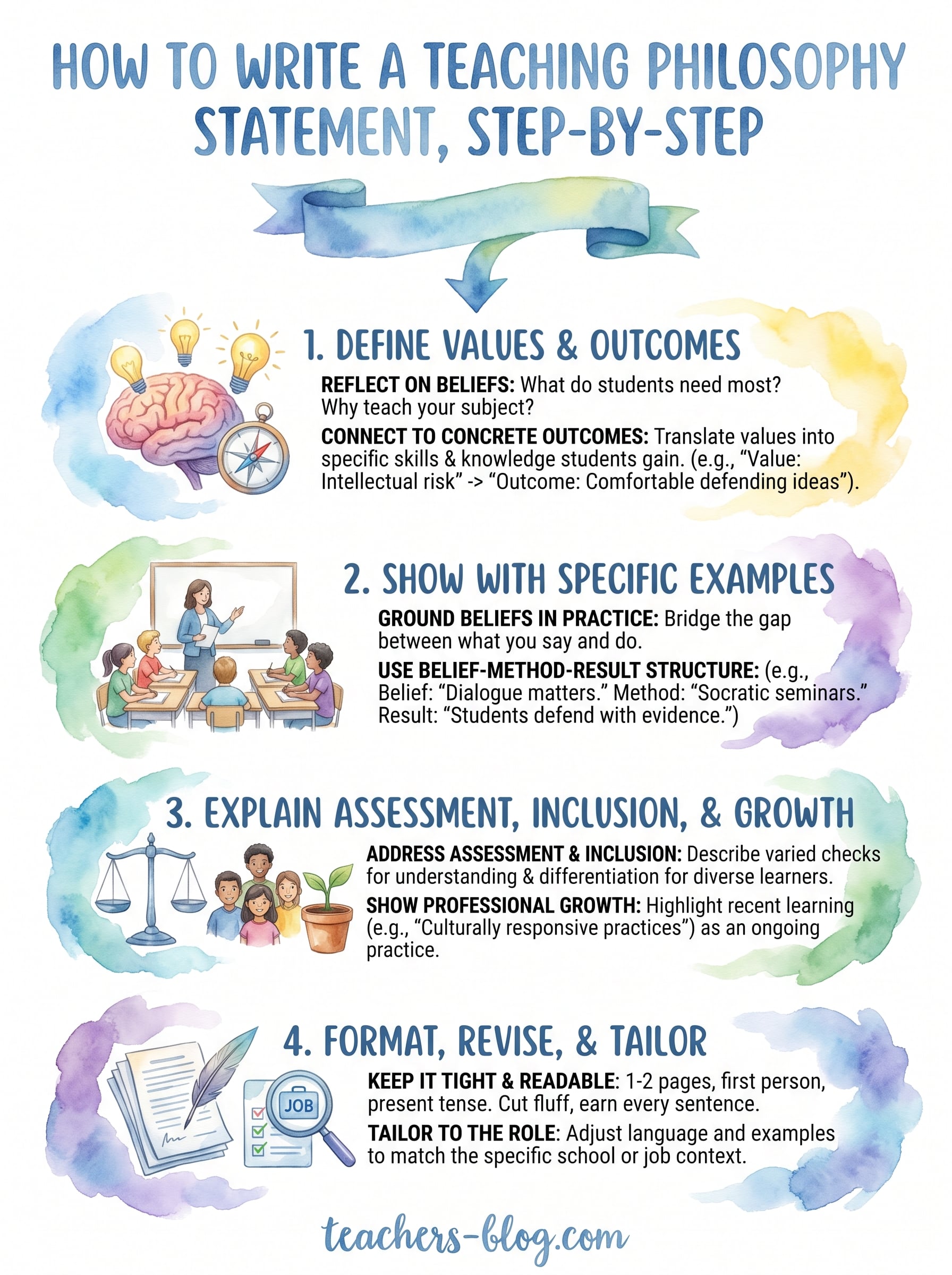
Step 1. Define your teaching values and student outcomes
Before you write a single sentence, you need to know what you actually believe about teaching and learning. This first step in how to write a teaching philosophy statement is about excavating your convictions, not crafting perfect prose. Sit down somewhere quiet and give yourself real time to reflect on what drives your decisions inside the classroom.
Ask yourself the right questions
Your values do not live in your job title; they show up in the choices you make daily. Start by answering a few focused prompts to surface what you genuinely believe.
The most memorable philosophy statements come from specific, honest reflection, not from borrowing language that sounds impressive.
Work through these questions in writing before you draft anything formal:
- What do you believe students need most from their education?
- Why do you teach the subject or grade level you do?
- What does a successful class period look like to you?
- What do you want students to be able to do six months after leaving your class?
Translate values into outcomes
Once you have your answers, connect each value to a concrete student outcome. For example, if you believe students learn through productive struggle, your outcome might be that students leave your class comfortable taking intellectual risks. This connection gives your statement direction and coherence from the very first paragraph.
Step 2. Show how you teach with specific examples
After you define your values, you need to ground them in practice. The weakest part of most philosophy statements is the gap between what a teacher claims to believe and how they actually behave in a classroom. Reviewers read dozens of statements that say things like "I believe in student-centered learning" without a single concrete example to back it up. Your job in this step is to close that gap.
Specific examples do more to build credibility in a teaching philosophy statement than any amount of polished language.
Turn beliefs into classroom moments
When you understand how to write a teaching philosophy statement effectively, you recognize that each belief you stated in Step 1 needs a corresponding method. Take one of your values and describe a specific instructional strategy you use to put it into practice. Show the reader what your classroom actually looks like.

Use this structure for each example you include:
- Belief: I think students learn through dialogue.
- Method: I run Socratic seminars twice per unit.
- Result: Students build the habit of defending ideas with evidence.
Work through two or three of your core beliefs this way. Concrete classroom moments give your statement texture and make it genuinely yours.
Step 3. Explain assessment, inclusion, and growth
The third section of your statement addresses how you measure learning, how you serve every student in the room, and how you keep growing as a teacher. This is where many educators get vague, but specificity here signals genuine professional maturity to any hiring committee.
Reviewers can tell the difference between a teacher who has thought carefully about inclusion and one who simply lists it as a value.
Address assessment and diverse learners
When you think about how to write a teaching philosophy statement, assessment and inclusion belong together because both reflect your commitment to actual student success rather than delivery of content alone. Describe how you check for understanding and what specific differentiation strategies you build in for diverse learners:

- How you adjust pacing or materials for students who need more support
- How you use formative feedback rather than relying only on grades
- How you create access for students with different learning needs
Show your growth as an educator
Name one area where you have grown recently, such as expanding your knowledge of culturally responsive practices or refining how you give written feedback. This specificity tells hiring committees you reflect on your work with purpose.
Each of these growth moments shows that you see teaching as an ongoing practice, not a fixed skill set you mastered and shelved.
Step 4. Format, revise, and tailor it to the role
Once you have a complete draft, the final step in knowing how to write a teaching philosophy statement is getting the format right and making it fit the specific role. Most statements run one to two pages, single-spaced, in a readable 11 or 12-point font. Write in first person, present tense, and keep the tone professional but personal.
Keep it tight and readable
Every sentence should earn its place. Cut anything that restates an idea you already made clearly. Read your draft aloud to catch awkward phrasing, and ask a trusted colleague to flag anything that sounds generic or hollow.
A tight, specific statement always outperforms a long, padded one.
Use this quick formatting checklist before you submit:
- Length: 1 to 2 pages, no more
- Font: 11 or 12-point, standard typeface
- Tense: present tense, first person
- Tone: reflective and direct, not boastful
Adjust for each application
Read the job posting carefully before you send your statement anywhere. If the role emphasizes project-based learning or a specific student population, revise one or two paragraphs to reflect that context. You do not need to rewrite the entire document, just make sure the language speaks directly to what that school or department values.
Next Steps
You now have a clear, step-by-step path for how to write a teaching philosophy statement that reflects your actual practice. Start with your values, ground them in specific classroom examples, address assessment and inclusion honestly, then format and tailor the final draft to each role you pursue. Each step builds on the last, so resist the urge to skip ahead to formatting before you have done the reflective work.
Your statement will improve every time you revise it, so treat it as a living document you update as your teaching evolves. Review it before each application cycle and add any new strategies or professional growth that genuinely changed how you work with students. The educators who stand out in hiring searches are the ones whose statements feel specific and real, not recycled from a template.
When you are ready to take the next step in your career, explore the full range of teacher career resources at The Cautiously Optimistic Teacher to support your professional journey.