
Whole Brain Teaching Classroom Management: Rules & Routines
You’ve tried the hand-raising. You’ve tried the quiet countdowns. You’ve tried "I’ll wait." And yet, half the class is still somewhere between zoned out and openly chatting. If that sounds familiar, whole brain teaching classroom management might be the reset your classroom needs. It’s a strategy built on the idea that students learn better when they’re physically, verbally, and emotionally engaged, not just sitting quietly.
WBT works because it replaces passive compliance with active participation. Instead of expecting students to absorb information in silence, it uses call-and-response techniques, gestures, and a tight set of rules to keep every part of the brain involved. It’s structured, it’s energetic, and, when done right, it transforms how students respond to instruction.
Here at The Cautiously Optimistic Teacher, we’re always looking for classroom management approaches that actually hold up under real conditions, not just in theory. This guide breaks down the core rules, routines, and gestures behind Whole Brain Teaching so you can start implementing them step by step, whether you’re brand new to WBT or looking to sharpen what you’ve already tried.
Why Whole Brain Teaching works for classroom management
Most classroom management systems focus on consequences. You post the rules, explain what happens when students break them, and wait to enforce. Whole brain teaching classroom management takes a different approach: it keeps students too engaged to misbehave, which reduces the need for consequences in the first place. That shift moves you from reactive to proactive, and it changes the entire energy of the room.
The brain science behind it
WBT is built on the idea that the brain learns better when multiple areas activate at the same time. When students only listen, they use their auditory cortex. When you add movement, gestures, and verbal response, you bring in motor cortex activity and social-emotional processing as well. Research on multimodal learning consistently shows that engaging more cognitive pathways improves both attention and retention, which is exactly what WBT is designed to do.
When students are physically moving and verbally responding, they have less mental bandwidth left for off-task behavior.
That’s the core mechanism. You’re not asking students to sit still and focus through willpower. You’re giving their brains enough stimulation that staying engaged becomes the natural default.
Why students actually follow along
Traditional management puts students in a passive role. They receive instructions and comply, or they don’t. WBT flips this by making students active participants in every routine. The call-and-response systems, the choral repetition, the gestures, these give students a clear job during instruction. When students have a defined behavioral role in every moment, they’re far less likely to fill that space with distraction.
Your students also benefit from the social momentum built into WBT structures. When the whole class responds together, individual students feel the pull to participate. This isn’t peer pressure in a negative sense, it’s group energy working in your favor. Students who might tune out during a lecture often stay on track when the class is moving and responding as a unit.
The core WBT tools that run the room
Whole brain teaching classroom management runs on a small set of tools, each designed to serve a specific function. You don’t need to implement everything at once, but understanding what each tool does helps you choose where to start and how to layer them together over time.
Class-Yes: the attention getter
Class-Yes is the foundation of WBT. You call out "Class!" and students respond "Yes!" in whatever tone or volume you used. If you say it quietly, they mirror that. If you draw it out, they do too. This gives you an instant reset mechanism that students actually enjoy responding to, which makes it far more reliable than waiting for silence. The novelty keeps it working longer than a simple clap pattern or countdown.
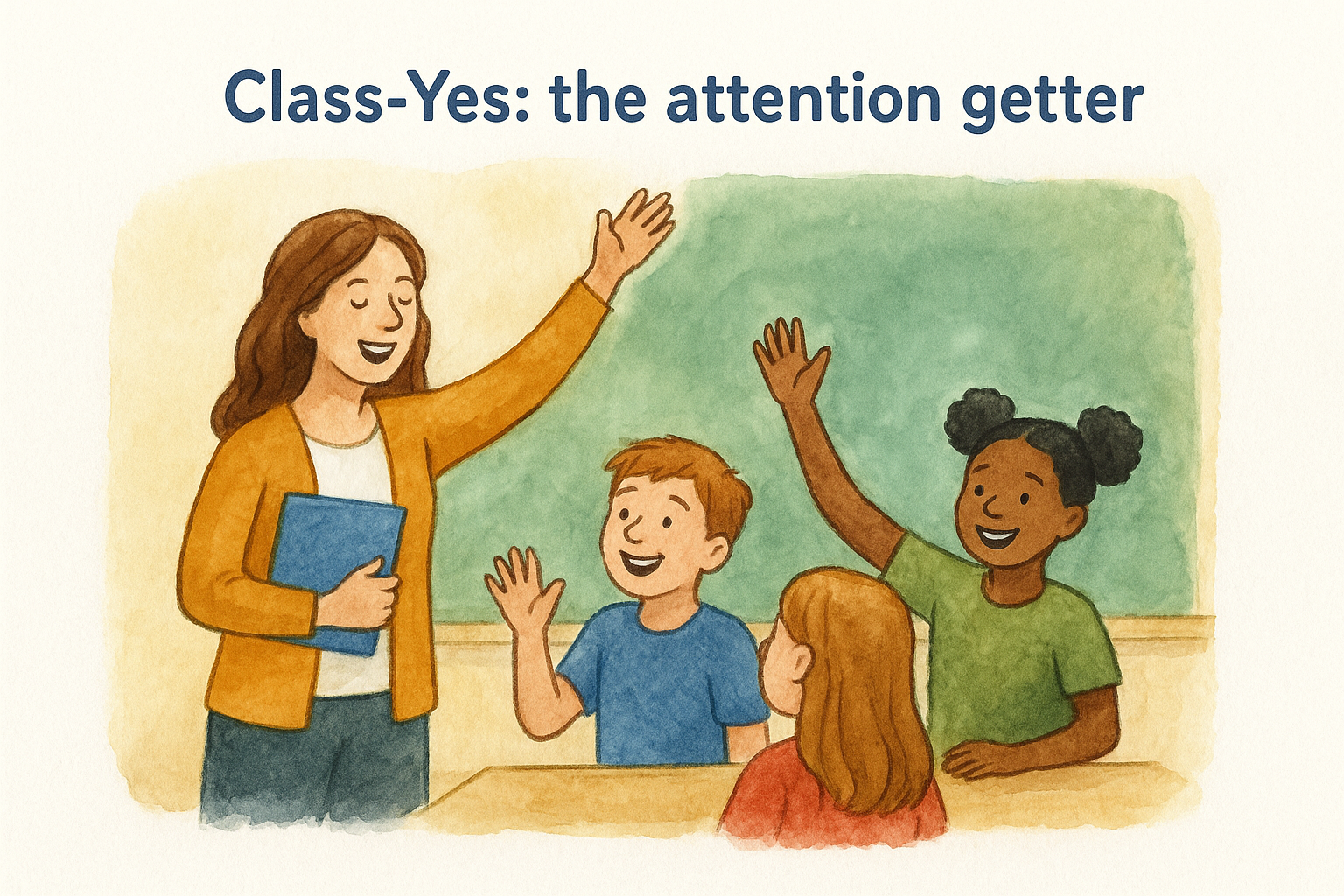
The moment students respond to Class-Yes, they are physically oriented toward you and ready for the next instruction.
Teach-OK: peer instruction built in
Teach-OK is the tool that turns your students into co-teachers. After you model a concept, you say "Teach!" and students respond "OK!" then immediately turn to a partner and explain what you just covered. This keeps every student actively processing the material rather than drifting while you talk. It also gives you a quick read on comprehension: if the room sounds confident, they got it; if it sounds shaky, you know to revisit before moving on.
How to teach the five rules and gestures
The five WBT rules are the backbone of whole brain teaching classroom management. Each rule comes with a physical gesture, so students aren’t just hearing the rule, they’re anchoring it in their bodies. That pairing is what makes the rules stick far longer than a poster on the wall ever could.
Introducing the rules on day one
Teach the rules one at a time. Say the rule, model the gesture, then have students repeat both back to you immediately. Work through all five this way:
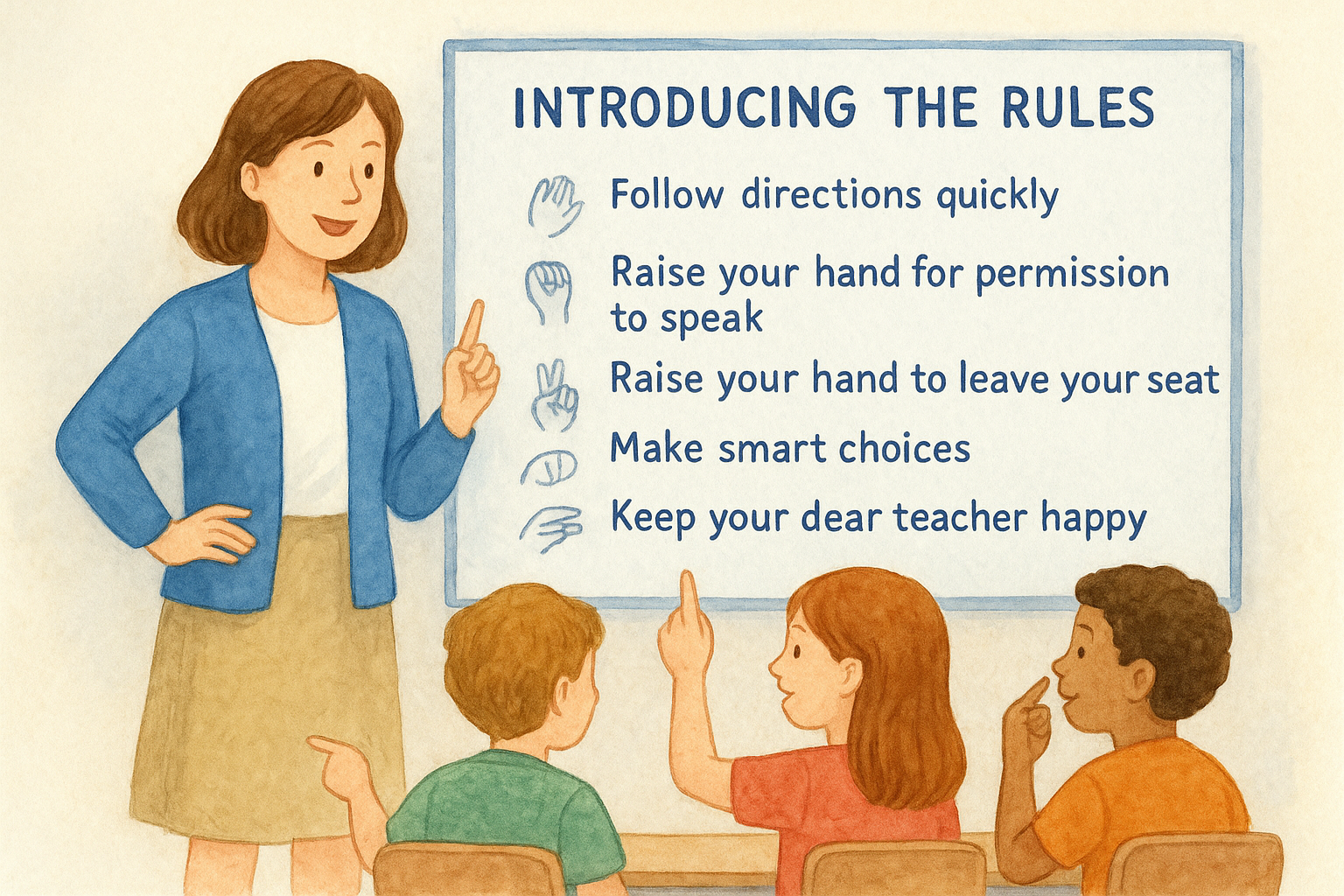
| Rule | Gesture |
|---|---|
| Follow directions quickly | Rapid swimming motion with one hand |
| Raise your hand for permission to speak | Raise hand, zip lips |
| Raise your hand to leave your seat | Raise hand, two fingers "walk" |
| Make smart choices | Point to your head |
| Keep your dear teacher happy | Frame your smile with both hands |
The first time students perform a gesture correctly as a class, the physical act of doing it together reinforces the rule better than repetition alone.
Practicing until the gestures stick
Run through the rules every day for the first two weeks. Call out a rule number and have students shout the rule and show the gesture. You can speed this up, slow it down, or add playful variations to keep it fresh. Consistency here matters more than creativity, because students need the rules to feel automatic before they can actually rely on them under pressure.
How to build WBT into daily routines and lessons
The goal isn’t to use WBT occasionally. Consistency is what makes whole brain teaching classroom management work long-term. When students encounter the same structures every single day, the routines become automatic, and your cognitive load as a teacher drops significantly because you’re not re-teaching expectations from scratch each lesson.
Anchor WBT at the start and end of class
Open every class with Class-Yes to signal the transition from hallway mode to learning mode. Then run through the five rules and gestures as a quick daily ritual, which takes under two minutes once students know them. Closing class the same way, with a brief Teach-OK recap of the day’s content, reinforces learning and gives you a natural endpoint that students can anticipate.
Students who know exactly what the first and last two minutes of class look like arrive and leave with far less disruption.
Weave Teach-OK into your direct instruction
Break your lessons into short instruction chunks of five to seven minutes, then follow each chunk with a Teach-OK. This keeps students from zoning out during long explanations and builds peer reinforcement directly into your lesson structure. You can adjust the Teach-OK prompt based on complexity: for straightforward content, ask students to summarize; for harder material, ask them to explain one part and identify one question they still have.
Common problems and practical fixes
Even with solid preparation, you’ll hit friction when you first implement whole brain teaching classroom management. Most of the problems teachers report fall into predictable patterns, which means they also come with predictable fixes. Understanding the most common friction points early keeps the system intact through the weeks when students are still calibrating to the new structure.
Friction in the first two weeks is normal; friction in the sixth week usually means a specific routine needs a deliberate reset.
When Class-Yes stops getting a response
If students stop responding to Class-Yes, the likely cause is overuse or missing follow-through. If you call it and keep teaching regardless of whether everyone responded, students quickly learn that compliance is optional. The fix is straightforward: pause after you call Class and wait until every student responds before you move on.
You can also vary your tone, speed, or volume each time you use Class-Yes. That variation keeps it from becoming background noise, which is the main reason the response fades after the first few weeks.
When Teach-OK turns into off-topic chatter
This usually means the prompt was too vague. Give students a specific question to answer and set a visible countdown of 60 to 90 seconds. Tell them exactly what you expect to hear when you call time, and students will stay far more focused.
If chatter persists, narrate what you observe calmly and specifically rather than addressing the whole room. That targeted, calm acknowledgment redirects most students faster than a broad request to refocus the entire class.
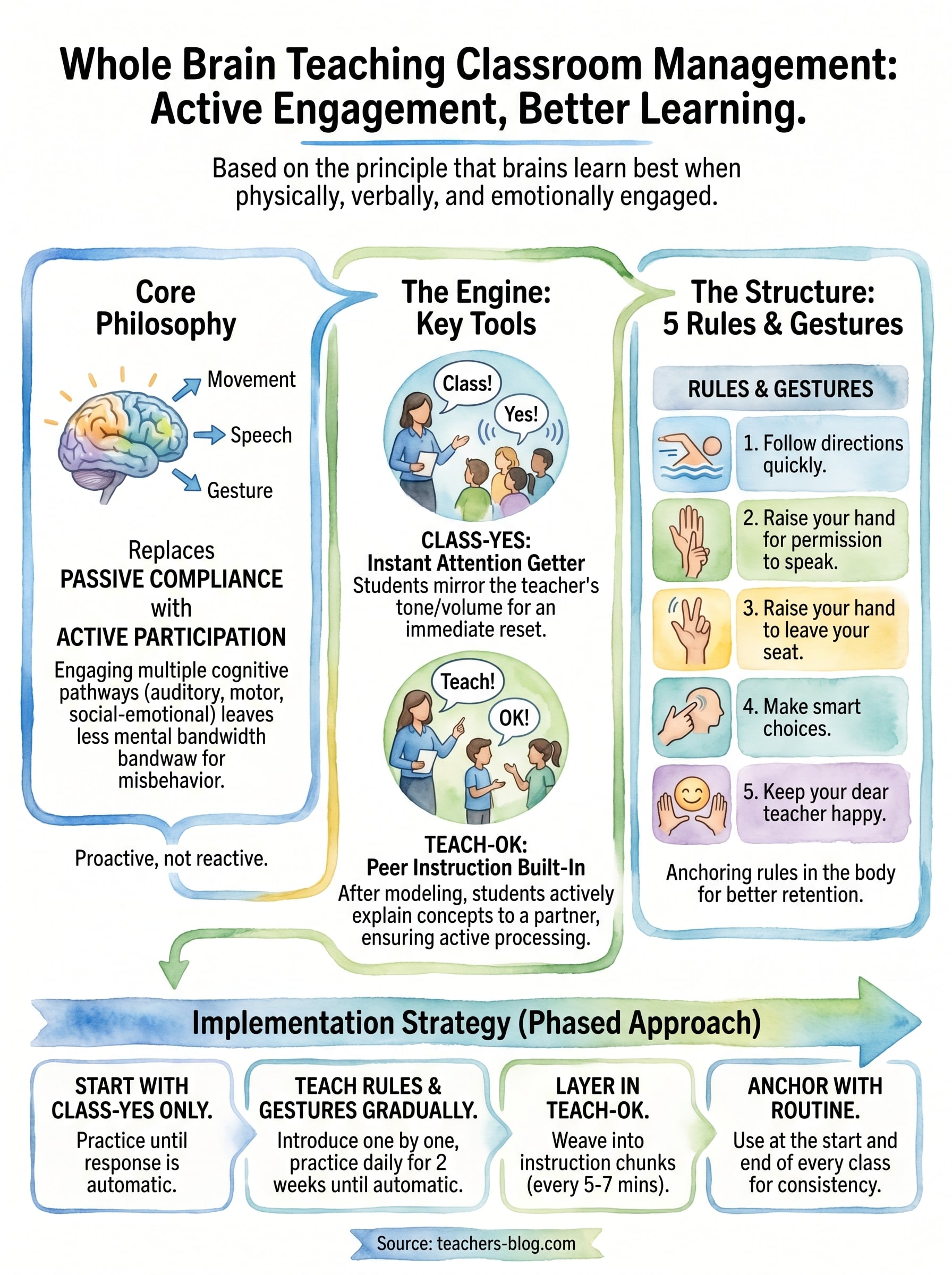
A simple way to start this week
Pick one tool and teach it tomorrow. Don’t try to roll out all five rules, Class-Yes, and Teach-OK in the same lesson. Start with Class-Yes only, practice it until the response feels automatic, then add the rules in the following days. That single decision removes most of the overwhelm that makes teachers abandon whole brain teaching classroom management before it has a chance to work.
By Friday, you’ll have a class that responds to your attention signal and knows at least the first two rules with their gestures. That foundation is enough to see a real shift in engagement. From there, you layer in Teach-OK and build the rest of the structure week by week.
If you want more practical strategies for managing and motivating your students, explore the full range of teaching resources at The Cautiously Optimistic Teacher and find what fits your classroom next.