
7 Critical Thinking Lesson Ideas That Work in Any Class Today
You already know your students need to think deeper. The problem isn’t awareness, it’s finding critical thinking lesson ideas that actually work without requiring a full curriculum overhaul or three hours of prep on a Sunday night. Most teachers want activities they can pick up and run with, regardless of subject area or grade level.
That’s exactly why we built The Cautiously Optimistic Teacher: to give educators practical, classroom-tested strategies that make a real difference. Critical thinking sits at the center of almost everything we care about here, from our AI-powered Question Generator to the discussion-based unit plans we’ve designed for literature classrooms. We’ve seen what works, and more importantly, what falls flat.
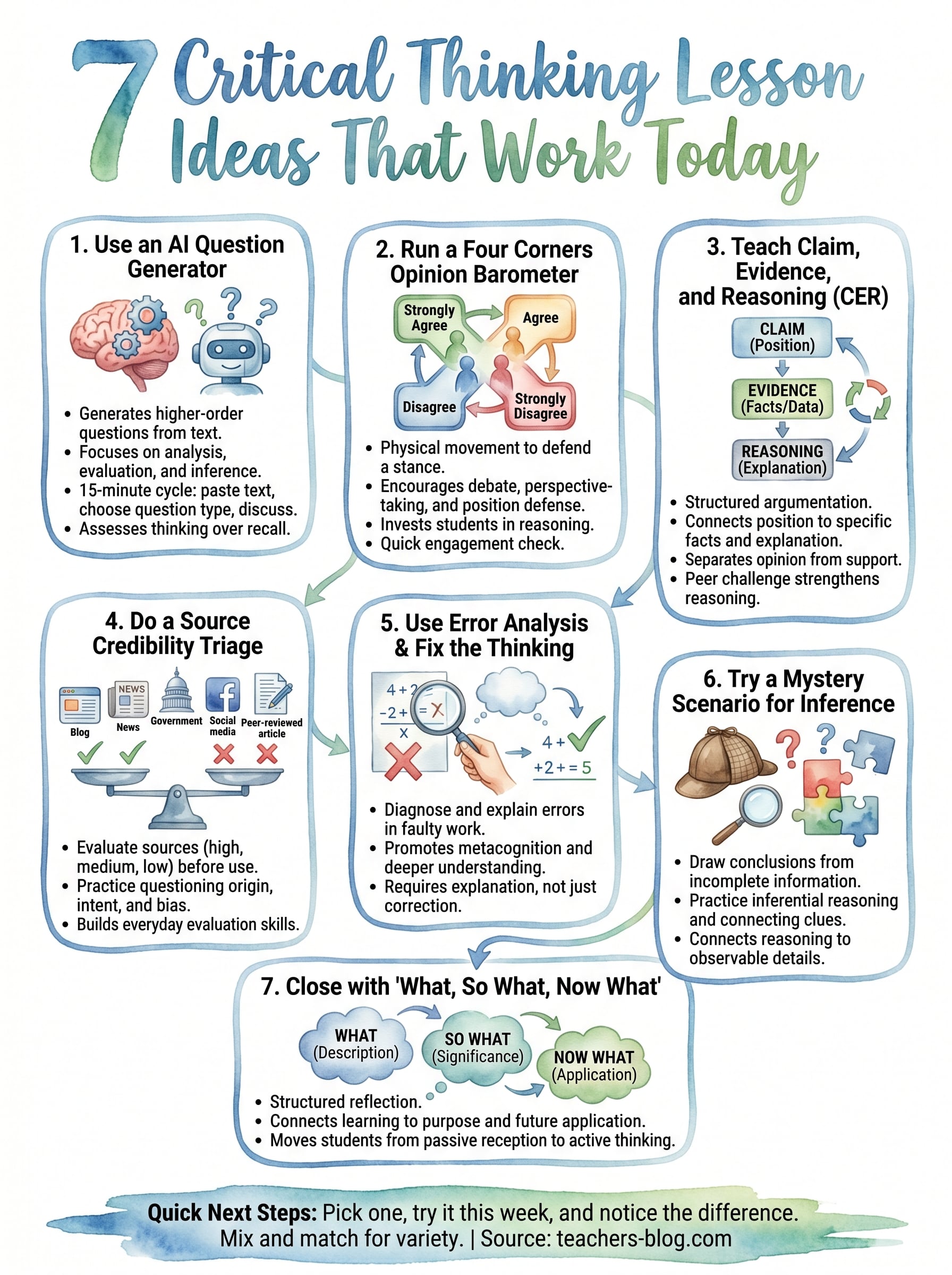
This article breaks down seven lesson ideas you can use across subjects, starting today. Each one targets a specific thinking skill, analysis, evaluation, reasoning, perspective-taking, and each one is flexible enough to adapt to your students. No filler activities. No abstract theory. Just approaches that push students to think harder and give you something concrete to bring to class this week.
1. Use an AI question generator
Among the most practical critical thinking lesson ideas available right now, using an AI question generator stands out because it removes the bottleneck of building discussion prompts from scratch. You paste in a text, a concept, or a passage, and the tool generates higher-order questions your students have to genuinely wrestle with, not just recall.
What students practice
Students practice analytical and evaluative thinking by responding to questions they haven’t seen before, which mirrors the kind of thinking they’ll need outside your classroom. Because the questions are generated from content they’re already studying, students can’t coast on a memorized answer. They have to interpret, connect, and defend their thinking in real time.
Unfamiliar questions force students to think, not just remember, and that difference is where real learning happens.
How to run it in 15 minutes
Start by selecting a short passage or concept from your current unit. Paste it into the AI Question Generator, then choose a question type (analysis, evaluation, or inference work especially well). Print or display three to five questions for students. Give them two minutes to pick one, three minutes to write a quick response, and then open it to discussion. The whole cycle runs in about 15 minutes flat, and you didn’t write a single question yourself.
How to adapt by grade level
For younger or struggling students, you can direct everyone to the same question and scaffold the response with a sentence frame like "I think… because the text says…" For advanced or older students, let them choose their question, defend their answer to a partner, and then challenge each other’s reasoning in a short back-and-forth. The same tool produces questions at different depths, so you can request simpler recall-style prompts or push toward synthesis depending on where your class is.
How to assess fast
You don’t need a rubric to get useful data here. Read responses quickly and sort them into three mental buckets: got it, almost there, needs a rethink. Use that informal read to decide who needs a follow-up question in tomorrow’s lesson and who’s ready to move forward. A quick exit ticket with one question and one sentence of reasoning gives you exactly what you need.
2. Run a four corners opinion barometer
Four corners is one of those critical thinking lesson ideas that looks deceptively simple but consistently generates the kind of genuine debate you want in your classroom. Label each corner of the room: Strongly Agree, Agree, Disagree, Strongly Disagree. Read a statement aloud, and students physically move to the corner that matches their position and then defend it.

What students practice
Students practice perspective-taking and position defense by committing to a visible stance and then explaining why they hold it. The physical act of moving raises the stakes slightly, meaning students are more invested in defending their reasoning than they’d be quietly filling out a worksheet.
Walking to a corner pushes students to own their thinking in a way a raised hand never does.
How to run it in 15 minutes
Pick three to four content-connected statements tied to your current unit. Read one aloud, give students 30 seconds to move, then call on two students from different corners to explain their position. Students can switch corners if someone makes a compelling argument, which keeps the whole room listening and thinking rather than tuning out.
How to adapt by grade level
With younger students, start with low-stakes opinion prompts before moving into content-based ones. With older or advanced students, require them to respond directly to a classmate’s point before speaking, which forces real engagement with competing ideas rather than just restating their own view.
How to assess fast
Watch who moves confidently and who hesitates during each round. A one-sentence written justification at the end of class tells you whether their verbal reasoning holds up on paper and quickly flags who needs more targeted support.
3. Teach claim, evidence, and reasoning with CER
CER (Claim, Evidence, Reasoning) is one of the most transferable critical thinking lesson ideas you can use across any subject. Students state a clear position, support it with specific evidence, and then explain exactly why that evidence connects to their claim. The structure forces students to slow down and link their thinking deliberately, rather than jumping to a conclusion.
What students practice
Students practice structured argumentation by separating their opinion from the evidence that supports it. Many students conflate opinion with fact, and CER makes that distinction visible in a concrete, repeatable way they can carry into any subject area.
How to run it in 15 minutes
Give students a short, debatable prompt connected to your current content. Ask them to write one sentence for each component:
- Claim: your position on the prompt
- Evidence: a specific fact, quote, or data point
- Reasoning: why the evidence supports the claim
Set a timer for five minutes, then pair students to challenge each other’s reasoning specifically. That final exchange is where the real thinking happens.
Targeting the reasoning step in peer review pushes students past surface-level responses faster than almost any other strategy.
How to adapt by grade level
With younger students, provide a sentence stem for each component so the structure feels manageable. With older students, require multiple pieces of evidence and ask them to address a counterargument within their reasoning section.
How to assess fast
Scan for weak reasoning first. A strong claim paired with solid evidence but a vague "this shows my point" explanation tells you exactly where to focus your next lesson.
4. Do a source credibility triage
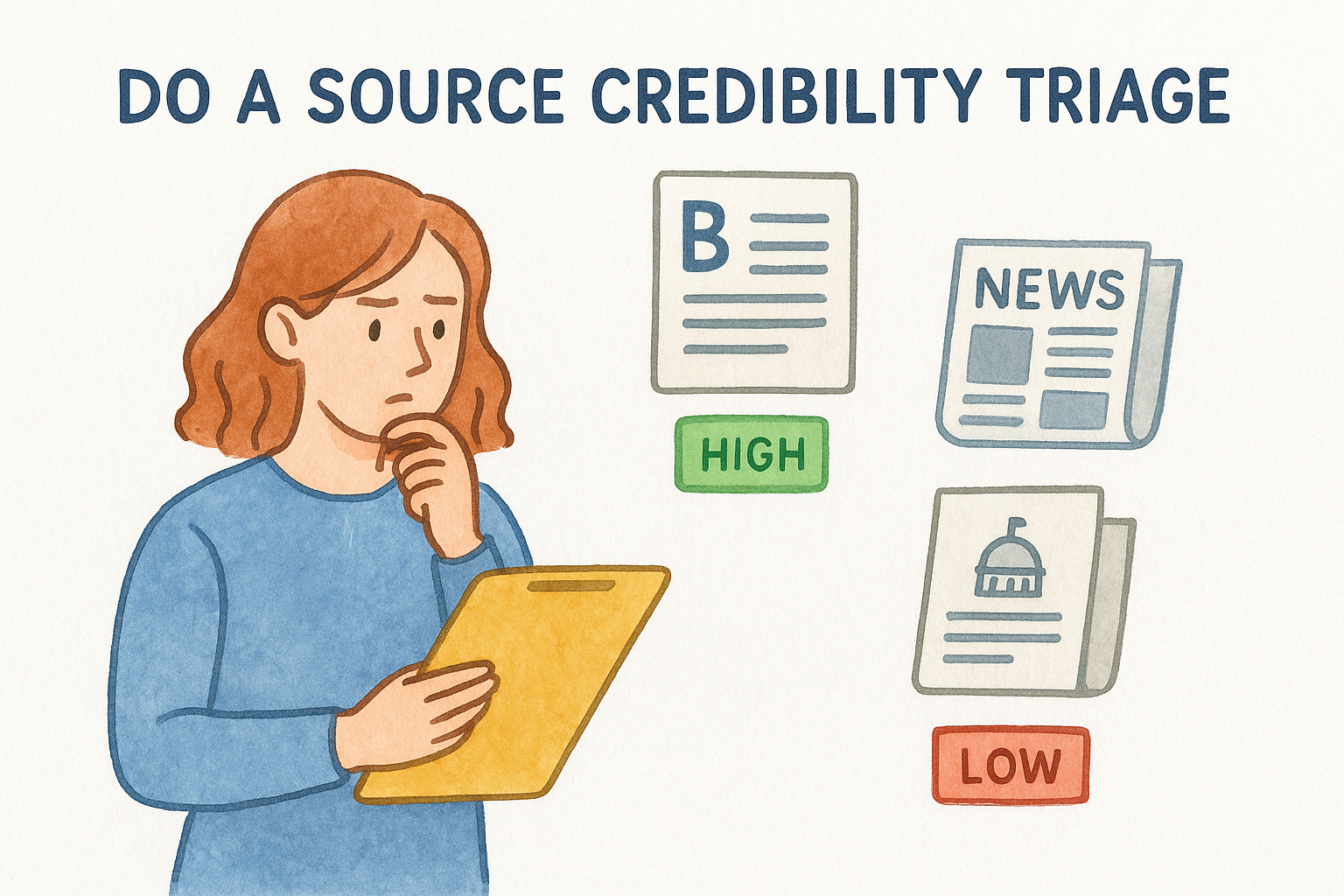
Source credibility triage is one of those critical thinking lesson ideas that transfers directly into students’ lives outside school. You give students a set of sources on the same topic, and they have to rank and justify which ones are trustworthy before they use them for anything else.
What students practice
Students practice evaluative reasoning by applying consistent criteria to judge information rather than accepting whatever they find first. This builds the habit of questioning the origin and intent of a source, which is a skill they will use every day, not just in your class.
Teaching students to vet a source before trusting it is one of the most practical skills you can develop in any classroom.
How to run it in 15 minutes
Pull three to five sources on a single topic: a blog post, a news article, a government page, a social media screenshot, and a peer-reviewed summary work well together. Ask students to rate each source on a simple scale of high, medium, or low credibility and write one sentence explaining why. The comparison between sources is where the thinking gets interesting.
How to adapt by grade level
With younger students, provide a short checklist covering author, date, and purpose to guide their evaluation. With older students, push them to identify potential bias and explain how that affects the source’s reliability.
How to assess fast
Collect the one-sentence justifications and scan for vague reasoning like "it looks official." That pattern tells you exactly who needs direct instruction on what credibility actually means.
5. Use error analysis and fix the thinking
Error analysis is one of the most underused critical thinking lesson ideas in any subject area. Instead of giving students correct models to copy, you give them flawed work and ask them to find what’s wrong, explain the mistake, and fix it. That inversion forces a level of reasoning that a standard assignment rarely demands.
What students practice
Students practice metacognitive thinking by diagnosing errors in someone else’s reasoning before they can correct it. Spotting a flaw requires understanding the concept well enough to recognize when it breaks down, which is a higher bar than simply producing a correct answer from scratch.
How to run it in 15 minutes
Pull a worked example with a deliberate mistake from your current unit, whether that’s a flawed math solution, a weak argument in an essay, or an incorrect scientific conclusion. Give students three minutes to identify the error, three minutes to write an explanation of why it’s wrong, and four minutes to produce a corrected version. Debrief as a class with a quick show of reasoning, not just the right answer.
The correction step matters less than the explanation, because explaining the error is where the thinking actually happens.
How to adapt by grade level
With younger students, limit the error to one obvious flaw. With older students, embed multiple subtle mistakes and ask them to prioritize which one most undermines the overall argument or solution.
How to assess fast
Collect the written explanations and look for vague responses like "it’s just wrong." Those students haven’t identified the actual reasoning failure yet and need a direct follow-up question to push them further.
6. Try a mystery scenario for inference
Mystery scenarios are one of the most engaging critical thinking lesson ideas you can run when you want students to practice inference. You give students a set of clues or partial information about a situation, and they have to piece together what happened, who was involved, or what comes next without being told directly.
What students practice
Students practice inferential reasoning by drawing conclusions from incomplete information. This mirrors real-world thinking, where full context is rarely available and people must reason from what they observe rather than what they’re told outright.
How to run it in 15 minutes
Choose a short scenario relevant to your content, whether it’s a historical event, a character’s motive, or a scientific phenomenon. Give students three to four clues on a handout, ask them to write their best-supported conclusion in two sentences, and then share out. The reveal at the end, where you show what actually happened, generates natural discussion about which clues mattered most.
The gap between what students infer and what actually happened is where the richest thinking conversations happen.
How to adapt by grade level
With younger students, provide four concrete clues and a sentence frame to structure their inference. With older students, introduce a misleading clue and ask them to explain why they accepted or rejected it when forming their conclusion.
How to assess fast
Collect the written conclusions and check whether students cited specific clues to support their inference. Vague conclusions that lack evidence tell you exactly who needs more direct instruction on connecting reasoning to observable details.
7. Close with what so what now what
"What, So What, Now What" is one of those critical thinking lesson ideas that works as a closing routine for any lesson in any subject. Students move through three structured prompts: describing what happened or what they learned (What), explaining why it matters (So What), and identifying what they’ll do with that knowledge (Now What). The sequence pushes students out of passive reception and into active reflection.
What students practice
Students practice reflective and evaluative thinking by connecting new information to a larger purpose. Moving from description to significance to application is a higher-order cognitive move that most students skip unless you build it into your routine.
How to run it in 15 minutes
Give students three minutes per prompt at the end of class. Write each question on the board, set a timer, and ask students to respond in writing before you open it to the group. The written step ensures every student thinks, not just the fastest hand-raisers.
The "Now What" prompt is where students stop being passive learners and start being active ones.
How to adapt by grade level
With younger students, keep the prompts literal and tied directly to the day’s lesson. With older students, push the "So What" further by asking them to connect the concept to a real-world situation or current event.
How to assess fast
Collect the written responses and scan the "Now What" answers specifically. Vague responses like "study more" signal that a student hasn’t made a meaningful connection yet and needs a targeted follow-up prompt before the next lesson.
Quick next steps
You don’t need to run all seven of these critical thinking lesson ideas in the same week. Pick one that fits your current unit, try it this week, and notice what your students do differently when they’re pushed to reason out loud. One well-run activity will tell you more about your students’ thinking than a month of passive note-taking.
From there, build a short rotation. Pair the AI Question Generator with CER for a writing-heavy week, or use Four Corners and Mystery Scenarios back-to-back when you want more discussion. Each activity targets a different thinking skill, so mixing them gives your students a fuller range of practice without overwhelming your planning time.
If you want more strategies, tools, and ready-to-use resources built specifically for educators, visit The Cautiously Optimistic Teacher and explore what’s there. Your students are ready to think harder. Give them the chance.