6 Formative Assessment Best Practices Teachers Use Daily
You gave a lesson, it seemed to land, and then the test scores came back sideways. Sound familiar? The gap between what students appear to understand and what they actually understand is where most instructional breakdowns happen. Formative assessment best practices close that gap, not at the end of a unit when it’s too late, but during the learning itself, when you can still do something about it.
Here at The Cautiously Optimistic Teacher, we build resources around one core belief: teaching gets better when feedback flows both ways. Formative assessment isn’t a separate task bolted onto your lesson plan. Done right, it’s woven into the fabric of instruction, a quick pulse check that tells you exactly where students are so you can adjust on the fly.
This article breaks down six practices that effective teachers rely on daily. These aren’t theoretical frameworks or conference buzzwords. They’re concrete, repeatable strategies you can put to work tomorrow morning, whether you’re checking for understanding in an 8th-grade essay unit or gauging readiness before a class discussion on Lord of the Flies. Each one is designed to give you actionable data without eating up your entire class period.
1. Use simple AI tools to create daily checks fast
One of the most underused formative assessment best practices right now is leveraging AI to build quick checks before your lesson even starts. ChatGPT, Gemini, and similar tools can generate exit tickets, short-answer prompts, and multiple-choice questions in seconds, cutting your prep time and freeing you to focus on what happens after you collect the data.
What this best practice means in real classrooms
This practice means you stop writing every single check from scratch and let the tool do the drafting. Instead, you give an AI tool your learning objective and a student level, and it returns several usable question options within seconds. A 10th-grade English teacher might paste in a paragraph from a class novel and ask for three inference questions at different difficulty levels. The questions come back ready to copy, paste, and use in a Google Form or on a whiteboard.
How to do it in under 10 minutes a day
Start with a single clear prompt: tell the AI your grade level, the skill you’re assessing, and the format you want, whether that’s an exit ticket, a whiteboard question, or a quick poll. Then ask for three to five questions and pick the best two. That whole process takes roughly three to five minutes. You can batch a week’s worth on Sunday evening or build it into your morning routine before first period to keep things consistent.
The faster you can build the check, the more consistently you’ll actually use it.
Smart ways to differentiate prompts without extra prep
Ask the AI to generate the same question at two or three reading levels or complexity tiers in one prompt. For example: "Give me the same exit ticket question for below-level, on-level, and above-level 8th graders reviewing main idea." You get three versions instantly, without writing anything twice. This approach works across ELA, math word problems, science explanations, and social studies sourcing tasks.
Mistakes to avoid when you use AI for formative checks
The biggest mistake is using the AI output without reading it first. AI tools sometimes miss the nuance of your specific unit or produce questions that are too broad to give you useful data. Always scan the output, adjust one or two words if needed, and confirm the question targets the exact skill you taught that day, not just a general topic area.
2. Clarify learning targets and success criteria up front
Students can’t hit a target they can’t see. Before you collect any formative data, you need to make sure your students know what they’re learning and what success looks like. This step sits at the core of formative assessment best practices because unclear targets turn your checks into guesswork for everyone in the room.
What to say so students actually understand the target
Paste your standard into a student-friendly sentence using plain language and a concrete verb. Instead of "analyze how an author develops theme," try "Explain how the author uses one specific detail to show the theme." Students should be able to repeat the target back to you in their own words, without prompting, before the lesson moves forward.
How to turn standards into student-friendly success criteria
Break the target into two or three observable steps students can check off as they work. If the skill is paragraph writing, your criteria might look like this:
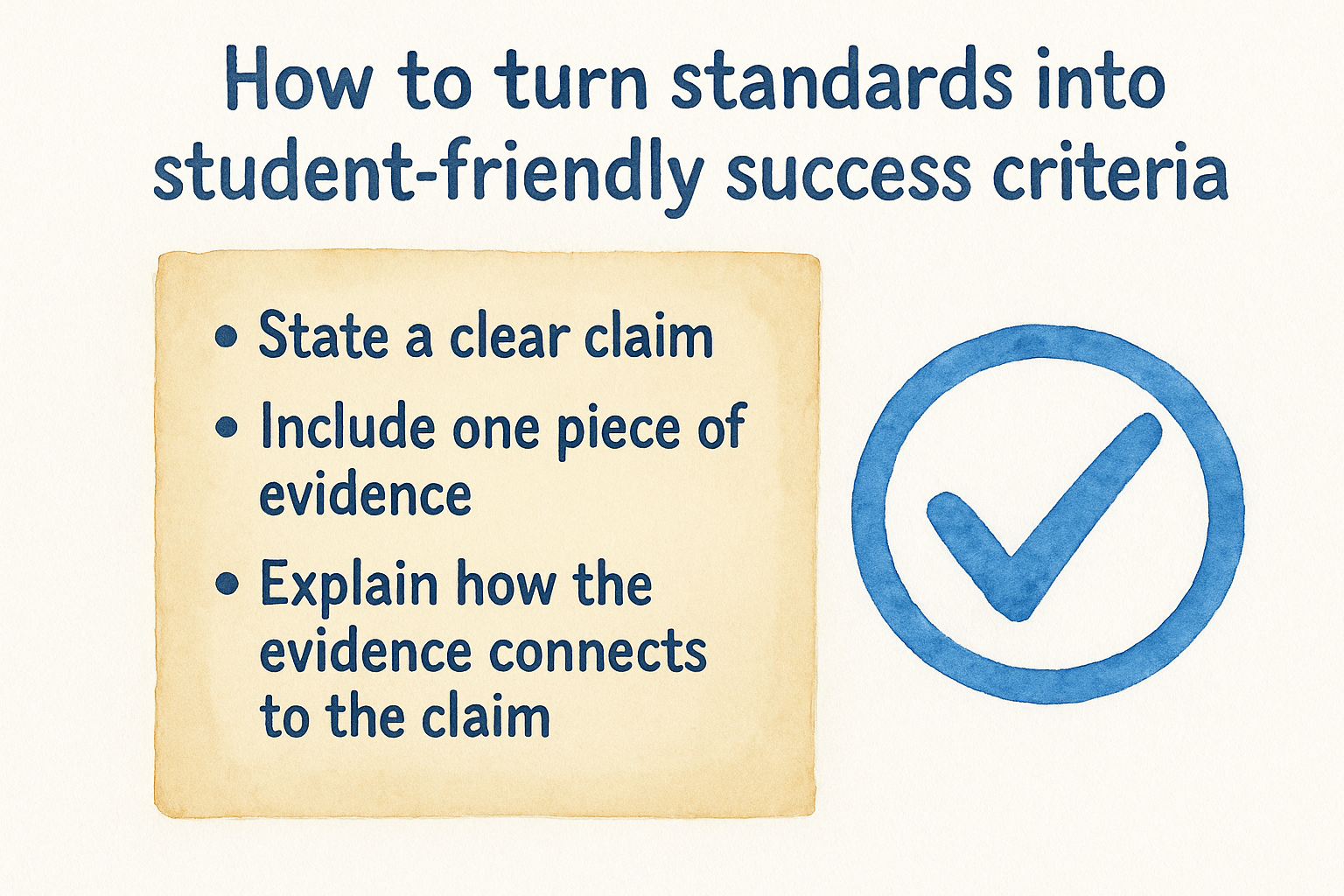
- State a clear claim
- Include one piece of evidence
- Explain how the evidence connects to the claim
Short, numbered or bulleted lists work better than paragraph-form descriptions here because students can self-monitor in real time.
Quick ways to model strong and weak examples
Show students one strong example and one weak example before they start. Ask them to identify what makes each one strong or weak using the criteria. This two-minute routine builds a shared vocabulary students can use during peer feedback and self-assessment later.
Criteria work best when students can use them independently, without asking you what comes next.
Mistakes to avoid that cause confusion or compliance work
Avoid posting targets only on the board and never referencing them again. Students treat them as decoration when they’re ignored mid-lesson. Return to the target at least twice per class, once mid-way and once during your closing check, so students connect their work to the actual goal.
3. Elicit evidence often with all-student responses
Calling on one raised hand doesn’t tell you what the other 28 students understand. True formative assessment best practices require you to pull evidence from every student at once, giving you a full classroom picture instead of a sample of two or three confident voices.
What counts as usable evidence of learning
Usable evidence is any student response that shows thinking, not just a yes or no. A simple thumbs up gives you nothing to work with. A written sentence, a labeled diagram, or a ranked choice with a brief reason gives you something you can sort and act on before the period ends.
Fast strategies that surface every student’s thinking
Whiteboards, index cards, and digital polls all work well here. Ask students to write one sentence and hold it up, respond in a shared Google Form, or place a sticky note on a class anchor chart. The key is that every student responds simultaneously, so no one coasts on a neighbor’s answer.
The moment you allow opt-outs, your evidence becomes incomplete and your adjustments become guesses.
Examples you can use tomorrow in ELA, math, science, and social studies
In ELA, ask students to write the theme in one sentence. In math, have them solve the first step of a problem and hold up their whiteboard. In science, ask them to draw and label a process. In social studies, give them two competing claims and ask them to choose one and write a single supporting reason.
Mistakes to avoid when checks turn into mini-tests
Avoid grading these responses or building any formal record around them. The moment students feel evaluated, they perform instead of respond honestly. Keep checks low-stakes and fast, and remind students the point is to help you teach better, not to assess their grade.
4. Use the evidence to adjust instruction the same day
Collecting evidence only matters if you act on it before students walk out your door. This is where formative assessment best practices either pay off or quietly fall apart. Most teachers collect the data but wait until tomorrow to respond, losing the instructional window when the learning is still fresh and adjustments actually stick.
A simple decision rule for what to do next
Look at your responses and ask one question: did most students get it, some students get it, or almost no one get it? That’s your fork in the road. If most got it, move forward and flag the few who didn’t for a quick side conversation. If the class split roughly in half, regroup. If almost no one got it, reteach the whole group before moving on.
How to sort responses quickly without overtracking data
Sort responses into three piles: got it, almost there, and not yet. You don’t need a spreadsheet. A quick visual scan of whiteboard responses or a Google Form summary gives you enough to make a decision in under two minutes.
Fast sorting is more useful than detailed tracking when your goal is same-day instruction.
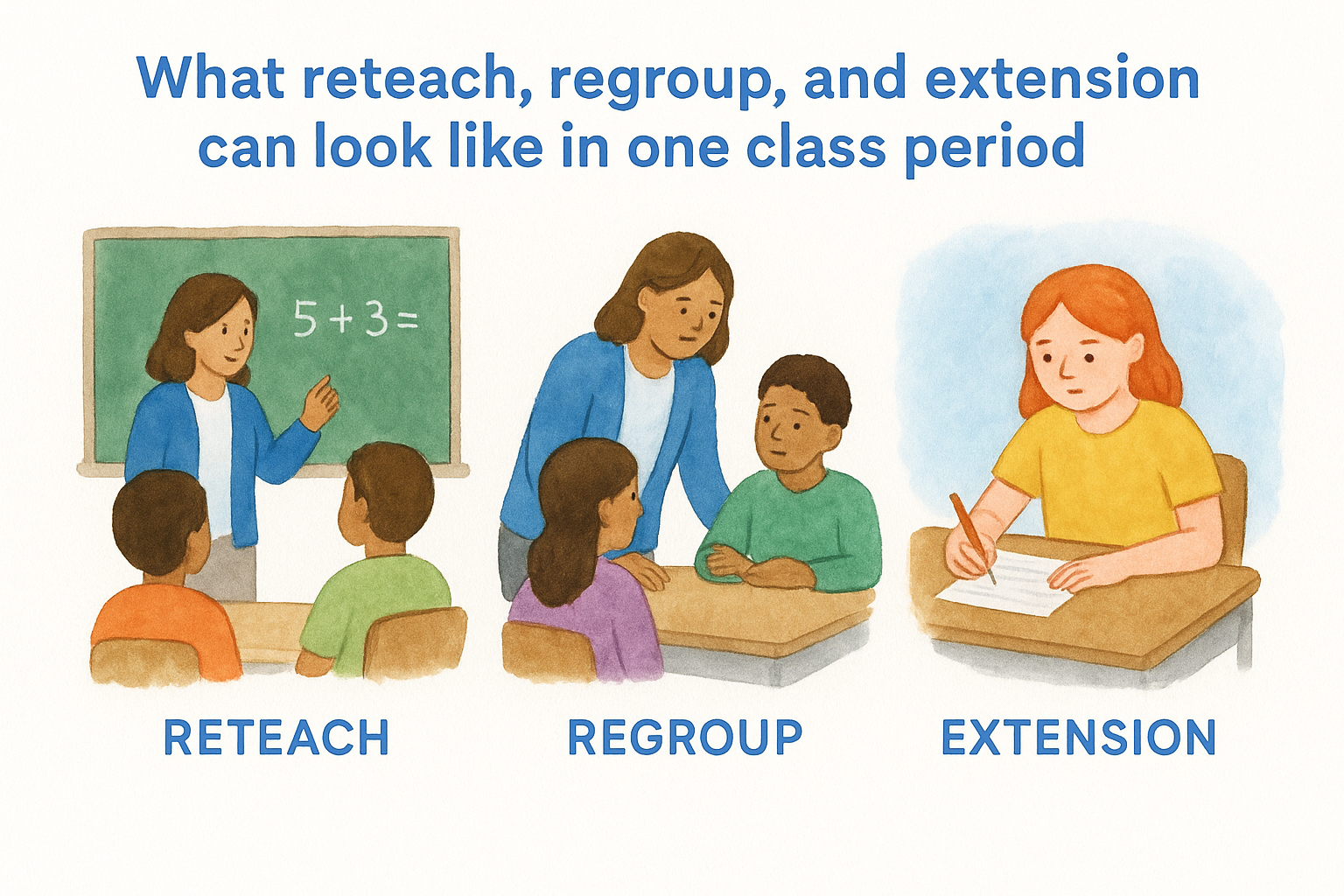
What reteach, regroup, and extension can look like in one class period
Reteach means pausing the class and trying a different explanation or example. Regroup means pulling a small group aside while others extend their thinking independently. Extension doesn’t require a new task; asking students to apply the same skill to a new example works well without any extra prep.
Mistakes to avoid that waste time or miss the real misconception
Avoid responding to surface errors when the real problem is conceptual. If students got the format wrong, that’s a quick fix. If students misunderstood the core idea, address that directly before you move anything else forward.
5. Build peer feedback and student self-assessment into routines
When peer feedback and self-assessment become part of your regular classroom structure, students stop waiting for you to tell them how they’re doing. This is one of the formative assessment best practices that compounds over time because it trains students to monitor and improve their own learning process.
How to teach students to give feedback that helps
Start by modeling what specific, criteria-based feedback sounds like before students ever assess a peer’s work. Show a sample response and walk through exactly how to apply the success criteria you set up earlier in the lesson, pointing out what qualifies as helpful versus vague.
Practice this with the whole class first. Students need repeated exposure to the process before they can do it independently with a partner.
Quick self-assessment routines that build ownership
A traffic light self-check works well here: students mark their work green (got it), yellow (almost there), or red (need help) before you collect anything. This quick habit gives you a fast read on confidence levels and teaches students to name where they actually are.
The more often students self-assess, the more accurately they learn to identify what they need next.
Prompts and sentence stems that improve reflection quality
Give students a structured sentence stem to anchor their reflection, such as "I understood… but I still need help with…" Without a prompt, open-ended reflection produces answers that neither you nor your students can act on.
Mistakes to avoid that make peer feedback vague or unsafe
Avoid letting students give feedback without the success criteria visible and in hand. Without a shared reference point, feedback drifts toward personal opinions, which undermines trust and derails the learning conversation entirely.
Keep it simple and keep it moving
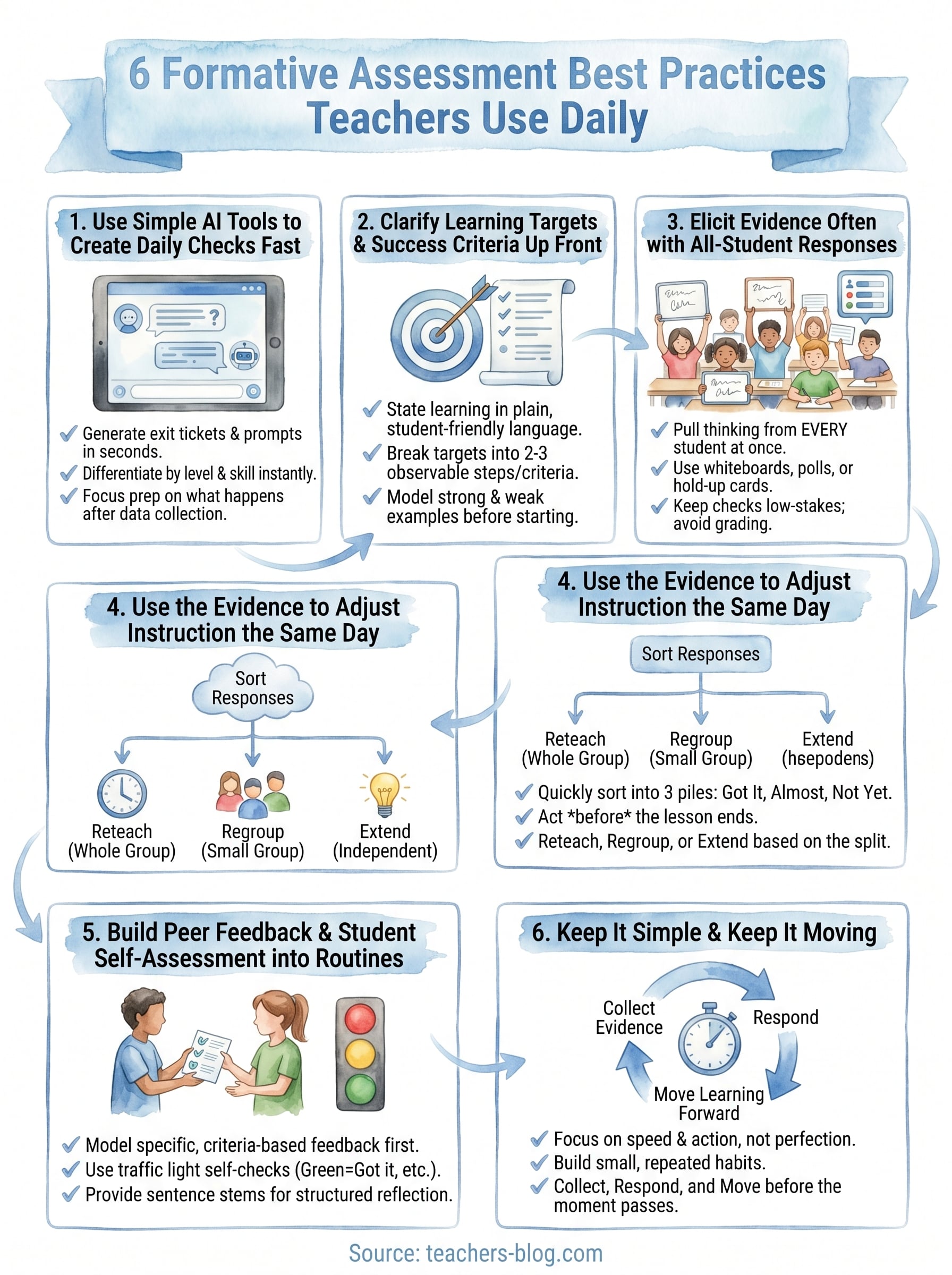
These six formative assessment best practices work because they’re built around speed and action, not perfection and paperwork. You don’t need to implement all six at once. Pick one practice that fits your current routine, run it consistently for two weeks, and then layer in another. Small, repeated habits produce better data and stronger student outcomes than elaborate systems you abandon by October.
The goal stays the same every day: collect evidence, respond to it, and move learning forward before the moment passes. When students see you adjust your teaching based on what they show you, trust builds. That trust makes every subsequent check more honest and more useful.
If you want more practical strategies, classroom tools, and teacher-tested resources to support your work, head over to The Cautiously Optimistic Teacher and explore what’s there for you.