
What Is Subject Specific Pedagogy? Examples by Subject
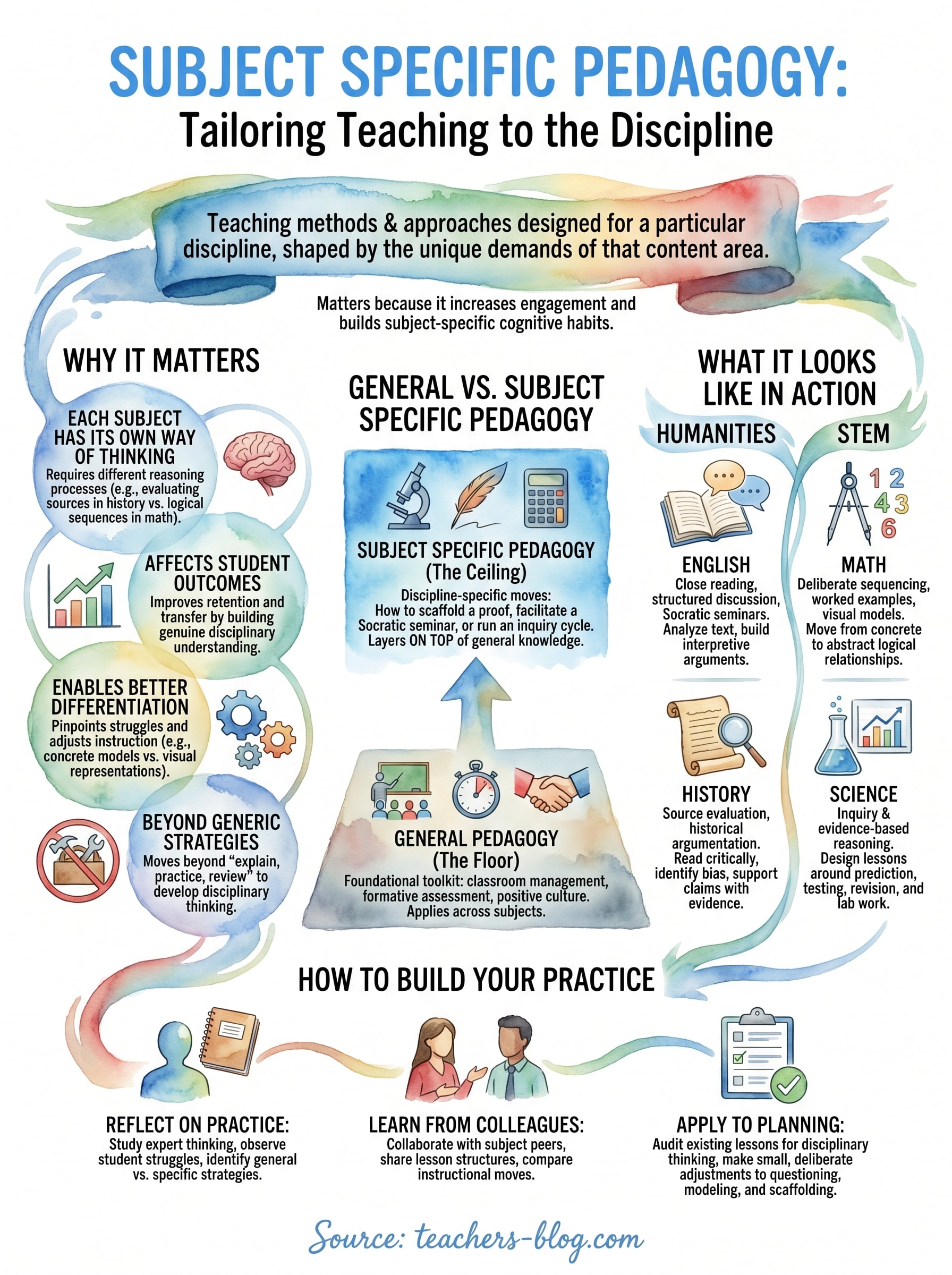
You already know that teaching math looks nothing like teaching English. The strategies you rely on, the way students interact with material, the types of thinking you’re trying to develop, it all shifts depending on the subject. That difference has a name: subject specific pedagogy. It refers to the teaching methods and approaches designed for a particular discipline, shaped by the unique demands of that content area.
This matters because a brilliant classroom strategy in one subject can fall completely flat in another. Understanding why, and knowing what works where, makes you a sharper, more intentional teacher. It’s exactly the kind of practical, subject-level thinking we build resources around here at The Cautiously Optimistic Teacher, from our differentiated literature unit plans to our AI-powered tools that help you tailor instruction.
In this article, you’ll get a clear definition of subject specific pedagogy, see how it differs from general pedagogy and pure content knowledge, and walk through concrete examples across multiple subjects. Whether you’re refining your own practice or preparing for a teaching interview, this breakdown will give you something useful to work with.
Why subject-specific pedagogy matters
Teachers often focus heavily on what they teach, but how you teach it is equally critical. When you understand what is subject specific pedagogy and apply it deliberately, student engagement increases because the instruction actually matches how that discipline works. A student learning to analyze a poem needs different scaffolding than a student solving a quadratic equation, and treating both the same way produces weaker results in both cases.
Your subject shapes not just the content students learn, but the cognitive habits they build through it.
Each subject has its own way of thinking
Every discipline operates on a different kind of reasoning. In history, students learn to evaluate sources, weigh evidence, and build arguments around contested interpretations. In science, they form hypotheses and revise thinking based on data. In math, they work through logical sequences and abstract relationships. These are not the same mental processes, and your teaching strategies need to reflect that difference.
Relying on a generic "explain, practice, review" loop across every subject misses the specific moves that actually develop disciplinary thinking. Subject-specific pedagogy gives you a framework for making those distinctions intentional instead of accidental, so your instruction does more than cover content.
It affects student outcomes directly
Research consistently shows that teachers with strong subject-specific pedagogical knowledge produce better learning outcomes. Students are not just absorbing facts; they are learning how to think like a mathematician, a writer, or a scientist. When your instruction aligns with those thinking patterns, retention and transfer improve because students build genuine understanding rather than memorize procedures.
This also pays off in differentiation. When you know the specific demands of your subject, you can pinpoint exactly where a student is struggling and adjust accordingly, whether that means offering more concrete models in English class or providing visual representations in geometry.
Subject-specific pedagogy vs general pedagogy
General pedagogy covers the broad principles that apply across all subjects: classroom management, formative assessment, and questioning techniques. These are valuable, and every teacher needs them. But they don’t tell you how to teach a primary source analysis or how to scaffold a geometric proof. That gap is exactly where subject-specific pedagogy lives.
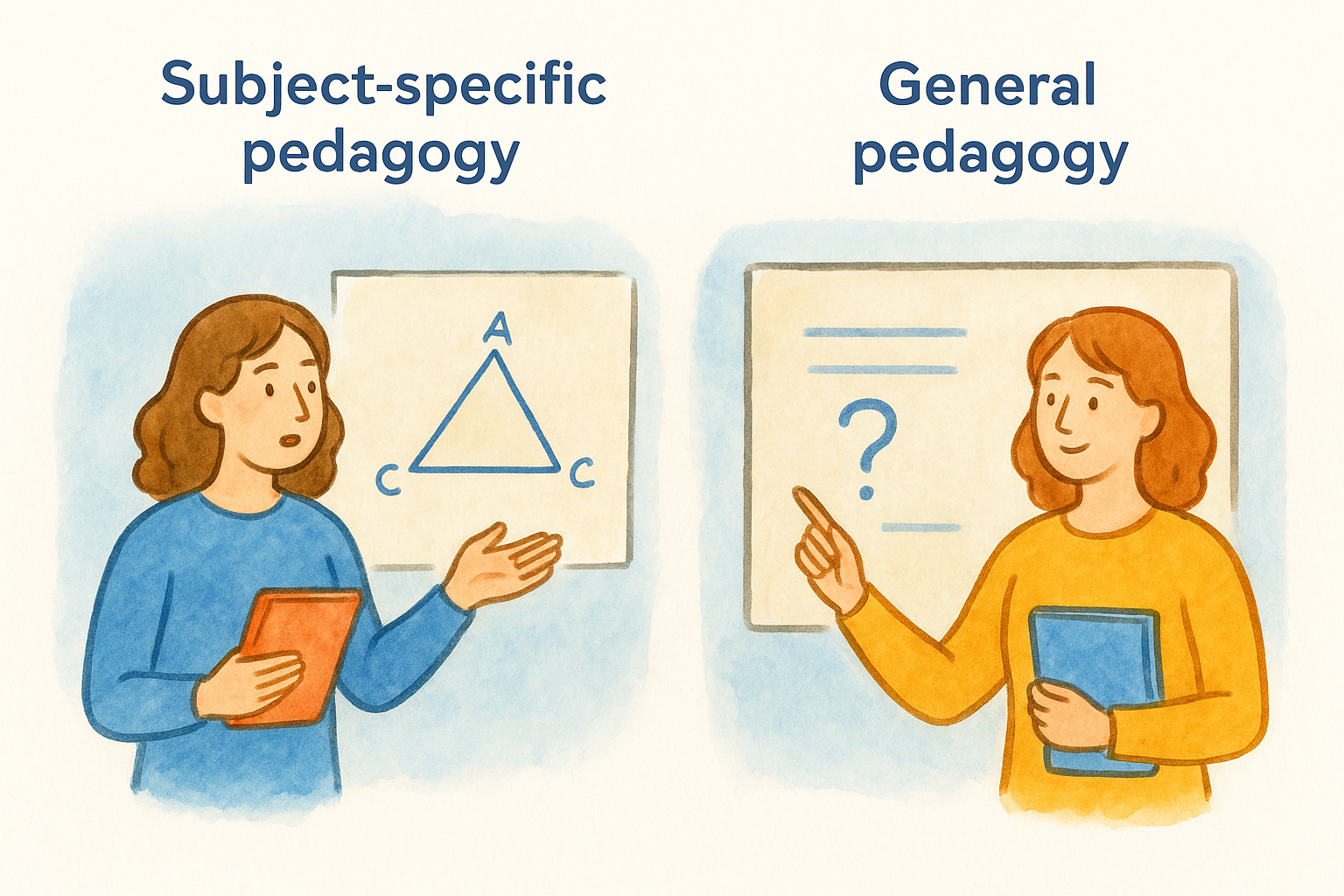
What general pedagogy covers
General pedagogy gives you the foundational toolkit: how to structure a lesson, how to check for understanding, and how to build a positive classroom culture. Think of it as the shared language of teaching.
General pedagogy is the floor, not the ceiling, of effective teaching.
These principles transfer across every subject on your timetable. They matter, but they stop short of telling you what disciplinary thinking looks like or how to develop it in your students.
Where subject-specific pedagogy takes over
Understanding what is subject specific pedagogy means recognizing it layers on top of general knowledge. It asks a targeted question: what does good instruction look like for this specific discipline? A science teacher runs inquiry cycles; an English teacher facilitates Socratic seminars.
These are discipline-specific moves that general pedagogy simply doesn’t address. Your content area demands its own instructional logic, and knowing that logic is what separates competent teaching from truly expert teaching.
What it looks like in different subjects
Understanding what is subject specific pedagogy is much easier when you see it in action across real classrooms. Teaching methods look dramatically different depending on the discipline, and those differences reflect the unique thinking demands of each subject area.
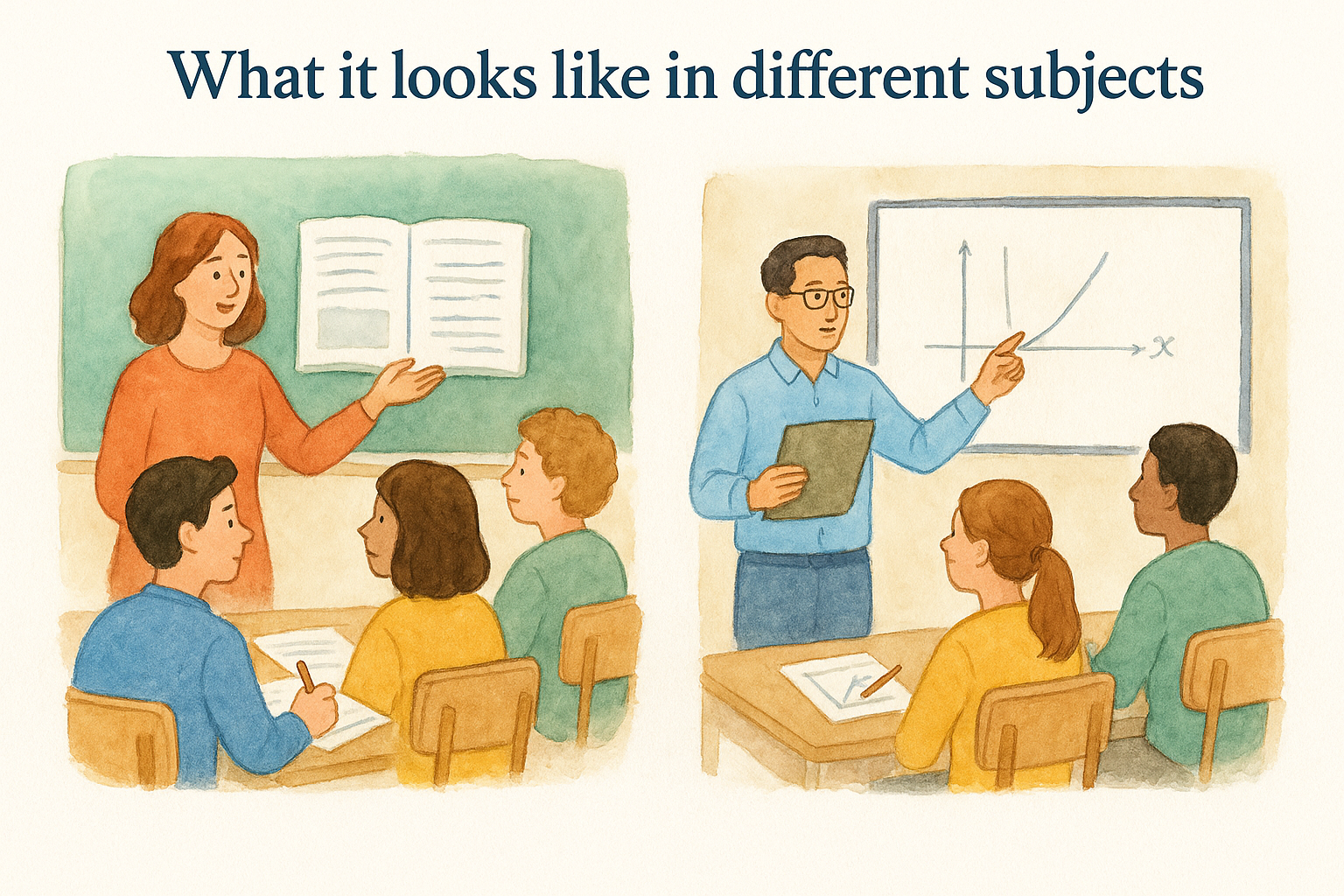
Humanities subjects
In English, close reading and structured discussion anchor effective instruction. You push students to analyze text, build interpretive arguments, and engage in dialogue that doesn’t have a single correct answer. Annotation activities and Socratic seminars develop the kind of disciplinary thinking the subject actually requires.
History shifts that focus toward source evaluation and historical argumentation. You teach students to read primary sources critically, identify bias and context, and support claims using evidence from competing viewpoints rather than simply recalling facts.
When students learn to argue from evidence in history, they are building a skill that transfers far beyond the classroom.
STEM subjects
Math instruction depends on deliberate sequencing and worked examples. You move students from concrete representations to abstract notation gradually, making sure the logic is visible before they work independently. Visual models bridge the gap between what students can see and what they need to understand symbolically.
Science centers on inquiry and evidence-based reasoning. You design lessons around prediction, testing, and revision. Lab work and data collection are not extras in this discipline; they serve as the primary vehicle for building scientific understanding.
How to build your subject-specific pedagogy
Building your subject-specific pedagogy starts with studying how experts in your discipline actually think, then designing instruction that develops those same habits in students. Understanding what is subject specific pedagogy means recognizing you are teaching a way of reasoning, not just a set of facts.
The clearest path to stronger subject-specific pedagogy is watching how your students work through discipline-specific problems, then adjusting your instruction around those patterns.
Reflect on your current practice
Observation and honest reflection are your most practical starting points. Record yourself teaching and identify moments where your instruction doesn’t match the cognitive demands of your subject. Three reflection prompts that help:
- What types of thinking does your subject actually require?
- Where do students consistently struggle with disciplinary reasoning?
- Which strategies come from general pedagogy rather than your specific content area?
Learn from your colleagues
Collaborative planning with other teachers in your subject area accelerates your development faster than working alone. Sit in on a colleague’s class, share lesson structures, and compare the instructional moves you each make to develop disciplinary thinking.
Over time, those professional conversations sharpen your decisions in ways that solo planning rarely matches. You build a clearer picture of what effective discipline-specific instruction actually looks like by seeing it through multiple lenses.
Quick answers to common questions
A few common questions come up repeatedly when teachers explore what is subject specific pedagogy. The short answers below address the most frequently misunderstood points directly.
Is subject-specific pedagogy the same as pedagogical content knowledge?
These two terms are closely related but not identical. Pedagogical content knowledge (PCK), a concept developed by education researcher Lee Shulman, refers to the blend of subject knowledge and teaching knowledge that lets you make content accessible to students.
Subject-specific pedagogy draws heavily from PCK but focuses more specifically on the discipline-level instructional moves you make in the classroom.
Can you apply subject-specific pedagogy across multiple subjects?
If you teach more than one subject, you need to shift your pedagogical approach for each one rather than carrying the same strategies across all of them. The core habits of good teaching transfer, but the discipline-specific moves do not.
Your reflection process stays the same, but your instructional decisions need to match the reasoning demands of each subject area separately. A strategy that works well in English class may actively undermine the logical sequencing that math instruction requires. Treating each subject as its own instructional context is what separates effective multi-subject teaching from a one-size-fits-all approach.
Next steps
Now that you understand what is subject specific pedagogy, the practical move is to apply that understanding directly to your lesson planning. Pick one unit you’re currently teaching, identify the specific disciplinary thinking it requires, and audit your existing lessons against that standard. Look for places where your instruction relies on generic strategies when a subject-specific approach would serve students better.
From there, build out your practice incrementally. Small adjustments to your questioning, your modeling, and your scaffolding add up quickly when they consistently reflect the cognitive demands of your discipline. You don’t need to overhaul everything at once; just start making more deliberate, subject-aware decisions each time you plan a lesson.
If you want practical tools and strategies to sharpen your instruction further, visit The Cautiously Optimistic Teacher for AI-powered tools and subject-specific resources designed to help you differentiate and plan smarter across every subject you teach.