What Do Teachers Use to Check for AI? Tools & Methods
A student turns in an essay that reads nothing like their last five assignments. Suddenly you’re staring at the screen wondering if you’re being paranoid or if you actually caught something. If you’ve searched what do teachers use to check for AI, you already know the guessing game gets old fast, and you want real answers, not vague reassurances.
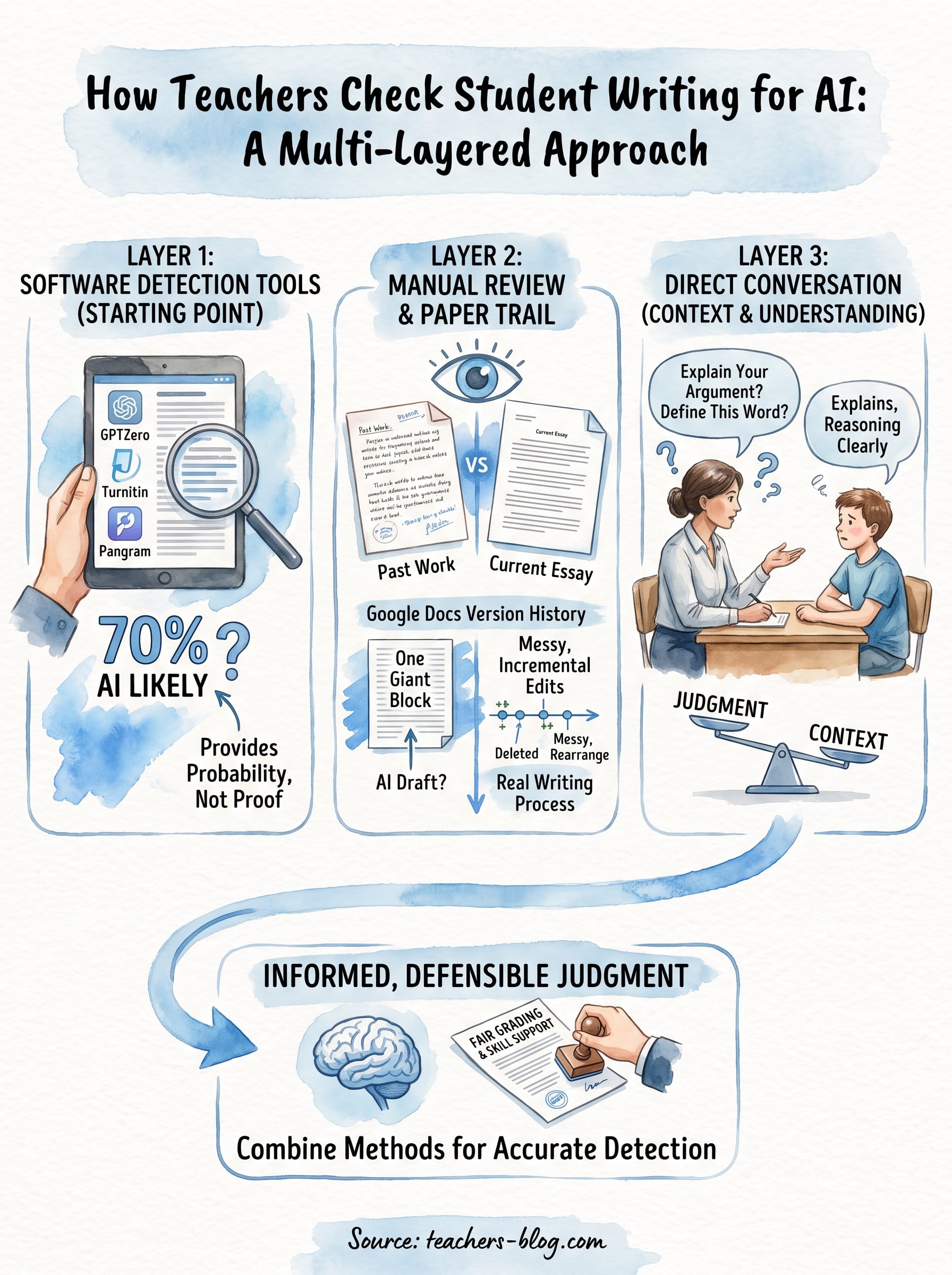
Here’s the direct answer: teachers rely on a mix of dedicated software and old-fashioned judgment. AI detection tools like GPTZero, Turnitin, and Pangram scan writing for patterns typical of language models, while plenty of educators still lean on manual review methods such as comparing tone against past work, checking edit history in Google Docs, or asking students to explain their own reasoning out loud.
This article walks through the specific tools teachers actually use, how each one works, where they fall short, and what a solid detection process looks like when you combine software with your own classroom instincts. If you’re building a fair, defensible approach to catching AI-generated work, you’ll find the practical breakdown here.
Why teachers need to check for AI in student work
Grading fairly gets impossible the moment you can’t trust that the words in front of you belong to the student who submitted them. When one kid spends three hours wrestling with a thesis statement and another pastes a prompt into a chatbot, you’re not measuring the same skill anymore, and every grade you hand out after that starts to feel shaky. Academic integrity isn’t an abstract value here, it’s the thing that keeps your grading book meaningful.
Skill gaps hide behind polished paragraphs
Beyond fairness, there’s a real learning problem. A student who leans on AI to write every essay never practices building an argument, organizing evidence, or revising a clunky sentence into a clear one, which is exactly why targeted feedback on student writing matters so much. Those are skills they’ll need on standardized tests, in college, and honestly in any job that requires written communication. If you don’t catch the pattern early, you end up with a student who can produce a flawless five-paragraph essay but can’t outline one from scratch under exam conditions.
If you can’t tell who did the thinking, you can’t teach the thinking.
Policies only work if you can enforce them
Most schools now have some kind of AI use policy, whether that’s an outright ban on chatbots for graded work or a tiered system that allows AI for brainstorming but not drafting, and the policy usually sits alongside some effort at teaching students when AI use is acceptable. Either way, a policy without enforcement is just a suggestion. Knowing what do teachers use for AI detection matters because it’s the difference between a policy that shapes behavior and one that students quietly ignore.
The stakes go beyond one assignment
A few concrete reasons this matters day to day:
- Grade accuracy: undetected AI use inflates scores for work the student didn’t actually produce.
- Skill tracking: you lose the ability to spot who’s struggling with writing and who needs more support.
- Trust with families: parents expect grades to reflect their kid’s actual effort and ability.
- Consistency across classes: if only some teachers check for AI, students learn which classrooms let them cut corners.
We’ve written more about the specific patterns that show up in machine-generated text in our piece on how to tackle AI plagiarism in your classroom, which is worth a read if you want the fuller picture before diving into tools and methods.
How teachers check student writing for AI
Most teachers don’t rely on one method alone. Instead, they layer software checks with the kind of detective work that comes from knowing their students’ writing habits. Combining a few approaches catches more than any single tool ever could, and it gives you evidence you can actually defend if a parent or administrator pushes back.
Running the text through detection software
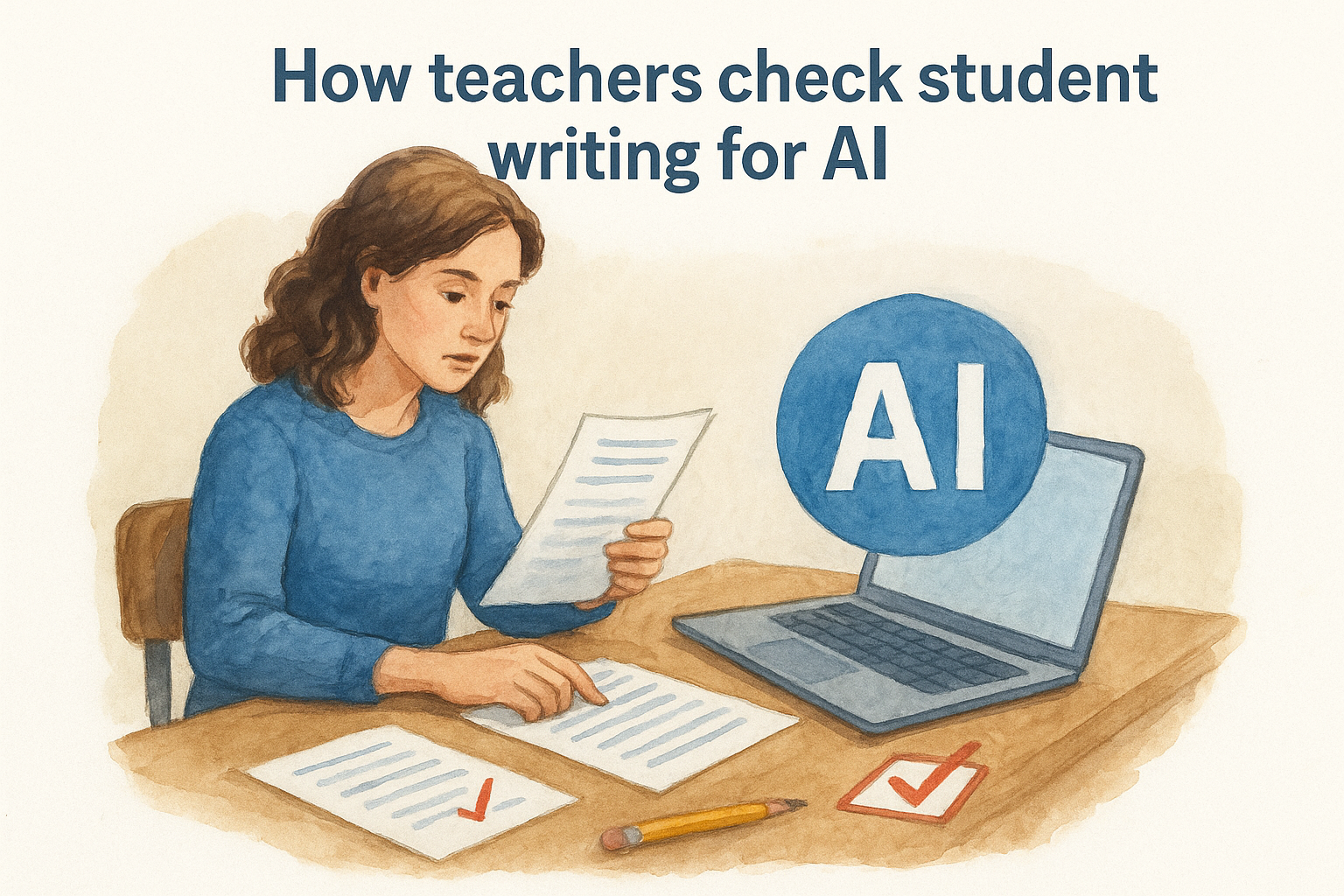
The first step for many teachers is pasting the essay into an AI checker for teachers. These programs analyze word choice, sentence rhythm, and predictability, then spit out a percentage estimating how likely the text is machine-generated. It’s fast and gives you a starting point, but treat the score as a lead worth investigating, not a verdict.
Checking the paper trail
Google Docs and similar platforms keep a version history that shows exactly how a document was built. A student who wrote the essay themselves usually shows messy, incremental edits: sentences added, deleted, rearranged over multiple sessions. A pasted AI draft often appears as one giant block of text dropped in at once. That single difference tells you more than most detection scores.
Comparing against past work
Teachers who’ve read a student’s writing all year develop an ear for their voice. When vocabulary, sentence length, or argument structure suddenly jumps several levels, that shift is worth noting even before you run any software.
Talking to the student directly
Finally, a short conversation settles a lot of doubt. Ask the student to explain a specific claim, define a word they used, or walk through their outline, the same teacher assessment strategies you’d use for any quick verbal check. A student who wrote the piece can usually answer without hesitation. One who didn’t often stumbles, and that gap tells you what a detector alone can’t.
Popular AI detection tools teachers rely on
Schools rarely leave detection up to one product. Most departments settle on a primary AI detection tool and keep a backup in mind for cases where the first one gives a murky result. GPTZero, Turnitin’s AI writing indicator, and Pangram show up most often in staff rooms, and each one approaches the problem a little differently.
The big three and how they differ
GPTZero built its reputation on analyzing "perplexity" and "burstiness," fancy terms for how predictable word choices are and how much sentence length varies. Turnitin folds AI detection into the same plagiarism-checking dashboard many schools already pay for, which makes it convenient if your district has a license. Pangram markets itself on lower false-positive rates, a detail that matters a lot once you’ve accidentally flagged an honest student’s paper.
| Tool | Where it’s built in | Known for |
|---|---|---|
| GPTZero | Standalone site or LMS plugin | Sentence-level perplexity scoring |
| Turnitin | Bundled with plagiarism checks | District-wide familiarity |
| Pangram | Standalone site | Lower false-positive claims |
Why the score is a starting point, not a verdict
None of these tools hands you certainty. They hand you a probability, and probabilities need context you supply yourself.
A detection score tells you where to look closer, not what grade to give.
Schools that use these tools well treat the percentage as one data point among several, not the final word. Understanding what do teachers use for AI detection matters less than understanding how to read what those tools actually produce, because a 70% score paired with messy edit history means something very different from a 70% score on a document pasted in as one clean block.
Signs of AI writing that don’t need a tool
Sometimes you don’t need software at all. Years of reading student essays train your eye to catch patterns that scream "machine-written" long before you paste anything into a checker. Learning these telltale signs means you can flag a suspicious paper in the time it takes to read the first paragraph.
The vocabulary doesn’t match the student
Watch for words a fourteen-year-old rarely uses in casual writing: "delve," "multifaceted," "underscore," "tapestry." AI models lean on a predictable set of formal transitions and adjectives, and when that vocabulary shows up in a student who usually writes in plain, direct sentences, something’s off.
Structure that’s too balanced
AI-generated essays often have suspiciously even paragraphs, each one hitting the same length, each one opening with a topic sentence and closing with a tidy summary. Real student writing is lumpier. Some paragraphs run long because the student got excited about a point; others trail off because they ran out of things to say.
Perfectly even paragraphs are rarely a sign of a strong writer. They’re usually a sign of a pattern generator.
Generic examples and vague claims
Look for essays that cite "studies show" without naming a single study, or that use examples so broad they could apply to any topic. Students writing from their own knowledge usually reach for specific, sometimes messy details: a book they actually read, an event they remember, a mistake they made.
A quick checklist worth keeping nearby
- Vocabulary that jumps several grade levels overnight
- Uniform paragraph length and rhythm
- Vague citations or unnamed "experts"
- Missing personal voice, quirks, or humor
- Transitions that feel templated ("In conclusion," "Moreover," "It is important to note")
These patterns won’t hold up as proof on their own, but they tell you exactly when it’s worth running a paper through a detector or opening the edit history.
What AI detectors can’t tell you
Detectors give you a percentage, not a verdict, and treating that number as proof puts you on shaky ground. False positives happen more often than most schools admit, especially with students who write in short, plain sentences or who learned English as a second language. Their writing often scores as "predictable" simply because it lacks the stylistic flourishes a detector expects from a fluent native speaker, which means you could be flagging your most careful, rule-following students for the crime of writing simply.
Editing can erase the evidence
Even when a student did start with an AI draft, a few rounds of paraphrasing or manual editing can knock a detection score down to nearly nothing. Students figure this out fast, and once they learn that light rewriting fools the software, the tool stops being useful on its own. That’s why manual review still matters even after you’ve run a paper through a checker.
A percentage score can tell you something looks off. It can never tell you why.
No detector proves intent
Guilt requires context a machine doesn’t have. A detector can’t distinguish between a student who fed an entire essay prompt into a chatbot and one who used AI to check grammar on a paragraph they wrote themselves, a distinction most school policies actually treat very differently. Only a conversation with the student, a look at their draft history, or a comparison against their earlier work fills that gap.
What this means for your process
Questions worth asking before you act on any score:
- Does the edit history match a real writing process?
- Does the student’s spoken explanation match their written argument, judged with the same checks for understanding strategies you use mid-lesson?
- Is this student’s writing style usually this formal?
None of these questions have a software answer. They need you.
Keeping academic integrity in an AI classroom
No single tool settles the question of what do teachers use to check for AI, and that’s the real takeaway here. Detection software like GPTZero, Turnitin, and Pangram gives you a starting signal, edit history gives you a paper trail, and a five-minute conversation gives you the context a percentage score never will. The teachers who catch AI misuse reliably aren’t the ones with the fanciest subscription. They’re the ones who layer methods and trust their own read on a student’s voice.
Building that kind of process takes time, and you don’t have to figure it out from scratch. If you want more classroom-tested strategies for spotting AI writing, teaching original thinking, and keeping your grading fair, browse the best educational resources for teachers for practical tools you can use this week.