5 UDL Strategies In The Classroom Teachers Can Use Today
Universal Design for Learning sounds great in theory, give every student multiple ways to engage, learn, and show what they know. But when you’re juggling 30 kids, a packed curriculum, and a never-ending stack of grading, implementing UDL strategies in the classroom can feel like one more thing on an already impossible list. The good news? It doesn’t have to be a complete overhaul. Small, intentional shifts in how you plan and deliver lessons can make a real difference for every learner in the room.
Here at The Cautiously Optimistic Teacher, we’re all about practical strategies that actually work, not just ideas that sound nice in a PD session and then collect dust. That’s why we put together this list of five UDL strategies you can start using today, no major prep required. Each one is grounded in the UDL framework’s three core principles: multiple means of engagement, representation, and action & expression.
Whether you’re brand new to UDL or looking to sharpen your approach, these strategies will give you concrete ways to build flexibility into your lessons. Let’s get into what this looks like in practice, not just on paper.
1. Use an AI differentiation helper for UDL options
AI tools have made differentiating for UDL far more manageable. Instead of writing three versions of every lesson from scratch, you can use an AI differentiation helper to generate options across all three UDL principles in a fraction of the time.
What this strategy changes in a UDL classroom
This strategy shifts your role from content builder to content reviewer. You spend less time creating variations and more time deciding which options best fit your students and align with your specific learning goals. That’s a meaningful shift in how you approach planning.
How to use it without lowering rigor
Always lead with your learning objective before prompting the AI. When the standard stays front and center, every variation the AI generates still targets the same cognitive demand, just through a different pathway.
The goal isn’t easier work. It’s accessible work that still challenges students to think.
Fast ways to generate options for representation
Ask the AI to reformat your content in these three ways:
- A visual summary or graphic organizer
- A simplified reading at a lower Lexile level
- A set of guiding questions that scaffold comprehension
Fast ways to generate options for action and expression
Prompt the AI with your assignment and ask for alternative demonstration formats. Recorded explanations, annotated diagrams, and structured outlines all assess the same skill while giving students more than one way to show what they know.
Fast ways to generate options for engagement
Ask the AI to suggest real-world connections tied to your topic. Even one or two relevance-based hooks can increase student investment without requiring you to redesign the whole lesson.
Guardrails to keep AI suggestions aligned to your goals
Check every AI suggestion against your original objective before using it. If a suggestion reduces complexity too far or drifts from the standard, revise it. Treat AI output as a first draft, not a finished resource.
2. Offer multiple ways to access the same content
One of the most practical UDL strategies in the classroom is giving students more than one way to reach the same information. You don’t need new content, just new pathways into what you already have.
What "multiple means of representation" looks like
Multiple means of representation means presenting the same idea through different formats: text, audio, or visuals. Students arrive with different processing strengths, and varied formats meet them where they are.
Quick swaps you can make with existing materials
Add a graphic organizer to a reading or record a short voice-over for a slide deck. These small moves reduce access barriers without requiring you to rebuild anything from scratch.
Accessibility moves that help everyone, not just some students
Closed captions and enlarged text don’t only help students with disabilities. Every learner benefits from clearer, more readable content when conditions get noisy or distracting.
Designing for the edges of your classroom improves conditions for everyone in it.
Examples in ELA, math, science, and social studies
Each subject gives you different entry points for representation. Try these quick format pairings to get started:
- ELA: audio versions of texts alongside the written copy
- Math: visual step-by-step worked examples
- Science: diagrams paired with labeled vocabulary
- Social studies: timelines alongside narrative summaries
How to keep options consistent without creating extra prep
Build a small resource bank of your go-to formats and reuse them across units. Consistency in your planning system means less work every time you design a new lesson.
3. Give choices for how students show learning
When you apply UDL strategies in the classroom, one of the most impactful moves is letting students choose how they demonstrate what they know. Students learn differently, and they express their understanding differently too.
What "multiple means of action and expression" means
Multiple means of action and expression means students reach the same learning target through different output formats. One student might write, another might record, and another might present visually.
A simple choice board that still targets one standard
A choice board gives students two or three options, all tied to the same standard. Keep the objective identical across every option so assessment stays consistent.
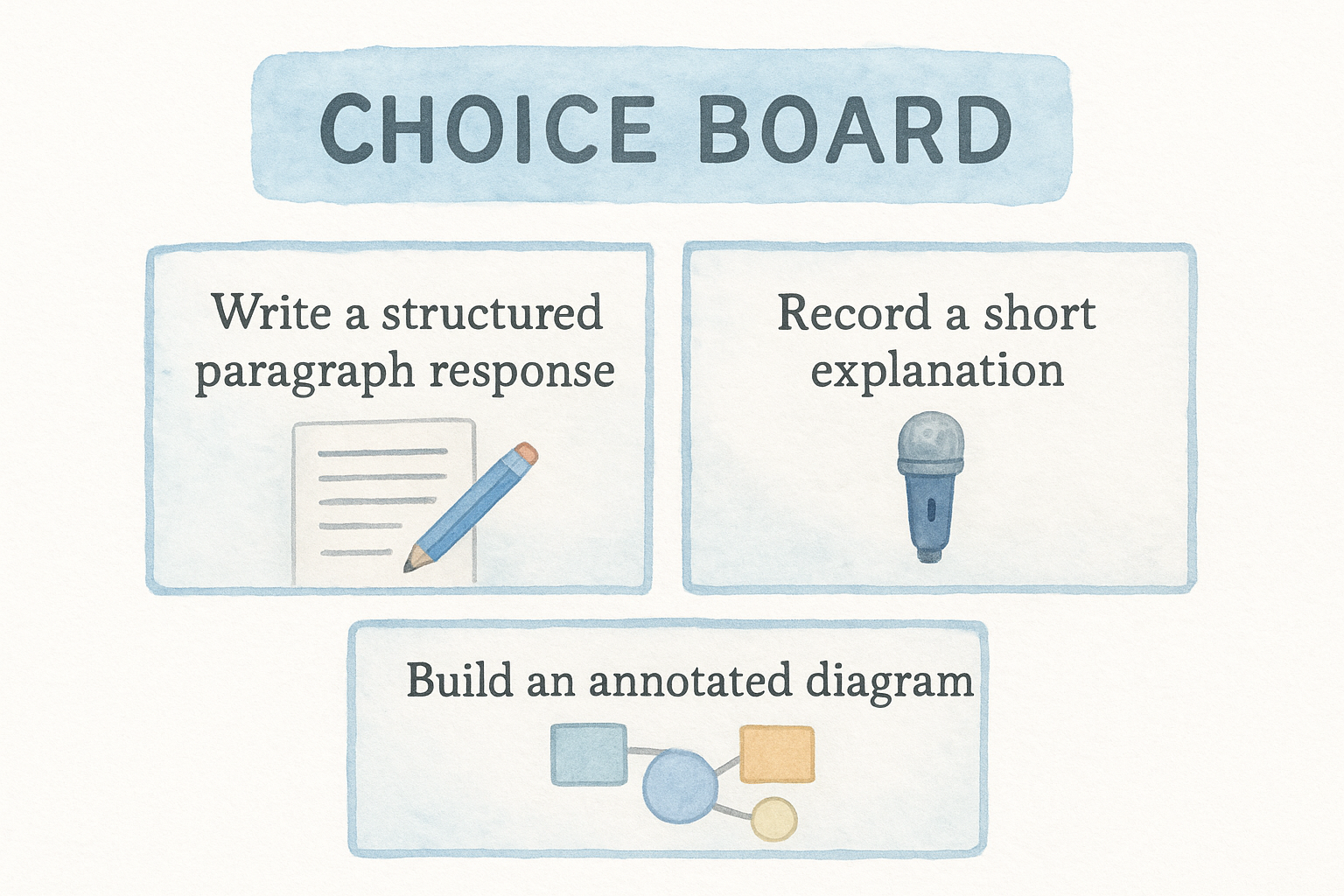
The format changes; the rigor doesn’t.
- Write a structured paragraph response
- Record a short explanation
- Build an annotated diagram
Alternatives to essays and worksheets that still assess well
Recorded explanations, annotated visuals, and structured outlines assess comprehension just as effectively as traditional writing. Each format still requires students to process and apply the material.
Rubrics that make different formats gradeable and fair
Use a skills-based rubric that focuses on the learning target, not the format. This keeps your grading criteria consistent across every choice a student makes.
How to prevent choice from becoming a free-for-all
Set clear parameters before students begin. When students understand the boundaries of each option, structured choice replaces guesswork and keeps everyone focused on the learning goal.
4. Build flexible routines and learning spaces
Flexible routines are one of the most overlooked UDL strategies in the classroom. When students know what to expect, they free up mental bandwidth to focus on learning rather than figuring out what comes next.
What "flexible" means without losing structure
Flexible does not mean unstructured. It means your routines accommodate different needs while keeping clear predictable patterns in place. Students still follow a consistent process; the pathway inside that process has room to shift.
Small changes to seating, grouping, and pacing
Rotating seating options and using flexible grouping based on task rather than ability can reduce disengagement quickly. Even adjusting your pacing by building in short processing pauses gives students time to consolidate before moving on.
A two-minute buffer between instruction and practice can close more gaps than re-teaching later.
Norms that make movement and collaboration work
Post clear behavioral expectations for transitions and group work so students know the rules before they move. Consistent norms let you offer more flexibility without losing classroom control.
Supports for attention, executive function, and anxiety
Visual schedules and posted agendas reduce cognitive load for students who struggle with transitions. Simple fidget tools or movement breaks built into your routine support self-regulation without disrupting the flow.
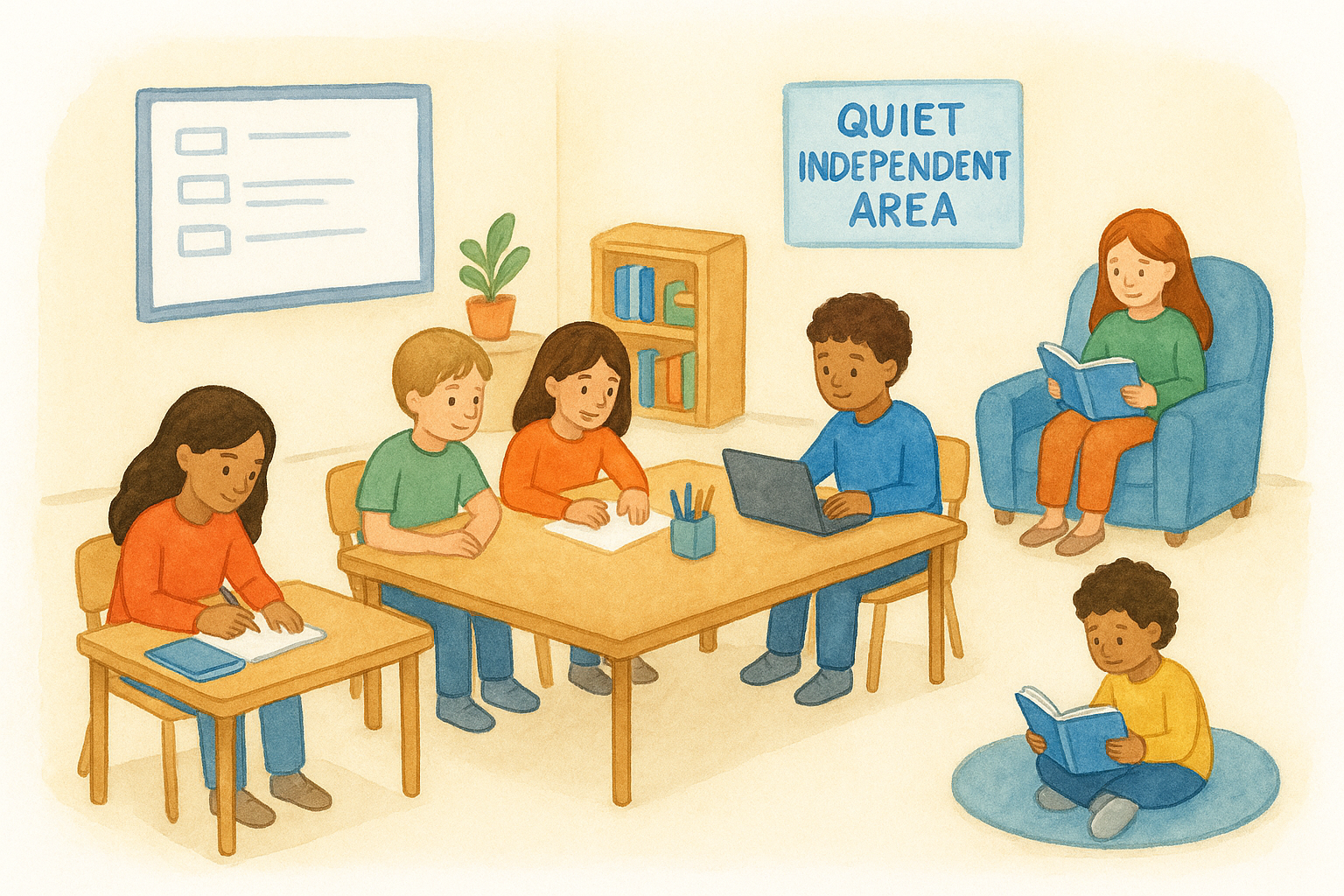
How to run flexible spaces in a crowded room
You do not need extra square footage. Designate zones by task type, such as a quiet independent area and a low-voice collaborative area, and rotate access based on the activity. Small shifts in room organization create meaningful options even in tight spaces.
5. Teach self-monitoring with frequent feedback
Self-monitoring is the piece that makes UDL strategies in the classroom stick long-term. When students track their own progress and you give consistent feedback, learning becomes a continuous cycle instead of a one-time event.
Why UDL depends on feedback loops
Without feedback, students can’t adjust their approach, and you can’t adjust your instruction. Frequent, low-stakes feedback closes the loop between what you teach and what students actually understand.
Lightweight ways to check for understanding daily
A quick exit ticket or thumbs-up/down signal takes under two minutes and gives you actionable data. Try these fast checks:
- One-sentence summary
- Traffic light self-rating (red/yellow/green)
- "Muddiest point" card
Student reflection routines that take under five minutes
Ask students to write one thing they learned and one question they still have before leaving. This habit builds metacognitive awareness without cutting into instruction time.
Feedback that supports effort, persistence, and regulation
Feedback on process ("You tried a different strategy when you got stuck") builds resilience more effectively than feedback on outcomes alone.
Specific, process-focused feedback tells students what to do next, not just how well they performed.
What to do when feedback shows gaps
When your data reveals a gap, adjust your next lesson rather than waiting for a formal assessment cycle. Small, targeted interventions based on daily feedback keep gaps from compounding.
Next steps
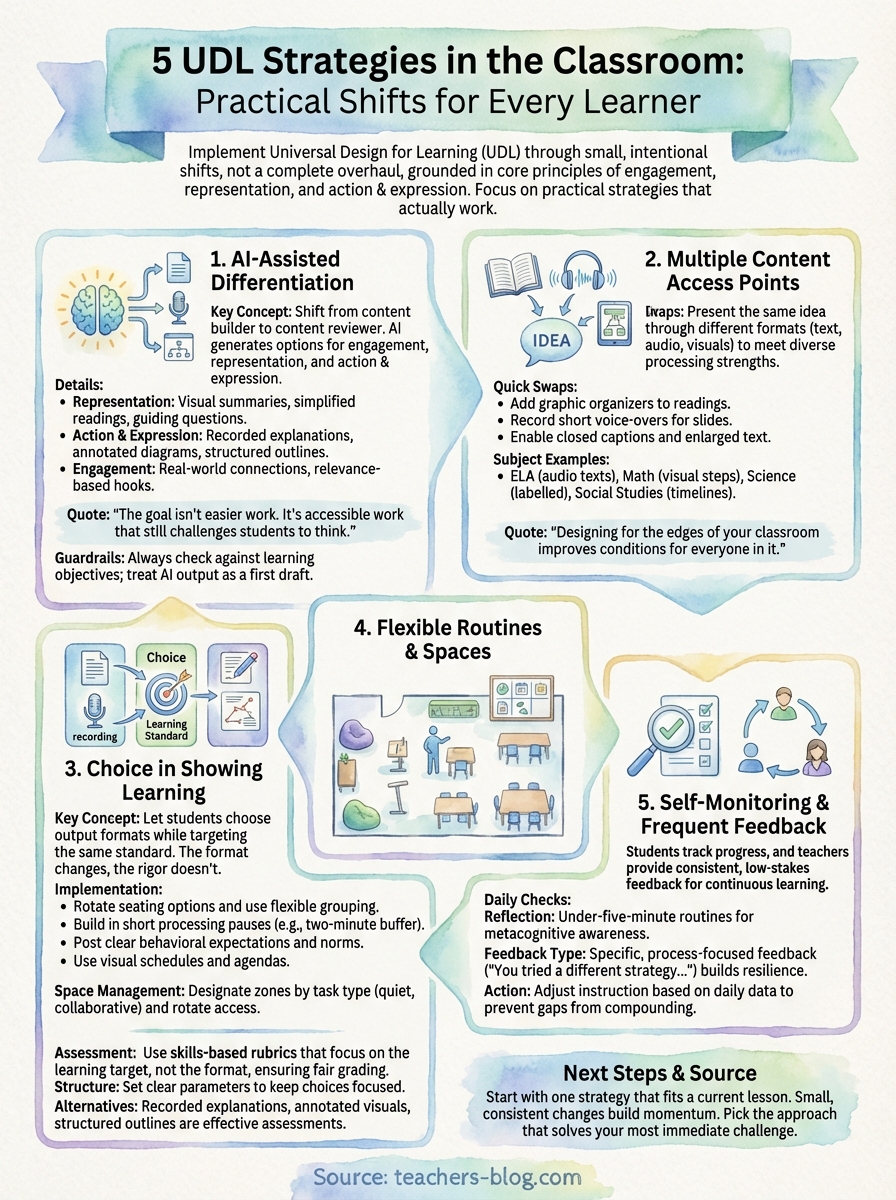
You now have five concrete, manageable ways to bring UDL strategies in the classroom to life without rewriting your entire curriculum. Start with one strategy that fits a lesson you already have planned this week. Small, consistent changes build momentum far faster than waiting until everything feels perfect.
Pick the approach that solves your most immediate problem, whether that’s offering more access to content, giving students choice in how they respond, or tightening your feedback loop. Each strategy connects to the others, so once one routine takes hold, the next one becomes easier to add.
When you’re ready to go deeper on planning and differentiation, The Cautiously Optimistic Teacher has tools and resources built specifically to help you work smarter, not harder. Your students benefit most when you have systems that support you, so take the next step today.