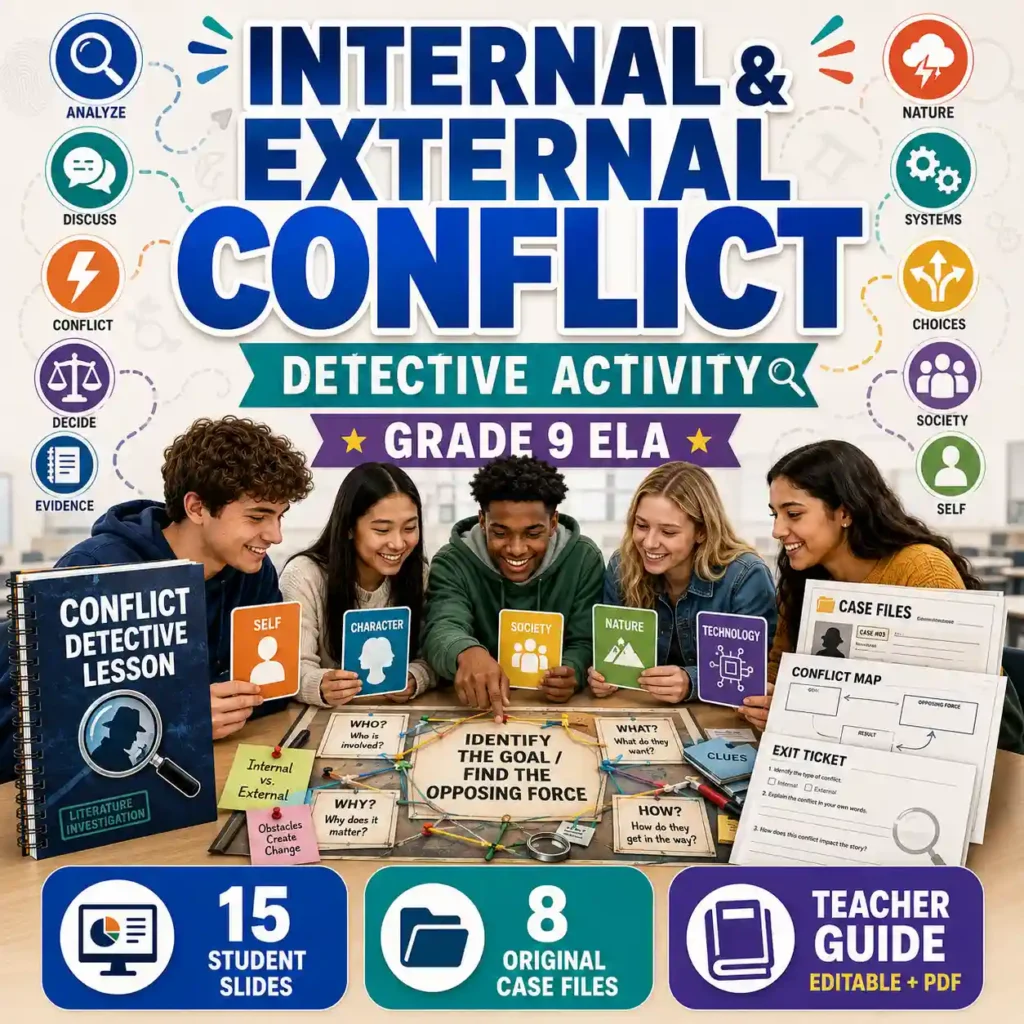
Teaching conflict in literature can look deceptively simple. Give students a list of conflict types, show a few examples, and ask them to label each one.The problem is that students often learn the labels without really understanding the struggle. They may see a storm and automatically write character vs. nature. They may see a worried character and call it character vs. self. They may identify every disagreement as character vs. character.A stronger approach to teaching conflict starts one step earlier: What does the character want, and what force prevents or complicates that goal?That single question turns conflict from a vocabulary exercise into literary analysis. Once students can identify the goal and the opposing force, internal and external conflict become easier to classify, compare, and explain.
Start Teaching Conflict with Opposing Forces
Conflict is a struggle between opposing forces. A setting, person, rule, machine, fear, or storm is not automatically a conflict on its own. It becomes part of a conflict when it actively blocks or complicates something a character wants.A simple sentence frame can help:
The character wants ______, but ______ prevents or complicates that goal.
For example, imagine a student who wants to deliver a presentation, but the classroom display will not open the file. The broken technology creates an external obstacle. If the student also fears speaking without the slides, there may be an internal struggle as well.This is a much richer starting point than asking students to hunt for keywords. It forces them to identify the active forces in the story.
Internal Conflict: Character vs. Self
Internal conflict happens within the character. The struggle may involve competing fears, values, loyalties, beliefs, desires, or decisions.One common mistake is assuming that any nervous or unhappy character is experiencing internal conflict. Emotion by itself is not enough. The internal struggle should influence a decision, goal, or action.For example, a student may want to submit a creative project but hesitate because of fear of judgment. The important conflict is not simply that the student feels nervous. The conflict exists because the fear actively competes with the goal of submitting the work.When students identify internal conflict, ask them to explain:
What does the character want?
What belief, fear, value, or desire pulls in another direction?
What decision does that struggle create?
External Conflict: More Than Character vs. Character
External conflict occurs when the opposing force comes from outside the character. Common categories include:
Type
Opposing force
Character vs. character
Another person whose goal, choice, or belief opposes the protagonist.
Character vs. society
A law, rule, policy, institution, tradition, or social expectation.
Character vs. nature
Weather, landscape, animals, illness, or another natural condition.
Character vs. technology
A machine, system, program, invention, or technological consequence.
Character vs. supernatural or fate
A force beyond ordinary human control or explanation.
The category matters, but the explanation matters more. Students should be able to state exactly how the force interferes with the character’s goal.Get the Classroom-Ready, No-Prep Lesson on Teachers Pay Teachers.Do Not Stop at the Conflict TypeStudents often think the task is finished once they have chosen a label. For Grade 9 literary analysis, that should be the beginning rather than the end.Ask students to connect the conflict to character development and plot:
What choice does the conflict force the character to make?
How does the character respond?
What becomes harder as the conflict develops?
How does the response change the direction of the story?
This connects naturally to CCSS RL.9-10.3 because students are analyzing how characters respond to events and how those responses advance the plot. It also supports RL.9-10.1 when students use precise evidence to justify their classification.
Teach Primary and Secondary Conflict
Many stories contain several conflicts at the same time. One of the most useful next steps in teaching conflict is helping students decide which struggle is primary.The primary conflict is the struggle that most strongly organizes the character’s central goal, major decisions, and outcome. A secondary conflict adds pressure, complicates the problem, or reveals something important about the character.A useful way to make this decision is to use four questions:
Goal test: Which struggle most directly blocks the central goal?
Decision test: Which struggle causes the most important choices?
Removal test: If one conflict disappeared, which removal would change the story most?
Outcome test: Which struggle must be addressed for the ending to feel complete?
These questions are especially valuable in layered stories where more than one answer may be defensible. The goal is not to guess the teacher’s preferred label. The goal is to justify the interpretation with evidence.If you want a ready-made way to practise this process, the Internal and External Conflict Detective Lesson uses independent case files and a four-part priority test so students can practise choosing and defending a primary conflict.
A FREE CLASSROOM GAME FOR ENGLISH TEACHERS
Make your next English review a Plot Twist!
Bring some unexpected fun to your next lesson. Get a free game of Plot Twist!, the ultimate classroom review game, and discover fresh ideas for teaching English.
Subscribe for English teaching ideas and occasional resource updates, plus your free Plot Twist! game. You can unsubscribe from emails at any time.
Help Students Notice Conflict Escalation
Strong conflict does not remain static. It escalates.Students can look for signs such as:
the opposing force becomes stronger or more immediate;
the character loses time, options, support, information, or safety;
a secondary conflict adds pressure to the main one;
the stakes increase and something more important may be lost or changed.
This shifts students from summarizing events to analyzing structure. Instead of saying, “Then another bad thing happened,” they can explain how the author increases pressure and narrows the character’s choices.A simple conflict map can follow this chain:Character goal → opposing force → escalation → character response → result.
Common Mistakes When Teaching Conflict
A few misconceptions appear again and again.
1. The topic is the conflict
“A storm” is not a complete explanation. Students should explain what the character is trying to accomplish and how the storm prevents it.
2. Any disagreement is character vs. character
Two people can disagree without creating the story’s meaningful conflict. Their goals or actions need to actively oppose one another.
3. A worried character always has internal conflict
Internal conflict requires a real struggle that affects a decision or goal. Feeling nervous is not enough by itself.
4. The most dramatic conflict must be primary
The loudest or most dangerous event is not automatically the central struggle. Use the goal, decision, removal, and outcome tests.
5. A story can have only one conflict
Many good stories layer conflicts. Students should learn to explain how secondary struggles intensify or complicate the primary one.
Use Ambiguous Examples on Purpose
One of the best ways to deepen understanding is to include examples where more than one classification is reasonable.Suppose technology fails during a presentation, but the character can still continue without it. If fear of speaking becomes the biggest obstacle, a student might reasonably argue that the internal conflict is primary. Another student might defend technology as primary because the equipment failure launches the action.Both interpretations can be useful if students explain their reasoning.This kind of ambiguity is much closer to real literary analysis than a worksheet where every example has one obvious keyword.
Make Conflict Analysis Feel Like Investigation
Conflict works especially well with a detective-style structure because students are essentially gathering evidence. They need to identify the goal, locate opposing forces, classify the struggle, decide which conflict matters most, and explain how it escalates.That structure also works well for independent practice. Students can investigate short passages one at a time, record evidence, and defend their conclusions before moving to a longer text.If you are building a larger short-story unit, this pairs naturally with my types of conflict lesson plan and conflict in fiction lesson.
What a Strong Conflict Lesson Should Include
A complete lesson does not need to overwhelm students with terminology. A strong sequence might include:
a short conflict snapshot that asks students to identify the goal and obstacle;
direct instruction on internal and external conflict;
guided classification with evidence;
independent analysis of mixed or layered cases;
a longer passage where students identify primary and secondary conflict;
an exit ticket that requires students to correct a weak conflict claim.
The progression matters. Students should move from recognizing conflict to explaining how it shapes decisions and plot.
Want the Complete No-Prep Conflict Lesson?
If you want the full sequence already prepared, the complete Grade 9 lesson includes a 15-slide presentation, teacher guide, five-page student investigation packet, eight original conflict case files, an extended original passage, differentiation, answer guidance, assessment criteria, and an exit ticket.The detective format is designed for independent work, and students practise not only classifying internal and external conflict but also identifying evidence, distinguishing primary and secondary struggles, and tracing escalation.
Final Thoughts on Teaching Conflict
The most important shift in teaching conflict is moving students away from labels and toward relationships between forces.Start with the character’s goal. Identify what blocks it. Then classify the conflict, decide which struggle matters most, trace how the pressure increases, and explain how the character responds.When students can do that, conflict becomes more than a literary-device worksheet. It becomes a way to understand why characters make decisions and why stories move forward.