
12 Teacher Interview Questions and Answers to Prepare
You’ve got a teaching interview coming up, and the nerves before a teacher interview are already setting in. Maybe you’ve googled teacher interview questions and answers at midnight, hoping to find something more useful than generic career advice that ignores what principals actually ask in a school hiring committee. You want real questions, real answers, and a sense of what separates a forgettable candidate from someone who gets the offer.
This article gives you exactly that. Below are 12 questions pulled from actual teacher interviews, covering classroom management, differentiation, and how you handle a lesson that flops. Each one comes with a sample answer you can adapt, plus notes on what interviewers are really listening for when they ask it.
We built this guide the same way we build everything else here: practical, classroom-tested, and written for teachers who need to walk into that room ready. Whether you’re a first-year teacher or switching districts after a decade in the classroom, you’ll leave with talking points, not just theory, and a clearer idea of how to tell your story with confidence.
1. Why do you want to become a teacher?
This question almost always opens the interview, and it sets the tone for everything after it. It sounds simple, but it’s your first chance to show the committee who you are before they’ve formed any opinion based on your resume. Treat it as your opening statement, not small talk.
Why interviewers ask this question
Principals ask this to gauge whether your motivation for teaching will hold up on the hard days, not just the good ones. They’re listening for authenticity over rehearsed lines, and they want to know if your reasons align with the mission of their school. A vague answer like "I love kids" tells them nothing about your judgment or your staying power in a demanding profession.
A hiring committee remembers the teacher whose "why" sounded lived-in, not memorized.
Sample answer
"I decided to become a teacher after tutoring a struggling reader in my sophomore year of college. Watching him go from avoiding books to asking to check one out changed how I thought about my own career. I realized I wanted a job where small, daily wins actually matter, and where I could help students see themselves as capable learners, especially the ones who don’t believe that yet. That’s still what drives me. I want to build classrooms where students who think they’re ‘bad at’ a subject discover they just hadn’t been taught it in a way that clicked for them."
Tips to make your response stand out
Anchor your answer in a specific moment, not a general sentiment. Interviewers hear "I’ve always loved working with kids" dozens of times a year, and it blends into noise. A concrete story, even a short one, sticks.
- Keep it under 90 seconds. Rambling here signals you haven’t organized your thoughts.
- Connect your motivation to a value the school likely cares about, like equity, growth mindset, or community.
- Avoid clichés about "making a difference" without backing them up with a real example.
- Practice your answer out loud a few times so it sounds natural, not scripted.
If you’re an aspiring teacher still refining your story, our guide on showing your potential as a new teacher walks through how to structure your narrative around the qualities schools are actually screening for.
2. What is your classroom management plan?
This question shows up in nearly every teaching interview because a shaky management plan derails everything else, no matter how strong your lesson plans are, which is why discussing your classroom management style deserves its own preparation. Committees want to see that you’ve thought through the daily mechanics of running a room, not just the exciting parts of teaching. It’s one of the most practical teacher interview questions and answers you’ll need to prepare, since vague responses here raise real red flags.

Why interviewers ask this question
Principals have sat through enough observations to know that classroom management makes or breaks a first year. They’re checking whether you have a proactive system in place, the kind that comes from building a classroom management plan step by step, versus reacting to problems as they happen. They also want to hear how you handle disruptions without losing instructional time or resorting to punitive measures that damage trust.
The teachers who last aren’t the ones with the strictest rules, they’re the ones with the clearest routines.
Sample answer
"I build my management plan around consistent routines and clear expectations set in the first week. Students know exactly what independent work looks like, how to transition between activities, and what happens when expectations aren’t met. I use a tiered response system, starting with a quiet redirect before escalating, and I always follow up privately rather than calling students out in front of peers."
Tips to make your response stand out
- Mention a specific routine, like entry tasks or transition signals.
- Explain how you rebuild relationships after a consequence.
- Avoid describing management as just "strict rules."
3. How do you differentiate instruction for diverse learners?
Differentiation questions come up because every classroom holds a mix of reading levels, language backgrounds, and learning styles, and interviewers want proof you can teach to all of them at once. This is one of the teacher interview questions where a generic answer about "meeting students where they are" won’t cut it. You need specifics.
Why interviewers ask this question
Schools face real accountability for closing achievement gaps, so committees want to know you can plan for diverse learners without writing three separate lesson plans every night. They’re also checking whether you understand the difference between differentiating content, process, and product, or if you just say "differentiation" as a buzzword. Districts serving English language learners or students with IEPs are especially listening for how you scaffold without lowering expectations.
A vague promise to "differentiate" convinces no one; a specific scaffold does.
Sample answer
"I differentiate by adjusting the process more than the content. For a novel study, every student reads the same core text, but I offer tiered graphic organizers, audio support for struggling readers, and extension questions for students ready to analyze theme independently. I also use exit tickets to regroup students the next day based on who needs reteaching."
Tips to make your response stand out
- Name a specific tool or strategy, like tiered assignments or choice boards.
- Mention how you use data, such as exit tickets, to adjust grouping.
- Reference a tool like our Differentiated Instruction Helper if you use AI to speed up planning for mixed-readiness classrooms.
4. How do you incorporate technology into your lessons?
Schools ask this because classrooms now run on a mix of devices, apps, and platforms, and administrators want teachers who use tech with a purpose rather than just for novelty. This question also tests whether you can talk about edtech tools without drowning the answer in jargon about "21st century skills," so it helps to know how showing your technology skills in a teaching interview actually lands with a committee. Interviewers want to hear how technology serves the lesson objective, not the other way around.
Why interviewers ask this question
Districts invest heavily in Chromebooks, learning management systems, and AI tools, and they want to know their investment won’t sit unused. Committees are listening for whether you can name a specific platform and explain the instructional reasoning behind it, since that shows real classroom experience rather than a rehearsed talking point. They also care about equity, meaning your tech plan should work for students without reliable internet at home.
Technology should disappear into good teaching, not distract from it.
Sample answer
"I use technology to save time on repetitive tasks so I can focus more energy on instruction. For example, I use an AI worksheet generator to build differentiated practice sets in minutes, then I use Google Classroom for feedback loops so students get comments the same day they submit work. I’m intentional about balance, though. Discussion and writing by hand still happen daily, because I don’t want screens replacing thinking."
Tips to make your response stand out
- Name one or two specific tools, not a vague list.
- Mention equity, like offline backup plans for tech-limited households.
- Explain how a tool like our Worksheet Maker, or any of the worksheet tools that cut planning time, frees up planning time without replacing your judgment.
5. How do you communicate and build relationships with parents?
Parent communication questions catch candidates off guard because so much interview prep focuses on lesson delivery, not the phone calls and emails that eat up your evenings. Committees ask this because a teacher who avoids parent contact until there’s a crisis creates problems that a proactive teacher never has. This is one of those teacher interview questions and answers where specifics about frequency and method matter more than good intentions.
Why interviewers ask this question
Principals field parent complaints, and they’d rather hire someone who prevents them. They want evidence of a communication routine, not a promise to "reach out when needed." Schools also care about equity here, since families without email access or English fluency need a different approach than a weekly newsletter.
Parents forgive a lot when they know you’ll tell them the truth early.
Sample answer
"I send a positive note home in the first two weeks for every student, before any problems come up. That way my first contact isn’t bad news. I use a weekly text update through Remind for quick wins, and I call home within 24 hours if a pattern of missing work starts, rather than waiting for a report card to surprise anyone."
Tips to make your response stand out
- Mention a specific tool, like Remind, ClassDojo, or another app for messaging families, or a weekly email.
- Describe how you handle a language barrier or lack of internet access.
- Give an example of turning a difficult conversation into a partnership, not a complaint session.
6. Describe a challenging teaching experience and how you handled it
This question separates candidates who’ve actually stood in front of a classroom from those who only sound good on paper. Committees expect every teacher to have a story where something went wrong, so refusing to name one, or claiming you’ve never struggled, reads as dishonest rather than impressive. This is your chance to show problem-solving under pressure, which matters more to most principals than a flawless track record.

Why interviewers ask this question
Schools deal with real conflict daily, from parent disputes to students in crisis, and they need teachers who stay level-headed rather than defensive. Interviewers listen for reflection and growth, the habit of reflecting on your teaching without self-blame, not just a dramatic story. They also want to know you take ownership of mistakes instead of blaming students, families, or administration when things go sideways.
Interviewers aren’t grading the crisis, they’re grading how you recovered from it.
Sample answer
"During my student teaching, I had a student who shut down completely after a failed test, refusing to engage for weeks. Instead of pushing academics right away, I met with him privately, learned he was struggling with anxiety, and adjusted my approach to give him low-stakes ways to show progress. Within a month, he was participating again. That experience taught me to look past behavior for the cause underneath it."
Tips to make your response stand out
- Choose a story with a clear resolution, not an unresolved complaint.
- Focus more on your response than the problem itself.
- Name a lesson you still apply today.
7. How do you support a student who is struggling academically?
This question tests whether you have a real intervention process for struggling learners or just good intentions. Committees want to hear how you catch struggling students early, before a failing grade forces the conversation. It’s one of the teacher interview questions and answers that reveals whether you see low performance as a mystery to solve or a label to accept.
Why interviewers ask this question
Schools track intervention data closely, especially under RTI or MTSS frameworks, so principals want proof you understand tiered support beyond just offering extra help after school. They’re listening for whether you can identify the root cause of a struggle, whether it’s a skill gap, a language barrier, or something outside academics entirely. A vague answer about "working one-on-one" doesn’t show that thinking.
Struggling students rarely need more worksheets, they need a teacher who figures out why the first ones didn’t work.
Sample answer
"When a student falls behind, I first look at whether it’s a skill gap or something else, like attendance or home stress. For a recent student struggling with essay writing, I discovered he understood the ideas but froze at organization. I gave him a simplified outline template and paired him with a peer for talk-before-write practice. Within three weeks, his drafts improved noticeably, and his confidence came back with it."
Tips to make your response stand out
- Reference a specific diagnostic step, like a quick skills check or informal conference.
- Mention collaborating with a specialist, counselor, or intervention team.
- Avoid framing struggle as solely the student’s problem to fix.
8. How do you keep students engaged and motivated?
Engagement questions trip up candidates who think excitement alone equals learning. Committees ask this because a lively classroom that isn’t producing results doesn’t help anyone, and they want to see that your idea of engagement goes beyond games and prizes. This is one of the teacher interview questions and answers where interviewers listen for substance behind the energy.
Why interviewers ask this question
Principals know that motivation drops off fast once the novelty of a new teacher wears off, so they want proof you have a sustainable strategy, not just a few flashy activities saved for observation days. They’re also checking whether you understand intrinsic versus extrinsic motivation, since a classroom built entirely on rewards tends to fall apart the moment the prizes stop.
Real engagement looks like students choosing to think harder, not just sitting up straighter.
Sample answer
"I keep students engaged by giving them ownership over some part of the lesson, whether that’s choice in a project topic or a say in how we tackle a discussion. I also build in curiosity gaps, like posing a question before I teach the content, so students want the answer before I give it. For motivation, I focus on progress they can see, using trackers or short reflections so students notice their own growth."
Tips to make your response stand out
- Name a specific strategy, like choice boards or Socratic seminars.
- Distinguish between short-term fun and lasting motivation.
- Mention how a tool that lets you generate questions from any text, like our Question Generator, sparks curiosity-driven discussion instead of passive note-taking.
9. Tell me about a time you worked with a team to solve a problem
Teaching looks like a solo job from the outside, but every school runs on collaboration, from grade-level teams to IEP meetings to department planning to working alongside a co-teacher. Committees ask this question because a teacher who can’t work well with colleagues creates friction that ripples into the classroom. This is one of the teacher interview questions and answers candidates underprepare for, assuming their content knowledge speaks for itself.

Why interviewers ask this question
Principals need staff who can sit in a room with different opinions and still reach a workable plan. They’re listening for collaborative problem-solving, not a story where you did everything yourself and colleagues just watched. Schools also want to see how you handle disagreement professionally, since staff conflict left unresolved affects morale and, eventually, students.
A team story that ends with "I fixed it alone" isn’t a team story at all.
Sample answer
"Our grade-level team noticed a schoolwide dip in writing scores, so we met weekly to break down the problem. I suggested we each teach one shared rubric element and swap student samples for calibration. Disagreements came up about pacing, but we compromised by piloting the plan for a month before revisiting it. Scores improved, and the process taught me how much stronger our decisions get when we build them together instead of in isolation."
Tips to make your response stand out
- Credit specific teammates or roles, not a vague "we."
- Mention how disagreement got resolved, not just glossed over.
- Tie the outcome back to student impact, not just team harmony.
10. What is your greatest strength and weakness as a teacher?
This classic pairing still shows up in most teacher interview questions and answers lists because it forces candidates to show self-awareness under pressure, so it pays to plan how to discuss your strengths and weaknesses as a teacher. Anyone can rattle off a strength, but naming a real weakness without sinking your own chances takes practice. Committees use this question to see whether you know yourself as a professional, not just as someone who performs well on good days.
Why interviewers ask this question
Schools want teachers who keep improving, not ones who think they’ve already arrived. Interviewers listen for genuine self-reflection, since a fake weakness like "I work too hard" signals you’re dodging the question rather than answering it. They also want your strength to connect to something the role actually needs, not just a generic compliment you’d give yourself at any job.
A weakness you’re actively fixing tells a committee more than a strength you’ve perfected.
Sample answer
"My greatest strength is building relationships with reluctant learners. I take time early in the year to find out what motivates each student outside of academics, and that pays off when I need buy-in later. My weakness is pacing. I sometimes let a great discussion run long, which can crowd the next activity. I’ve started using a visible timer and building buffer time into my lesson plans to keep myself honest."
Tips to make your response stand out
- Choose a weakness you’re actively working on, with a specific fix in progress.
- Match your strength to a need the school likely has, like differentiation or family outreach.
- Skip weaknesses tied to core teaching skills, like classroom management or content knowledge.
11. How do you assess student learning?
Assessment questions separate teachers who grade papers from teachers who use data to actually change instruction. Committees ask this because report cards and standardized tests only tell part of the story, and they want to know how you check understanding day to day. This is one of the teacher interview questions and answers where naming a formative strategy, not just a grading policy, makes the difference.
Why interviewers ask this question
Schools care about assessment because it drives everything from grouping to grades to parent conferences. Principals listen for the difference between formative and summative assessment, since a candidate who only mentions tests and quizzes hasn’t shown how they adjust teaching in real time. They also want proof that your feedback helps students improve, rather than just ranking them.
Grades tell you what happened, formative checks tell you what to do next.
Sample answer
"I assess constantly, not just at the end of a unit. Exit tickets and quick polls tell me who needs reteaching the next day, while projects and essays show deeper mastery over time. I give feedback that’s specific and actionable, and I use rubrics students see before they start, so expectations aren’t a surprise. For report cards, I keep detailed notes throughout the term so comments reflect real patterns, not last-minute impressions."
Tips to make your response stand out
- Distinguish clearly between formative checks and summative grades.
- Mention a specific feedback method, like rubrics shared in advance.
- Reference a tool like our Report Card Commentor, or a bank of effective report card comments, if you use one to keep feedback consistent and timely across a full roster.
12. Why do you want to teach at this school?
This closing question tests whether you actually researched the school or just applied everywhere with the same generic cover letter. Committees ask it last because it reveals whether you’ll stick around past the first tough semester or bolt the moment another offer appears. A strong answer here shows genuine school fit, not just enthusiasm for teaching in general.
Why interviewers ask this question
Hiring and onboarding a new teacher costs a district real time and money, so principals want signs you’ll stay. They’re listening for specifics about their school culture, mission, or programs, since vague praise about "a great community" could apply to any building in the district. Interviewers also want to hear whether your teaching philosophy actually matches how their school operates day to day.
Nobody hires the candidate who sounds like they could be interviewing anywhere.
Sample answer
"I want to teach here because your school’s focus on project-based learning matches how I already plan units. I looked into your ninth-grade capstone program, and I’d love to contribute to that model rather than teach in isolation. I also noticed your emphasis on restorative practices, which lines up with how I handle classroom conflict. This feels like a place where my approach would fit the existing culture, not fight against it."
Tips to make your response stand out
- Reference a specific program, initiative, or value from the school’s website.
- Mention something you learned from a current staff member if possible.
- Avoid answers that would work word-for-word at any other school.
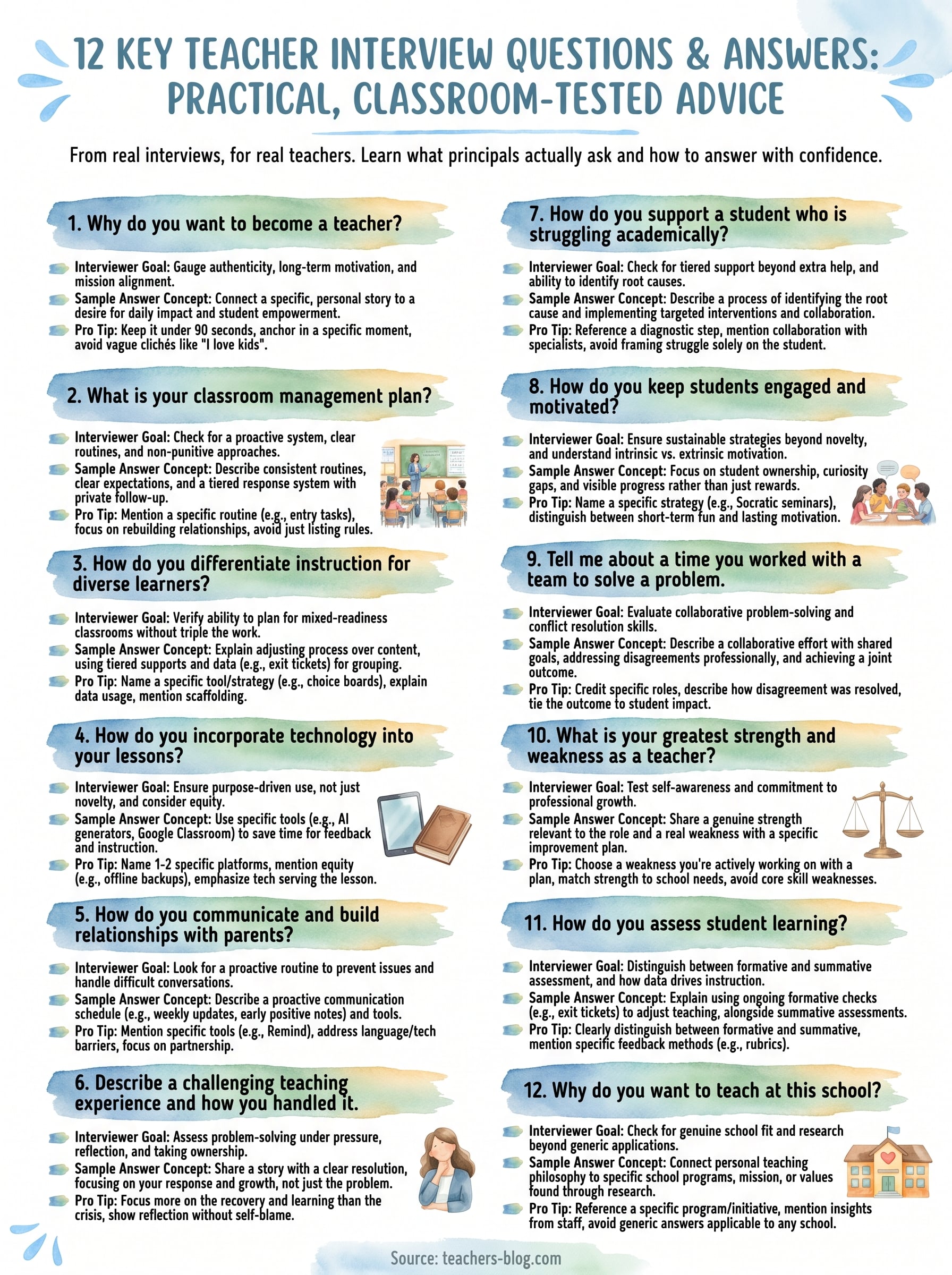
Walking into your interview with confidence
You don’t need a scripted answer for every possible question, you need a handful of real stories and a clear sense of your own teaching philosophy. Go back through these 12 teacher interview questions and answers and pick two or three from your own classroom experience that you can tell without stumbling. Committees remember specifics, not polish.
Practice your answers out loud, not just in your head, so the words feel natural instead of memorized. Bring a printed lesson plan or student work sample if the interview allows it, since showing beats telling every time. Then walk in knowing you’ve prepared better than most candidates in that waiting room.
If you want more support before the big day, from resume tips to what to wear, everything we’ve written about teacher interviews has the rest of what you need to walk in ready and walk out with an offer.