Reciprocal Teaching Strategies: The 4 Steps That Build Comprehension
You hand students a dense chapter, and half of them read every word without absorbing a thing. They can decode text but can’t tell you what it meant. That’s a comprehension problem, not a decoding one, and it’s exactly what strategies for reciprocal teaching were designed to fix.
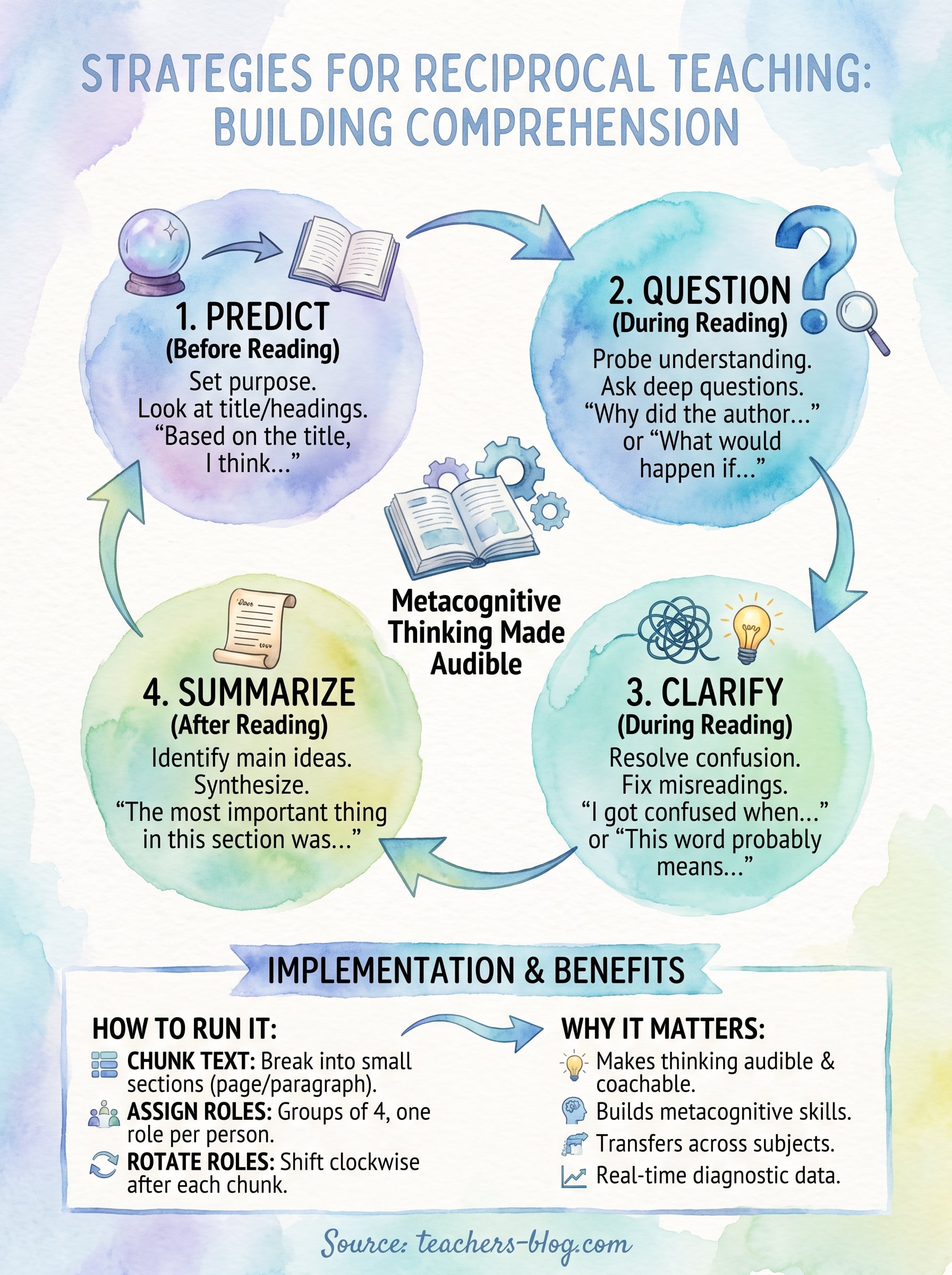
Reciprocal teaching breaks comprehension into four teachable moves: predicting, questioning, clarifying, and summarizing. Students rotate through these roles in small groups, talking through a text the way strong readers think through it in their heads. Instead of guessing whether kids understood a passage, you give them a repeatable process for building that understanding themselves, and eventually they run it without you.
This article walks through each of the four reciprocal teaching strategies one at a time, explaining what it looks like in practice and why it matters for comprehension. You’ll get concrete steps for introducing the method to a class that’s never used it, grouping students, and troubleshooting the awkward first few sessions when kids default to one-word answers. By the end, you’ll have a classroom-ready framework you can start using tomorrow.
Why reciprocal teaching strategies matter for comprehension
Comprehension is invisible until you make students say it out loud, and that’s exactly why reciprocal teaching strategies succeed where a highlighter or a worksheet fails. A kid can underline every topic sentence in a chapter and still miss the point entirely, because underlining tests attention, not understanding. The four roles force metacognitive thinking into the open, turning a silent, internal process into something you can hear, correct, and coach in real time.
You can’t fix comprehension you can’t see, and reciprocal teaching makes thinking audible.
Palincsar and Brown developed the method in the early 1980s for students who could decode text fluently but couldn’t explain what they’d just read, a gap that standard round-robin reading never closes. Their original research showed struggling readers jumping from around 30 percent comprehension accuracy to 70 to 80 percent after consistent practice with the four roles, and the National Reading Panel later listed reciprocal teaching among the comprehension approaches with the strongest research support (source: NICHD). That track record is why the method has stuck around in classrooms for over forty years instead of fading like most instructional fads.
Benefits show up in more than test scores. Teachers who run this rotation consistently report:
- Struggling readers gain a script. Instead of freezing when asked "what did you understand," they have four concrete moves to reach for.
- Strong readers get sharper. Summarizing and questioning push advanced students past surface-level recall into analysis.
- Comprehension transfers across subjects. The same four moves work on a science article, a primary source document, or a word problem.
- You get real diagnostic data. Listening to a group’s questions and summaries tells you exactly where understanding breaks down, faster than any quiz.
Groups matter here too, since students construct meaning together instead of in isolation, catching each other’s misreadings before they harden into misunderstanding. Once a class internalizes the four roles, you stop being the sole source of comprehension checks, and that shift alone is worth the awkward first few sessions.
How to implement the four strategies step by step
Running this rotation for the first time works best when you separate teaching the moves from assigning the roles. Model each strategy yourself using a short, familiar passage before you ever hand a text to a group, because kids who’ve never seen a predictor sound like will default to "I think this book is about… stuff." Spend one class period walking through all four roles aloud, thinking out loud as you predict, question, clarify, and summarize the same paragraph, so students hear what a real answer sounds like.
Give every role a sentence starter
Students freeze less when they have language to borrow. Post these prompts where groups can see them during the first several sessions:
| Role | Starter phrase |
|---|---|
| Predictor | "Based on the title/heading, I think…" |
| Questioner | "Why did the author…" or "What would happen if…" |
| Clarifier | "I got confused when…" or "This word probably means…" |
| Summarizer | "The most important thing in this section was…" |
Give students the words before you give them the roles, or the roles collapse into shrugs.
Rotate roles across four short sessions
Grouping students in fours lets each person own one role per passage, then rotate on the next chunk of text. Follow this sequence:
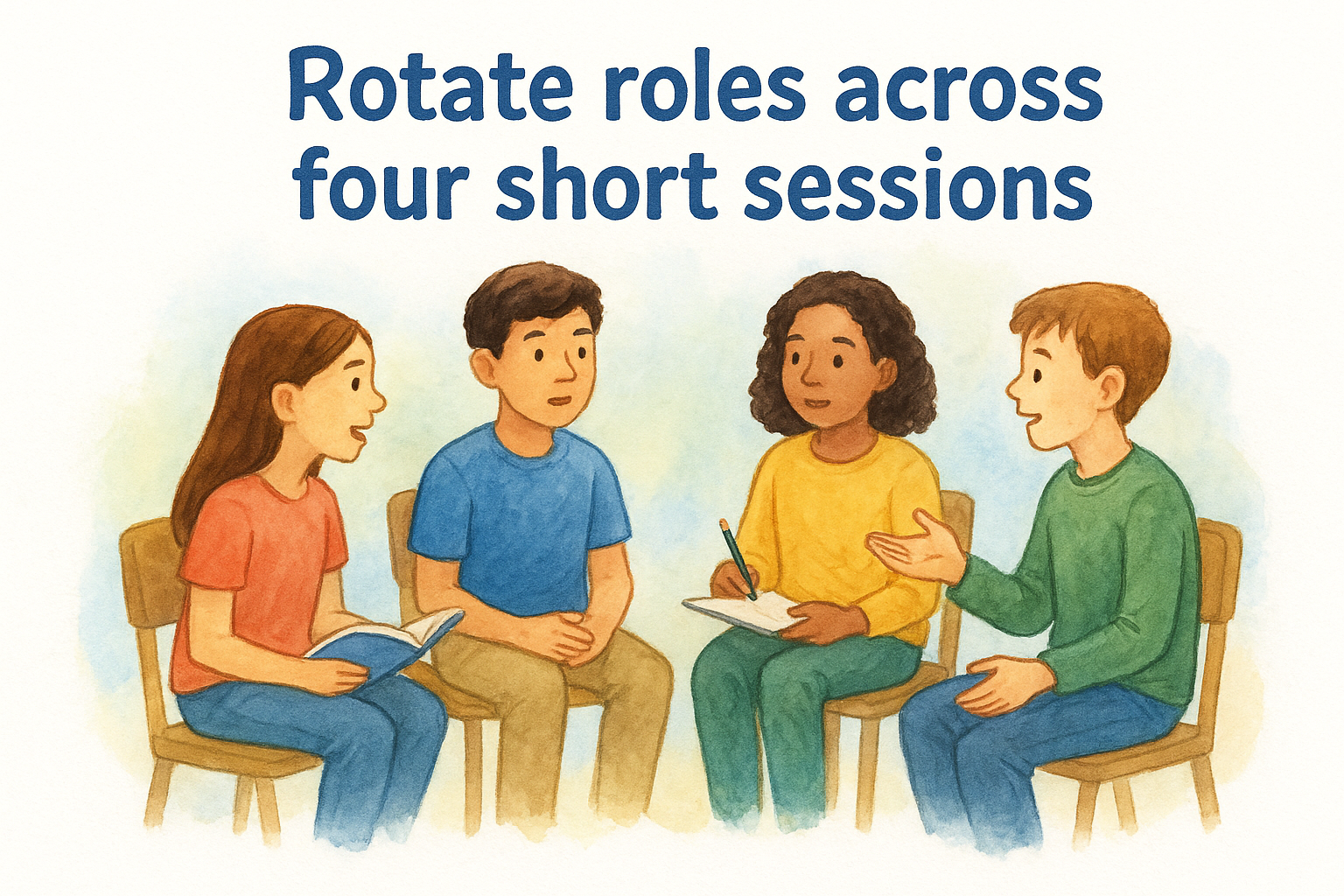
- Chunk the text into short sections, no more than a page for younger readers.
- Assign roles for the first chunk, then read silently or aloud together.
- Run the discussion in order: predictor, then questioner, then clarifier, then summarizer.
- Rotate roles clockwise before starting the next chunk.
Expect the first two or three sessions to feel slow. Practicing reciprocal teaching strategies consistently, even for ten minutes a day, matters more than running one long, polished lesson.
A sample reciprocal teaching lesson in action
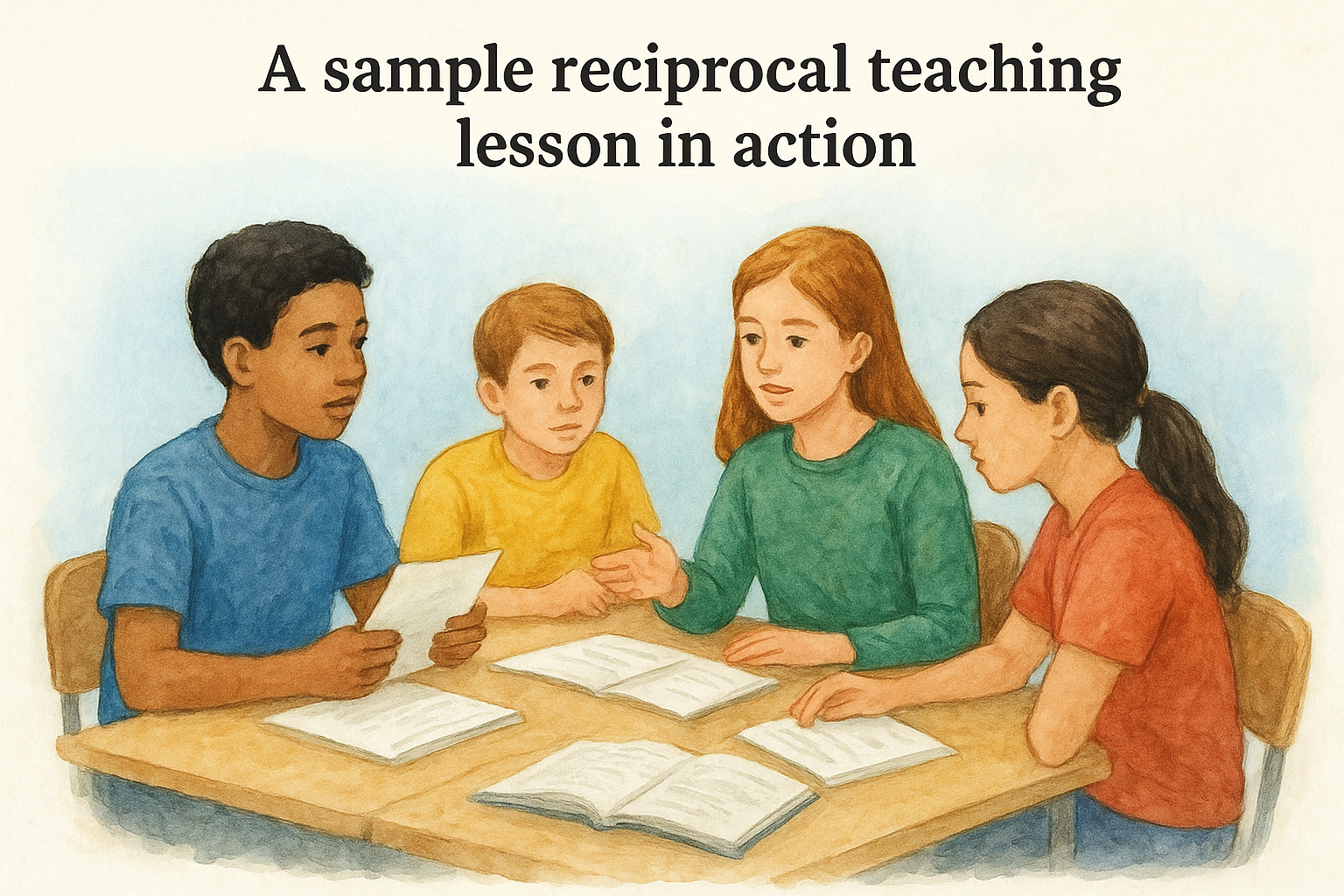
Picture an eighth-grade class working through a short article on wolf reintroduction in Yellowstone. Four students sit in a cluster with the text chunked into three paragraphs, and each one has already claimed a role for the first chunk: predictor, questioner, clarifier, summarizer. Before anyone reads a word, the predictor says, "Based on the title, I think this is about animals coming back to a park and what happens next." That thirty-second prediction sets a purpose for reading that a silent read-through never provides.
Watching the roles play out
After the group reads the first paragraph together, the questioner asks, "Why did the author mention that elk populations dropped?" The clarifier jumps in with, "I got confused by ‘trophic cascade,’ but I think it means one change causes a chain of other changes." Then the summarizer wraps the chunk: "The main idea is that wolves changed more than just the deer population." Notice how each role builds on the last one instead of repeating it.
A group that runs all four roles well can explain a text better than most students can explain it alone.
What you listen for
Roles rotate clockwise for chunk two, so last session’s summarizer becomes this session’s predictor. While groups work, you circulate and listen rather than lecture, catching moments like a clarifier mangling a vocabulary word or a questioner asking something too literal to spark discussion. Coaching in that moment, quietly and briefly, teaches more than any worksheet. Sessions like this one show why reciprocal teaching strategies work best as a habit, not a one-day activity you run once and file away.
Adapting reciprocal teaching for different classrooms
No single script fits every grade level, so treat the four roles as a framework you bend, not a rigid script you follow. Younger readers, English language learners, and students with reading disabilities all need the same core moves, just with different scaffolding around them. Reciprocal teaching strategies flex easily because the roles describe thinking, not a specific text or grade band.
Younger and struggling readers
Drop the group size to three roles instead of four for early elementary classes, folding clarifying into questioning until kids can juggle more. Use picture-heavy texts and let the predictor point instead of speak if language is still developing. Sentence starters matter even more here, so keep them posted and read aloud together before every session.
English language learners
Pair a stronger English speaker with an emerging one inside the same role rather than assigning roles solo, so no student carries the language load alone. Let clarifiers name confusing words in their home language first, then translate, since naming confusion is the skill you’re building, not translation speed.
Adapt the scaffolding, never the four roles themselves, or the method stops working.
Whole-class and one-on-one versions
Small groups aren’t mandatory. Run the four roles whole-class with you as facilitator early on, calling on volunteers for each role before releasing students into groups. For one-on-one reading intervention, cycle through all four roles yourself with a single student each time you meet, which builds the habit faster than group rotation ever could.
For learners who need heavier scaffolding across a whole unit, our Differentiated Instruction Helper can generate role-specific prompts matched to each student’s reading level.
Making the four roles a classroom habit
Start small. Pick one short text this week and run predicting, questioning, clarifying, and summarizing with a single group while the rest of the class works independently. Don’t wait for a perfect unit plan or a polished packet of materials; the messy first attempt teaches you more about your students’ comprehension gaps than any prepared lesson could.
Growth here comes from repetition, not from a single flawless session. Keep the sentence starters posted, keep rotating roles, and keep circulating to coach instead of lecture. Within a few weeks, the four roles stop feeling like an assignment and start feeling like how your students naturally talk about text, which is the entire point of reciprocal teaching strategies.
If you want ready-made prompts and role cards so you’re not building everything from scratch, browse the full library of classroom tools at The Cautiously Optimistic Teacher.