
100 Report Card Comments for Math You Can Use Today
It’s 9 PM, you’ve got 27 more report cards to write, and you’re staring at the math section wondering how many ways you can say "struggles with fractions" without sounding like a robot. If you’re searching for report card comments for math, you already know the drill: the same five phrases keep looping in your head, and none of them feel specific enough for the kid in front of you.
This list gives you exactly what you need: 100 ready-to-use comments covering everything from problem-solving and number sense to test performance and homework habits. You’ll find phrases for your strongest students, your strugglers, and everyone in between, so you can grab a line, swap in a name, and move on to the next stack. No fluff, no filler, just classroom-tested wording that actually reflects what happened in your math class this term.
Below, we’ve organized the comments by skill area and performance level, so you can jump straight to what fits. Whether you teach elementary arithmetic or high school algebra, you’ll walk away with phrasing you can copy into your gradebook software today, plus a few tips on tailoring comments so they don’t read like a template.
Looking for more options? Browse our Report Card Comments hub for topic-specific examples, a writing formula, and links to additional comment banks.
1. Overall math performance and effort
Overall performance comments open the math section of a report card, so they carry more weight than you might think. General effort comments capture how a student approaches the subject as a whole, whether that means steady focus, visible struggle, or real curiosity about numbers. These lines work best as your opening sentence, then you can follow with something more specific about skills or behavior. Parents often skim straight to this first line, so clear, honest wording matters more here than almost anywhere else on the report card.
The first sentence of a math comment sets the tone parents remember most.
Positive comments
Use these when a student shows consistent effort, curiosity, or steady growth across the term. They work for kids who aren’t necessarily top scorers but who show up ready to try, and they’re just as valid as comments praising raw skill.
- Approaches math with enthusiasm and confidence, tackling new concepts without hesitation.
- Consistently puts forth strong effort in math class, even when the material is challenging.
- Shows a genuine love of numbers and looks forward to math lessons.
- Demonstrates a solid grasp of grade-level math concepts and applies them accurately.
- Works diligently and takes pride in producing careful, well-organized work.
- Has made noticeable progress in math this term and should feel proud of that growth.
- Brings a positive attitude to math, which helps set the tone for the whole class.
- Completes math assignments with accuracy and independence.
Needs improvement comments
These comments describe students who need a nudge, whether that’s more consistent effort, better focus, or extra support at home. Keep the wording specific enough that a parent knows exactly what to work on with their child.
- Would benefit from increased effort and focus during math lessons.
- Struggles with confidence in math and often second-guesses correct answers.
- Needs to build consistency, since performance varies significantly from day to day.
- Has not yet mastered several grade-level math skills and would benefit from extra practice.
- Rushes through math work, which leads to avoidable errors.
- Would benefit from additional review of core concepts before moving to new material.
- Shows understanding during class discussion but struggles to demonstrate it on independent work.
- Needs encouragement to persist through challenging math problems rather than giving up early.
2. Problem-solving and critical thinking
Problem-solving comments describe how a student thinks through a math task, not just whether they land on the right answer. Critical thinking skills show up when a student explains their reasoning, tries more than one strategy, or catches their own mistake mid-problem. This section matters most for parents who want to know if their child truly understands math or just memorized a procedure. Report card comments for math that address reasoning give a fuller picture than a grade alone ever could.
A right answer means little if a student can’t explain how they got there.
Positive comments
These lines highlight students who reason through problems rather than guess, and who can explain their thinking clearly to others.
- Approaches word problems with strong reasoning skills, breaking them into manageable steps.
- Applies multiple problem-solving strategies and chooses the most efficient one for each task.
- Explains mathematical thinking clearly and confidently, both in writing and aloud.
- Shows real persistence when a problem doesn’t work out on the first try.
- Identifies patterns quickly and uses them to solve unfamiliar problems.
- Checks work carefully and catches errors independently before submitting.
Needs improvement comments
Use these for students who can compute but freeze up on multi-step problems or struggle to explain their reasoning.
- Struggles to apply known skills to multi-step word problems.
- Needs support choosing an appropriate strategy before starting a problem.
- Has difficulty explaining reasoning, even when the final answer is correct.
- Tends to give up quickly on problems that require extra thinking.
- Would benefit from practicing how to break down complex problems into smaller parts.
- Often skips checking work, leading to preventable mistakes.
3. Number sense and place value
Number sense is the foundation everything else in math sits on. Place value understanding tells you whether a student truly grasps what a digit represents or is just following steps without meaning behind them. A kid who can regroup, compare numbers, and estimate reasonably has a mental model of how numbers work, not just a memorized procedure. When you’re writing report card comments for math this term, this section deserves its own line because it flags problems early, long before they show up as struggles in bigger operations.
Weak place value understanding quietly undermines every math skill built on top of it.
Positive comments
These comments fit students who show flexible, confident thinking about how numbers are built and compared.
- Demonstrates a strong understanding of place value across whole numbers.
- Compares and orders numbers accurately and with confidence.
- Uses estimation skills effectively to check if answers make sense.
- Understands how digits shift value when regrouping or renaming numbers.
- Reads and writes numbers correctly, including in expanded and standard form.
- Shows solid number sense, recognizing relationships between numbers quickly.
Needs improvement comments
Use these for students who can complete place value worksheets but stumble when the concept shows up somewhere new, or who still count on fingers for tasks that should be automatic.
- Struggles to identify the value of digits in multi-digit numbers.
- Needs more practice comparing and ordering numbers of varying sizes.
- Has difficulty estimating before solving, which affects accuracy.
- Would benefit from hands-on practice with regrouping and renaming numbers.
- Confuses place value when working with larger numbers.
- Relies on counting strategies rather than applying number sense to solve problems efficiently.
4. Addition, subtraction, and multiplication facts
Fact fluency is the skill that either speeds up every other math task or slows it down. Basic operations need to become automatic, because a student who’s still counting on fingers for 7+8 in fifth grade is spending mental energy that should go toward the actual problem in front of them. This section of your report card comments for math should call out whether a student has that automaticity or is still building it, since fluency gaps compound fast once multiplication and division enter the picture.
Fact fluency isn’t about speed for its own sake, it frees up thinking for harder math.
Positive comments
These comments describe students who recall facts quickly and accurately, without needing to stop and calculate from scratch.
- Recalls addition and subtraction facts quickly and accurately.
- Has mastered multiplication facts through the required range for this grade level.
- Applies fact fluency to solve problems efficiently, without relying on counting strategies.
- Shows strong mental math skills when adding and subtracting multi-digit numbers.
- Uses known facts to solve related problems, showing flexible number thinking.
- Completes timed fact practice with speed and consistent accuracy.
Needs improvement comments
Use these for students whose fact recall still slows down their overall math work, even when their understanding of concepts is solid.
- Still relies on counting on fingers for basic addition and subtraction facts.
- Has not yet mastered multiplication facts, which slows down multi-step problems.
- Needs continued practice to build automatic recall of basic facts.
- Struggles with subtraction involving regrouping.
- Would benefit from daily fact practice to build speed and confidence.
- Confuses operations, particularly when switching between addition and subtraction in the same task.
5. Fractions, decimals, and percentages
Fractions trip up more students than almost any other math topic, and decimals and percentages just add new layers to the same confusion. Rational number understanding shows whether a student sees fractions as actual quantities or just symbols to manipulate with rules they’ve memorized. A student who can convert between a fraction, decimal, and percentage on the fly has a real grasp of how these three forms describe the same value. Your report card comments for math should flag this connection specifically, since it’s one of the biggest predictors of success in middle school math.
A student who truly understands fractions can move between fractions, decimals, and percentages without hesitation.
Positive comments
These comments fit students who work confidently across fractions, decimals, and percentages and can convert between them without prompting.
- Demonstrates a strong understanding of fractions as parts of a whole.
- Converts confidently between fractions, decimals, and percentages.
- Compares and orders fractions with different denominators accurately.
- Adds and subtracts fractions correctly, including with unlike denominators.
- Applies decimal place value knowledge to solve problems with precision.
- Understands percentages and applies them correctly in real-world contexts.
Needs improvement comments
Use these for students who can follow fraction rules mechanically but lose accuracy once numbers get more complex or contexts shift.
- Struggles to compare fractions with different denominators.
- Has difficulty converting between fractions, decimals, and percentages.
- Needs more practice finding common denominators before adding or subtracting fractions.
- Confuses decimal place value, especially with numbers containing multiple decimal places.
- Would benefit from visual models to build a stronger sense of what fractions represent.
- Struggles to apply percentage calculations in word problems.
6. Geometry and measurement
Geometry and measurement pull math off the page and into the real world, which is exactly why some students click with it faster than they do with abstract numbers. Spatial reasoning shows up when a student can name shapes, spot symmetry, or picture how a net folds into a 3D solid without needing a manipulative in hand. Measurement skills, meanwhile, test whether a student can select the right tool and unit for the job, whether that’s a ruler, a protractor, or a formula for area. Report card comments for math in this category should note whether a student connects these concepts to everyday situations, since that transfer is often the clearest sign of real understanding.
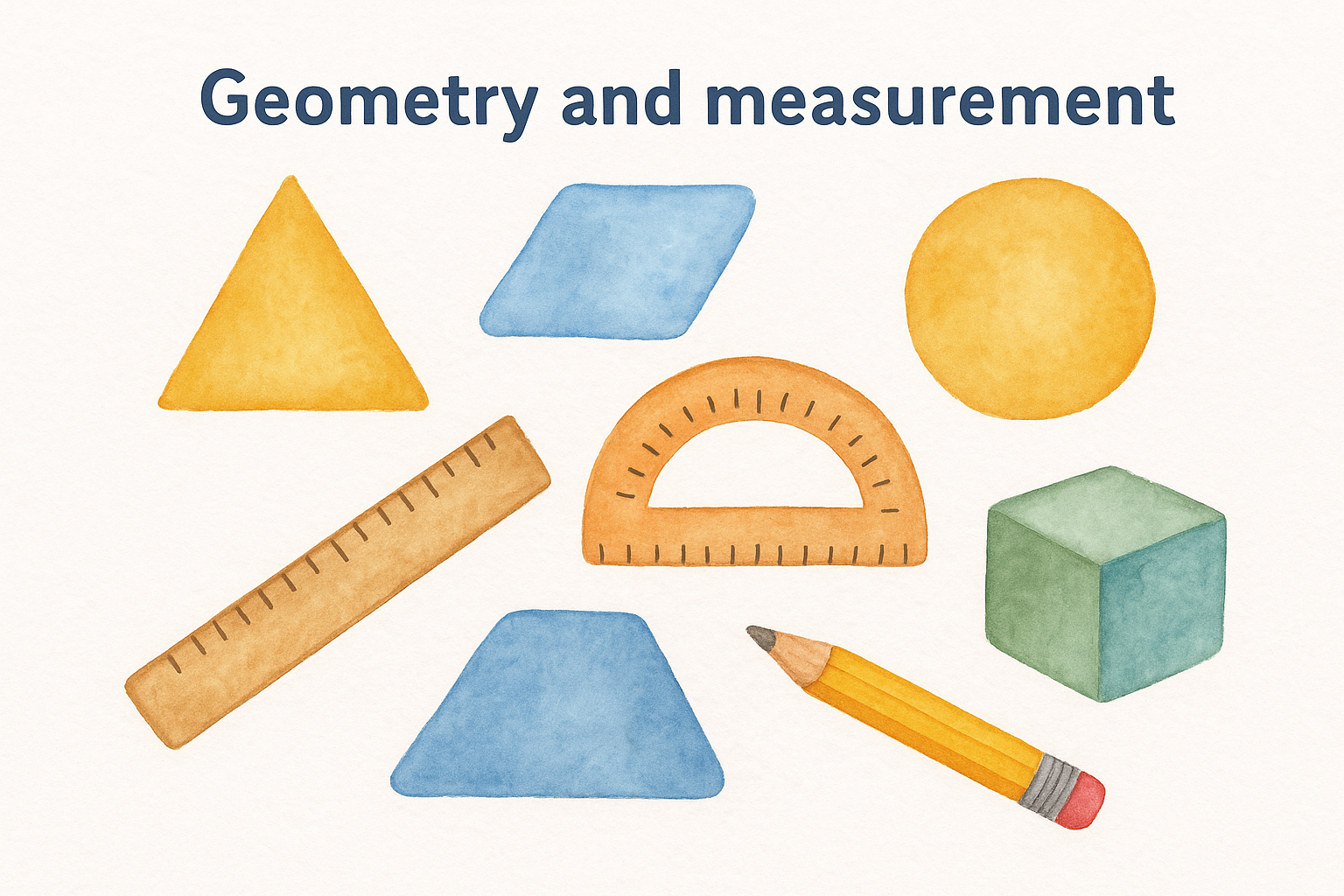
Geometry rewards students who can see math, not just calculate it.
Positive comments
These comments describe students who visualize shapes accurately and measure with precision and confidence.
- Identifies and classifies shapes and their properties with confidence.
- Uses measurement tools accurately, including rulers, protractors, and scales.
- Calculates area and perimeter correctly across a variety of shapes.
- Demonstrates strong spatial reasoning when working with 2D and 3D figures.
- Applies geometry concepts to real-world situations with ease.
- Understands and uses angle relationships accurately in problem-solving.
Needs improvement comments
Use these for students who mix up shape properties, misread measurement tools, or need more hands-on practice before formulas click.
- Struggles to identify properties of shapes, particularly with more complex figures.
- Needs more practice using measurement tools accurately.
- Confuses formulas for area and perimeter.
- Has difficulty visualizing 3D shapes and their nets.
- Would benefit from hands-on practice with angles and geometric relationships.
- Struggles to choose the appropriate unit of measurement for a given task.
7. Data, graphs, and charts
Data literacy shows up everywhere once you start looking, from reading a bar graph in a science textbook to interpreting a chart on the news. Graph reading skills reveal whether a student can pull accurate information from a visual and use it to answer a question, not just recognize that a chart exists. Creating graphs is a separate skill worth watching too, since a student can label axes correctly but still misrepresent the data inside them. Report card comments for math in this category should note whether a student reads critically or just glances at the picture and guesses.
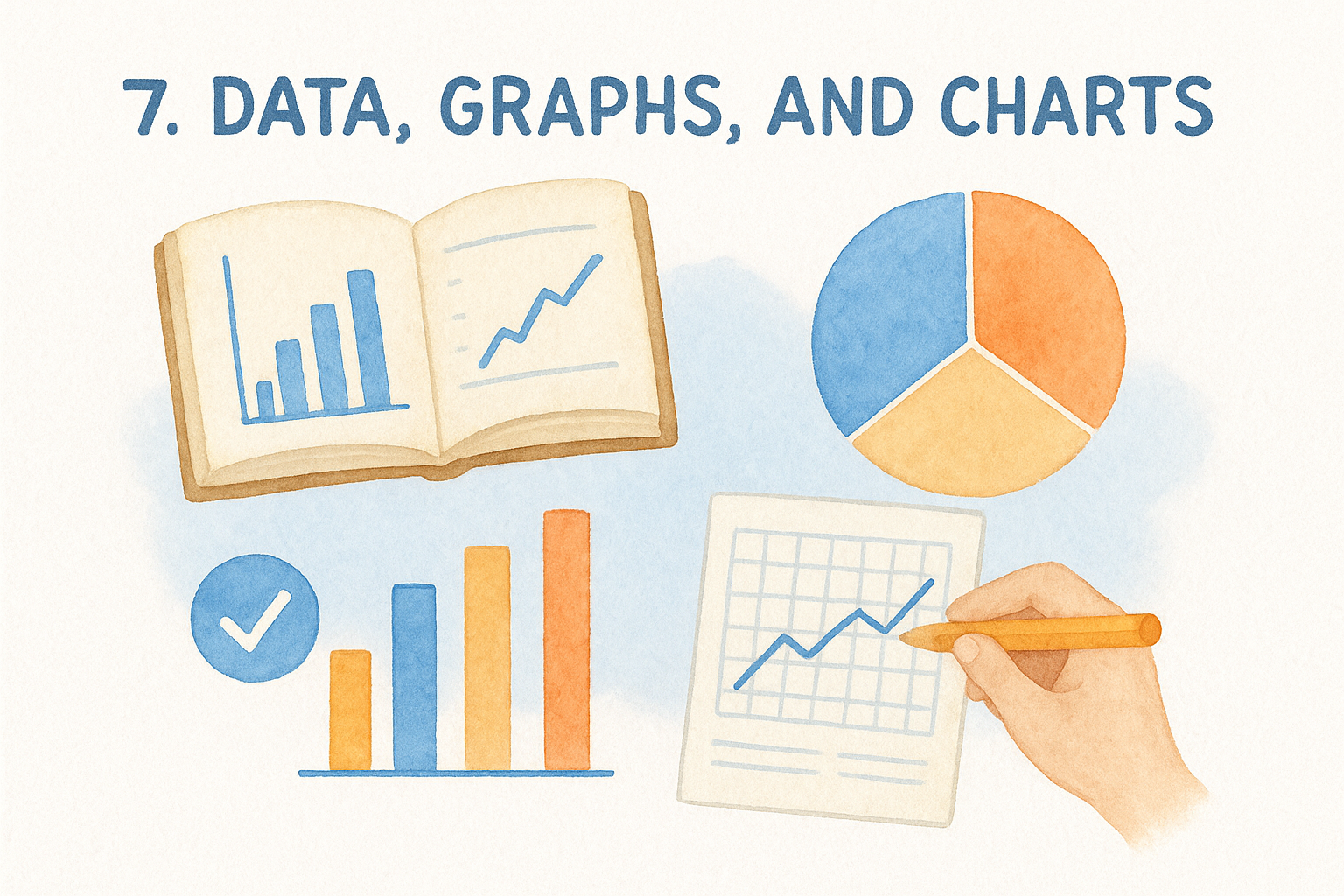
A student who can read a graph accurately can often reason about real-world information better than one who just computes well.
Positive comments
These comments fit students who read, interpret, and construct graphs accurately and can pull specific conclusions from data sets.
- Reads and interprets bar graphs, line graphs, and pictographs accurately.
- Creates clear, accurate graphs with correctly labeled axes and titles.
- Draws valid conclusions from data, showing strong data analysis skills.
- Understands and calculates mean, median, and mode correctly.
- Compares data sets and explains differences and trends clearly.
- Applies data interpretation confidently to solve real-world problems.
Needs improvement comments
Use these for students who can build a graph but struggle to draw meaning from it, or who misread scales and labels.
- Struggles to interpret information presented in bar graphs and charts.
- Needs more practice labeling axes and titles correctly when creating graphs.
- Has difficulty calculating mean, median, and mode accurately.
- Confuses scale and intervals when reading graphs, leading to misinterpretation.
- Would benefit from more practice drawing conclusions from data sets.
- Needs support connecting graphed data to real-world questions or problems.
8. Money and time skills
Money and time are the two math skills students use the moment they leave your classroom, whether that’s counting change at a store or reading a clock to catch the bus. Practical math application is exactly what this section measures, since these skills rarely show up in isolation the way algebra does. A student can be strong with abstract computation and still fumble making change or telling time to the nearest five minutes, because these tasks demand quick, real-world thinking rather than a worked-out procedure on paper. Report card comments for math should call this out specifically, since parents often notice these gaps at home before they ever show up on a test.
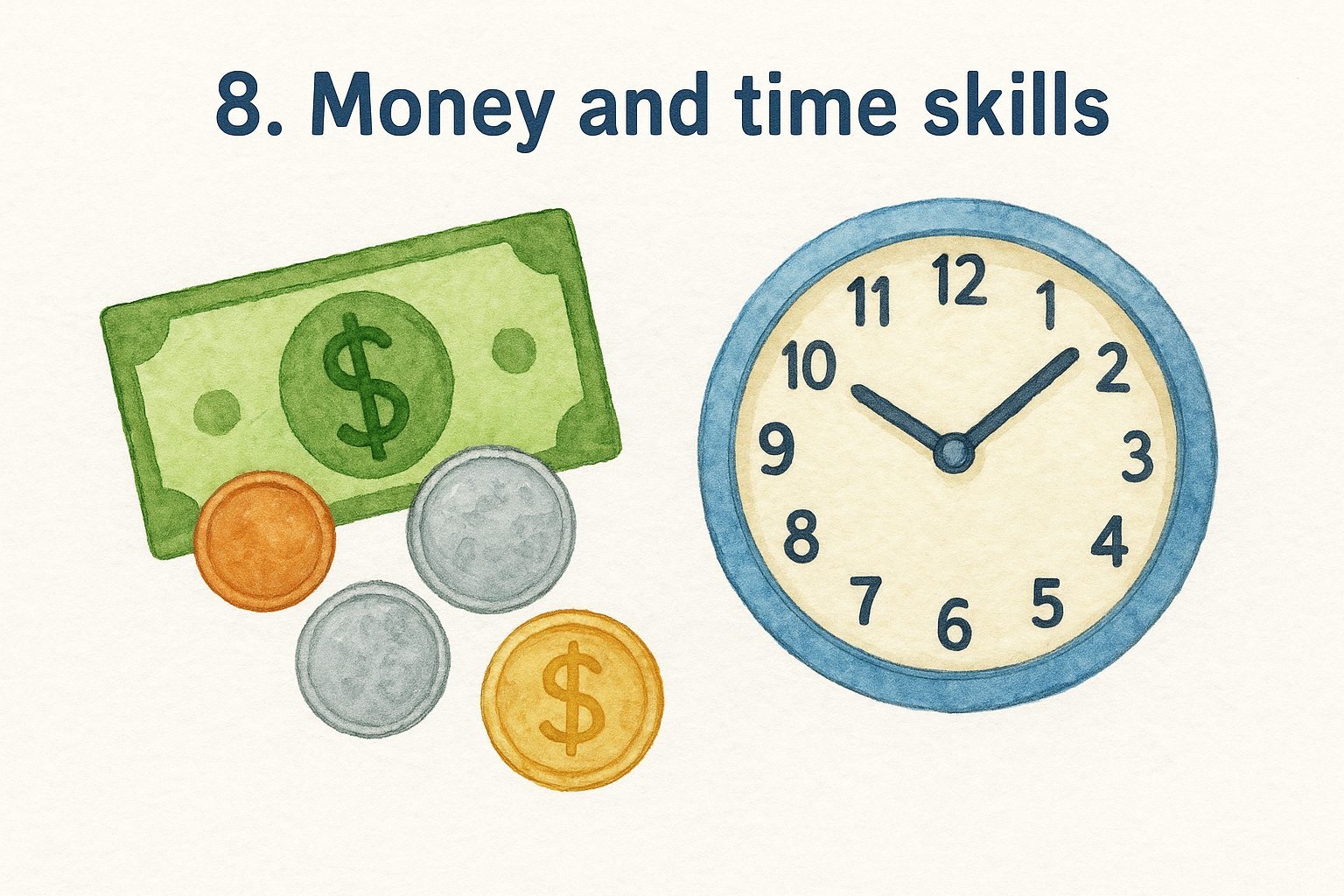
Money and time skills show whether math actually works outside the classroom.
Positive comments
These comments describe students who apply money and time concepts accurately and without hesitation, whether they’re counting coins or reading an analog clock.
- Counts and calculates money accurately, including making correct change.
- Tells time confidently on both analog and digital clocks.
- Solves elapsed time problems correctly, including across the hour.
- Applies money skills to real-world scenarios, such as budgeting and shopping problems.
- Understands and converts between units of time with ease.
- Demonstrates strong practical application of money and time concepts.
Needs improvement comments
Use these for students who understand the concept in theory but still make errors when money or time problems require quick, applied thinking.
- Struggles to make correct change in money-based problems.
- Has difficulty reading analog clocks accurately.
- Needs more practice calculating elapsed time.
- Confuses units of time, particularly when converting between them.
- Would benefit from hands-on practice with coins and bills.
- Struggles to apply money concepts to real-world word problems.
9. Class participation and collaboration
Math class runs on discussion just as much as computation, since students learn a lot from explaining their thinking to a partner or defending an answer in a group. Participation habits tell you whether a student engages with math socially, sharing ideas, asking questions, or helping a classmate work through a tricky problem. Collaboration also reveals confidence level in ways a worksheet never will, since a student might compute perfectly alone but shut down the moment they’re asked to explain their steps out loud. Report card comments for math in this category give parents a window into how their child shows up during group work, not just how they perform on a quiz.
How a student talks about math often reveals more than how they solve it silently.
Positive comments
These comments describe students who contribute actively to discussions and support classmates during group math tasks.
- Participates actively in math discussions, offering ideas and asking thoughtful questions.
- Works well with peers during group problem-solving activities.
- Willingly shares strategies and helps classmates understand difficult concepts.
- Listens respectfully to others’ ideas and builds on them during class discussions.
- Volunteers to explain reasoning at the board, showing strong communication skills.
- Collaborates effectively, taking on a fair share of group work responsibilities.
Needs improvement comments
Use these for students who hesitate to speak up, dominate group work, or struggle to work productively with peers.
- Rarely participates voluntarily during math discussions.
- Needs encouragement to share thinking with the whole class.
- Struggles to collaborate productively during group activities.
- Tends to work independently rather than engage with assigned partners.
- Would benefit from practicing how to listen and respond to classmates’ ideas.
- Needs support taking turns and sharing responsibility during group math tasks.
10. Work habits and time management
How a student manages their math work says almost as much as their test scores. Time management skills show up in whether a student finishes assignments within the class period, checks work before turning it in, or leaves half a worksheet blank because they ran out of time on problem three. Organization matters here too, since a student who tracks assignments and shows up with materials ready has an easier path through every unit than one who’s constantly searching for a pencil or a missing handout. Report card comments for math in this section give parents a practical, actionable picture, something they can actually address at home rather than a vague nudge toward "trying harder."
Strong work habits often predict math success better than raw ability does.
Positive comments
These comments fit students who manage their time well, stay organized, and complete work independently without constant reminders.
- Manages class time effectively, completing assignments within the given period.
- Keeps math materials organized and ready for each lesson.
- Completes and submits homework consistently and on time.
- Works independently and stays on task without frequent reminders.
- Uses class time wisely, avoiding unnecessary distractions.
- Plans ahead for longer assignments, breaking them into manageable steps.
Needs improvement comments
Use these for students who lose track of assignments, rush through work, or need frequent redirection to stay on task.
- Struggles to complete classwork within the allotted time.
- Needs reminders to stay organized with math materials and assignments.
- Frequently submits homework late or incomplete.
- Requires frequent redirection to remain on task during independent work.
- Would benefit from breaking larger tasks into smaller, manageable steps.
- Rushes through assignments, which affects overall accuracy.
11. Growth and improvement over time
Growth comments do a job no other section on the report card can do: they compare a student to their own past self, not to grade-level standards or classmates. Progress tracking matters most for kids who started the term behind and worked their way up, even if they haven’t hit grade level yet, because raw scores alone erase that effort completely. It also matters for parents who watched their kid struggle at home and need to hear that the work paid off. Good report card comments for math should name the starting point and the shift, not just the current state, so the improvement actually registers as real progress.
Growth comments tell parents the story a single grade never can.
Positive comments
These comments highlight students whose math skills or confidence have visibly improved since the start of the term, even if they still have room to grow.
- Has made significant progress in math since the beginning of the term.
- Shows growing confidence when tackling new or challenging concepts.
- Improved accuracy and speed with practice and consistent effort.
- Built stronger problem-solving skills compared to earlier in the year.
- Demonstrates clear growth in independent work habits.
- Closed several skill gaps through consistent practice and effort.
Needs improvement comments
Use these for students whose progress has stalled, or whose growth hasn’t kept pace with the rest of the class despite support.
- Has shown limited progress in key math skills this term.
- Needs continued support to close existing skill gaps.
- Progress has been inconsistent, with some weeks stronger than others.
- Would benefit from targeted practice to build on recent small gains.
- Has not yet closed the gap in foundational math skills.
- Growth has slowed, and consistent effort is needed to maintain earlier gains.
12. Areas for growth and next steps
Some comments need to look forward, not just backward, and that’s what this final skill area covers. Forward-looking comments name a specific target for next term, whether that’s a skill to master or a habit to build, so the comment reads as a plan rather than a verdict. Parents want to know what comes next, not just where their child stands today, and these lines give them something concrete to support at home. Rounding out your report card comments for math with a clear next step turns the whole page into a roadmap instead of a scorecard.
A comment that names the next step is more useful than one that only grades the last one.
Positive comments
These comments fit students who are already doing well but have a clear, specific direction for stretching further.
- Is ready to take on more advanced problem-solving and deeper challenges next term.
- Would benefit from exploring enrichment activities to extend current math skills.
- Should continue building on strong foundational skills with more independent challenges.
- Is well-positioned to move into more complex applications of current concepts.
- Could take on a leadership role in group math tasks going forward.
- Should be encouraged to pursue deeper exploration of favorite math topics.
Needs improvement comments
Use these when a student needs a specific, achievable target rather than a vague push to "do better."
- Should focus on strengthening fact fluency before moving to new material.
- Needs targeted practice with multi-step word problems next term.
- Would benefit from a daily practice routine to build consistency.
- Should work on checking work carefully before submitting assignments.
- Needs to build confidence through smaller, achievable math goals.
- Should prioritize closing gaps in place value before advancing further.
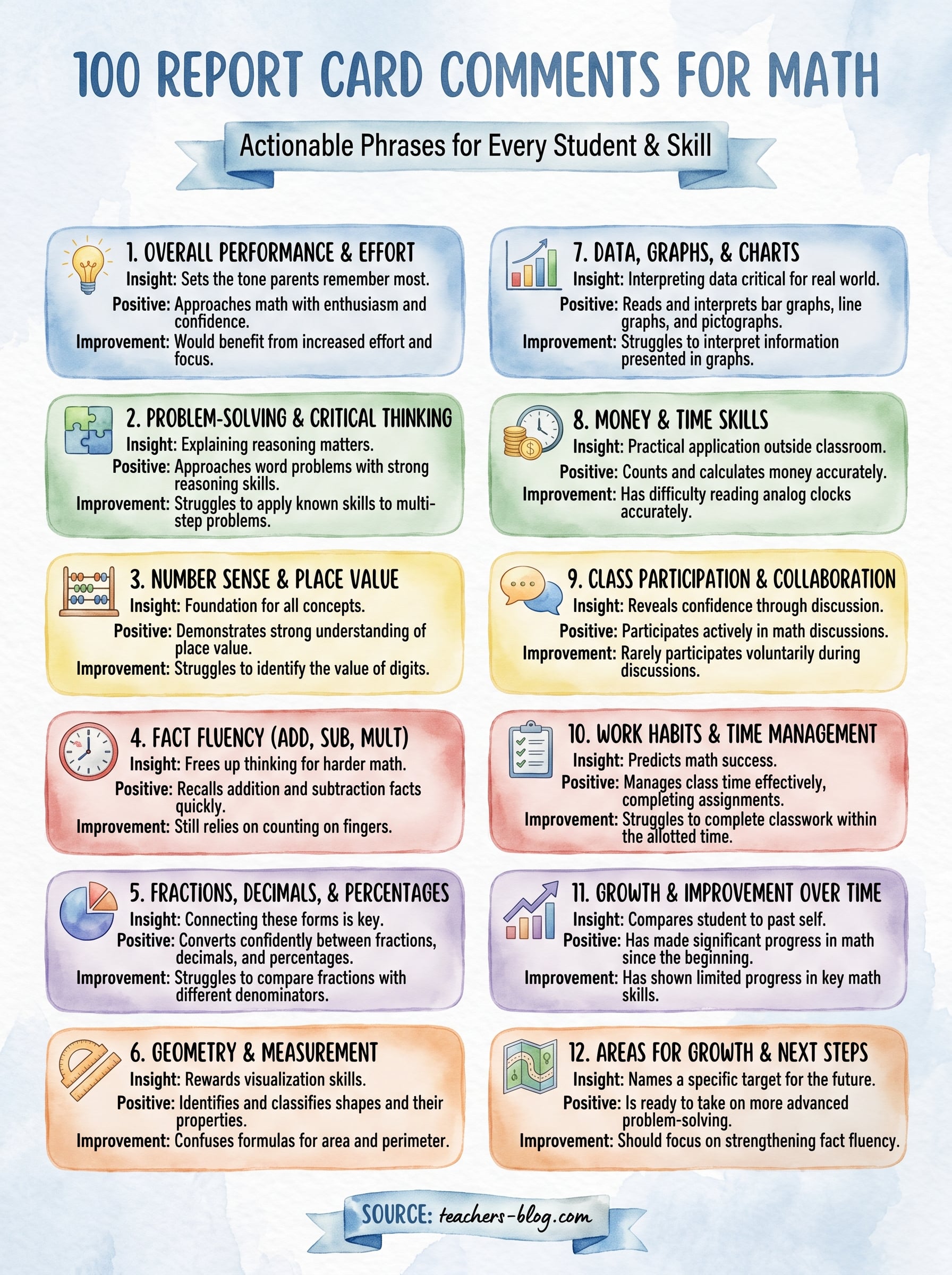
Making report card comments count
You’ve got 100 phrases now, but the real work is picking the right one for the right kid. Grab a comment, swap in the name, then tweak a word or two so it sounds like you wrote it about that specific student, not a template. Report cards land in parents’ hands as one of the few direct windows into their child’s math progress, so a comment that’s specific and honest carries more weight than five generic lines strung together.
Zero in on what actually happened this term: the fraction unit where a student clicked, the fact fluency that still needs work, the group project where they finally spoke up. That’s what turns a report card comment into something a parent reads twice.
Need more tools to lighten the load beyond comment season? Visit The Cautiously Optimistic Teacher for AI-powered classroom tools and teaching resources built for exactly this kind of everyday grind.