Learning Targets And Success Criteria Examples For Lessons
You wrote an objective on the board. Students copied it down, or pretended to. And then everyone moved on without a second thought. Sound familiar? The gap between posting a learning objective and actually using it to drive instruction is where most lessons quietly fall apart. That’s exactly why learning targets and success criteria examples matter so much. When done right, they turn a vague goal into a clear roadmap that both you and your students can follow.
Learning targets tell students what they’re going to learn. Success criteria tell them how they’ll know they learned it. Together, they create a feedback loop that makes formative assessment natural rather than forced. Students stop asking "what are we doing today?" and start understanding where they’re headed and what quality work actually looks like.
At The Cautiously Optimistic Teacher, we build practical resources that help educators teach with more clarity and less guesswork. This article breaks down what learning targets and success criteria actually are, shows you how to write them well, and gives you ready-to-use examples across subjects and grade levels so you can put them into practice tomorrow.
Learning targets vs success criteria
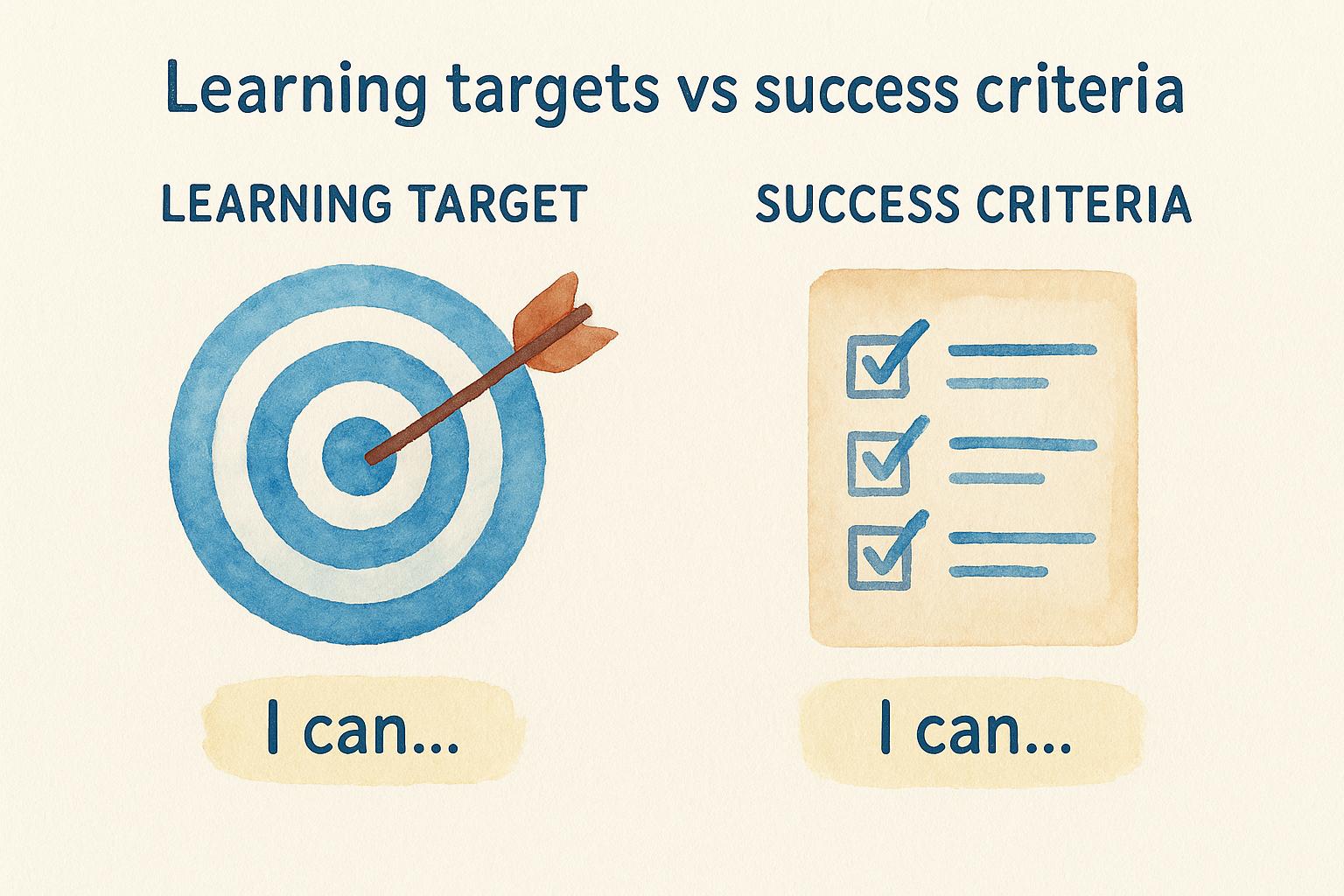
People use learning targets and success criteria interchangeably, but they serve different functions in a lesson. Treating them as the same thing is one of the most common mistakes teachers make, and it blurs the line between what students are supposed to learn and how they’ll prove they learned it.
What is a learning target?
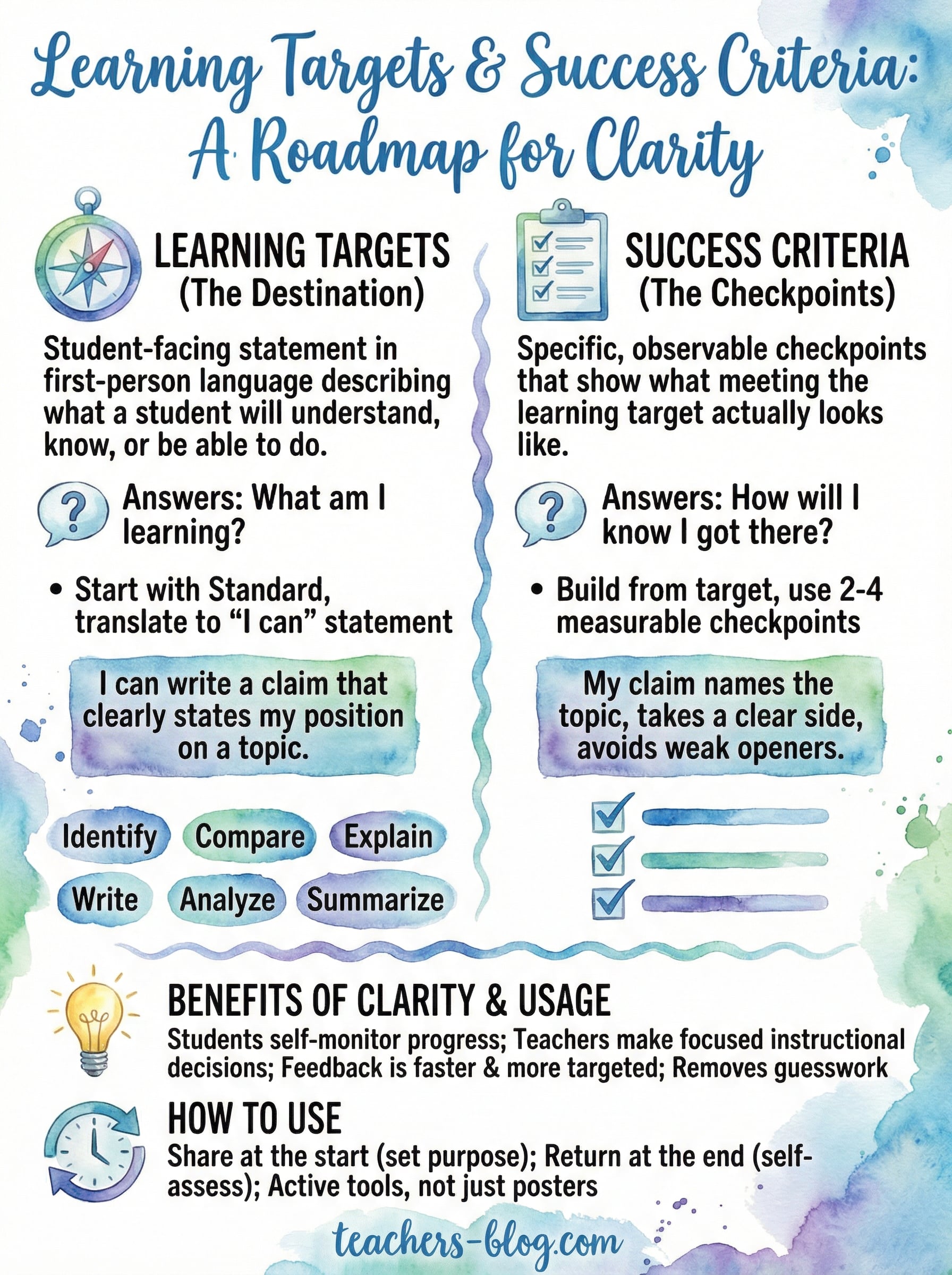
A learning target is a student-facing statement written in first-person language that describes what a student will understand, know, or be able to do by the end of a lesson or unit. It comes directly from your standards or curriculum goals, but it’s translated into language your students can actually read and use. Instead of posting "CCSS.ELA-LITERACY.W.7.1" on the board, you write "I can write a claim that takes a clear position on a topic." That shift in language puts the goal in the student’s hands.
A learning target describes the destination, not the journey.
What are success criteria?
Success criteria are the specific, observable checkpoints that tell students what meeting the learning target actually looks like in practice. Where a learning target answers "what am I learning?", success criteria answer "how will I know I got there?" For a writing lesson, your success criteria might list a clear claim sentence, at least two pieces of evidence, and a concluding statement that connects back to the claim. These concrete benchmarks give students something to self-assess against before they turn in their work.
When you look at strong learning targets and success criteria examples, the pattern is consistent: the target is broad and goal-oriented, while the criteria are narrow and measurable. Both matter, but they do different jobs. Keeping them separate in your planning forces you to think clearly about both what you want students to learn and what evidence will actually show you they got there.
Why clarity matters for students and teachers
When students don’t understand what they’re working toward, they can’t gauge their own progress or ask useful questions. Clear learning targets and success criteria examples solve this problem at the source by making the invisible visible for everyone in the room.
For students
Clarity removes the guesswork that frustrates learners. When students see exactly what they need to demonstrate, they shift from passive participation to active self-monitoring. Research consistently shows that students who understand what quality work looks like produce more focused and higher-quality outputs than students who are simply told to "do their best."
Students can only hit a target they can see.
For teachers
Precision benefits you just as much as it benefits your students. When your learning target is specific, your instructional decisions sharpen automatically. You stop adding activities because they seem engaging and start choosing tasks that actually move students toward the goal. Feedback becomes faster and more targeted because you already know what you’re measuring. You also spend less time re-explaining vague expectations and more time responding to real student work. Over time, teachers who use clear success criteria consistently report that grading feels less like guesswork and more like confirmation of what they already noticed during class.
How to write learning targets and success criteria
Writing strong learning targets starts with your standard, but it ends with your student. You need to translate curriculum language into something a real learner can read, understand, and use independently. The formula is straightforward: strip the academic code out of the standard and rebuild it in first-person, student-facing language.
Start with the standard
Pull the core skill or knowledge directly from your standard, then ask yourself what a student needs to do to demonstrate that skill. Rewrite it as an "I can" statement using plain, specific language your grade level actually uses. Skip vague verbs and replace them with observable ones instead.
The cleaner your target language, the easier your criteria are to write.
Strong verbs for learning targets include:
- Identify
- Compare
- Explain
- Write
- Analyze
- Summarize
Build your success criteria from the target
Once your target is clear, break it into two to four checkpoints that show what meeting it looks like in practice. Each checkpoint should describe something you can actually observe or measure in student work. Reviewing existing learning targets and success criteria examples from your subject area helps you calibrate whether your criteria are specific enough without turning into a full rubric.
A simple checklist format works well for students. Keep each criterion to one sentence and use the same observable verb style you used in the target.
Examples across subjects and grade levels
Seeing learning targets and success criteria examples from multiple subject areas helps you calibrate your own writing and gives you a ready starting point to adapt right away. The examples below cover both middle and high school levels across three core subjects.
The best examples are ones you can borrow, adjust, and use by next period.
English Language Arts
Strong ELA targets focus on reading, writing, or speaking skills that students can demonstrate directly in their work. Here is a classroom-ready example:
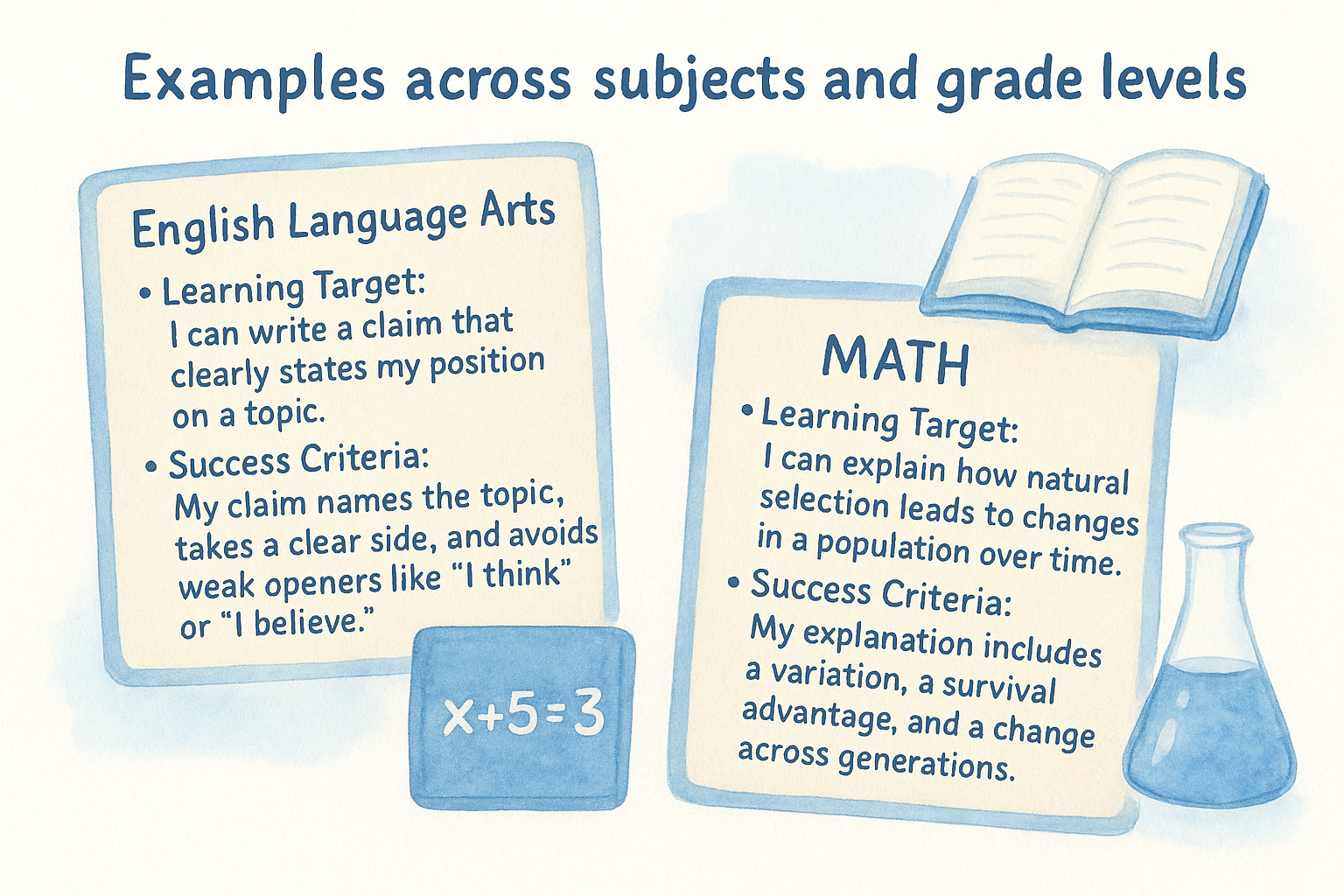
- Learning Target: I can write a claim that clearly states my position on a topic.
- Success Criteria: My claim names the topic, takes a clear side, and avoids weak openers like "I think" or "I believe."
Math
Math targets work best when they name the specific operation or concept students will practice during the lesson. A seventh-grade example:
- Learning Target: I can solve one-step equations using inverse operations.
- Success Criteria: I show each step, apply the correct inverse operation, and check my answer by substituting it back into the original equation.
Science
Science criteria often need to address both content knowledge and process skills because students must understand concepts and apply them together. A high school example:
- Learning Target: I can explain how natural selection leads to changes in a population over time.
- Success Criteria: My explanation includes a variation, a survival advantage, and a change across generations.
How to use them in daily lessons
Posting your target on the board is a start, but what you do with it throughout the lesson determines whether it actually changes student behavior. The most effective teachers treat learning targets and success criteria as active tools they return to repeatedly, not one-time announcements they forget five minutes into instruction.
Share them at the start of class
Before you give any direct instruction, read the learning target aloud with your students. Ask them to predict what the lesson might involve based on what the target says. This move activates prior knowledge and sets a clear purpose for everything that follows. Students who understand the destination before the journey starts stay more focused when the work gets hard and are quicker to ask specific questions when they get stuck.
Students who know the target from the start are more likely to self-correct before you need to intervene.
Return to them before the lesson ends
Reserve the last three to five minutes of class to come back to your success criteria. Ask students to check their work against each criterion and identify one thing they met and one area they still need to strengthen. This low-stakes self-assessment gives you real-time formative data without adding a separate task. Regularly revisiting learning targets and success criteria examples alongside student work also helps your class build a shared understanding of what quality looks like across the whole unit.
Wrap up and plan tomorrow
Learning targets and success criteria are not extra work layered on top of your lesson. They are the structural core that makes everything else in your lesson work harder. When you write a clear target and pair it with specific, observable criteria, you give students a tool they can actually use to monitor their own progress and ask better questions before the work falls apart.
The examples in this article give you a starting point, but the real skill comes from practicing the writing yourself. Pull one standard from tomorrow’s lesson, strip out the academic language, and rebuild it as an "I can" statement. Then write two or three criteria that describe what meeting it looks like. That small planning shift compounds quickly across a unit.
If you want more practical resources that help you teach with less guesswork and more clarity, explore what The Cautiously Optimistic Teacher has to offer.