8 Kinesthetic Teaching Strategies That Actually Engage Students
You’ve got the kid who can’t sit still, the one tapping a pencil, the one who learns best when their hands are moving. Sitting through a lecture doesn’t work for them, no matter how good your slides are. That’s where kinesthetic teaching strategies come in, and they’re not just a nice-to-have for a handful of restless students. They change how much information sticks for everyone in the room.
If you’re searching for ways to reach kinesthetic learners, you need activities that get bodies moving while content actually gets learned, not just busywork disguised as fun, which is exactly what accommodating diverse learning styles looks like in practice. That means structured movement built into your lesson objectives, plus hands-on tasks that replace passive note-taking without turning your classroom into chaos.
Below are eight strategies I’ve used and refined in real classrooms, from vocabulary charades to gallery walks and role-play debates. Each one gives kinesthetic learners a reason to get up, touch something, or act something out, while still hitting the standards you’re accountable for. Pair these with tools like our Differentiated Instruction Helper and other ways of using AI to differentiate instruction, and you’ve got a lesson plan that works for the movers, not just the sitters.
1. Hands-on experiments and simulations
Hands-on experiments put physical experimentation at the center of the lesson instead of treating it as a reward for finishing early. Students mix, build, measure, and observe, which means the learning happens through their hands before it ever gets written down. This is one of the most reliable kinesthetic teaching strategies, and one of the strongest active learning strategies for teachers, because it mirrors how scientists, engineers, and researchers actually work.
When students build the knowledge with their own hands, they remember it long after the worksheet is gone.
How it works
Start with a question students can test physically rather than answer from a textbook. Give them materials, a clear procedure, and a way to record what happens. Then let them run the experiment or simulation themselves in small groups, with you circulating to ask questions rather than lecturing. The goal is guided discovery, one of the classic inquiry based learning methods, where you set the boundaries but the students do the touching, mixing, and measuring.
Best subjects and grade levels
Science classes are the obvious fit, but this strategy stretches further than most teachers realize:
- Elementary and middle school science: density towers, volcano reactions, plant growth trials
- High school chemistry and physics: titrations, circuit building, momentum labs
- Math: probability simulations using dice or cards, geometry with physical shapes
- Economics or social studies: market simulations, supply-and-demand role trading
Materials and prep
Most experiments need common classroom or household items: baking soda, vinegar, cups, string, rulers, batteries, or simple manipulatives you already have on hand. Budget prep time for testing the experiment yourself first. Failed demonstrations in front of a class kill momentum fast, so run it once at home or during a prep period before students touch anything.
Tips for success
Keep groups small, three or four students, so everyone gets hands-on time instead of watching one classmate do all the work. Write the procedure steps on the board or a handout so students aren’t waiting on you for instructions mid-experiment. Build in a five-minute reflection at the end where students write or discuss what they observed, connecting the physical activity back to the concept you’re teaching. If you need a quick recording sheet or lab worksheet tailored to the experiment, an AI worksheet generator can build one from your keywords in seconds, saving you the prep time for the parts of the lesson that actually need your attention.
2. Role-playing and historical reenactments
Role-playing turns abstract history or literature into something students physically live through instead of just read about. Kinesthetic learners grasp cause and effect faster when they’ve argued a case, negotiated a treaty, or acted out a scene, because the emotional and physical memory of the activity anchors the facts. Among kinesthetic teaching strategies, this one does double duty: it builds empathy and perspective-taking while cementing content.
Students remember the treaty they negotiated far longer than the one they only read about.
How it works
Assign students specific roles tied to real historical figures, literary characters, or opposing viewpoints on an issue. Give each student or small group a role card with goals, background, and constraints, then set up a scenario, a trial, a debate, a mock congress, or a scene from a novel, where they have to act, speak, and move within that role. You act as facilitator, nudging the scenario forward and asking follow-up questions that push deeper thinking.
Best subjects and grade levels
This fits history and social studies most naturally: mock trials, constitutional conventions, or reenacting pivotal negotiations. It also works well in English class for scenes from novels like To Kill a Mockingbird or Lord of the Flies, where students can physically stage a courtroom scene or tribal council. Middle and high schoolers tend to engage more deeply since they can handle nuanced roles and sustained argument.
Materials and prep
Role cards, simple props, and a rearranged classroom layout are usually enough. Spend prep time writing clear, specific role instructions so students know their motivations and limits before the scene begins.
Tips for success
Set ground rules for respectful disagreement before starting, especially with sensitive historical topics. Debrief afterward, connecting the reenactment back to the real historical outcome or textual evidence.
3. Building models and using manipulatives
Manipulatives give students something physical to hold while their brain works through an abstract idea. Physical models turn fractions, molecules, and cell structures into objects you can rotate, stack, and rebuild when the first attempt goes wrong. This is one of the simplest kinesthetic teaching strategies to start using tomorrow, since most classrooms already have blocks, counters, or clay somewhere in a supply closet.
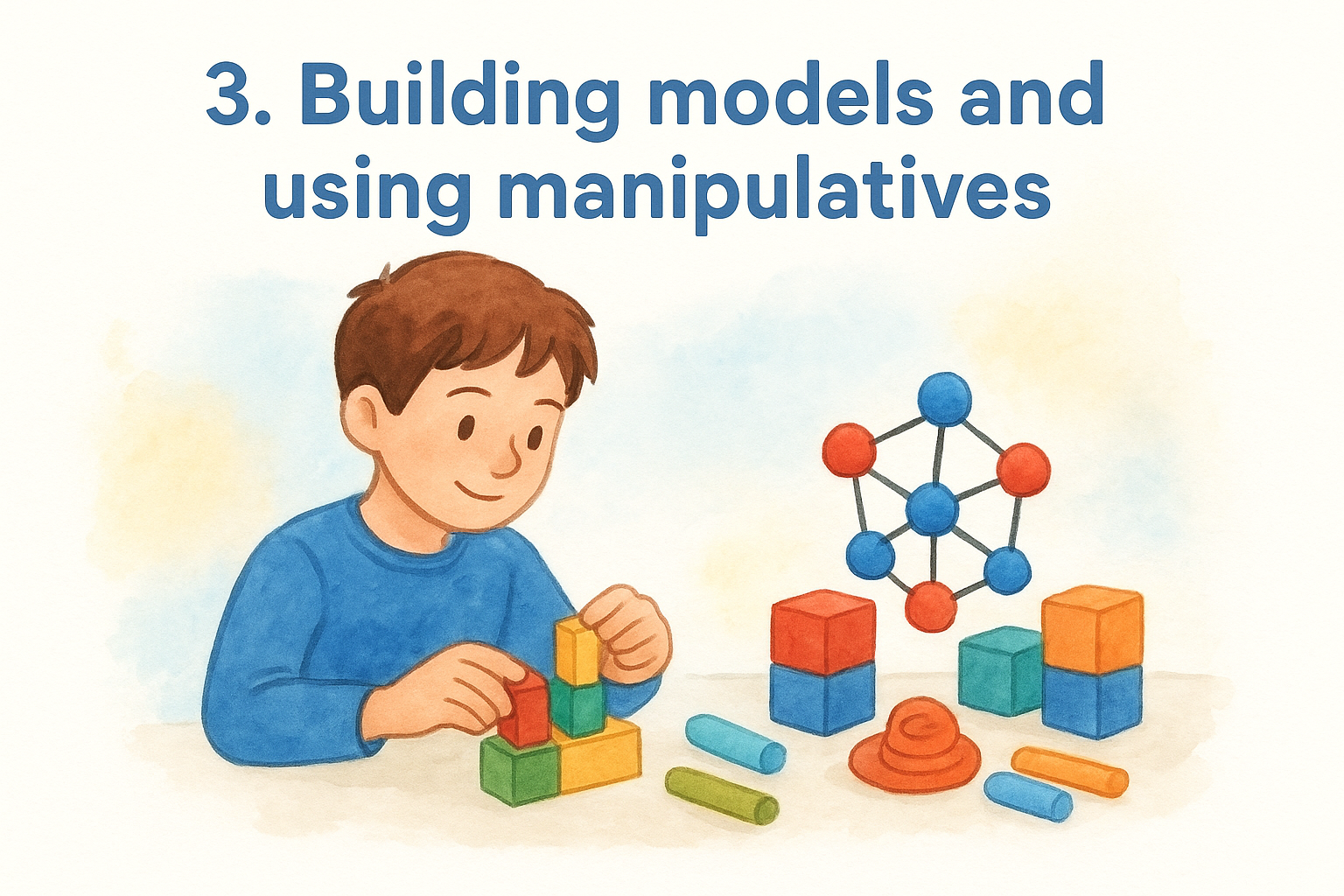
A model you can rebuild teaches more than a diagram you can only stare at.
How it works
Give students a target structure or concept, then let them build a physical version of it using blocks, clay, straws, or magnetic tiles. Mistakes show up immediately because the model won’t stand, balance, or match the proportions, and students fix the error with their hands instead of erasing a worksheet.
Best subjects and grade levels
Math benefits most obviously, fraction bars, base-ten blocks, geometric solids, and manipulatives are a cornerstone of differentiated instruction for math, but the approach reaches further. Elementary science classes build food chains and water cycles with craft materials, while middle schoolers construct DNA strands or atomic models. High school students can model bridges, circuits, or historical architecture for engineering and social studies units.
Materials and prep
Stock a bin with reusable manipulatives: counting blocks, modeling clay, pipe cleaners, and toothpicks cover most needs across subjects. Sort materials into group sets ahead of time so distribution doesn’t eat into building time.
Tips for success
Assign each group member a specific job, builder, materials manager, recorder, so nobody stands around watching. Require a quick explanation of the finished model, since verbalizing the structure locks in the concept behind it.
4. Learning stations and rotation activities
Learning stations break a lesson into physical zones, forcing students out of their seats every ten to fifteen minutes instead of staying anchored to one desk for an hour. Rotation activities work because they combine movement with variety, so kinesthetic learners get the physical reset they need while covering multiple skills or subtopics in a single period. This is one of the more flexible kinesthetic teaching strategies because you can scale it up or down depending on room size and prep time, and station rotations for differentiated instruction let you tier the tasks at the same time.
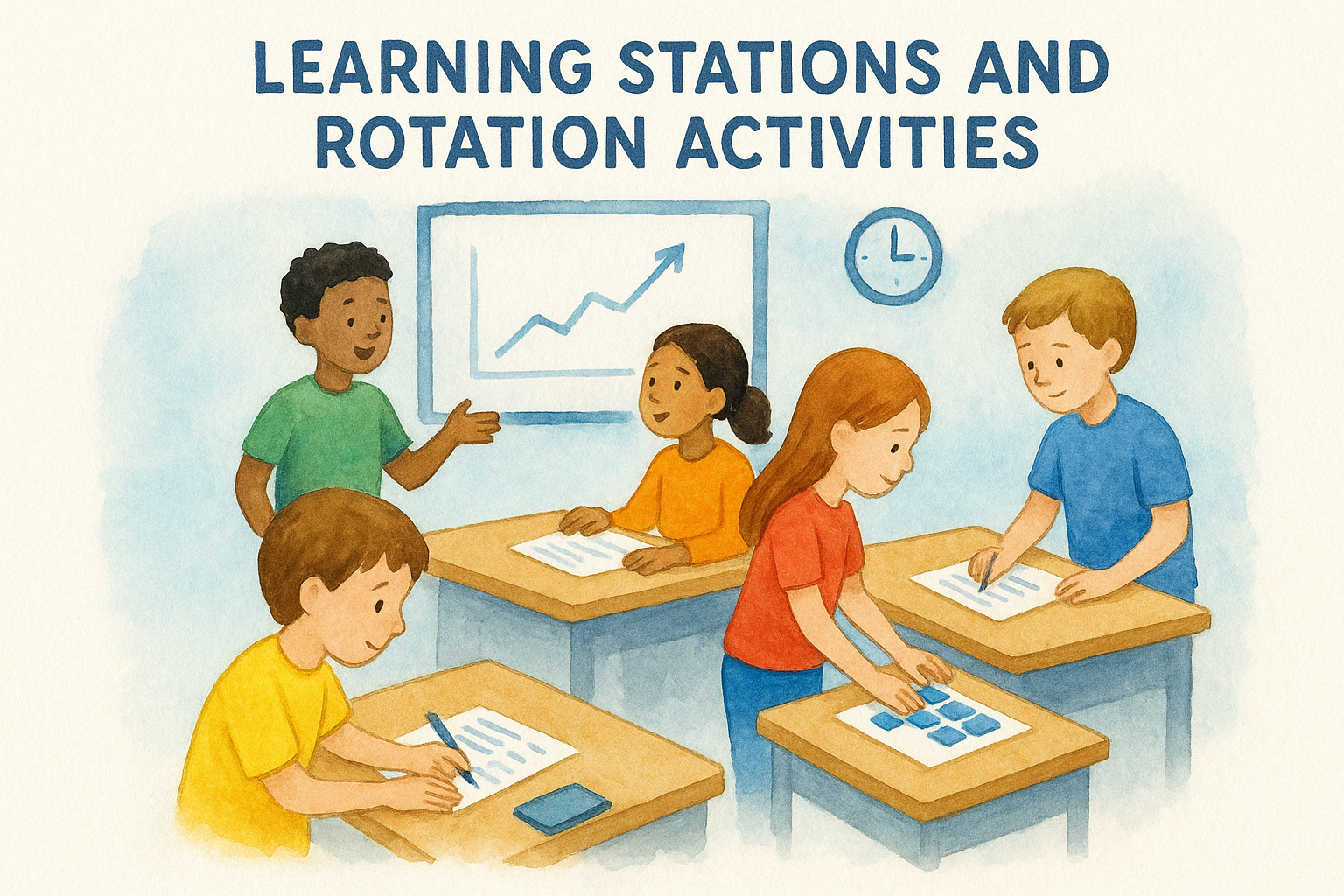
A student who moves every fifteen minutes stays sharper than one glued to a desk all hour.
How it works
Set up four to six stations around the room, each with a distinct task tied to the same lesson objective. Group students into small teams, give each group a set amount of time per station, and signal rotations with a timer or bell. Some stations can be hands-on builds, others can be short problem sets or discussion prompts, but each one should require students to physically get up and relocate.
Best subjects and grade levels
Elementary classrooms use stations constantly for literacy and math centers, but middle and high school subjects adapt just as well: science lab rotations, vocabulary and grammar stations in English, or primary-source analysis stations in history.
Materials and prep
Each station needs its own instructions, materials, and answer key, so prep upfront is heavier than a single whole-class activity. Laminated task cards save you from reprinting every unit.
Tips for success
Keep rotation groups small, three or four students, and post a visual timer so transitions stay smooth without you calling out every switch.
5. Movement breaks and brain-based transitions
Movement breaks give the brain a reset button between heavier chunks of instruction, using short bursts of physical activity to fight off the fidgeting that shows up around minute twenty of any lesson. Brain-based transitions aren’t downtime, they’re built on the same research behind other brain-based learning strategies, showing that physical activity boosts blood flow and attention, which means the next chunk of content actually lands. Of all the kinesthetic teaching strategies on this list, this is the easiest to drop into any classroom tomorrow with zero extra planning.
A ninety-second stretch can buy you ten more minutes of real attention.
How it works
Insert a two to five minute movement activity between lesson segments, a stretch sequence, a quick stand-up-and-high-five, or a call-and-response set of jumping jacks tied to vocabulary words. Time it before attention visibly drops, not after, so you’re preventing the slump instead of reacting to it.
Best subjects and grade levels
This works in every subject and every grade band, since it’s not tied to content, it’s tied to attention span. Younger students benefit from more frequent, shorter breaks, while older students do well with one or two longer resets per class period.
Materials and prep
No materials required, though a timer, a playlist, or a printed list of quick brain breaks helps you stay consistent instead of improvising every day.
Tips for success
Anchor breaks to a signal, a chime, a phrase, so students know exactly when movement starts and stops without confusion eating into instructional time.
6. Educational games and gamified challenges
Games turn practice into something students chase instead of avoid, using competition and physical action to drive repetition that would otherwise feel like a worksheet. Gamification works because the body gets involved, running to a whiteboard, tossing a beanbag, racing a partner, which locks in content review while keeping energy high. Among kinesthetic teaching strategies, this one solves the review-day problem better than almost anything else on this list.
A relay race for vocabulary review beats a quiz every time attention is the goal.
How it works
Pick a physical format, relay races, scavenger hunts, or a life-size board game, then attach academic content to each step. Students answer a question or solve a problem before they’re allowed to move to the next station, tag a teammate, or advance a piece, so the physical reward is tied directly to correct thinking.
Best subjects and grade levels
Vocabulary review, math fact fluency, and grammar practice all adapt easily across elementary and middle school. High schoolers respond well to review games before tests, especially content-heavy subjects like biology terminology or historical timelines, where speed and physical movement make repetition feel less like drilling.
Materials and prep
Most games need only index cards, tape, and a stopwatch. Write questions ahead of time and laminate cards so you can reuse the same set across periods or years.
Tips for success
Set clear physical boundaries before starting, since excitement tends to override spatial awareness fast. Keep score visible so the competitive structure stays motivating without turning chaotic.
7. Outdoor and real-world learning experiences
Taking a lesson outside gives kinesthetic learners space that a classroom desk never will. Outdoor learning lets students walk a distance instead of measuring it on paper, collect real specimens instead of viewing photos, and interact with the actual environment a lesson describes. Among kinesthetic teaching strategies, this one delivers the biggest jump in engagement because novelty and movement combine in a single activity.
A student who measures the schoolyard remembers the math longer than one who only reads the word problem.
How it works
Pick a concept with a physical, observable counterpart nearby: erosion in a schoolyard ditch, plant life cycles in a garden bed, angles and shadows on the blacktop. Walk students through the objective indoors first, then move outside where they collect data, sketch observations, or complete a task tied directly to that objective. Bring the class back in to compare findings and connect the outdoor activity to the standard you’re teaching.
Best subjects and grade levels
Science and environmental studies fit most naturally, think water cycle observations, weather tracking, or ecosystem surveys. Math works too, with geometry in architecture around the building or measurement using the track and field. English classes can hold nature-writing sessions, and social studies can map local history through a walking tour.
Materials and prep
A clipboard, pencil, and simple recording sheet cover most outdoor tasks. Check school policy on outdoor supervision and scout the location beforehand for hazards or distractions.
Tips for success
Set clear behavior expectations before stepping outside, since the open space invites more energy than a classroom. Build in a firm return signal so transitions back indoors don’t eat into the rest of your period.
8. Peer teaching and collaborative physical tasks
Putting students in charge of teaching each other forces them to move, gesture, and demonstrate instead of sitting through another lecture from you. Peer teaching works because explaining a concept out loud while physically walking a classmate through the steps cements the material far deeper than passive listening ever could. Rounding out the list of kinesthetic teaching strategies, this one builds leadership and communication skills right alongside the academic content.
The student who teaches the concept ends up learning it best.
How it works
Pair or group students so one explains a concept while the other physically works through it, solving a problem on a whiteboard, assembling a model, or acting out a process step by step. Rotate roles partway through so every student gets a turn teaching and a turn doing, the same principle behind most cooperative learning techniques. You circulate to catch misconceptions before they spread between partners.
Best subjects and grade levels
Math fits naturally, with one student walking another through solving an equation on a whiteboard. Science labs work well too, since one partner can narrate a procedure while the other performs it. Middle and high schoolers handle this best, since it requires enough content mastery to explain confidently, though upper elementary grades manage simpler tasks like spelling drills or math fact practice.
Materials and prep
Whiteboards, task cards, and a simple rubric for what a good explanation includes are usually all you need. Prep partner pairings ahead of time, matching stronger and developing students thoughtfully.
Tips for success
Model what strong peer teaching sounds like before turning students loose, since collaborative tasks fall apart fast without that example. Check in on quieter pairs, where one partner sometimes does all the talking and moving.
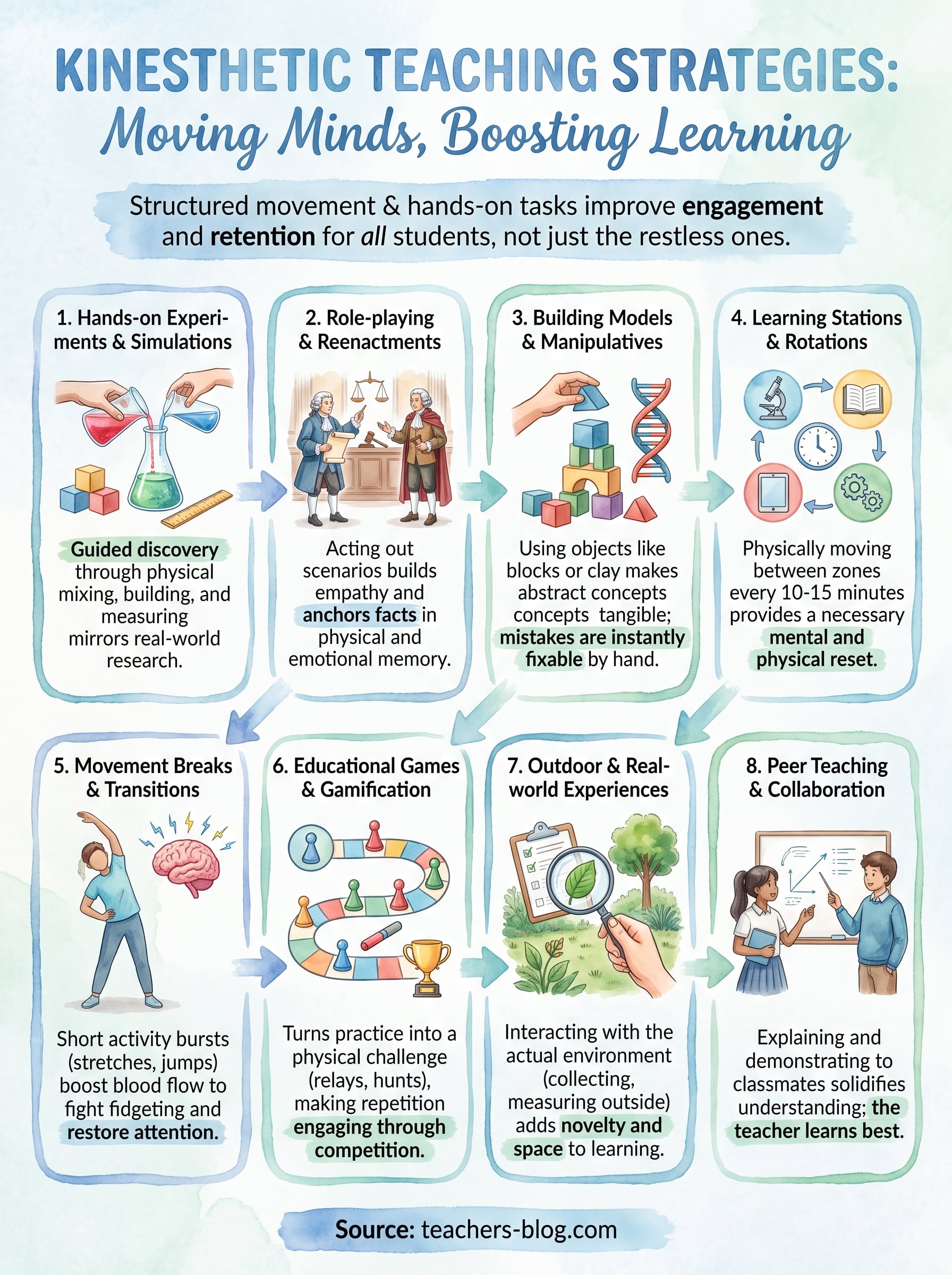
Making movement a natural part of your lessons
You don’t need to overhaul every lesson to reach kinesthetic learners. Start with one strategy this week, a movement break between two chunks of instruction, or a single learning station rotation, and build from there once you see how much sharper the room gets. Kinesthetic teaching strategies work because they respect how a real chunk of your students actually think and learn, not because they’re trendy or flashy.
Building is the part that eats time, though, especially when you’re already juggling grading, planning, and everything else on your plate. That’s exactly why tools built for teachers matter here. If you want lesson plans, worksheets, and differentiated materials that support hands-on activities without adding hours to your prep, try the free AI assistants for teachers on The Cautiously Optimistic Teacher and get your next movement-based lesson built in minutes instead of a weekend.