
How to Prepare for a Teacher Interview and Land the Job
You’ve got the interview scheduled, and now the panic sets in. Learning how to prepare for a teacher interview takes more than rereading your resume the night before. Principals and hiring committees ask pointed questions about classroom management, differentiation, and how you’d handle a parent complaint, and they can tell within minutes who actually walked in ready.
This guide gives you a straightforward path from application to offer letter. You’ll get a realistic prep timeline, the questions that show up in almost every teacher interview, and language for answering them without sounding rehearsed. We also cover the portfolio pieces that make principals remember you after they’ve talked to five other candidates that day.
We built this from watching new and veteran teachers land jobs (and lose them over avoidable mistakes). You’ll walk away with a concrete checklist and sample answers you can adapt to your grade level and subject, whether you’re interviewing for your first classroom or moving to a new district. No vague advice about
Why teacher interview prep makes the difference
Hiring committees interview three to eight candidates for a single opening, and most of them blur together by the end of the day. Teacher interview preparation is what separates the candidate they remember from the one they can’t quite place. A principal isn’t just checking that you know your content. She’s trying to predict how you’ll handle a chaotic Monday morning, a parent email at 9 p.m., or a student who refuses to open a book. Answers that are vague or generic signal that you haven’t thought hard about the actual job.
Committees also move fast. Many districts make an offer within 48 hours of a strong interview, especially for hard-to-fill positions in math, science, or special education. If you show up underprepared, you lose the window entirely, not just that one interview.
The candidates who get hired aren’t the most qualified on paper. They’re the ones who prove, in twenty minutes, that they’ve already thought through the job.
Preparation also calms your nerves, which matters more than people admit. Teacher interview anxiety makes strong teachers ramble, forget classroom examples, or answer a different question than the one asked. Practicing out loud, not just in your head, fixes this. Teachers who rehearse with a friend or record themselves answering practice questions consistently report feeling more in control once they’re in the room.
Finally, real prep protects you from a bad fit. Researching the school and rehearsing your philosophy isn’t just about impressing them. It’s how you find out, before you sign a contract, whether this school’s culture and expectations actually match how you want to teach.
Step 1. Research the school and district
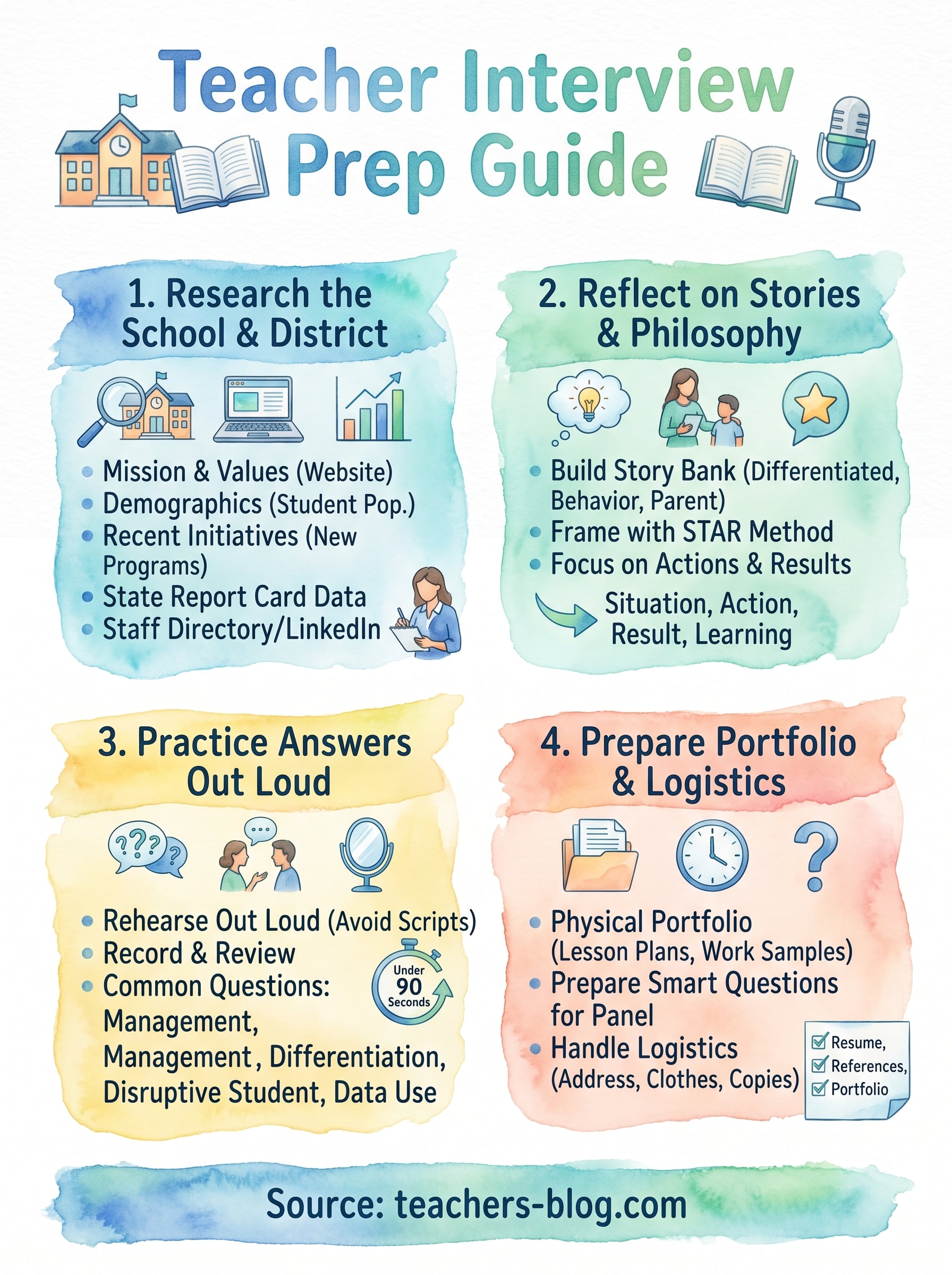
Before you rehearse a single answer, dig into the school itself. District research shows the committee you’re not just applying everywhere and hoping something sticks. Start with the school’s website and most recent state report card, then check its mission statement, demographic makeup, and any recent news coverage, like a new curriculum rollout or a building renovation.
Committees can tell within the first two minutes whether you researched them specifically or just Googled "teacher interview questions" the night before.
What to look up before interview day
- District mission and values: pull language straight from their website to echo in your answers.
- School demographics: student population, free/reduced lunch rate, English language learner percentage.
- Recent initiatives: new reading programs, 1:1 device rollouts, restorative discipline practices.
- State report card data: available through most Departments of Education, including the U.S. Department of Education.
- Staff directory or LinkedIn: knowing your interviewer’s background helps you tailor examples.
Use this background knowledge deliberately. When asked why you want this position, reference something specific, like the school’s new inclusion model, instead of a generic answer about "making a difference."
Step 2. Reflect on your teaching stories and philosophy
Once you’ve researched the school, turn inward. Your teaching philosophy shouldn’t sound like something copied from a syllabus, so it helps to write a teaching philosophy statement in your own words first. Interviewers want two or three real classroom moments you can describe in under a minute each, the kind that show how you actually think, not just what you believe in theory.

Build your story bank
Pull from your real classroom experience, or student teaching if you’re new, and prepare a short story for each of these situations:
- A time you differentiated a lesson for a struggling or advanced student
- A behavior challenge you resolved without sending the student to the office
- A moment you adjusted your teaching after a lesson clearly wasn’t landing
- A time you communicated with a difficult parent and turned it around
Interviewers don’t remember your philosophy statement. They remember the story that proves it.
Frame every story the same way
Use a simple structure so your behavioral interview answers stay tight: situation, action, result, and what you learned. Practicing this format out loud, not silently in your head, keeps you from rambling when nerves kick in during the actual interview.
Step 3. Practice answers to common teacher interview questions
Every committee cycles through a similar set of teacher interview questions and answers, and you can prepare tight answers for most of them before you ever walk in. Reciting a script word for word backfires, but knowing your key points cold keeps you from freezing when nerves hit.
If you can’t talk about your classroom management style in an interview in under 90 seconds, you haven’t practiced enough yet.
Questions to rehearse out loud
| Question type | What they’re really testing |
|---|---|
| "Describe your classroom management style" | Whether your systems are proactive, not just reactive |
| "How do you differentiate instruction?" | If you actually plan for varied ability levels |
| "How would you handle a disruptive student?" | Judgment and de-escalation skills |
| "How do you use data to guide instruction?" | Comfort with assessment and reflection |
| "Why do you want to teach here?" | Whether you researched the school |
Recording yourself answering these, then watching the playback, exposes filler words and rambling faster than practicing silently ever will. Say your answers out loud to a friend, spouse, or mirror at least three times before interview day so the rehearsed answers sound natural instead of memorized.
Step 4. Prepare your portfolio, questions, and interview day logistics
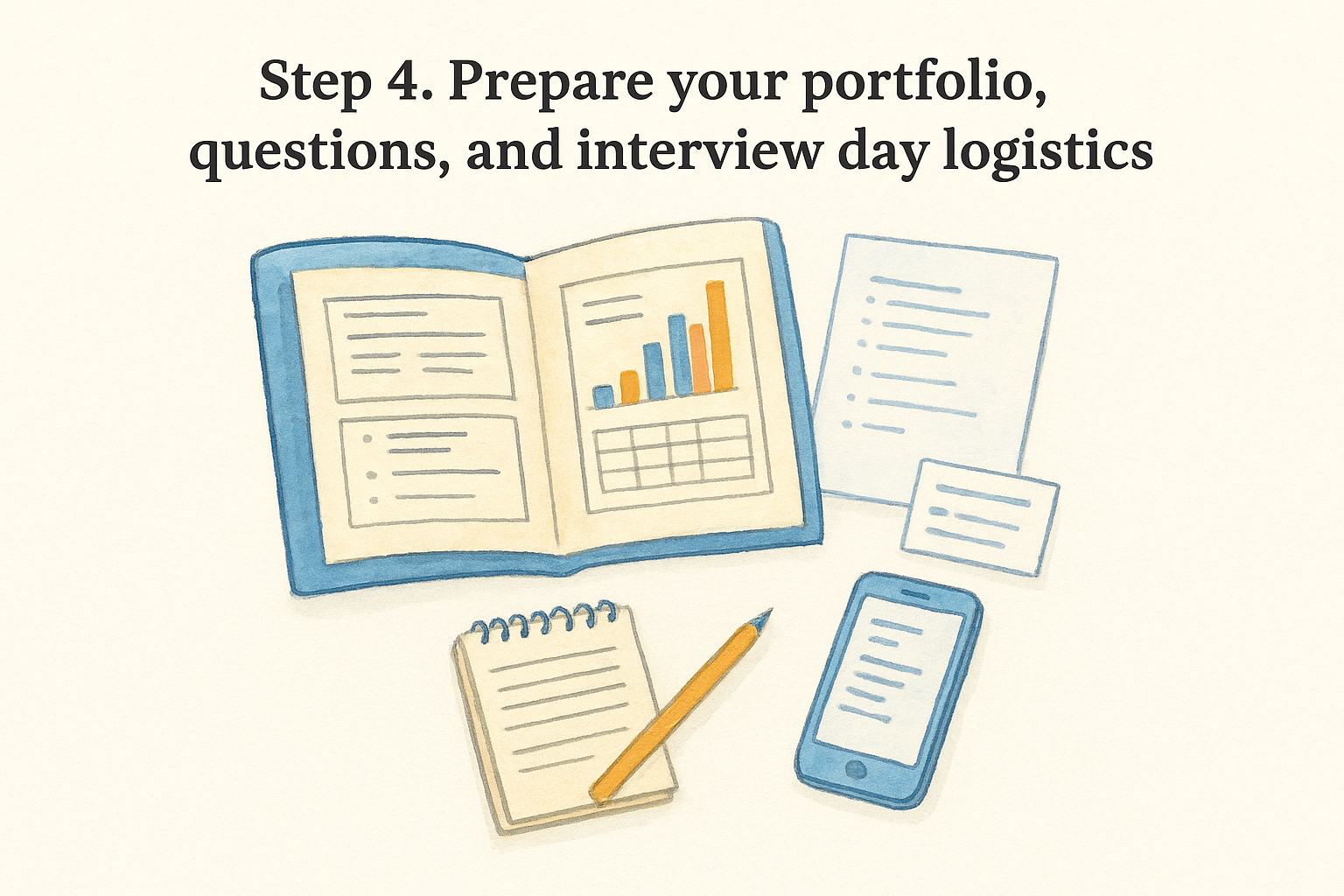
Bring physical proof of your work, not just talk about it. A teacher portfolio template filled with three or four sample lesson plans, student work samples with names removed, and a page of data or growth charts gives the committee something concrete to remember you by after the interview ends. Print copies of your resume and references too, even if you emailed them already.
Build your portfolio checklist
- Two to three differentiated lesson plans
- Sample rubric or assessment tool
- Photos or descriptions of classroom setup
- One-page reference sheet with contact info
Prepare smart questions and logistics
Asking sharp, strategic questions of the panel signals genuine interest, not desperation. Try: "What does a first-year teacher’s support system look like here?" or "How does the school handle differentiated PD?"
A candidate who asks nothing looks like they haven’t thought past getting the job offer.
Handle logistics the night before: confirm the address and parking, lay out professional clothes, charge your phone, and pack two printed resume copies plus a notepad. Small interview day logistics mistakes, like arriving late or forgetting names, undo weeks of preparation fast.
Walking into your interview with confidence
You now have what most candidates skip: real research, a story bank, rehearsed answers, and a portfolio that backs up every claim you make. Teacher interview preparation isn’t about memorizing a script. It’s about walking in knowing you’ve done the work a distracted, underprepared candidate never bothered to do. That difference shows up the moment you start talking.
Go back through the checklists in this guide the night before your interview, not the morning of. Print your resume, pack your portfolio, and say your answers out loud one more time. Nerves will still show up, but they won’t run the show.
If you land the job, the real prep starts on day one. For lesson plans, AI tools, and the classroom management strategies new teachers need to make that first year manageable, keep reading at The Cautiously Optimistic Teacher.