How Do Teachers Check for AI? The Methods Explained
You just graded a stack of essays that all sound a little too polished, and now you’re wondering how do teachers check for AI before you say anything to a student. That instinct is worth trusting. Something feels off when sentence structure suddenly gets smoother, vocabulary jumps a grade level overnight, or an essay nails the prompt without a single rough edge. But suspicion alone doesn’t hold up in a parent conference or an academic honesty hearing.
This article answers the question directly: teachers rely on a mix of detection software, writing-pattern analysis, and old-fashioned classroom knowledge of how a specific student actually writes. None of these methods work perfectly alone, and none should be used as the only piece of evidence against a kid.
Below, you’ll get a breakdown of the actual tools teachers use, the telltale signs that show up in AI-generated writing, and the classroom strategies that catch problems before grading even starts. If you’re building assignments that are harder to fake and easier to verify, this covers the practical side of that too.
Why checking for AI matters for academic integrity
Grading isn’t just about assigning a letter to a paper, and no AI grading tool changes that. It’s how you measure whether a student actually learned to build an argument, analyze a text, or organize their own thoughts on the page. When an essay is fully or partially generated by a chatbot, that measurement breaks. You end up certifying a skill the student doesn’t have, and that gap shows up later on a timed exam, a college application essay, or a job that requires clear writing. Academic integrity isn’t an abstract virtue here; it’s the thing that keeps your grades meaningful.
The stakes for students and schools
Schools that ignore AI-generated submissions face real consequences beyond one bad grade. Colleges and employers increasingly assume a diploma reflects actual competence, and when that assumption breaks down at scale, it damages the credibility of every student who did the work honestly. Districts that get caught flat-footed on AI plagiarism policies often scramble to write rules after a scandal instead of before one, which tends to produce harsher, less fair systems for everyone. Getting ahead of the issue now protects both the students who cheat and the far larger group who don’t.
A single ungraded chatbot essay is a minor problem. A policy that can’t catch a pattern of them is a school-wide one.
Why detection alone isn’t enough
Catching one AI-written paper feels like a win, but it doesn’t fix the underlying issue: students reach for AI when an assignment is easy to fake and hard to verify. Detection tools matter, and we’ll cover them next, but they’re a backstop, not a solution. Relying only on detection software to police integrity puts you in a permanent arms race against tools that update faster than any single classroom can track. Meanwhile, students who genuinely struggle with writing may get flagged unfairly, which creates its own integrity problem in the opposite direction.
Building a culture of honest work
Schools that handle this well treat AI detection as one piece of a bigger integrity system, not the whole system. That usually means:
- Clear, written policies on what AI use is and isn’t allowed for a given assignment
- Assignments designed around in-class drafting, personal reflection, or specific source material that’s harder to outsource
- Consistent consequences applied the same way regardless of who gets caught
- Ongoing conversations with students about why the skill matters, not just what happens if they skip it
Teachers who build this culture spend less time playing detective later. Understanding how detection actually works, though, still matters, both for catching real cases and for knowing the limits of what any tool can prove. The U.S. Department of Education has flagged academic integrity around AI as an emerging policy area, which tells you this isn’t a passing classroom trend but a shift schools need real answers for.
How teachers actually check for AI in student work
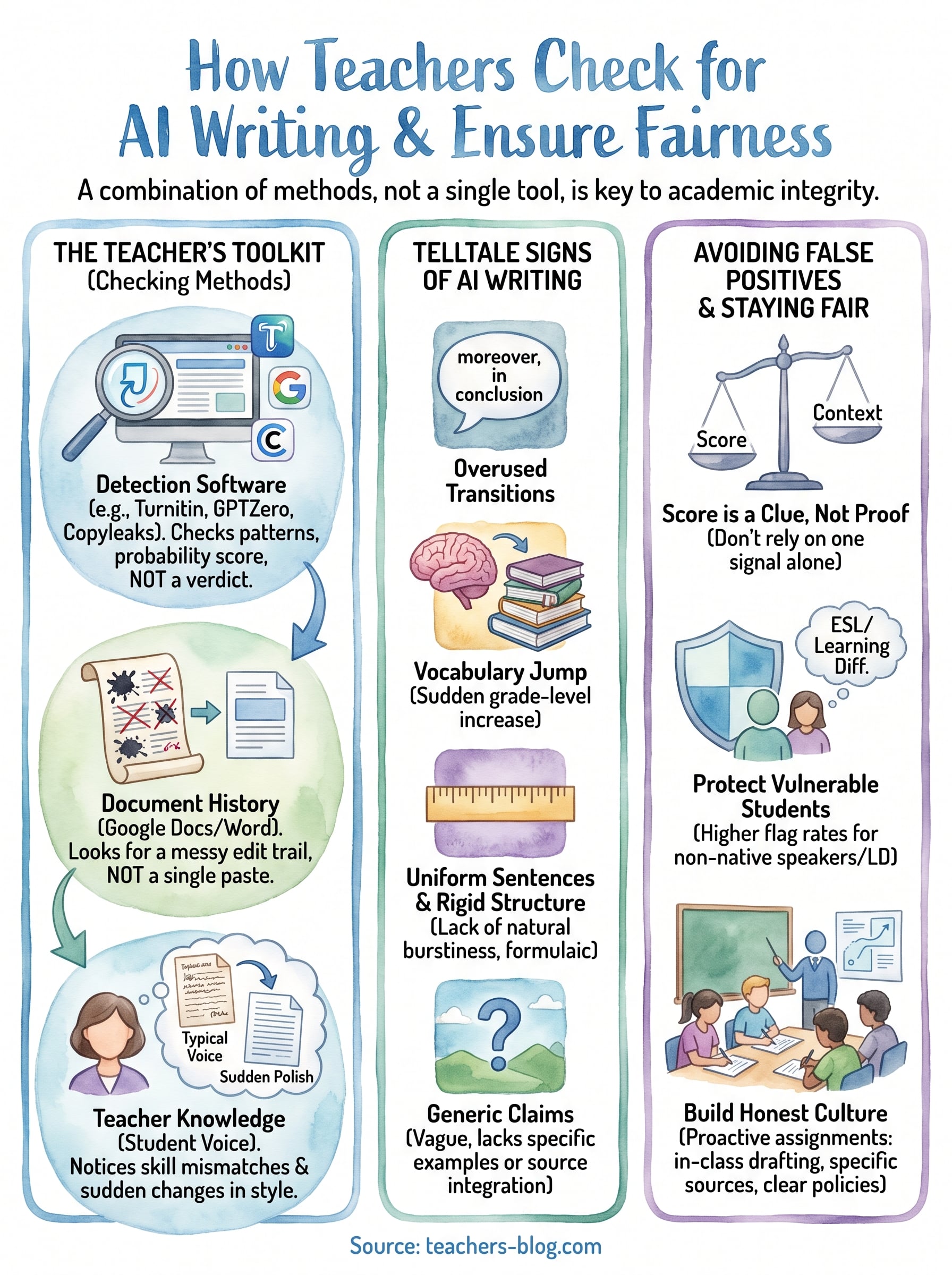
Teachers rarely rely on one method alone, though it helps to know the full range of tools and methods teachers use before you pick one. Most start with detection software like Turnitin’s AI writing indicator, GPTZero, or Copyleaks, which scan a paper’s word choices and sentence patterns and compare them against known AI outputs. These tools spit out a probability score, not a verdict, and that distinction matters more than most students realize, whichever AI checker you choose to catch AI writing.
No single score, no matter how confident it looks, proves a student cheated on its own.
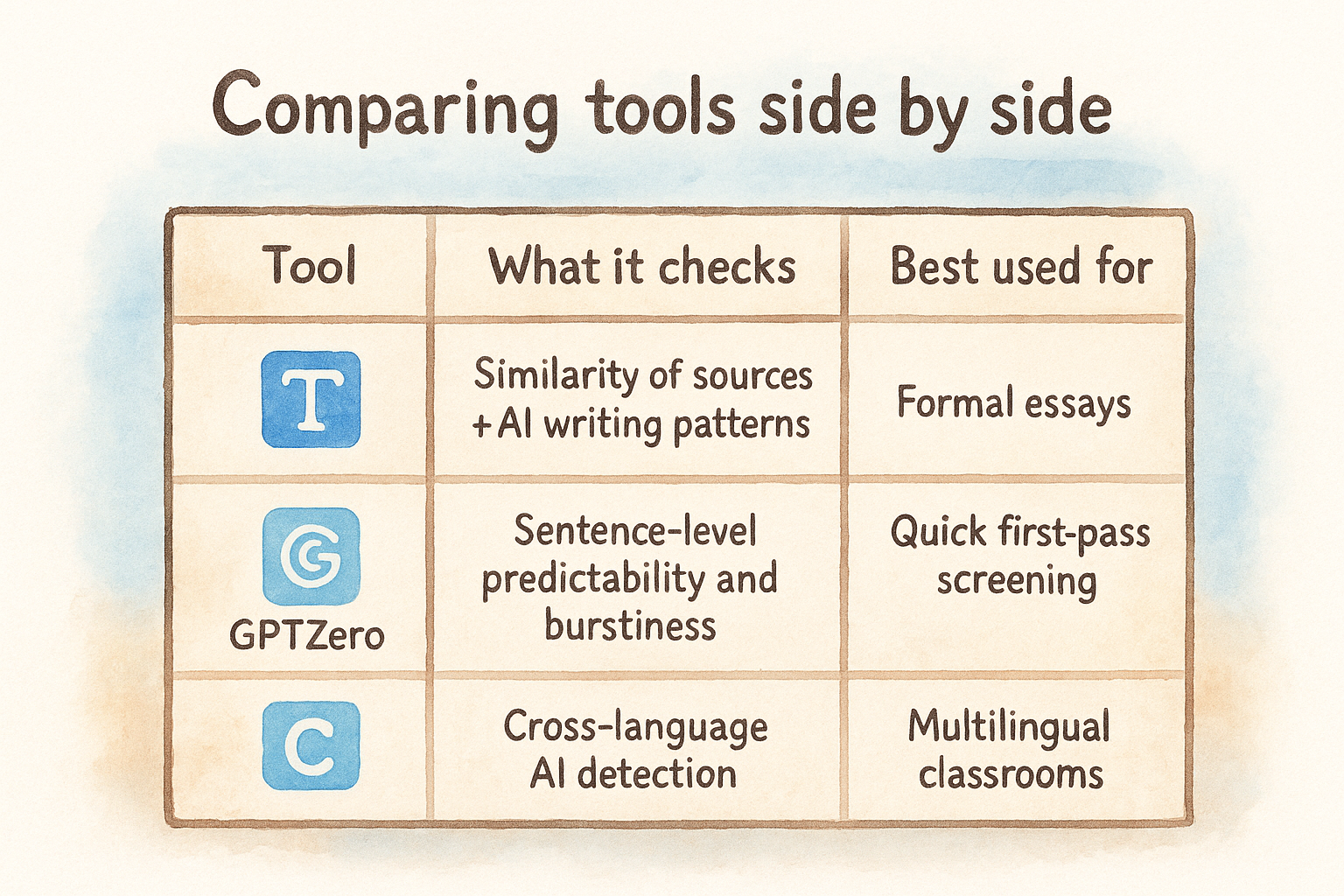
Comparing tools side by side
Different platforms catch different things, so many schools run more than one before drawing conclusions, and a detailed comparison of AI detectors helps sort out which fits your setting.
| Tool | What it checks | Best used for |
|---|---|---|
| Turnitin | Similarity to sources plus AI writing patterns | Formal essays submitted through an LMS |
| GPTZero | Sentence-level predictability and burstiness | Quick first-pass screening |
| Copyleaks | Cross-language AI detection | Multilingual classrooms |
Checking the paper trail
Beyond software, teachers pull up document history in Google Docs or Microsoft Word to see how a paper was actually built. A student who writes gradually leaves a messy trail of edits, deleted paragraphs, and typos fixed over days. A document that appears in one paste, fully formed, with no revision history is a red flag worth a conversation, even before any software gets involved.
Knowing how a student actually writes
Experienced teachers also lean on something no algorithm can replicate: familiarity with a specific student’s voice. If a kid who struggles with topic sentences suddenly turns in flawless transitions, that mismatch is often more reliable than any detection score. Combining that classroom knowledge with writing-pattern analysis from software gives you a fuller picture than either approach alone, and it’s the combination schools that handle this well tend to use.
Telltale signs that reveal AI-generated writing
Beyond software scores, certain patterns show up again and again in AI-generated text, and learning to spot them by eye speeds up your grading and cuts down on false positives. Chatbots tend to produce writing that’s grammatically clean but strangely flat, like a student who memorized the rules without ever developing a voice. Spotting AI writing gets easier once you know what to look for instead of just trusting a gut feeling.
Language patterns that give it away
A few habits show up constantly in generated text:
- Overuse of transitional phrases like "moreover," "in conclusion," or "it is important to note"
- Vocabulary that’s consistently a grade level or two above the student’s usual work
- Sentences that are uniform in length and rhythm, with none of the natural burstiness of human writing
- Vague, generic claims with no specific examples pulled from class discussion or assigned texts
Structural red flags
Structurally, AI-generated essays often follow a rigid five-paragraph template with a thesis, three supporting points, and a conclusion that just restates the intro. Real student drafts rarely arrive that tidy on a first attempt. Genuine writing wanders, backtracks, and sometimes buries the best idea in the middle of a paragraph instead of the topic sentence.
Perfectly balanced paragraphs are a warning sign, not a compliment.
Content mismatches worth a second look
Mismatches between the essay and the actual assignment are another giveaway. Content that ignores specific instructions, like citing a particular chapter or responding to a class discussion, while still sounding polished, suggests the writer never saw your prompt at all. Papers that reference the wrong edition of a text, cite sources that don’t exist, or misstate a plot detail from a book the class read closely are classic signs of AI-generated writing filling gaps with confident-sounding fabrication rather than real knowledge.
How to avoid false accusations and stay fair to students
False positives happen more often than most detection companies like to admit. Non-native English speakers get flagged at noticeably higher rates because their sentence structures can look more formulaic to an algorithm trained mostly on native-speaker patterns. Students with dyslexia or other learning differences who rely on grammar-checking tools like Grammarly often produce text that reads as suspiciously polished, even though every idea came from their own head. Treating a detection score as proof rather than a clue can turn a well-meaning integrity policy into a tool that punishes your most vulnerable students.
A detection score tells you to look closer. It never tells you to hand out a punishment.
Build a fair process before you need one
Decide how you’ll handle a suspected case before the first flag ever shows up on your screen. A process built in the heat of the moment tends to skip steps and lean too hard on one piece of evidence.
- Never accuse based on a single AI detection score alone
- Pair software results with document history, classroom writing samples, and your own knowledge of the student
- Ask the student to explain their process and talk through their argument out loud
- Give them a chance to show notes, outlines, or earlier drafts
- Apply the same standard and consequence to every student, regardless of how
Staying ahead of AI in your classroom
Detection software, writing-pattern habits, and plain classroom knowledge of your students all matter, but none of them replace a clear plan you commit to before the flags start showing up. How do teachers check for AI without wrecking trust with honest kids? By treating every score as a starting point for a conversation, not a verdict, and by designing assignments that make outsourcing harder in the first place. That combination protects the students doing real work and gives you solid ground to stand on when a case gets contested.
Staying current matters more than finding one perfect tool. The tools will keep changing, and so will the ways students try to get around them, so your process needs to flex too. If you want more classroom-tested strategies for building assignments that hold up and catching problems early, The Cautiously Optimistic Teacher has practical resources built for exactly this.