Growth Mindset vs. Fixed Mindset Worksheet: Free Activity Ideas
You know the moment. A student crumples up a worksheet because it’s
Why growth mindset worksheets matter for your classroom
Because it’s “too hard,” and the paper hits the floor before she’s read past the first line. That reaction isn’t laziness or defiance, and it often looks a lot like learned helplessness. It’s fixed mindset thinking, the belief that ability is set in stone and struggle proves you’re not smart enough. A growth mindset vs fixed mindset worksheet gives that student, and every other kid in your room, a concrete way to catch that thought and swap it for one that actually helps her learn.
Educators didn’t invent this idea out of thin air. Psychologist Carol Dweck spent decades studying how students respond to challenge, and her research showed that kids who believe intelligence can grow outperform peers who think it’s fixed, especially after setbacks. You can read more about the underlying research on mindset and motivation through the American Psychological Association. Abstract psychology doesn’t stick with a twelve-year-old, though. Seeing the two mindsets side by side, in plain language, does.
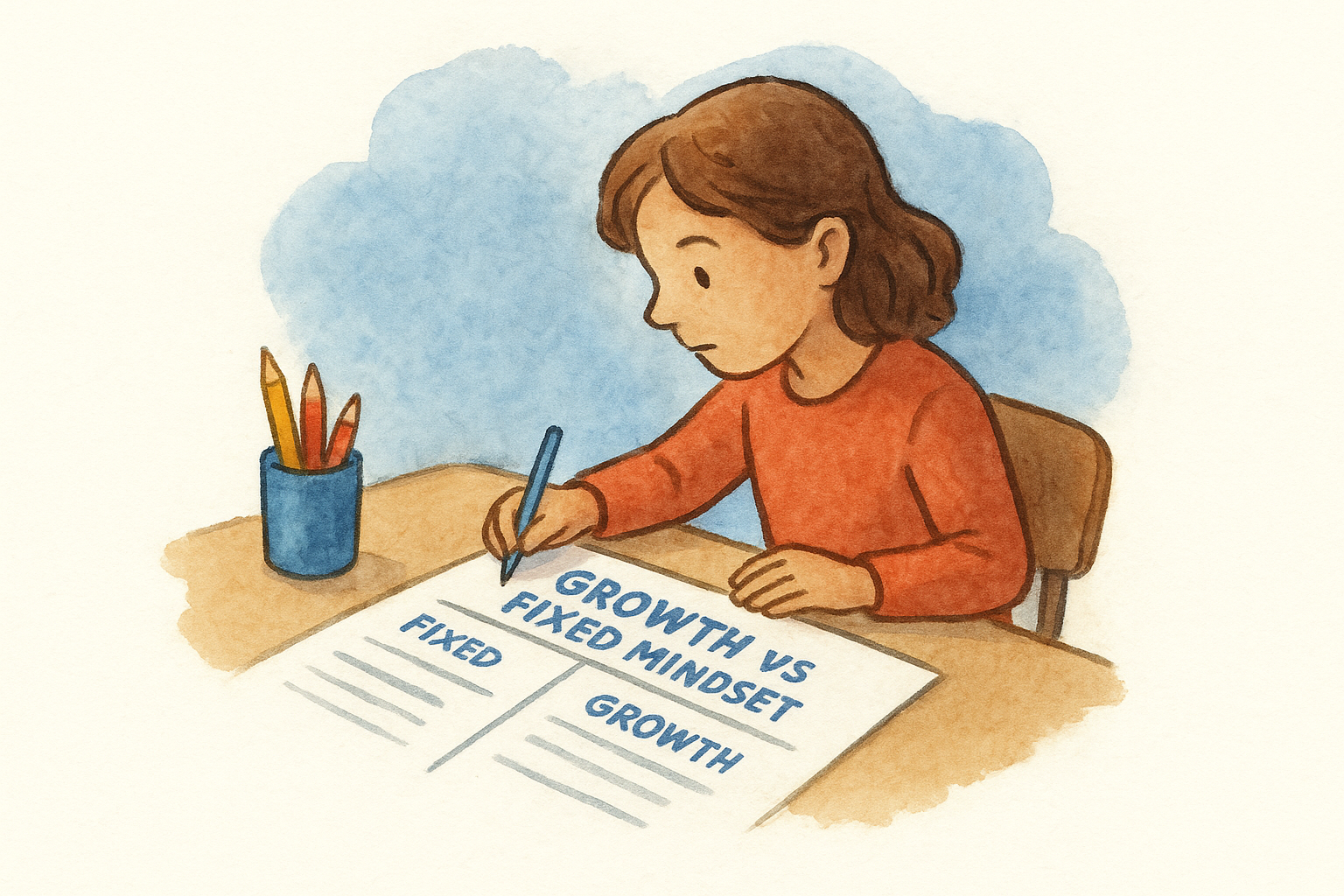
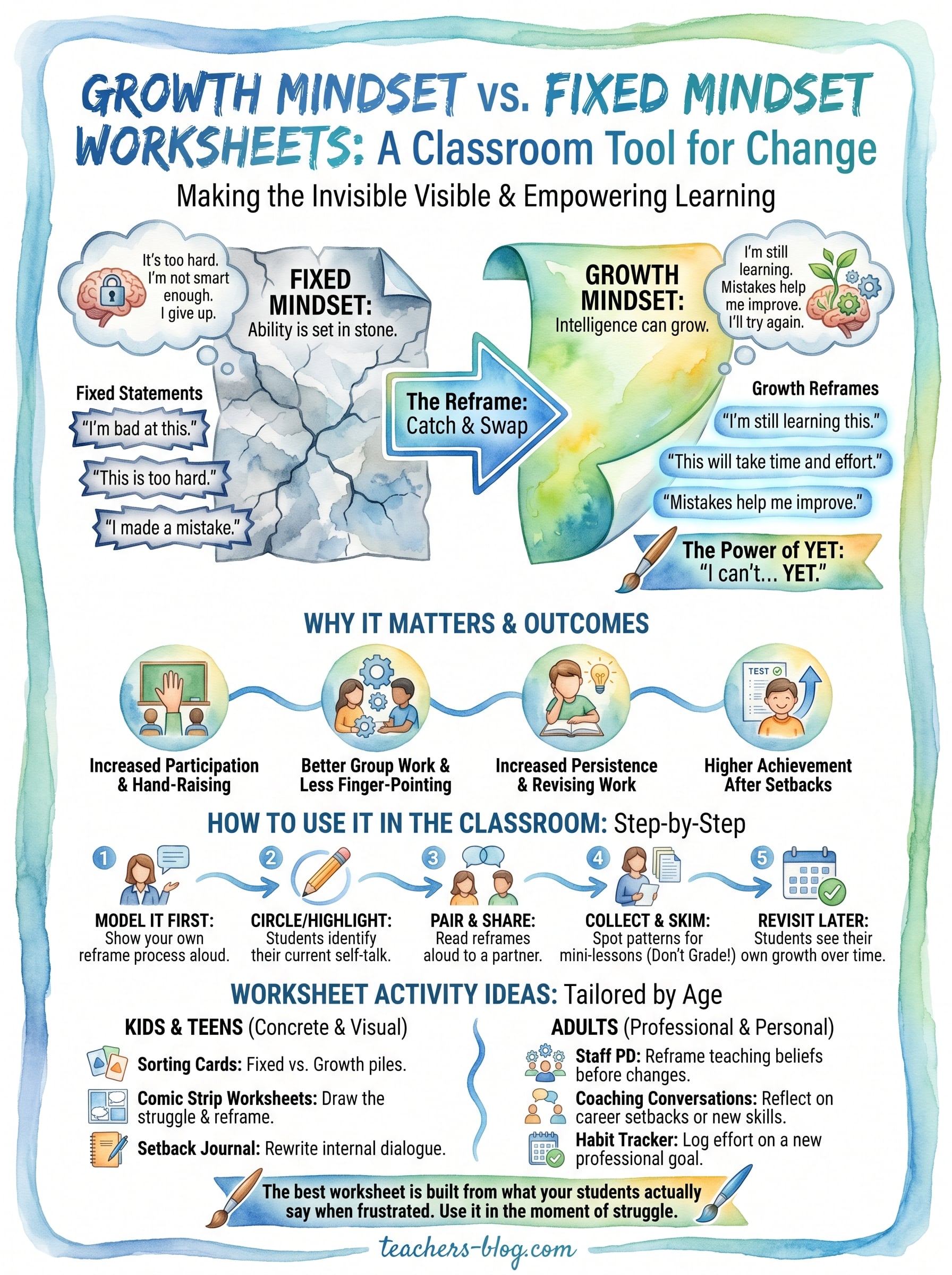
Students rarely realize they’re thinking in fixed-mindset patterns until you hand them a mirror. A fixed vs growth mindset worksheet works as that mirror. It lists the exact phrases kids already say to themselves, things like “I’m just not a math person” or “I’ll never get this,” next to a growth reframe they can practice out loud. Once a student can name the pattern, she can start to interrupt it. That single skill, catching your own self-talk, transfers to test anxiety, sports, friendships, and eventually job performance.
The comparison makes the invisible visible
| Fixed mindset statement | Growth mindset reframe |
|---|---|
| “I’m bad at this.” | “I’m still learning this.” |
| “This is too hard.” | “This will take time and effort.” |
| “I give up.” | “I’ll try a different strategy.” |
| “I made a mistake.” | “Mistakes help me improve.” |
| “She’s just naturally smart.” | “She probably worked hard to get good at this.” |
What changes in daily classroom behavior
Once you build these comparisons into a regular routine instead of a one-off handout, the shift shows up fast. Teachers who use a growth vs fixed mindset worksheet weekly report students raising their hands more during hard problems instead of shutting down. Struggling readers ask for a second attempt instead of guessing and moving on. None of this requires a curriculum overhaul, just a repeatable tool students can return to whenever frustration shows up.
Here’s what that looks like in practice over a few weeks:
- A student who used to say “I can’t” starts saying “I can’t yet,” which is the power of yet showing up in daily language
- Group work includes less finger-pointing and more “let’s try another way”
- Kids ask clarifying questions instead of staying silent when confused
- Test corrections get done without being assigned as extra credit
Outcomes worth tracking
Track these signs over a grading period to see if the practice is landing and whether the benefits of a growth mindset are showing up:
- Increased persistence on multi-step assignments before asking for help
- Fewer self-defeating comments during group work or independent tasks
- More students revising work after feedback instead of accepting the first grade, a sign of how students read their own mistakes
- Higher participation from kids who used to stay quiet during challenging work
If you’re already running mindset-building activities like our Brain Builders Workshop, pairing them with a written comparison worksheet reinforces the message in a format students can revisit on their own, long after the lesson ends. The combination of spoken discussion and written reflection is what makes the shift stick, rather than fading after one good class period.
How to use a growth mindset vs fixed mindset worksheet
Handing a stack of papers to your class and saying “fill this out” won’t do much. The worksheet only works when it’s tied to a specific moment of struggle, not treated as busywork. Use it right after a hard quiz, a frustrating group project, or a moment when you hear a student say something like “I’m just not good at this.” That timing matters more than the worksheet’s design.
Step-by-step classroom rollout
Start small and build the habit over a few weeks rather than expecting instant buy-in. Here’s a sequence that works in most classrooms, from elementary through high school, and it pairs easily with free mindset lesson plans by grade:
- Model it first. Read a fixed mindset statement aloud and show your own thought process for reframing it before asking students to try.
- Have students circle or highlight which column, fixed or growth, matches their current self-talk on a recent assignment.
- Pair students up to swap worksheets and read each other’s reframes out loud. Hearing it in another voice makes it feel less abstract.
- Collect and skim them, not to grade, but to spot patterns worth addressing in a mini-lesson.
- Revisit the same worksheet a month later so students can see their own growth in writing.
The worksheet only changes behavior if students use it during an actual struggle, not as a disconnected warm-up activity.
Matching the format to the moment
Some situations call for a quick five-minute check-in; others need a fuller reflection. A growth mindset vs fixed mindset worksheet pdf you keep on hand digitally works well for the quick version, like the other printable classroom activities you can print in bulk or push out through a learning management system without extra prep. Save the longer, discussion-based version for after a major test or project, when students have more to unpack and more time to write.
Reviewing responses without turning it into homework
Grading these defeats the purpose. Instead, walk the room while students fill them out and ask follow-up questions like “What would it look like if you tried that growth statement out loud next time?” Students open up more when they know there’s no red pen involved, the same logic behind good feedback strategies for formative assessment. If you want a reference point for what solid responses look like, keep a growth mindset vs fixed mindset worksheet answers key on hand, not to mark students right or wrong, but to guide your prompts and make sure your own reframes stay consistent across classes. Consistency in the language you model is what makes the tool stick beyond a single lesson.
Worksheet activity ideas for kids and teens
Kids and teens process mindset language differently depending on age, so a single worksheet rarely fits every grade. A growth vs fixed mindset worksheet built for a second grader needs pictures and short sentences, while a version for a tenth grader can handle journaling prompts and real setbacks like a failed driving test or a cut from the team. Matching the activity to developmental stage keeps kids engaged instead of confused or bored.
Elementary activities that keep it concrete
Young kids learn mindset concepts best through characters and visuals rather than abstract self-reflection. Try these formats with elementary students, or borrow from a longer list of classroom growth mindset activity ideas:
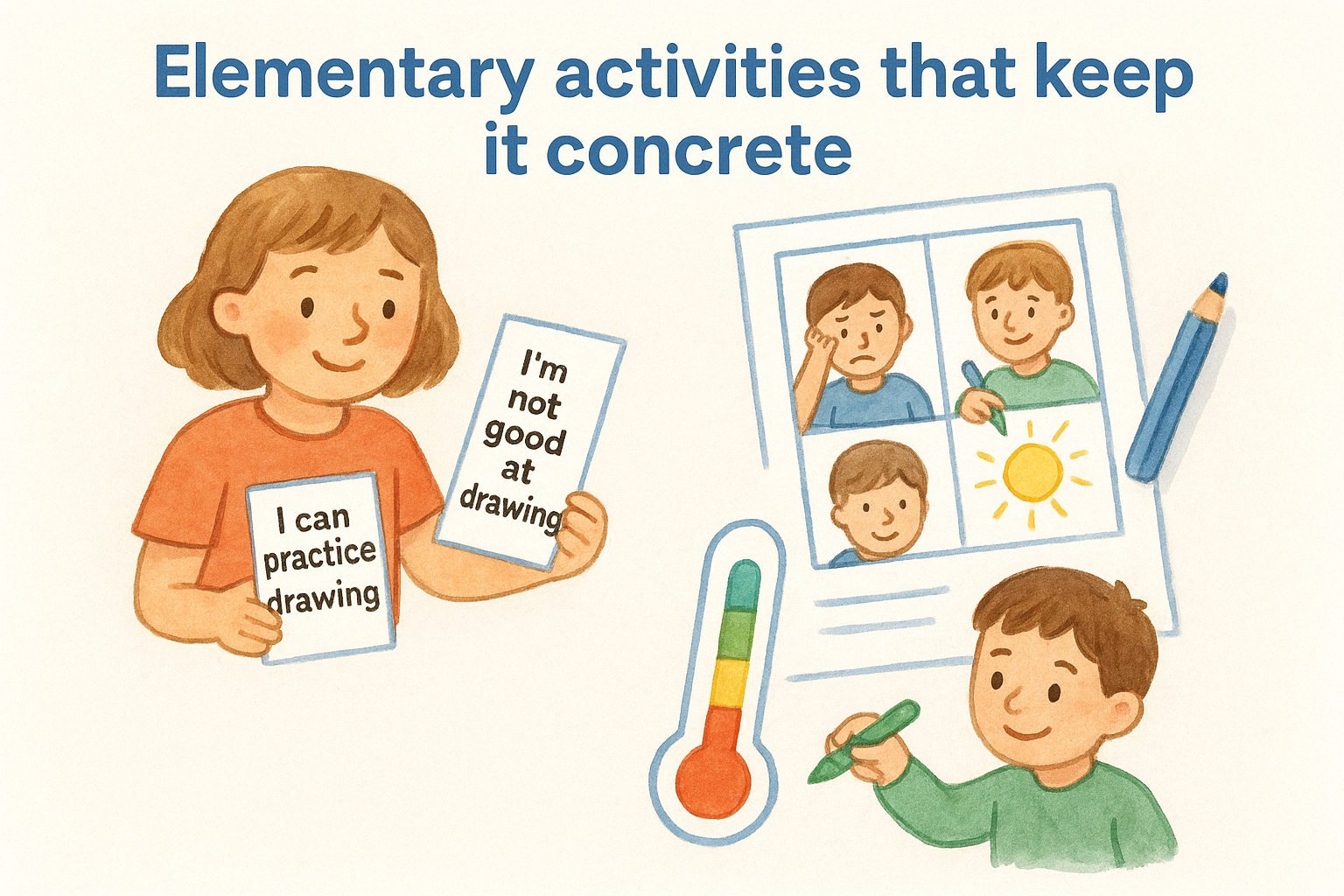
- Sorting cards: print statements like “I’m not good at drawing” and “I can practice drawing” on separate cards for kids to sort into a fixed or growth pile
- Comic strip worksheets: students draw a character facing a hard task, then draw a second panel showing the character trying a growth mindset response
- Color-coded thermometers: a visual scale where kids color in how “stuck” they feel before and after using a growth statement
Younger kids don’t need the vocabulary word “mindset” to grasp the idea. They just need to see two choices and pick the one that helps them try again.
Middle and high school activities that go deeper
Teens respond better to worksheets that connect directly to their own lives instead of hypothetical scenarios, the same reason certain mindset activities work with older students. A growth mindset vs fixed mindset worksheet pdf for this age group works well when it includes open-ended prompts rather than fill-in-the-blank comparisons. Consider these formats:
| Activity | What students do |
|---|---|
| Setback journal | Write about a recent failure, then rewrite the internal dialogue using a growth lens |
| Mindset interview | Interview a classmate about a challenge they overcame and identify the growth statements they used |
| Goal tracker | Set a skill goal, log weekly effort, and note where fixed-mindset thoughts crept in |
| Debate card | Argue for and against a fixed-mindset statement to expose its flawed logic |
High schoolers especially benefit from prompts tied to grades, sports, or college applications since those are the moments where fixed thinking hits hardest, which is why a student goal setting worksheet pairs so well with these prompts. If you’re short on prep time, our Worksheet Maker tool and similar AI tools that build worksheets can generate a custom set of mindset prompts from a few keywords, saving you the trouble of building these from scratch every unit.
Worksheet activity ideas for adults
Adults carry the same fixed-mindset habits kids do, they just dress them up in more sophisticated language. A teacher who says “I’m just not a tech person” during a staff PD session is running the exact same script as a ninth grader who says “I’m not a math person.” A fixed mindset vs growth mindset worksheet built for grown-ups works best when it skips the cartoon characters and goes straight at real professional and personal stakes: a stalled career goal, a hard conversation avoided, a skill left untouched because trying feels risky.
Staff meetings and professional development
Schools already run PD sessions on classroom management and curriculum, so growth mindset professional development deserves the same treatment. Hand out a growth mindset vs fixed mindset worksheet pdf at the start of a staff meeting and ask colleagues to write down one belief about their own teaching that feels fixed, then reframe it using a growth statement. This works especially well before rolling out new technology or a new grading system, moments when adult resistance often masquerades as practicality rather than fear.
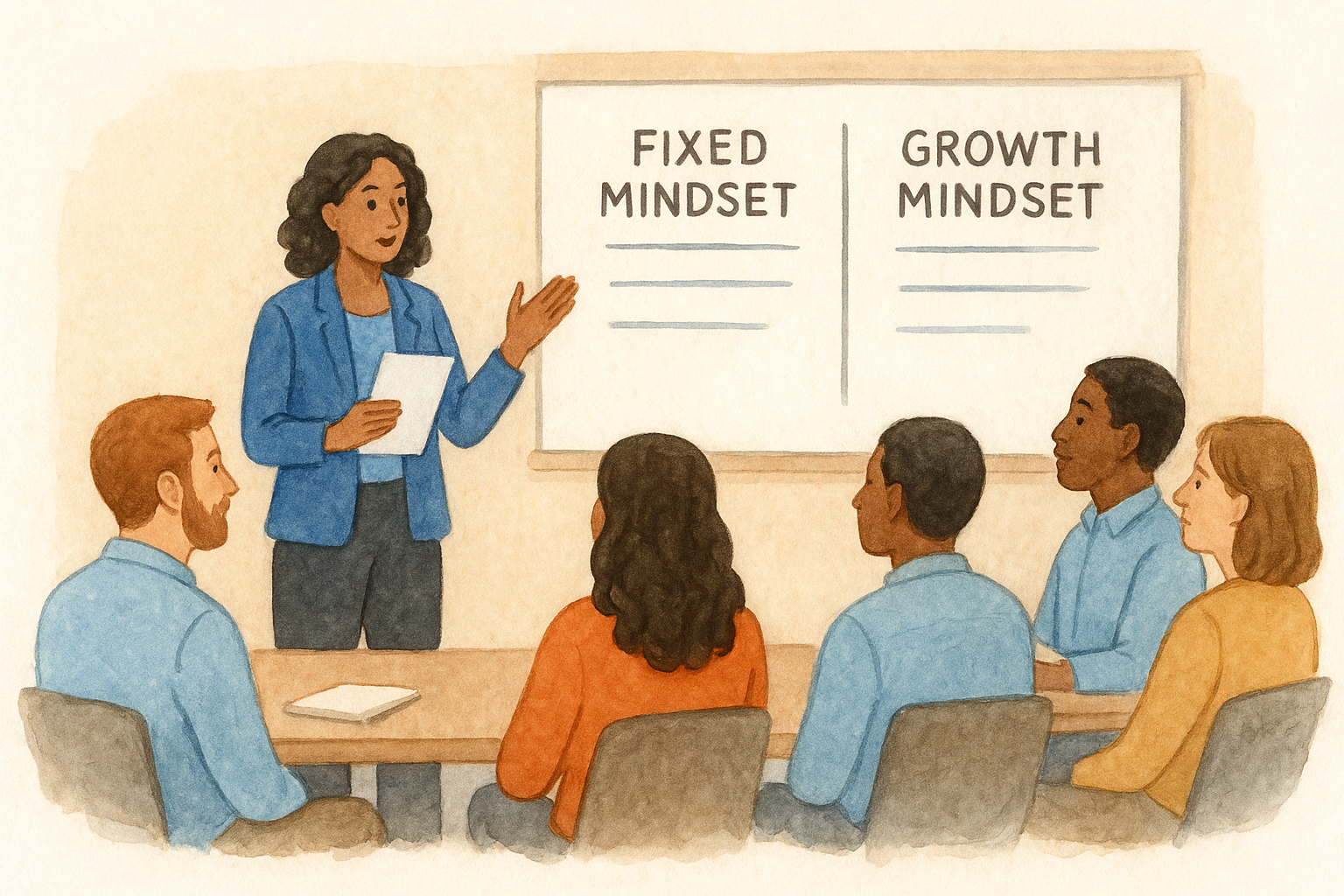
Adults resist change for the same reason kids resist hard homework: it feels safer to believe you can’t than to risk trying and failing.
Personal reflection and coaching conversations
One-on-one coaching, whether between an instructional coach and a teacher or a manager and an employee, benefits from a written reflection instead of just a verbal check-in. A growth vs fixed mindset worksheet gives both people something concrete to reference instead of relying on memory of a conversation from three weeks ago. Try these formats in a coaching or mentoring context:
| Activity | Best for |
|---|---|
| Career setback log | Reflecting on a passed-over promotion or difficult evaluation |
| Skill-risk journal | Trying a new teaching strategy or technology for the first time |
| Feedback reframe sheet | Processing critical feedback from a supervisor or peer observation |
| Habit tracker | Building a new professional habit, like weekly parent communication |
These formats work outside the school building too. Parent workshops, new-employee onboarding, and even personal goal-setting at the start of a new year all benefit from the same side-by-side comparison, since the underlying psychology doesn’t change once someone turns eighteen. If you want a ready-made starting point rather than drafting these prompts from scratch, our Brain Builders Workshop materials adapt easily for an adult audience, since the core reframing skill stays identical whether you’re coaching a ten-year-old or a colleague twenty years into their career.
How to build your own custom worksheet
Pre-made templates work fine for a general lesson, but nothing beats a worksheet built around your own students’ actual struggles. A growth mindset vs fixed mindset worksheet you design yourself can reference the specific assignment that tripped up your class last week, the exact phrase a student muttered under her breath, or the sport season your athletes are grinding through right now. Generic examples about “learning to ride a bike” rarely land the way a reference to Tuesday’s fraction quiz does.
Start with the language your students already use
Before you open a blank document, spend a week just listening. Jot down the fixed-mindset comments students actually say out loud, not the ones you assume they’re thinking. Kids rarely say “I have a fixed mindset.” They say things like “my brother’s the smart one” or “I always mess up on essays.” Building your worksheet from real quotes makes the comparison feel personal instead of generic, and that personal connection is what gets a worksheet used instead of tossed in a folder.
The best worksheet isn’t the most polished one. It’s the one built from what your students actually say when they’re frustrated.
A simple structure to follow
You don’t need design software or a background in curriculum writing to put together something solid. Follow this basic layout:
Section 1: The Statement
[Blank line for student to write a fixed-mindset thought they had recently]

Section 2: The Reframe
[Blank line for student to rewrite it as a growth statement]

Section 3: The Evidence
[Prompt: "What's one time effort actually helped you improve at something?"]

Section 4: The Next Step
[Prompt: "What's one small action you'll try next time this thought shows up?"]
This four-part format scales up or down easily. Younger students can answer with a single sentence and a drawing. Older students can turn each section into a full paragraph. Either way, the structure keeps the focus on action instead of just labeling a mindset and moving on.
Tools that speed up the process
Building worksheets from scratch every unit isn’t realistic once report cards, parent emails, and lesson plans pile up. That’s the gap our Differentiated Instruction Helper is built to close. Feed it a topic or a recent classroom struggle, and it generates a growth mindset vs fixed mindset worksheet tailored to your students’ grade level in a fraction of the time a manual draft takes. Pair it with our Question Generator if you want deeper reflection prompts instead of simple fill-in-the-blank statements. Neither tool replaces your judgment about what your class needs, but both cut the prep time down from an evening to a few minutes, which matters when mindset work is one priority among a dozen others on your plate.
Putting the worksheet into practice
A growth mindset vs fixed mindset worksheet only earns its place in your classroom if you use it when it matters, right after the quiz that stung or the group project that fell apart. Templates and comics and journaling prompts all work, but none of them replace the moment you catch a student mid-frustration and hand them language to think differently. Build the habit slowly, revisit old worksheets so students see their own progress, and stay consistent with the reframes you model, whether you’re talking to a second grader or a colleague at a staff meeting.
Start with one worksheet this week, tied to one real struggle your students are facing right now. If drafting it from scratch feels like one more thing on your plate, let our Differentiated Instruction Helper build a custom version for you in minutes instead of an evening, and see how else you can use AI to personalize learning materials.