
Growth Mindset AP Psychology Definition: Exam Guide
If you’ve hit a vocabulary question about mindset theory in your AP Psychology review and blanked, you’re not alone. The growth mindset AP Psychology definition shows up in unit 2 or unit 7 depending on your course sequence, and College Board expects you to know it cold, not just recognize the term. Students often confuse it with generic self-help advice, but on the exam it’s tied to specific research and specific contrast terms.
Here’s the short answer: what a growth mindset actually is comes down to the belief that abilities and intelligence can be developed through effort, strategy, and feedback, a concept built on Carol Dweck’s research. It sits opposite the fixed mindset, which treats intelligence as static and unchangeable, and the growth mindset versus fixed mindset comparison is worth studying as a pair. Knowing both definitions side by side is what actually earns you points on free-response questions.
This guide breaks down the exam-ready definition, walks through examples you might see in multiple-choice or FRQ prompts, and lays out the fixed-versus-growth comparison in plain terms. As teachers who build unit plans and classroom strategies around student mindset every day, we’ve written this the way we’d explain it to a student sitting across from us at office hours.
Why growth mindset matters in AP Psychology
College Board doesn’t include mindset theory as filler. It sits inside the motivation and emotion unit because psychologists use it to explain why some students persist after failure while others give up, which is also the importance of student motivation in plain classroom terms. Understanding this connection helps you see why exam writers keep circling back to Dweck’s work: it links directly to attribution theory, self-efficacy, and locus of control, three other terms you’ll need for the same free-response section.
Where it fits in the curriculum
Unit 7 (Motivation, Emotion, and Stress) is where most courses place growth mindset officially, though some sequences fold it into Unit 2 alongside cognitive development. Either way, expect it to appear paired with terms like intrinsic motivation and self-efficacy, since College Board loves testing how these concepts interact. A single MCQ might ask you to identify which mindset predicts higher intrinsic motivation after a setback, so you need more than a definition. You need to know what growth mindset predicts behaviorally.
Why the College Board tests it this way
Exam writers favor concepts with clear, testable contrasts, and fixed versus growth mindset gives them exactly that. They can write a vignette about a student who avoids challenges after a bad grade, then ask you to label the mindset and explain the underlying belief. That’s why memorizing a one-line definition isn’t enough.
Growth mindset only earns FRQ points when you connect the belief to a specific behavior or outcome, not just the label.
Mastering this also pays off beyond the test. Teachers who build lessons around mindset development, like the Brain Builders Workshop, report that students who understand the psychology behind effort and feedback actually apply it during review sessions. Recognizing the theory helps you study smarter, not just answer one question correctly. That’s the real reason this shows up on the exam: it’s psychology you can use on yourself while you prepare for the rest of the test.
How to spot growth mindset in exam questions
Questions rarely say "growth mindset" outright until the answer choices. Instead, College Board hides the concept inside a scenario: a student who studies harder after a failing grade, a coach who praises effort instead of talent, or a kid who uses "yet" as a learning reframe and says "I can’t do this yet." Spotting these signals fast is the skill that separates a quick correct answer from a wasted thirty seconds rereading the stem.
Key phrases that flag the concept
Train yourself to scan for language tied to effort, process, and change over time, the same characteristics of a growth mindset you’d see described in a classroom setting. These words almost always point toward growth mindset rather than its opposite.
- "Effort led to improvement"
- "Believes ability can be developed"
- "Views failure as feedback"
- "Persists after a setback"
- "Seeks out challenges despite risk of failure"
If the scenario shows someone changing strategy after failing, that’s growth mindset, not talent or luck.
Common traps in the answer choices
Exam writers plant distractor answers that sound similar but describe self-efficacy or intrinsic motivation instead. Self-efficacy is about confidence in a specific task, not a belief about whether intelligence itself can grow, so watch for that distinction in FRQ rubrics. Test-writers also like pairing a growth mindset scenario with a fixed mindset distractor describing someone who quits because "they’re just not a math person." Recognizing that phrase as the fixed mindset marker, not growth, saves you from picking the wrong label under time pressure. Once you can separate belief statements from behavior descriptions, MCQs on this topic get noticeably faster to answer.
Growth mindset vs fixed mindset at a glance
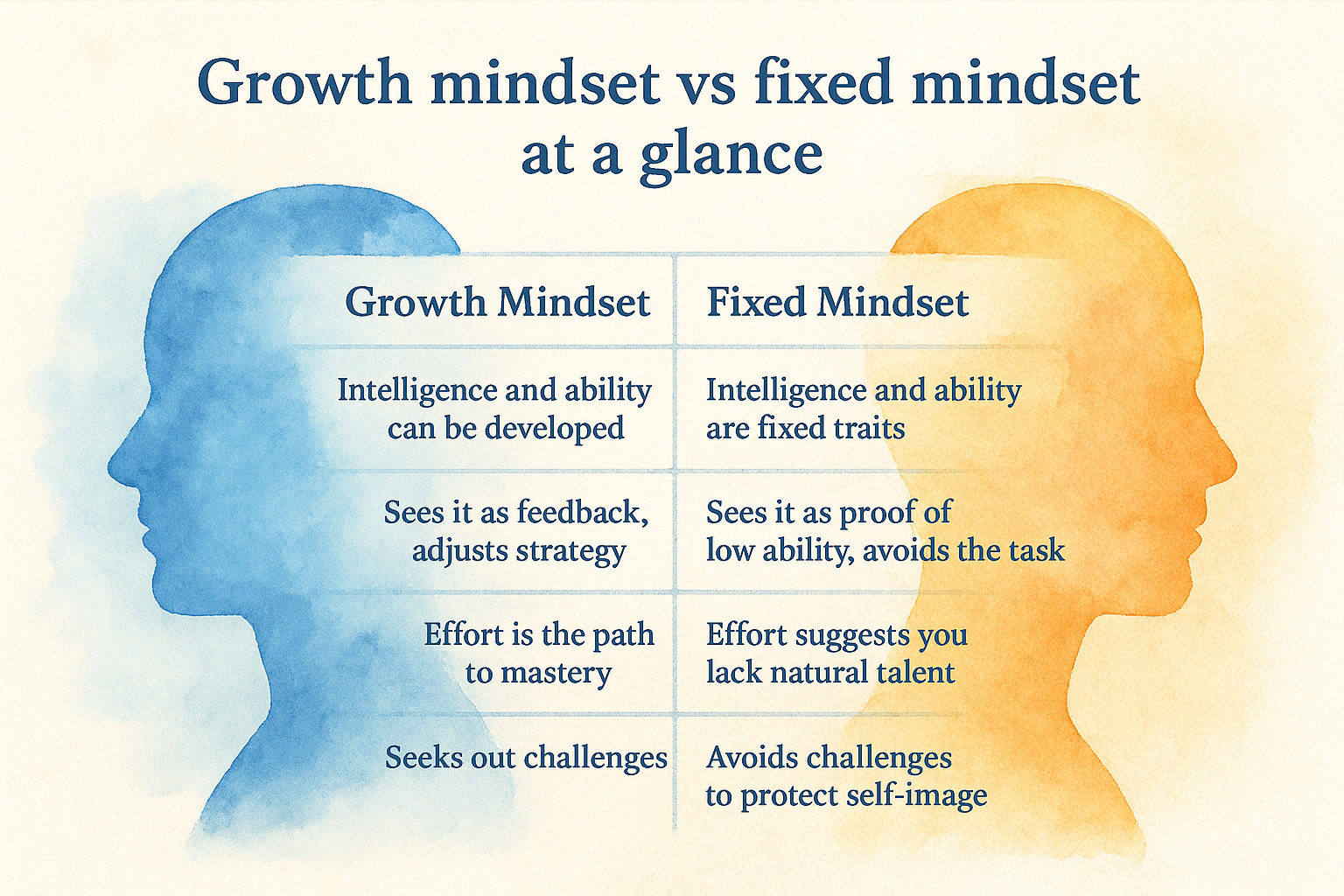
Sometimes the fastest way to lock in a definition is to see it next to its opposite. The table below is the same comparison you’d sketch on scratch paper during the exam, built around the core belief each mindset holds and how that belief plays out in behavior.
| Feature | Growth Mindset | Fixed Mindset |
|---|---|---|
| Core belief | Intelligence and ability can be developed | Intelligence and ability are fixed traits |
| Response to failure | Sees it as feedback, adjusts strategy | Sees it as proof of low ability, avoids the task |
| View of effort | Effort is the path to mastery | Effort suggests you lack natural talent |
| Reaction to challenge | Seeks out challenges | Avoids challenges to protect self-image |
| Reaction to criticism | Uses it to improve | Ignores or resents it |
| Related psychologist | Carol Dweck | Carol Dweck (same researcher, contrasting concept) |
Why the contrast matters for scoring
College Board loves testing pairs like this because a single vignette can be flipped to test either side. If a prompt describes a student who stops trying after one bad quiz grade, that’s a fixed mindset marker, not growth. Getting the direction backward is the single most common error students make on this topic.
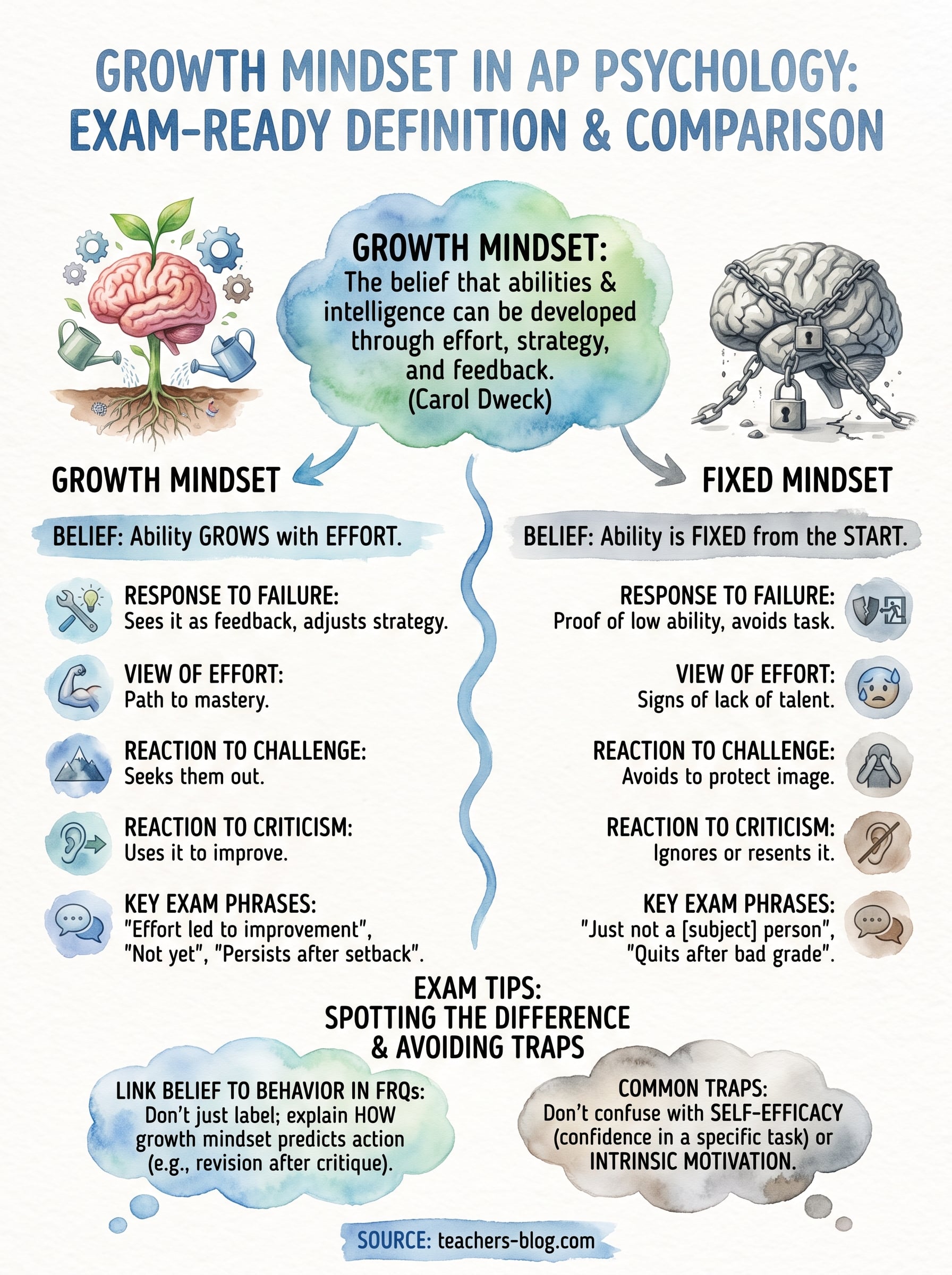
Growth mindset says ability grows with effort; fixed mindset says ability is set from the start.
Once you can recite both columns without hesitation, you’re ready to apply them to actual exam scenarios instead of just defining terms in isolation.
Growth mindset examples for FRQs and MCQs
Seeing the concept in a full example question, or in seven growth mindset examples drawn from real life, does more for retention than another paragraph of definitions. Below is a sample MCQ stem paired with the reasoning you’d use to eliminate wrong answers, plus a short FRQ-style prompt so you can practice writing the connection between belief and behavior yourself.
Sample multiple-choice question
"After failing her first chemistry test, Maria reviews her notes, asks her teacher for extra practice problems, and tells her friend, ‘I just haven’t figured out the right study method yet.’ Maria’s response best illustrates:"
- (A) Self-efficacy
- (B) Fixed mindset
- (C) Growth mindset
- (D) External locus of control
The correct answer is (C), because Maria treats the failing grade as information about her strategy, not proof of low ability, which is exactly how growth-minded students interpret a bad grade. Notice the phrase "haven’t figured out yet," a classic growth mindset marker College Board writers use to distinguish it from a confidence statement, which would point to self-efficacy instead.
Sample FRQ prompt and response outline
"Explain how growth mindset would predict a student’s response to receiving critical feedback on an essay draft."
A strong response names the theory, defines it in one sentence, then ties it to a specific behavior:
A student with a growth mindset, defined as the belief that ability develops through effort and feedback, would revise the essay using the critique because they view criticism as a tool for improvement rather than a judgment on fixed talent.
Rubrics reward that link between definition and behavior, so never leave the second half implied.
Locking in the concept before test day
At this point, you’ve got the growth mindset AP Psychology definition down cold: the belief that ability grows through effort and feedback, not a fixed trait you’re stuck with. You’ve seen it paired against fixed mindset, spotted the key phrases exam writers hide in vignettes, and practiced connecting the label to actual behavior in both MCQ and FRQ formats.
Before test day, quiz yourself with new scenarios instead of rereading the definition again. Write your own one-sentence example, then flip it into a fixed mindset version. That exercise mirrors exactly what College Board asks you to do under time pressure.
If you want more classroom-tested strategies for building this kind of mindset, not just memorizing it, browse our classroom-tested growth mindset resources, where the same principles get applied well beyond exam prep.