
Fixed Mindset vs. Growth Mindset Video: Best Picks for the Classroom
You’ve explained the difference between fixed and growth mindset a dozen times, and half your class still nods along without really getting it. That’s normal. Mindset is abstract for a twelve-year-old, and a fifteen-minute lecture rarely sticks the way a well-chosen fixed mindset vs growth mindset video does. Kids remember stories and visuals long after they forget your bullet points.
If you’re searching for a growth mindset vs fixed mindset video to open a lesson or spark discussion, this list is built for that exact moment. Every pick here shows the contrast clearly, works for middle and high schoolers, and runs short enough to fit into a real class period without eating your whole plan.
Below, you’ll find video recommendations organized by grade level and purpose, plus discussion questions to pair with each one. Some are animated explainers, others feature real students describing how they shifted their thinking. This is content built to complement resources like our Brain Builders Workshop, so you can turn a five-minute fixed vs growth mindset video into a genuine classroom conversation, not just background noise.
Why show growth mindset videos in your classroom
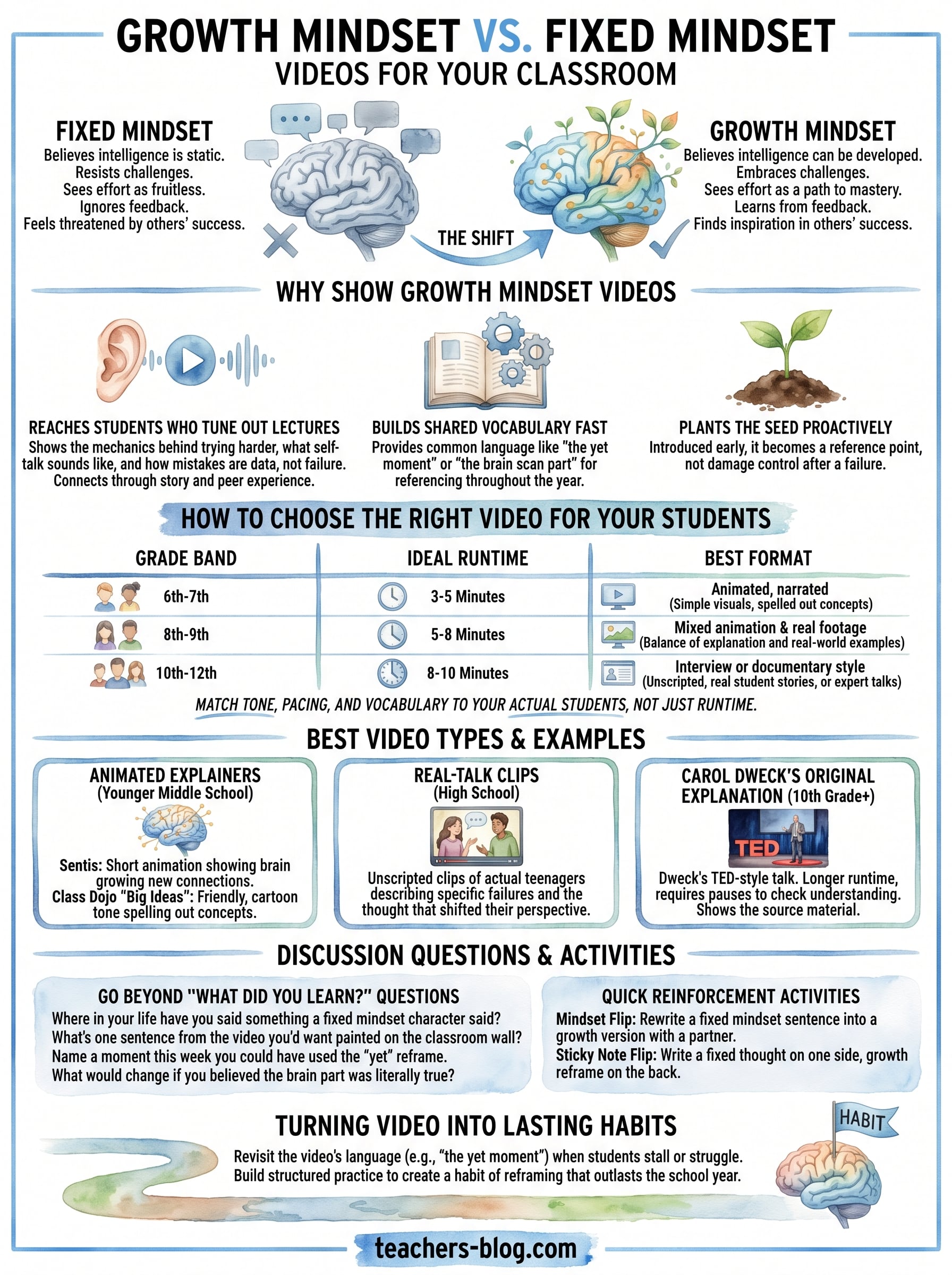
Watching a short film hits different parts of the brain than listening to a teacher talk. Video pairs facial expression, tone, and story arc together, so students absorb the emotional weight of struggle and breakthrough instead of just the vocabulary. A growth mindset vs fixed mindset video does the heavy lifting a slideshow never could, because kids see someone their own age wrestling with failure and choosing to try again.
It reaches students who tune out lectures
Middle and high schoolers have heard “just try harder” from every adult in their life. That phrase means nothing on its own. Video content shows the mechanics behind trying harder: what self-talk sounds like, what a setback actually feels like, and how students with a growth mindset see their mistakes as data instead of proof of failure. Struggling learners and reluctant participants often connect faster to a peer on screen than to another adult telling them to believe in themselves.
A well-chosen video does in five minutes what a week of pep talks can’t.
It builds shared vocabulary fast
Once your class watches the same clip, you’ve got common language for the rest of the year. You can reference “the yet moment” or “the brain scan part” months later and everyone knows exactly what you mean. That shorthand saves you from re-explaining growth mindset every time a student says “I’m just bad at math.”
It plants the seed before you need it
Show the video early, before your first big test or project, not after a student bombs one. Kids resist mindset talk when it feels like damage control. Introduced proactively, a fixed vs growth mindset video becomes a reference point students can return to on their own, rather than a lecture that only shows up when something’s already gone wrong.
It works across subjects
Science teachers use it before a hard lab. English teachers use it before revision week. Math teachers use it constantly. Wherever students expect to feel stuck, a quick video primes them to expect the discomfort and push through it instead of shutting down.
How to choose the right video for your students’ age group
Not every mindset video works for every classroom. A clip built for third graders reads as babyish to a tenth grader, and a dense TED-style talk loses your sixth graders in the first thirty seconds. Match the tone, pacing, and vocabulary to your actual students, not to what won an award or went viral. The best fixed mindset vs growth mindset video for your room might be the shortest, plainest one on this list, not the flashiest.
The right video for your students is the one they’ll actually remember, not the one with the most polish.
Match runtime to attention span
Middle schoolers hold focus for roughly five to seven minutes before you lose the room. High schoolers can handle eight to ten if the content stays concrete. Anything longer needs a built-in pause for discussion, or you’ll watch eyes glaze over halfway through.
Match vocabulary to reading level
Animated explainers with narration work well for younger middle schoolers who need the concept spelled out plainly. Older students respond better to real interviews or documentary-style clips where the growth mindset lesson isn’t stated outright, just shown through someone’s actions.
| Grade band | Ideal runtime | Best format |
|---|---|---|
| 6th-7th | 3-5 minutes | Animated, narrated |
| 8th-9th | 5-8 minutes | Mixed animation and real footage |
| 10th-12th | 8-10 minutes | Interview or documentary style |
Preview every clip before showing it. A growth mindset vs fixed mindset video that seemed perfect in a search result can still include a tone, joke, or reference that misses with your specific class.
Best fixed mindset vs. growth mindset videos to show in class
Several video styles show up again and again in classrooms, and each fits a different purpose. You don’t need every option here, just one or two that match your students and the moment you’re teaching into.
Animated explainers for younger middle schoolers
Sentis’ short animation on growth mindset remains a staple because it’s under four minutes and uses simple visuals to show a brain literally growing new connections after a mistake. Class Dojo’s “Big Ideas” series covers similar ground with a friendlier, cartoon tone that works well for sixth and seventh graders who need the concept spelled out rather than implied.
Real-talk clips for high schoolers
Older students respond better to unscripted moments. Look for classroom-recorded clips where a fixed mindset vs growth mindset video features an actual teenager describing a specific failure and the exact thought that shifted, not an actor reading a script. These feel less like a lesson and more like eavesdropping on someone honest.
The best videos don’t lecture about mindset, they show it happening in real time.
Carol Dweck’s original explanation
Dweck’s own TED-style talk, widely available and easy to find with a quick search, still holds up as the source material behind every derivative video your students will encounter. It runs longer, so save it for tenth grade and up, and pause it once or twice to check understanding before it loses your slower processors.
Discussion questions and activities to pair with the video
Playing a growth vs fixed mindset video without pairing it with interactive video questions wastes half its value. The clip opens the door, but discussion is what makes the idea stick past the bell. Give students two or three minutes to write before anyone speaks, so quieter kids aren’t drowned out by the first loud opinion.
Questions that go beyond “what did you learn”
Skip generic prompts like “what is growth mindset.” Ask questions that force students to locate themselves in the video instead of just describing it:
- Where in your own life have you said something a fixed mindset character said?
- What’s one sentence from the video you’d want painted on the classroom wall?
- Name a moment this week you could have used the “yet” reframe.
- What would change if you believed the brain part of the video was literally true?
A good discussion question makes a student place themselves inside the video, not just recite it back.
Quick activities that reinforce the message
Follow the discussion with something hands-on while the video’s still fresh. Try a two-minute “mindset flip” from our growth mindset activities list, where students rewrite a fixed mindset sentence like “I’m bad at this” into a growth mindset version, then trade with a partner. Give one student a sticky note pad: each kid writes one fixed mindset thought they’ve caught themselves having, then flips the note over to write the growth reframe on the back. Both activities take under ten minutes and turn a passive fixed mindset vs growth mindset video into something students actually practice, not just watch and forget by lunch.
Turning the video into lasting classroom habits
One viewing rarely changes how a student thinks about failure long-term. The real payoff comes when you revisit the same fixed mindset vs growth mindset video language weeks later, when a kid stalls out on a hard problem or bombs a quiz. Reference “the yet moment” instead of retelling the whole clip, and you’ll see students catch themselves mid-complaint and self-correct. That’s the actual goal: not a great five minutes of viewing, but a habit of reframing that outlasts the school year.
Start small. Pick one video from this list, pair it with a discussion question, and give it a permanent spot in your first week of class. Build from there with structured practice rather than one-off screenings.
If you want a ready-made way to extend this work, check out our growth mindset lesson plans built around exactly this kind of mindset shift.