Direct Instruction Teaching Strategies: What They Are and How to Use Them
You’ve got a room full of students who need to learn a specific skill by Friday, not eventually. That’s the moment direct instruction teaching strategies earn their keep. This isn’t the vague "lecture more" advice you’ve heard before. It’s a structured, research-backed method built on explicit modeling and guided practice, where you tell students exactly what they’re learning, show them how it works, and check understanding before ever letting them fly solo.
If you’re wondering whether direct instruction still has a place next to inquiry based learning methods or student-centered approaches, the short answer is yes, especially when teaching foundational skills like grammar rules, math procedures, or essay structure. The method works because it removes guesswork. Students aren’t left to discover concepts through trial and error; they get clear objectives and immediate feedback.
In this article, we’ll break down what direct instruction actually looks like in practice: the core principles behind it, the step-by-step sequence from modeling to independent work, and real classroom examples you can adapt tomorrow. Whether you’re planning a mythology unit or teaching MLA formatting, you’ll leave with strategies ready to use.
Why direct instruction teaching strategies matter
The evidence behind explicit teaching
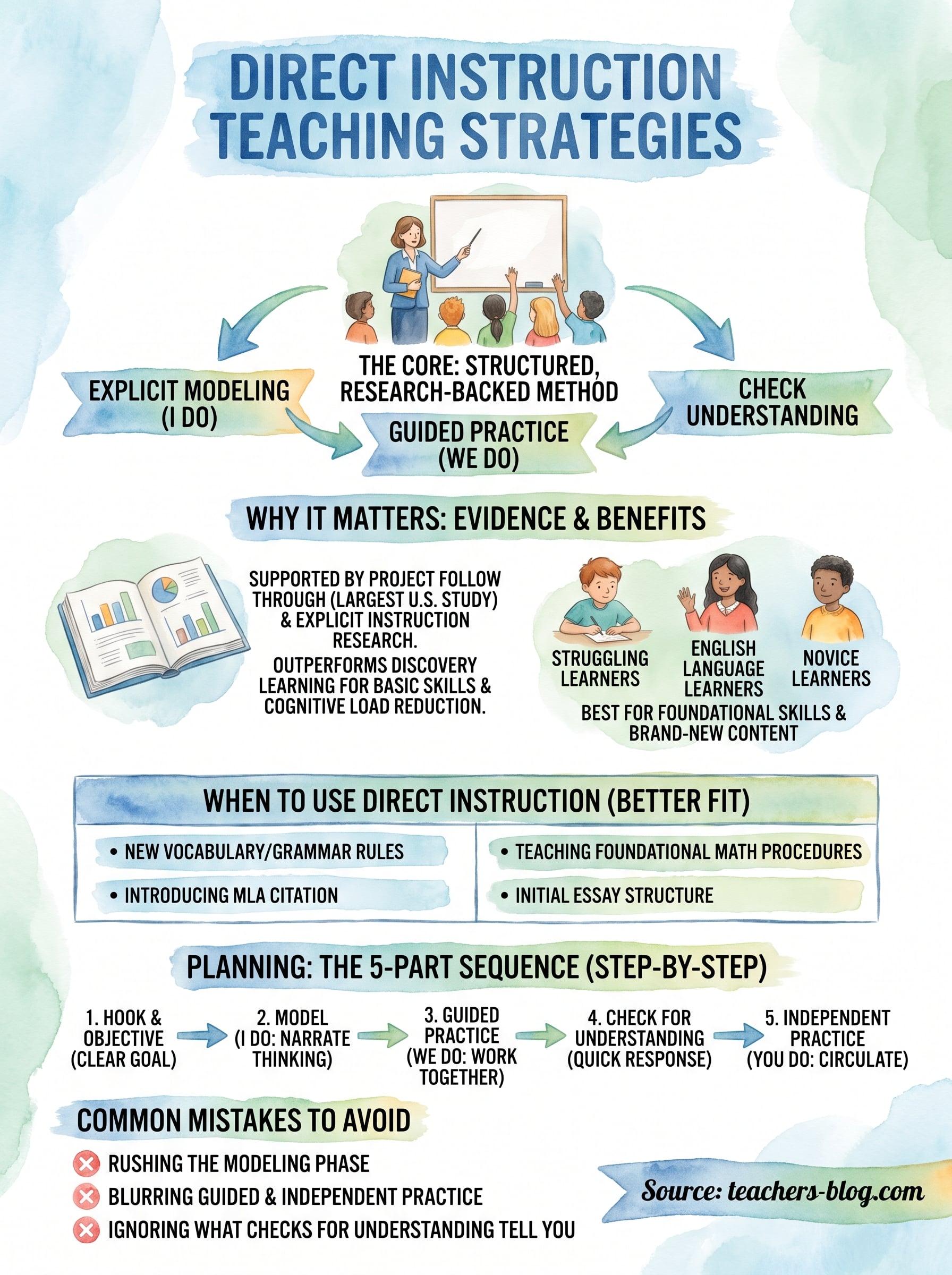
Decades of research back this up, not just teacher intuition. The largest education study ever funded by the U.S. government, Project Follow Through, tracked nearly 700,000 students across nine years and found that the Direct Instruction model outperformed every other approach tested, including discovery learning and open classrooms, on measures of basic skills, cognitive skills, and even student self-esteem. That’s not a small sample or a one-off study. It’s why so many literacy and math intervention programs still lean on explicit instruction in the classroom as their backbone, especially for skills that build on each other, like phonics before fluency or algebraic steps before word problems.
Clear modeling removes guesswork, and removing guesswork is how struggling students catch up.
Who gains the most from a structured approach
Struggling learners especially benefit from this method, along with English language learners and any student encountering brand-new content for the first time. Barak Rosenshine’s widely cited Principles of Instruction found that breaking material into small steps, modeling extensively, and checking for understanding before moving on reduces cognitive load for novice learners who don’t yet have the background knowledge to fill in gaps on their own. Once students have that foundation, they can handle more open-ended, inquiry-driven tasks with less frustration. Skip the scaffolding teaching strategies too early, and you end up with students who look busy but aren’t actually building the skill you’re after.
Where it fits alongside other methods
Direct instruction doesn’t need to replace every other type of teaching strategy in your toolkit, and treating it that way is a mistake. It works best when paired strategically with other approaches depending on what you’re teaching and where students are in the learning process.
| Classroom scenario | Better fit |
|---|---|
| Teaching new vocabulary or grammar rules | Direct instruction |
| Introducing MLA citation format | Direct instruction |
| Exploring an open-ended science question | Inquiry-based learning |
| Applying a skill after mastery, like a Socratic seminar | Discussion-based |
Use the table as a quick gut check before you plan. If students have zero prior exposure to a concept, lead with teacher-led instruction first, then hand over control. That sequencing, structure before autonomy, is what makes lessons planned with tools like our UDL Lesson Plan Template so effective: it builds in the explicit teaching phase before asking students to apply what they’ve learned independently.
How to plan a direct instruction lesson step by step
Start with a clear learning objective
Every direct instruction lesson begins with one sentence: what will students be able to do by the end of class that they couldn’t do at the start? Write that learning objective in student-friendly language and post it where they can see it. Skipping this step is the fastest way to end up with a lesson that drifts, because you won’t know when to stop modeling and start releasing responsibility. Pin the objective to a specific, observable skill, like "identify three examples of foreshadowing in Chapter 2," not a vague goal like "understand foreshadowing."
Sequence the lesson into five parts
Once you have the objective, map out the lesson using the same five-part structure every time, much like the Madeline Hunter lesson plan model, so students learn to expect it and you don’t skip steps under time pressure:
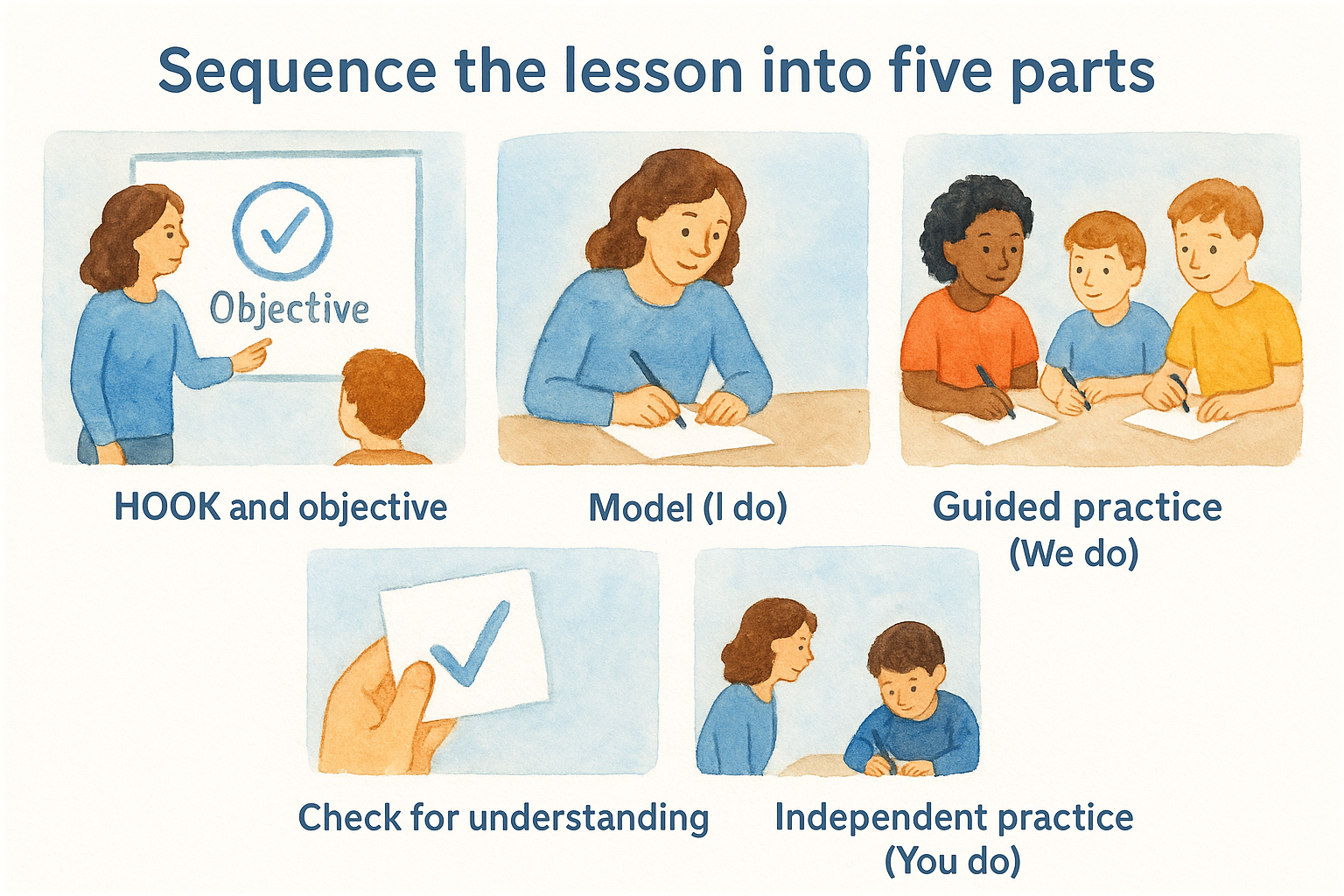
- Hook and objective: State the goal and connect it to something students already know.
- Model (I do): Demonstrate the skill yourself, narrating your thinking out loud.
- Guided practice (We do): Work examples together, calling on students to supply the next step.
- Check for understanding: Use a quick response method, like whiteboards or thumbs-up/down, before moving on.
- Independent practice (You do): Release students to try it alone, circulating to catch errors early.
This sequence, often shortened to "I do, we do, you do," is the backbone of most direct instruction teaching strategies, and it works because each phase builds directly on the last one.
Build in checks before releasing control
Don’t move to independent practice just because the clock says it’s time. Watch for genuine signs of readiness, like students answering correctly without prompting or explaining their reasoning back to you in their own words. If more than a few students miss the check for understanding, loop back to guided practice instead of pushing forward. That single decision, whether to advance or reteach, separates lessons that stick from ones students forget by the next class.
If students can’t explain it back to you, they’re not ready to do it alone.
Planning this way takes more upfront work than a loose lecture outline, but it pays off in fewer reteach days later.
Direct instruction examples for every step
Seeing the five-part structure applied to a real topic makes it easier to replicate than reading the steps in the abstract. Below are two full walkthroughs, one for a grammar skill and one for essay structure, so you can see how the same direct instruction teaching strategies flex across subjects without losing their shape.
A grammar mini-lesson from hook to independent work
Imagine you’re teaching comma usage with coordinating conjunctions. Here’s how the sequence plays out in a real 20-minute block:
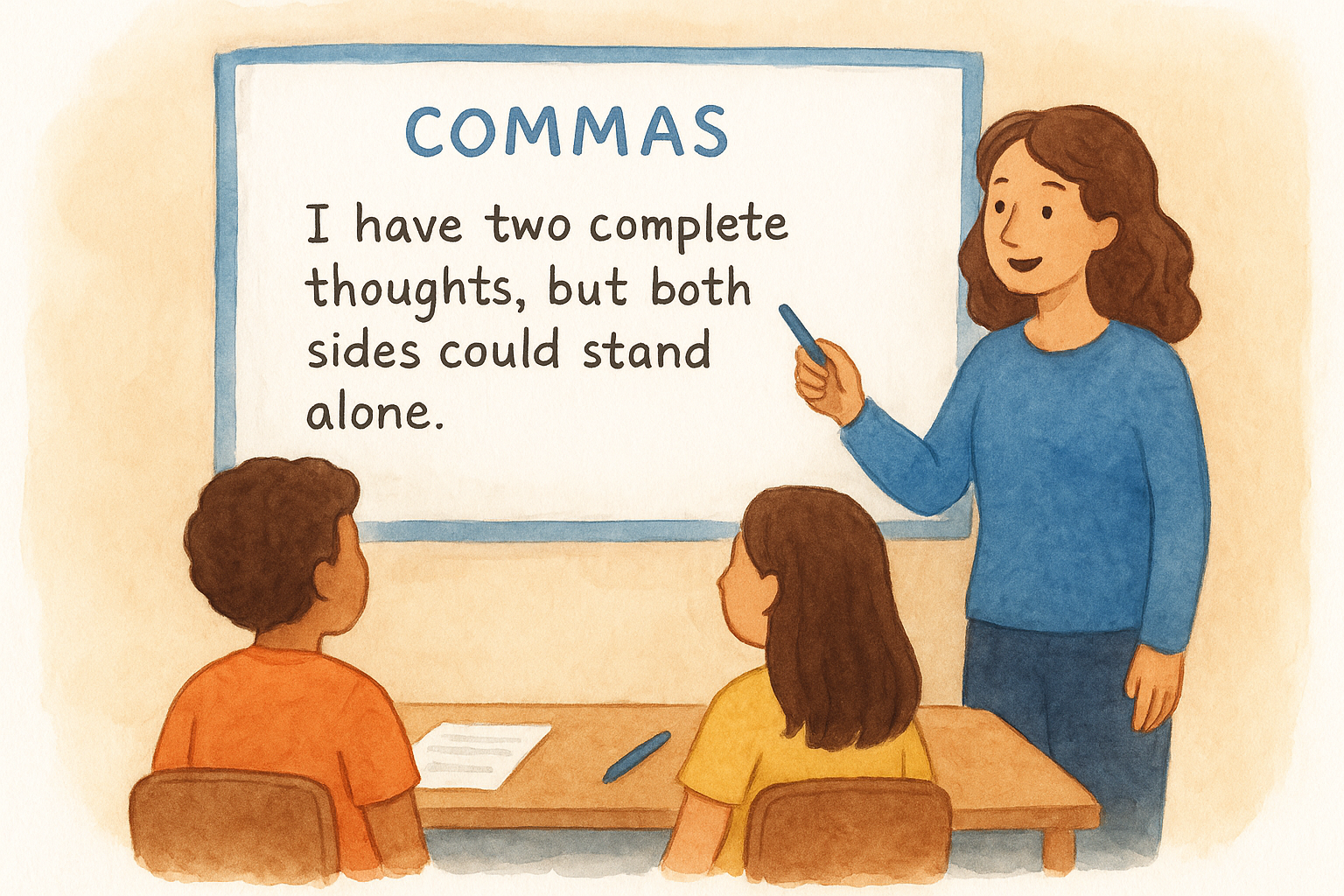
- Hook and objective: "Today you’ll be able to join two complete sentences with a comma and and, but, or so."
- Model: Write a sentence pair on the board and narrate: "I have two complete thoughts. I’ll add a comma before but because both sides could stand alone."
- Guided practice: Give students a new sentence pair and ask them to supply the missing comma while you write.
- Check for understanding: Hold up two sentence pairs; students give a thumbs-up if a comma belongs, thumbs-down if not.
- Independent practice: Hand out five sentence pairs for students to punctuate on their own, then collect for a quick scan.
Notice how little is left to chance here. Every step has a visible product you can check before moving forward.
The best direct instruction examples give you proof of learning at every single step, not just at the end.
Teaching MLA essay structure the same way
Underneath any essay writing unit, the same sequence works just as well for something like MLA formatting. You model a properly formatted heading and works-cited entry on the projector, narrating each decision out loud. Students then format a practice heading with you, calling out where the date and title go. A quick check, maybe a printed heading with errors to spot, tells you whether they’re ready. Only then do students format their own paper’s heading independently, with you circulating to catch stray commas or misplaced dates before the habit sets in wrong.
Across both examples, the pattern holds: model first, practice together, verify, then release. That order never changes, only the content inside it.
Common mistakes that weaken direct instruction
Even teachers who understand the five-part structure can undercut it with small habits that erode its effectiveness. Here are the three that show up most often in classroom observations, along with what to do instead.
Rushing the modeling phase
Skipping ahead in the "I do" step is the single most common mistake teachers make with explicit instruction. You know the material cold, so it’s tempting to demonstrate a skill once and move on, but students seeing it for the first time need to hear your thinking, not just watch the result appear on the board. Narrate every decision, including the ones that feel obvious to you, because those are usually the exact spots where students get stuck later during independent practice.
A rushed model teaches students to copy your answer, not your reasoning.
Blurring the line between guided and independent practice
Guided practice loses its purpose when you let it slide into students working silently at their desks while you circulate. That’s independent practice wearing a different label. Real guided practice means you’re still calling on students, correcting errors in real time, and keeping the whole group moving together before anyone works alone. If you notice half the room has quietly started their own pace, pull them back and finish the guided step as a group.
Ignoring what the check for understanding tells you
Many teachers build in a check for understanding, like a whiteboard response or exit question, and then move forward regardless of what it shows. That defeats the entire point of collecting the data in the first place. Watch for these warning signs that a lesson needs to slow down rather than advance:
- More than a handful of students miss the same question on a quick check.
- Students can produce a correct answer but can’t explain how they got it.
- Independent work comes back with the same error repeated across many papers.
Any one of those signals means you loop back to guided practice, not push forward on schedule. Protecting that step is what keeps direct instruction teaching strategies from becoming just another script you read off a lesson plan.
Bringing it all together in your classroom
Direct instruction works because it respects how novice learners actually build skill: model first, practice together, verify understanding, then release control. Skip a step or rush the modeling, and you end up reteaching next week instead of moving forward. Stick to the sequence, and even your trickiest concepts, grammar rules, MLA formatting, essay structure, become teachable in one clean block instead of three scattered ones.
Start small. Pick one upcoming lesson, write a single observable objective, and map it against the five-part structure before you touch a slide deck. You’ll notice almost immediately where your current plans skip straight from modeling to independent work without a real check in between.
If you want that structure built in from the start rather than added after the fact, browse the free lesson planning templates and unit plans on The Cautiously Optimistic Teacher. They’re built around this same explicit-to-independent sequence, so you’re not reinventing it lesson by lesson.