Differentiated Instruction for English Language Learners
You have a classroom full of students who need different things from you, and among them, your English Language Learners often need the most intentional support. Differentiated instruction for English Language Learners isn’t just a buzzword from your last PD session. It’s a practical framework that, when done right, removes barriers to learning while respecting each student’s linguistic and cultural strengths.
The challenge? Most teachers genuinely want to support their ELLs but feel stuck between rigid curriculum demands and the reality of varying language proficiency levels sitting side by side in the same room. Maybe you’re modifying assignments on the fly, or you’re unsure whether your scaffolding is actually helping or accidentally lowering expectations. You’re not alone in that tension, and there are concrete ways to move through it.
Here at The Cautiously Optimistic Teacher, we build resources and strategies that help educators meet diverse learners where they are, including our AI-powered Differentiated Instruction Helper, designed to make tailoring lessons less of a guessing game. This article breaks down what differentiated instruction looks like specifically for ELLs: practical strategies, classroom-ready tips, and guidance you can start applying this week.
Why differentiated instruction matters for ELLs
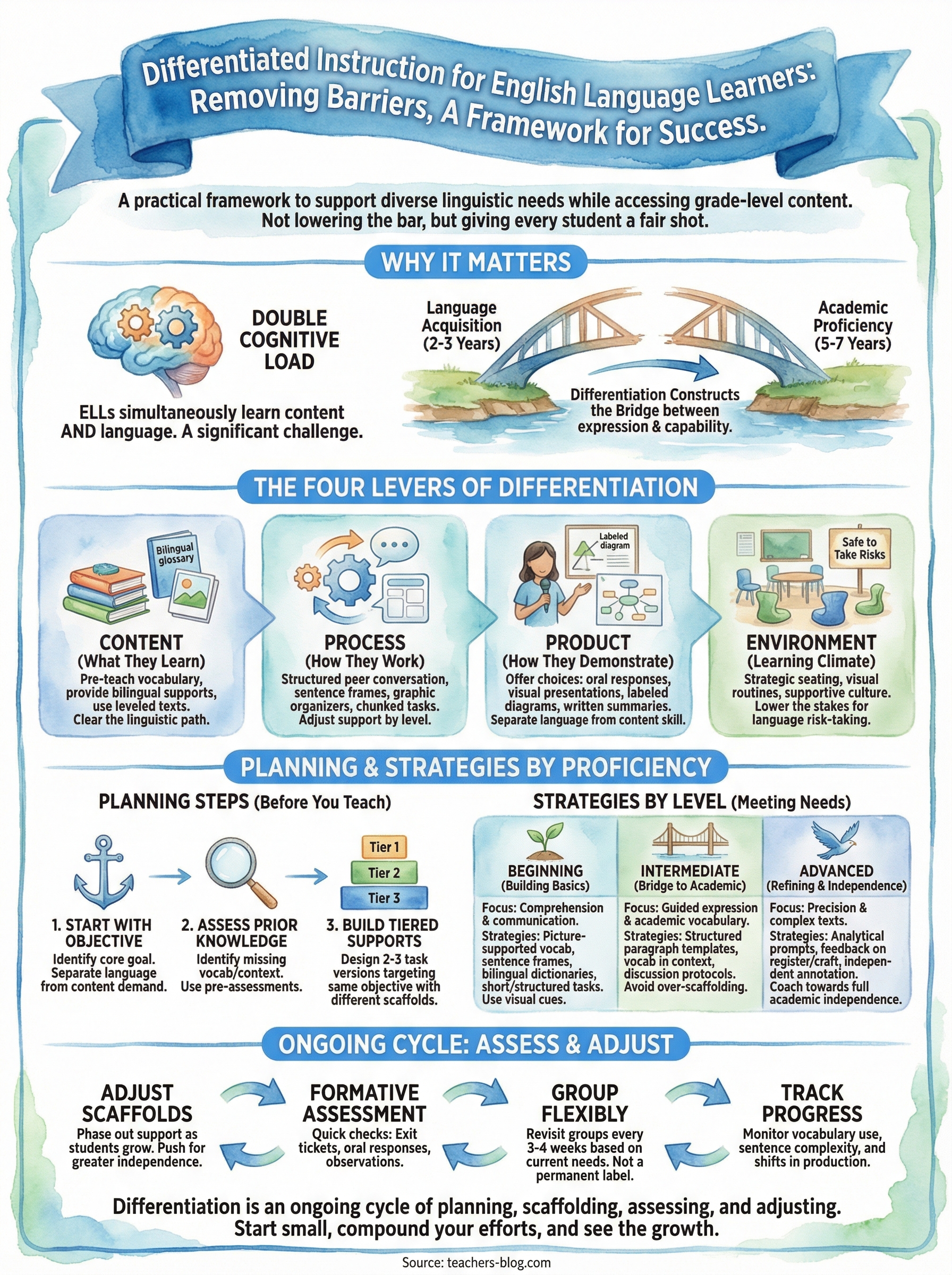
ELLs carry a double cognitive load that their native-speaking peers simply don’t have to manage. While your other students focus entirely on mastering the content, your ELLs are simultaneously learning the content and the language of instruction. That’s not a small lift. Research from the National Academies of Sciences, Engineering, and Medicine consistently shows that language acquisition takes years, and during that time, students still need access to grade-level thinking and ideas. Failing to differentiate during this window can permanently widen the achievement gap between ELLs and their English-proficient classmates.
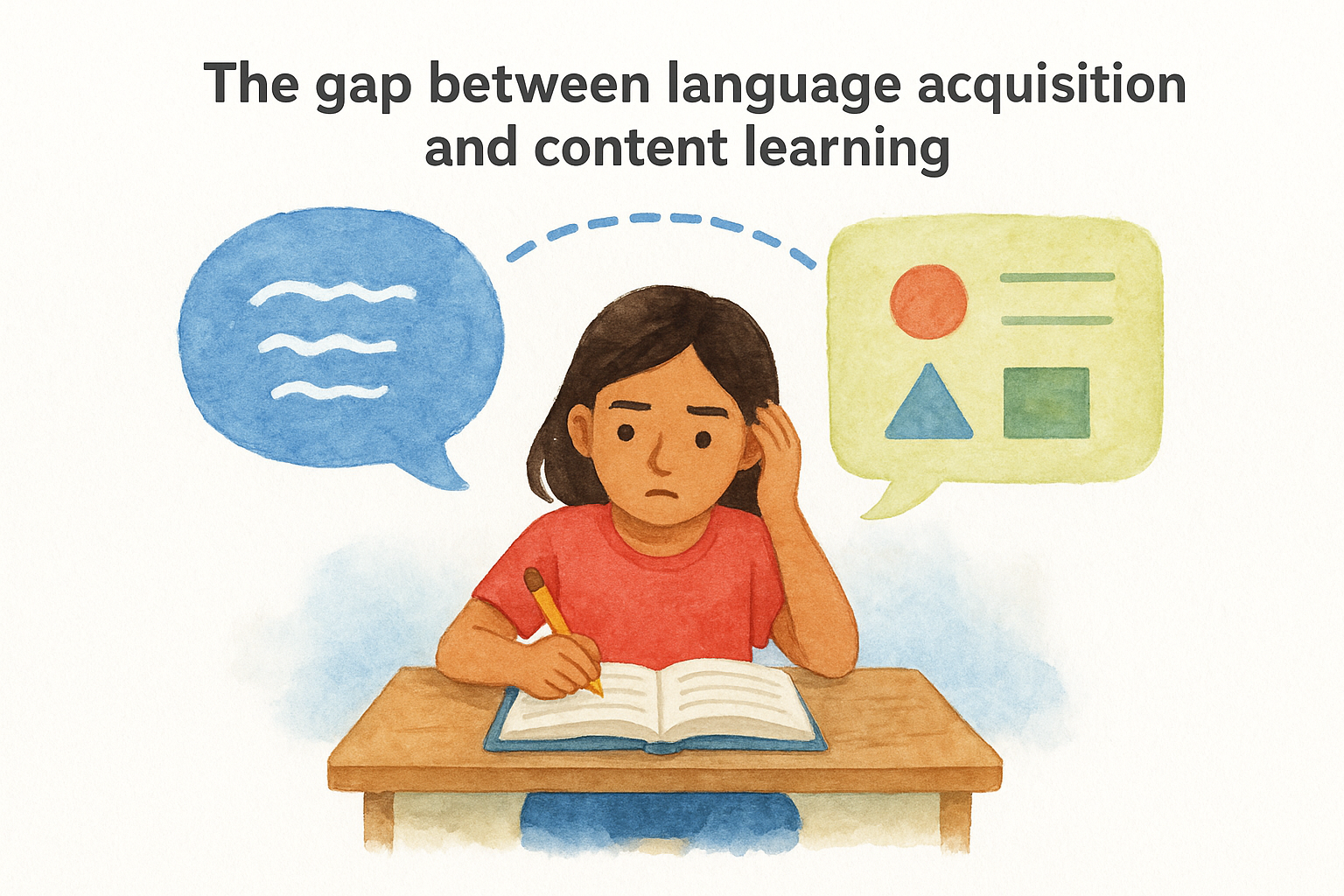
The gap between language acquisition and content learning
Most ELLs develop conversational English within two to three years. But academic language proficiency, the kind needed to read a dense textbook or write an analytical essay, typically takes five to seven years to build. Your curriculum doesn’t slow down for that gap. When you apply differentiated instruction for English Language Learners, you’re essentially constructing a bridge between what a student can currently express and what they’re actually capable of thinking. Without that bridge, students fall behind not because they lack understanding, but because they lack the linguistic tools to demonstrate it.
The goal of differentiation is not to lower the bar but to give every student a fair shot at reaching it.
ELLs are not a monolithic group
It’s tempting to treat all ELL students as one category, but your ELLs likely represent a wide range of languages, literacy levels, and prior schooling experiences. A student who is literate in Spanish transfers many reading skills to English. A student who has had interrupted formal education faces entirely different challenges and needs different support. Some ELLs in your class may be nearly fluent but still struggle with academic writing conventions; others may be at the earliest stages of English exposure. One-size-fits-all modifications will miss the mark for most of them, regardless of how much effort you put into creating them.
Recognizing this diversity is itself a key reason why differentiation matters. You can’t hand every ELL the same modified worksheet and expect meaningful results. The scaffolds that genuinely help a beginning-level student can feel unnecessarily limiting to an intermediate learner who is ready for more complex tasks. Understanding where each student sits linguistically shapes every instructional decision you make, from how you structure group work to which vocabulary you front-load before a reading assignment.
Why traditional instruction often falls short
Standard whole-class instruction assumes a baseline level of language fluency that many ELLs simply haven’t reached yet. When you deliver a lesson through lecture, assign reading without scaffolding, and assess through written tests, you end up measuring language proficiency as much as content knowledge. That’s a real problem, because your job is to assess what students know, not just what they can articulate in English. Traditional instruction also rarely accounts for cultural context, which shapes how students interpret texts, respond to discussion prompts, and approach certain writing tasks. Differentiated instruction pushes you to redesign those default structures so that language becomes a supported tool in your classroom rather than an invisible barrier standing between your students and the learning you want them to access.
What you can differentiate for ELLs
When teachers think about differentiation, they often jump straight to modifying assignments. But differentiated instruction for English Language Learners actually gives you four distinct levers to work with: content, process, product, and learning environment. Pulling any one of these levers thoughtfully can make a real difference for your ELLs, and combining them strategically makes instruction genuinely accessible.
Content and Process
Content refers to what students learn and how they access it. For ELLs, this might mean pre-teaching key vocabulary before a unit begins, providing a bilingual glossary alongside a reading, or offering leveled texts that carry the same concepts at different linguistic complexity. You’re not watering down the idea; you’re clearing the linguistic path so the idea can actually land.
Differentiating content means giving students a path to the same destination, not a shortcut to a different one.
Process is how students work through the material. You can adjust process for ELLs by building in structured peer conversation using sentence frames, offering graphic organizers to scaffold thinking, or chunking tasks into smaller steps with clear checkpoints. Your intermediate ELLs will likely need lighter scaffolding than beginners, so design your process supports with that range in mind rather than creating one version and applying it to everyone.
Product and Learning Environment
Product means how students demonstrate their understanding, and a written essay is just one of many options. ELLs at early proficiency levels can show mastery through labeled diagrams, recorded explanations, visual presentations, or structured oral responses. Consider offering choices like these:
- Written summaries with sentence starters
- Illustrated timelines or concept maps
- Short recorded verbal explanations
- Structured partner presentations
Expanding your product options doesn’t compromise rigor; it separates language skill from content knowledge so you can see what your student actually understands.
The physical and emotional climate of your classroom shapes how willing ELLs are to take risks with language. Strategic seating that pairs beginning ELLs with supportive bilingual peers, clear visual routines posted on the wall, and a classroom culture that treats language errors as part of learning all lower the stakes enough for students to participate more fully in the lessons you design.
How to plan a differentiated lesson for ELLs
Planning with differentiated instruction for English Language Learners in mind starts before you open your curriculum guide. The most effective differentiated lessons aren’t patched together after the fact; they begin with a clear picture of who your ELLs are and what they need to access the same rigorous content as everyone else. When you treat differentiation as a planning-stage decision rather than a last-minute fix, your lessons become more cohesive and less exhausting to manage in the classroom.
Start with your learning objective
Before you build any scaffold or modify any text, identify the core learning objective you want every student to reach. Separating the language demand from the content demand at this stage is critical. Ask yourself: is the goal for students to analyze a character’s motivation, or is the goal to write a structured essay? Those are two different targets, and conflating them creates unnecessary barriers for students who are still developing academic English. Once your objective is clear, you can design supports that keep the content goal intact while reducing the linguistic load.
Your learning objective is the anchor. Everything you differentiate should point back to it.
From that anchor, map out what prior knowledge your ELLs might be missing, whether that’s vocabulary, background context, or familiarity with a text structure. A quick pre-assessment, even an informal one, tells you where to invest your scaffolding energy before the lesson begins rather than guessing mid-lesson.
Build in tiered supports from the start
Tiered supports mean you design two or three versions of a task simultaneously, each targeting the same objective but requiring different levels of language production. A beginning ELL might complete a sentence frame template; an intermediate student might write a short structured paragraph; a more advanced student might respond with minimal scaffolding. Building these tiers during your planning session keeps your instruction intentional and your pacing on track when the lesson is actually running.
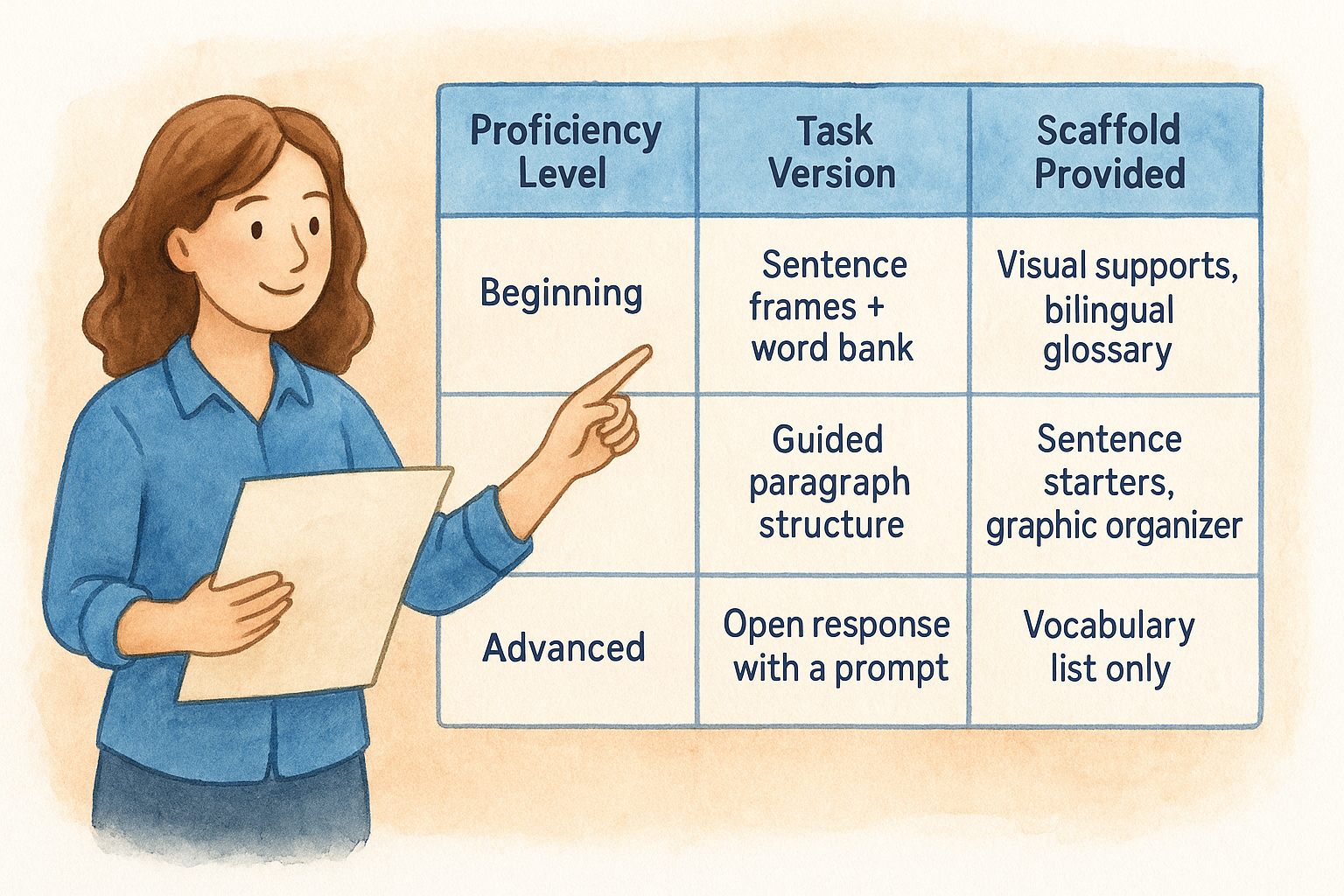
Use a simple planning table like this to organize your tiers before the lesson begins:
| Proficiency Level | Task Version | Scaffold Provided |
|---|---|---|
| Beginning | Sentence frames + word bank | Visual supports, bilingual glossary |
| Intermediate | Guided paragraph structure | Sentence starters, graphic organizer |
| Advanced | Open response with a prompt | Vocabulary list only |
Strategies by language proficiency level
When you apply differentiated instruction for English Language Learners, matching your strategies to each student’s proficiency level makes your scaffolding far more effective than a one-size approach. Proficiency levels give you a practical framework for deciding which supports to include, how much language production to expect, and where to start pushing students toward greater independence.
Beginning-level learners
Students at the beginning level are still building a basic English vocabulary and rely heavily on visual and contextual clues to make meaning. Your priority with these students is comprehension and communication, not grammatical precision. Use strategies like:
- Picture-supported vocabulary cards and word walls
- Sentence frames for speaking and writing ("The character feels ___ because ___.")
- Bilingual dictionaries or glossaries in the home language
- Short partner tasks with a supportive bilingual peer
Meeting beginning-level ELLs where they are is not lowering your expectations; it is giving them the tools to eventually meet those expectations on their own.
Keeping tasks short and structured at this stage reduces cognitive overload and builds confidence faster than open-ended assignments will.
Intermediate-level learners
Intermediate students can communicate in English with some consistency but still struggle with complex sentence structures and academic vocabulary. These students need less visual support than beginners but still benefit from guided frameworks. Give them structured paragraph templates, vocabulary lists with definitions in context, and discussion protocols that require discipline-specific language. Push them toward longer written responses where they have to produce academic language, not just receive it.
Avoid over-scaffolding at this level. When you remove supports too slowly, intermediate students plateau and stop pushing their language production forward.
Advanced-level learners
Advanced ELLs often sound fluent in conversation but still hit walls with dense academic texts and formal writing conventions. Your focus here shifts to refining, not building. Offer these students complex texts, analytical writing prompts, and feedback that targets precision and register rather than basic comprehension.
You can also assign independent annotation tasks in grade-level texts with minimal support. The goal is full academic independence, which means your role shifts from scaffolding content to coaching language craft and argument clarity.
Assess and group students as needs change
Effective differentiated instruction for English Language Learners depends on knowing where each student is right now, not where they were at the start of the school year. Your ELLs are actively acquiring language, which means their needs shift throughout the year, sometimes faster than your formal assessment schedule can capture. Building regular, low-stakes assessment into your routine gives you the real-time data you need to make smart instructional decisions.
Grouping is a tool, not a label. The moment it stops serving a student’s growth, you change it.
Use formative assessment to track progress
Relying only on end-of-unit tests or formal language assessments gives you snapshots that are often weeks apart. In that gap, a student might have moved from beginning to intermediate without you noticing, or they might have stalled and need additional support. Use quick formative checks like exit tickets, brief oral responses, or annotated reading responses to track where students are at the end of each week. These checks don’t need to be elaborate. A simple prompt like "explain what happened in today’s reading using at least three complete sentences" tells you a great deal about where a student’s language production stands.
Watching for shifts in vocabulary use and sentence complexity is equally useful. Track these observations in a simple running log so you can spot patterns over time rather than reacting to isolated moments. When a student starts producing longer, more precise sentences unprompted, that’s your signal to pull back a scaffold and give them room to stretch.
Group flexibly and revisit often
Static ability groups are one of the fastest ways to limit an ELL’s academic trajectory. When you lock students into the same group for an entire semester, you signal that their current level is their ceiling. Instead, build flexible grouping structures that you revisit every three to four weeks. Some tasks benefit from grouping by proficiency level so you can target specific scaffolds. Other tasks work better in mixed-proficiency groups where advanced ELLs model academic language while beginners gain natural exposure to it.
Revisiting your groups regularly also keeps you honest about which scaffolds are still necessary and which ones you can phase out to push students toward greater independence.
Next steps
Differentiated instruction for English Language Learners is not a one-time fix you apply and forget. It’s an ongoing cycle of planning, scaffolding, assessing, and adjusting that gets sharper the more you practice it. The strategies in this article give you a solid starting point, but the real growth happens when you start applying them consistently and reflecting on what your specific students actually need.
Start small. Pick one lever, whether it’s tiering a task or adding sentence frames to a discussion, and build from there. Trying to overhaul every lesson at once will burn you out fast, but making one intentional adjustment per week compounds into real classroom transformation over time.
When you’re ready to speed up the process, our Differentiated Instruction Helper can help you build tailored lesson scaffolds faster so you spend less time planning and more time actually teaching the students in front of you.