6 Co-Teaching Strategies Every Classroom Duo Should Know
You walked into co-teaching expecting magic and instead got two adults awkwardly hovering at the front of the room, unsure who’s supposed to talk next. That’s not a partnership problem, it’s a strategy problem. Co-teaching strategies give you and your teaching partner an actual structure to follow instead of improvising every period and hoping it clicks.
If you’re searching for how the different co-teaching models actually work, you’re in the right place. This article breaks down six approaches, including station teaching and parallel teaching, and shows you when to use one teach-one assist instead of team teaching, or why alternative teaching fits certain lessons better than others. You’ll see the mechanics of each model, not just the textbook definition.
Whether you’re pairing a general education teacher with a special education co-teacher in an inclusive classroom, blending content expertise with an ESL specialist, or just tired of one person doing all the heavy lifting, these co teaching strategies will help you divide the work and the room more intentionally. By the end, you’ll know exactly which model fits your next lesson, your students, and your particular duo.
1. One teach, one observe or assist
How it works
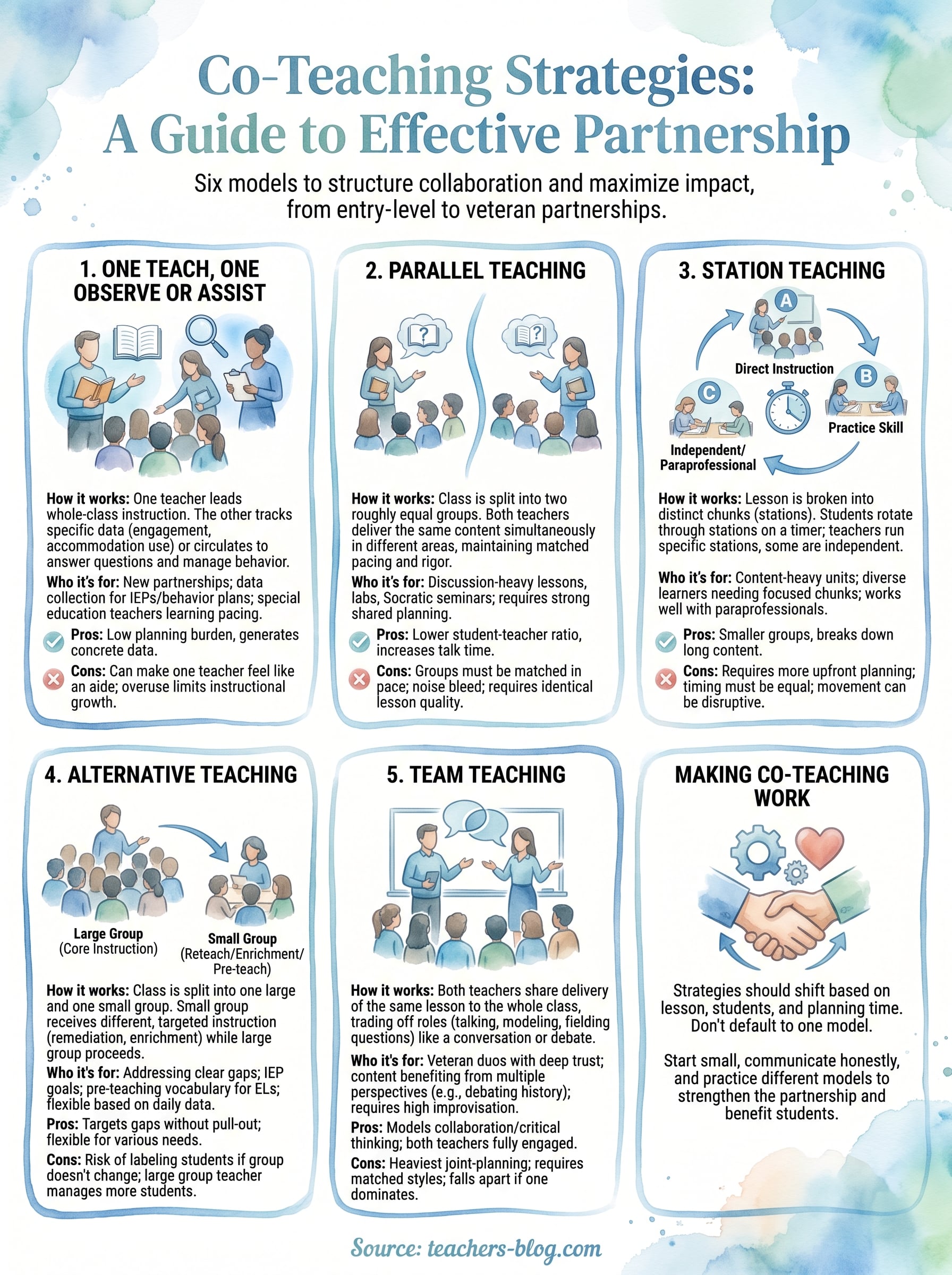
One teacher plans and delivers the lesson to the whole class while the other steps back, either watching specific students or moving around to lend a hand. The observer isn’t just standing there. They’re tracking data on a student’s engagement, noting how long it takes a group to grasp a concept, or checking whether an accommodation is actually working. In the assist version, that second teacher answers questions, redirects off-task behavior, or hands out materials without ever taking over the lesson. This is often the entry point for new co-teaching pairs because it requires the least amount of joint planning time compared to the other co-teaching strategies on this list.
Who it’s for
Use this model when you’re just starting a partnership and haven’t built up the trust or shared planning habits that other approaches demand. It also works well when you need hard data on a specific student, say for an IEP progress report or a behavior intervention plan, and want a dedicated set of eyes rather than a teacher splitting attention between instruction and observation. Special education co-teachers frequently rely on this setup during the first few weeks of a new school year while they learn a general education teacher’s pacing and classroom management style. If you want that observation time to double as differentiation planning, our Differentiated Instruction Helper can turn those notes into targeted adjustments for your next lesson, the same way you’d use formative assessment data to guide instruction.
One teach, one observe works because it gives you real data instead of a guess about what your students actually need.
Pros and cons matter here because this model gets overused. Leaning on it every single day turns your co-teacher into a glorified aide instead of an equal instructional partner, which defeats the purpose of having two credentialed teachers in the room.
| Pros | Cons |
|---|---|
| Low planning burden, easy for new partnerships | Can make one teacher feel like support staff, not a co-teacher |
| Generates concrete data for IEPs and behavior plans | Students may see one adult as the "real" teacher |
| Assist version keeps both adults actively engaged | Overuse limits co-teacher’s instructional growth |
2. Parallel teaching
How it works
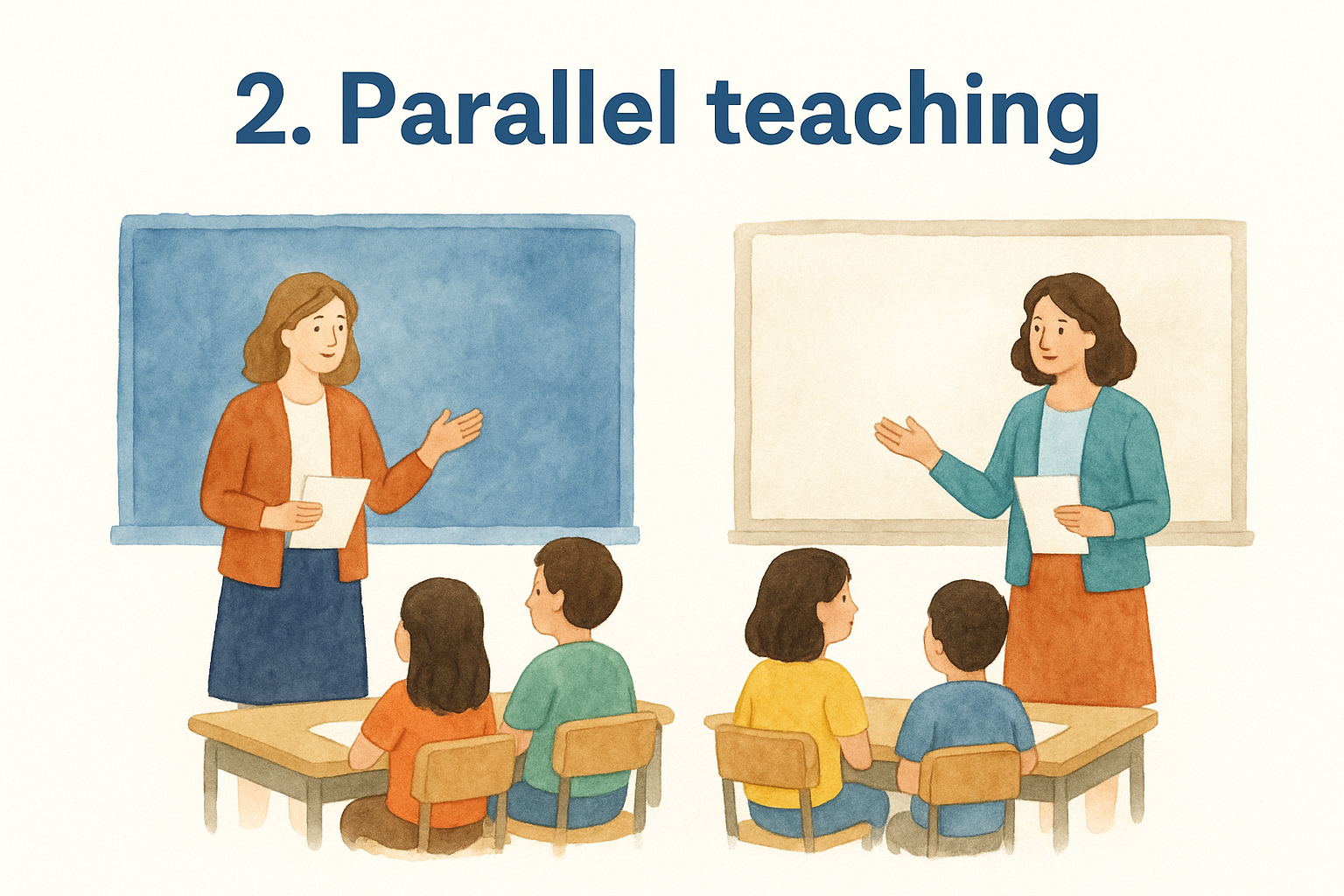
Split the class into two groups of roughly equal size and skill level, then teach the same content simultaneously on opposite sides of the room. Both teachers cover identical material, same objective, same worksheet, same exit ticket, but each works with half the students. Parallel teaching cuts the student-to-teacher ratio in half without changing what gets taught, which means faster response times to raised hands and more chances for kids to actually talk during discussion. Timing matters here: you both need to hit the same pacing so neither group finishes early or falls behind.
Who it’s for
Reach for this model when you want smaller group dynamics for a discussion-heavy lesson, a lab activity, or a Socratic seminar where quieter students need more room to speak up. It suits duos who’ve already built strong shared planning habits, since both teachers must deliver the same lesson with matching rigor and pacing. General education and ESL co-teachers often use this setup for vocabulary-heavy content, letting the ESL teacher’s group move at a pace suited to language acquisition.
Parallel teaching doesn’t change what you teach, it changes how many students hear your voice at once.
Pros and cons
Grouping decisions carry real weight in this model, since an uneven split can leave one teacher managing a much harder room.
| Pros | Cons |
|---|---|
| Cuts group size in half instantly | Groups must stay matched in pace and rigor |
| Increases student talk time and participation | Noise from two groups can bleed together |
| Both teachers deliver full instruction, not support roles | Requires nearly identical lesson quality from both teachers |
3. Station teaching
How it works
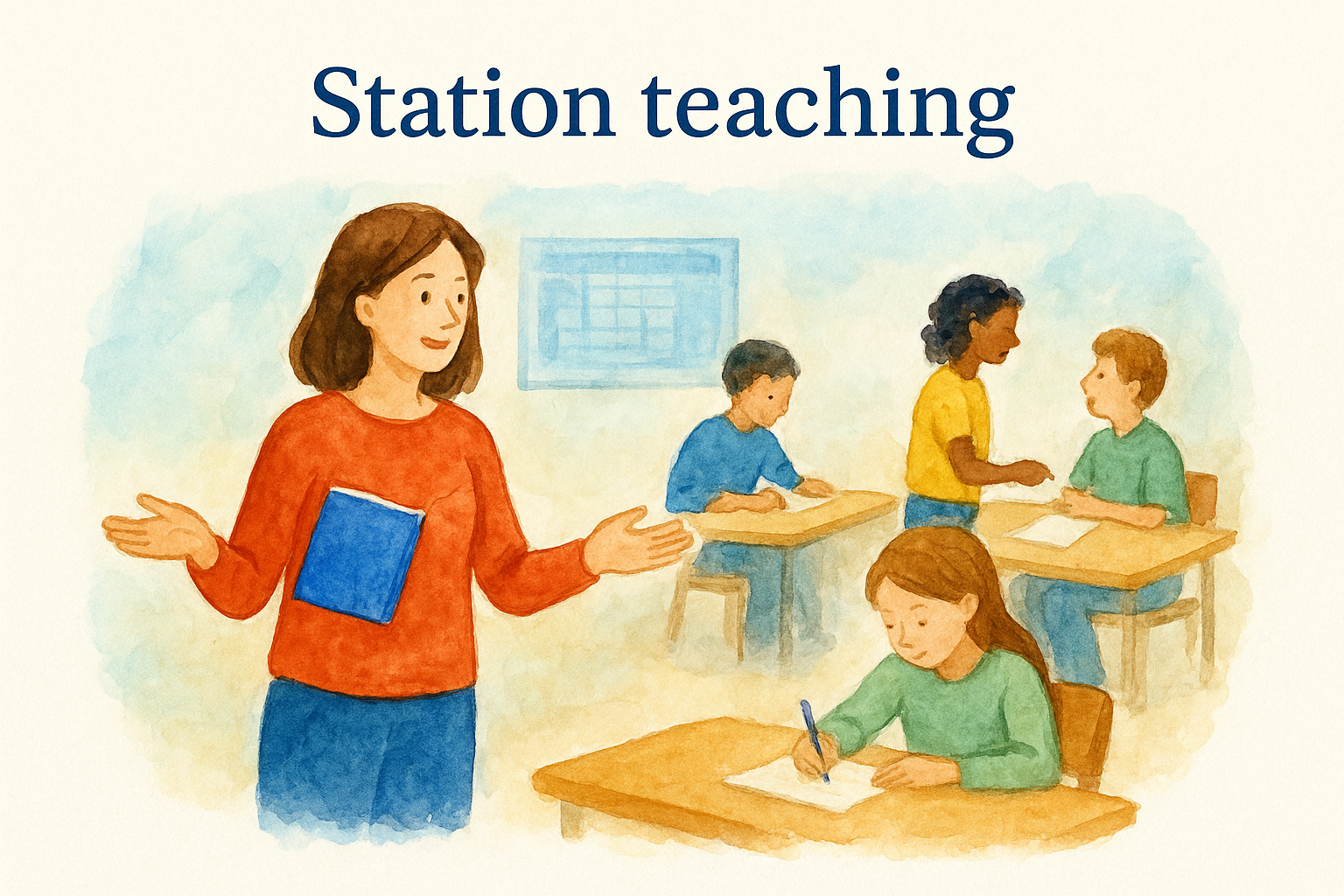
Break the lesson into three or four distinct chunks and set up a station for each one, then rotate small groups of students through them on a timer. One teacher runs a station that needs direct instruction, the other runs a second station, and the remaining stations run independently or with a paraprofessional. Station teaching works best when the content naturally splits into separate skills, like a grammar lesson that covers punctuation at one table and sentence structure at another. Rotations usually run 10 to 15 minutes, so plan your timer and transition routine before day one or you’ll lose half the period to shuffling desks.
Who it’s for
Grab this model for content-heavy units where students benefit from smaller, focused chunks instead of one long lecture, which is exactly why learning stations work so well for diverse learners. It suits duos willing to plan multiple mini-lessons instead of a single shared one, and it’s a natural fit when you’ve got a paraprofessional or student teacher who can run an independent station. Our Worksheet Maker can generate the independent practice sheets for stations you’re not directly supervising, so students stay on task without you hovering.
Station teaching turns one long lesson into several short, focused ones, which keeps attention from drifting.
Pros and cons
The biggest planning challenge is making sure every station takes roughly the same amount of time, or your rotation schedule falls apart by the third group.
| Pros | Cons |
|---|---|
| Smaller groups mean more individual attention | Requires more upfront planning than whole-group models |
| Breaks long content into manageable chunks | Noise and movement between stations can disrupt focus |
| Works well with a third adult in the room | Uneven station timing throws off the whole rotation |
4. Alternative teaching
How it works
Split your class into one large group and one small group, then teach the small group something different from what the rest of the class is covering. Maybe six kids need a reteach on fractions while the other twenty move ahead with word problems, or a handful of advanced students tackle an extension task while everyone else practices the core skill. Alternative teaching isn’t about tracking kids permanently into a slow group and a fast group. The small group changes based on the day’s data, sometimes it’s remediation, sometimes it’s enrichment, sometimes it’s a pre-teach for a concept coming up next week.
Who it’s for
Grab this model when you’ve got a clear gap, a handful of students missing a prerequisite skill, an IEP goal that needs direct instruction time, or a cluster of English learners who need vocabulary front-loaded before the whole class discussion. It works well for co-teaching pairs supporting students with significant learning needs, since the small group gets focused, targeted instruction without singling anyone out publicly. Our Question Generator can build the extension questions for your advanced small group while you focus on the reteach.
Alternative teaching gives you a way to close gaps without ever pulling a student out of the classroom.
Pros and cons
Watch the makeup of that small group closely, since pulling the same students every time risks labeling them and hurting morale, one of the real drawbacks of grouping students flexibly.
| Pros | Cons |
|---|---|
| Targets specific gaps without pulling kids out of the room | Risk of the same students always in the small group |
| Flexible for reteach, enrichment, or pre-teaching | Requires careful, data-driven grouping decisions |
| Supports IEP and language goals directly | Large group teacher manages more students alone |
5. Team teaching
How it works
Both teachers share the same lesson in front of the whole class at the same time, trading off who talks, who models, and who fields questions. Team teaching looks like a conversation more than a lecture: one of you introduces a concept while the other jumps in with a counterexample, or you debate two interpretations of a poem to show students that disagreement is part of learning. Neither teacher takes a back seat here, which is what separates this model from one teach-one assist. Planning has to happen together, line by line in some cases, because you’re essentially co-writing a script you’ll both perform live.
Who it’s for
Choose this model once you and your partner have logged real time together and can read each other’s cues without a script. Veteran co-teaching duos gravitate here because it demands quick improvisation and a shared sense of humor about interrupting each other mid-sentence. It also shines for content that benefits from two perspectives, like analyzing a primary source or debating a historical decision, where hearing two credentialed adults disagree models critical thinking better than any worksheet, one of the more engaging teaching methods you can build a lesson around.
Team teaching works best when your partnership is strong enough that students can’t tell who’s actually in charge.
Pros and cons
This model asks the most of your relationship, so weigh the payoff against the planning time honestly.
| Pros | Cons |
|---|---|
| Models collaboration and debate for students | Requires deep trust and matched teaching styles |
| Both teachers stay fully engaged, no support role | Heaviest joint-planning demand of any model |
| Great for content needing multiple perspectives | Falls apart quickly if one teacher dominates |
Making co-teaching work for your classroom
None of these six models works if you pick one and stick with it out of habit. Co-teaching strategies should shift depending on the lesson, the students in front of you, and how much planning time you and your partner actually have that week. Station teaching fits a grammar unit; alternative teaching fits a reteach; team teaching only works once you’ve earned the trust it demands. Rotate through them deliberately instead of defaulting to one teach-one assist because it’s easiest.
Start small if you’re new to this. Pick one model, try it for a week, and talk honestly with your co-teacher about what felt clunky. That conversation matters more than any framework. Your partnership will get sharper the more models you both practice, and your students will notice two adults who actually know what they’re doing up there. For more classroom-tested ideas on making a partnership work, read our full list of co-teaching strategies that actually work at The Cautiously Optimistic Teacher.