How To Differentiate Instruction In The Classroom: Examples
You’ve got 30 students in your room, and no two of them learn the same way. Some race ahead while others need more time. Some thrive with visuals; others need to talk it out. Figuring out how to differentiate instruction in the classroom isn’t just a nice-to-have skill anymore, it’s the difference between reaching your students and losing them. Yet for something so critical, most teacher prep programs barely scratch the surface of what it actually looks like in practice.
Differentiated instruction means adjusting your content, process, product, or learning environment to meet students where they are. Simple concept. Harder to pull off on a Tuesday morning with a full roster and three different reading levels staring back at you. That’s exactly why we built The Cautiously Optimistic Teacher, to give educators practical strategies and tools (including our AI-powered Differentiated Instruction Helper) that make this work manageable, not just aspirational.
This guide breaks down the four core pillars of differentiation, walks through real examples you can use tomorrow, and gives you a framework for supporting every learner in your classroom, without burning out in the process. Whether you’re new to differentiation or looking to sharpen what you’re already doing, you’ll find concrete, actionable strategies ahead.
Why differentiated instruction matters
Walk into any classroom and you’ll see students at wildly different points in their learning. Some already mastered last week’s concept before you taught it. Others are still wrestling with foundational skills from two years ago. Every one of those students deserves a realistic shot at making progress, and differentiation is how you make that possible.
Students don’t arrive at the same starting line
The range of readiness in a typical classroom is wider than most people outside education realize. Research consistently shows that variability in how students learn is the norm, not the exception. Students differ in background knowledge, processing speed, language proficiency, and the way they best demonstrate understanding. Treating them as a uniform group means some will coast while others fall further behind, and both groups lose out.
Differentiation doesn’t mean writing 30 individual lesson plans. It means making smart adjustments that give every student a realistic path to the same learning goal.
When you ignore those differences, you end up with two problems at once. Students who are underchallenged disengage quickly, often showing up as behavioral issues or low effort. Students who are overwhelmed shut down and stop trying. Both groups stop learning, and both outcomes are completely preventable with intentional lesson design.
The cost of a one-size-fits-all approach
Teaching to the middle of your class is the default for a reason: it feels efficient. However, that efficiency comes at a real cost to the students on either end of the spectrum. The student who already knows the material sits bored, and the student who isn’t ready yet nods along and falls further behind with every lesson.
Learning gaps also compound over time. A student who doesn’t grasp a foundational concept in October will struggle with everything built on top of it by March. By the time you notice the gap, it’s much larger and much harder to close. Differentiating early, even with small adjustments, keeps gaps from growing into something that takes months to address.
Why this matters more now
Classrooms today are more diverse than ever in terms of language backgrounds, learning profiles, and prior academic experiences. Knowing how to differentiate instruction in the classroom is no longer a strategy reserved for special education teachers or resource rooms. Every teacher in every subject area benefits from building flexibility into their lessons from the start.
The good news is that differentiation, done well, doesn’t pile more work onto your already full plate. It means designing smarter from the beginning. When you build multiple entry points into a lesson upfront, you reduce the reactive scrambling that happens when half your class isn’t following along. You spend less time reteaching and more time actually moving students forward. That shift from reactive problem-solving to proactive planning is what makes differentiation genuinely worth your time and effort.
The four ways to differentiate in any lesson
When you think about how to differentiate instruction in the classroom, it helps to know that differentiation falls into four distinct categories: content, process, product, and environment. You don’t need to adjust all four in every lesson. Even targeting one of these areas thoughtfully can make a meaningful difference for your students.
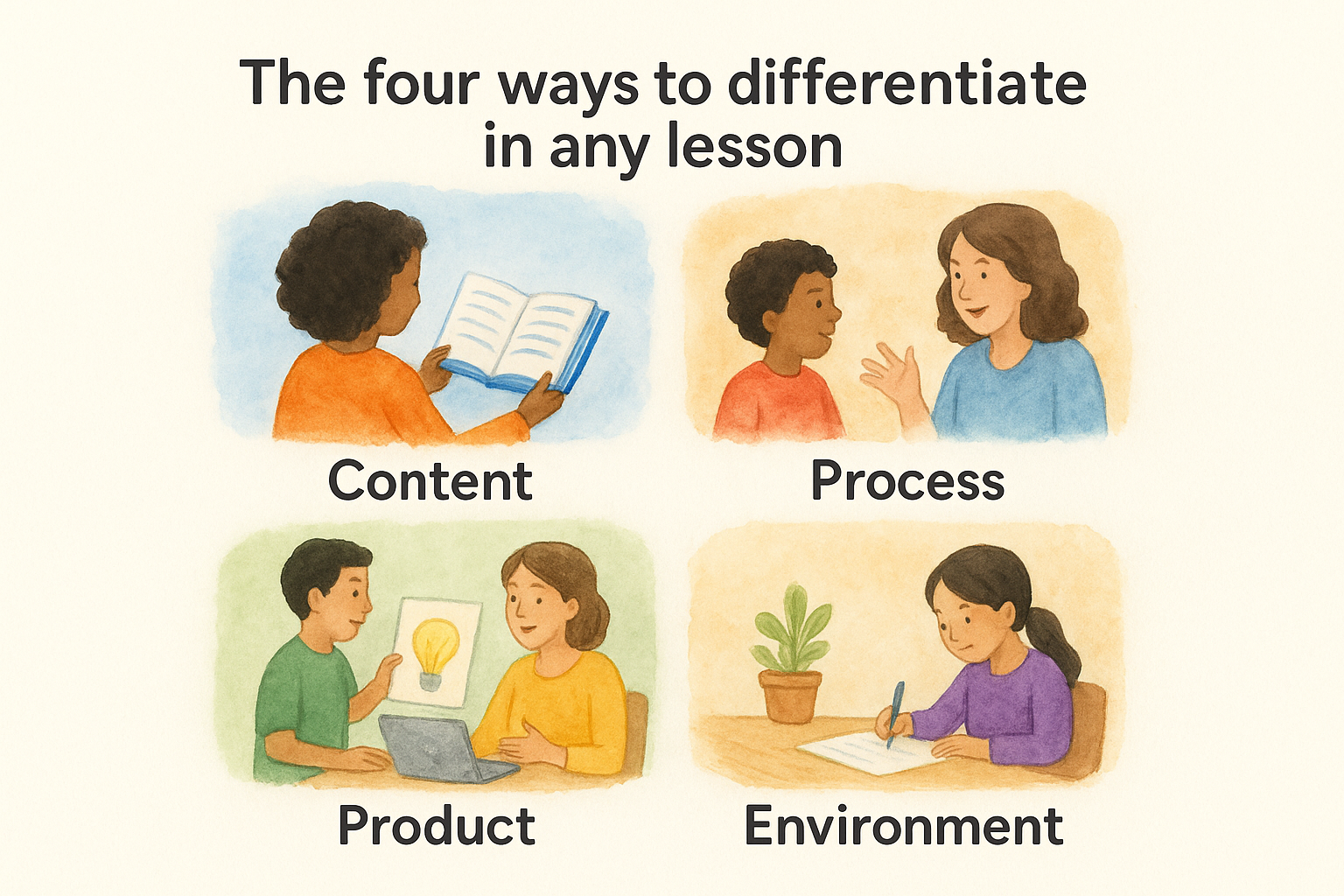
Differentiation isn’t about creating entirely separate lessons for every student. It’s about building smart adjustments into the lesson you’re already planning.
| Element | What you adjust | Quick example |
|---|---|---|
| Content | What students access | Tiered texts at different reading levels |
| Process | How students engage with ideas | Choice boards, flexible grouping |
| Product | How students demonstrate mastery | Written, visual, or oral options |
| Environment | Where and how students work | Quiet zones, collaborative spaces |
Content and process
Content differentiation means adjusting what students access, not what they’re expected to learn. You might give one group a complex primary source and another group a summarized version of the same text, but both groups work toward the same learning objective. The goal stays consistent; the entry point shifts to meet students where they actually are.
Process differentiation focuses on how students engage with the material after you’ve introduced it. A student who processes information best through discussion needs something different from a student who works better writing independently. Offering structured choices during practice time, like graphic organizers, partner talk, or written reflection, lets students build understanding in a way that actually sticks.
Product and environment
Product differentiation gives students options for how they demonstrate mastery. Instead of one assignment format for everyone, you might offer a visual project, an oral explanation, or a traditional written response. Students still meet the same standard; they just reach it through a path that plays to their strengths.
Environment differentiation is often overlooked, but the physical and social setup of your room directly shapes how students engage. Offering a quiet corner for independent work, flexible seating, or small-group spaces during practice can reduce anxiety and increase focus, especially for students who struggle in traditional whole-class formats.
How to plan differentiation without doubling prep time
The biggest reason teachers avoid differentiation is time. Planning one solid lesson already takes significant effort, and the idea of creating separate versions for every student sounds impossible. The key shift is moving from "more lessons" to "one flexible lesson" with multiple entry points already built in. When you add that flexibility upfront, you stop scrambling mid-lesson to accommodate students who lost the thread ten minutes ago.
You don’t need to build entirely separate materials for every student. You need to build one lesson that’s smart enough to flex.
Start with the learning goal, not the activity
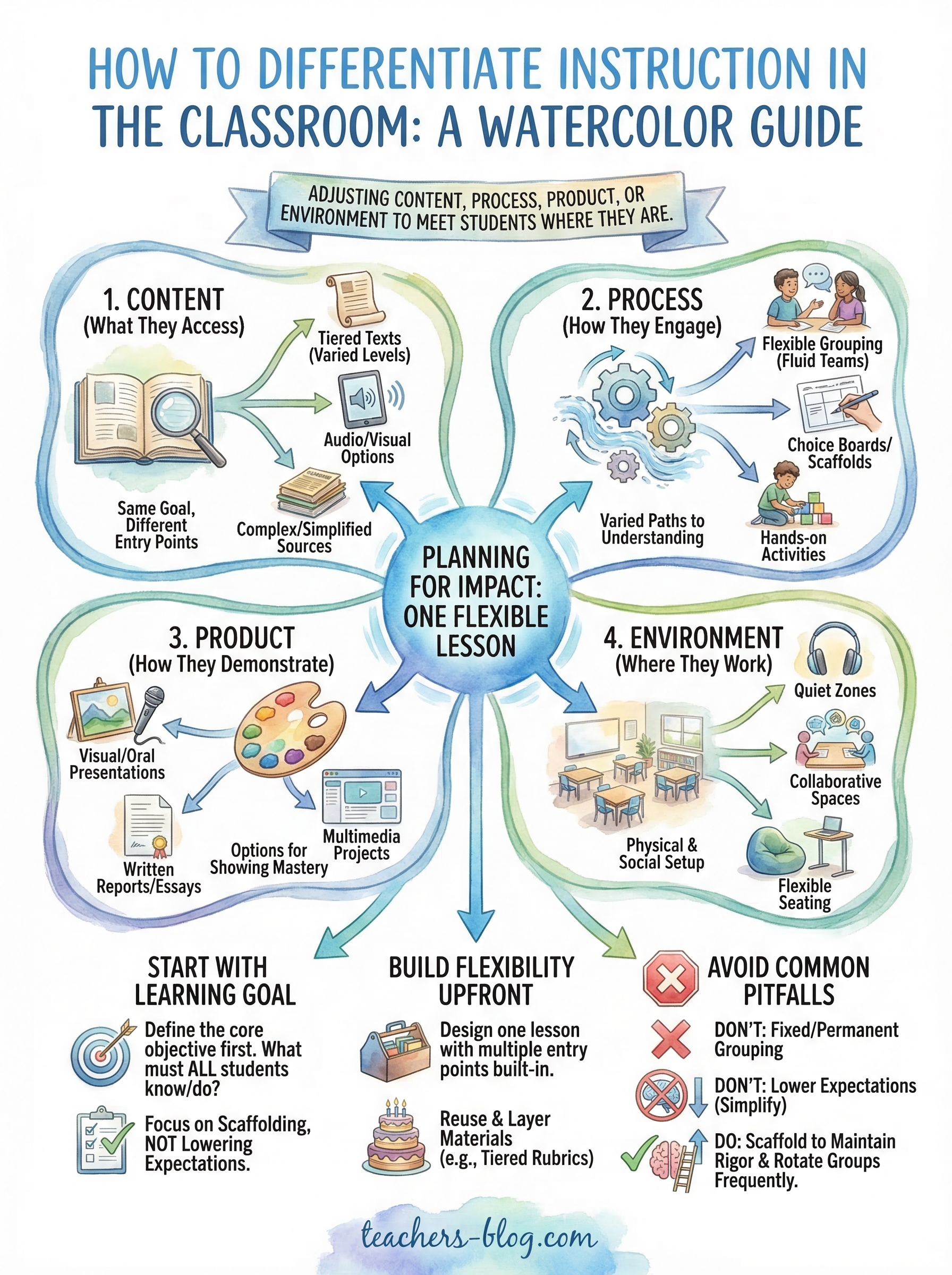
Every differentiation decision should begin with your learning objective, not the task or worksheet you’ve already planned. Ask yourself: what do all students need to know or be able to do by the end of this lesson? Once that target is clear, you can work backward to identify where different students need different levels of support or challenge to reach it.
Working from the goal outward makes adjustments much easier to spot, and it also keeps the scope of your planning manageable. You’re not rewriting the whole lesson; you’re identifying which specific parts need a second entry point. A complex text still serves its purpose when paired with a structured reading guide. A task that’s too simple for advanced learners becomes more meaningful with a short extension question added on.
Reuse and layer, don’t recreate
One practical approach to how to differentiate instruction in the classroom without wrecking your weekend is to build materials that work at multiple levels from the start. A single graphic organizer with optional sentence starters serves students who need scaffolding and those who don’t. One rubric with tiered criteria covers multiple performance levels without requiring entirely separate assignments.
Batching similar tasks also saves real prep time. When you write discussion questions for a unit, draft a few at different complexity levels all at once rather than returning later to revise them. Layering complexity into materials you’re already building keeps your total prep time close to what it was before, while giving students genuinely different experiences within the same lesson structure.
High-impact differentiation strategies with examples
Knowing the theory behind how to differentiate instruction in the classroom is useful, but seeing it work in practice is what actually changes your teaching. The strategies below are high-leverage moves that fit into existing lesson structures without requiring a complete redesign of your curriculum.
Tiered assignments
Tiered assignments give students different versions of the same task scaled to their current readiness level. All students work toward the same learning target, but the complexity, scaffolding, or depth of the task adjusts to match where each student starts. For example, if your class is analyzing a persuasive text, one tier might ask students to identify the author’s claim and two supporting details. A second tier asks students to evaluate how effectively those details support the claim. A third tier asks students to compare the rhetorical strategies across two different texts. Same skill, three distinct entry points.
Flexible grouping
Flexible grouping means you shift how students work together based on the specific task, not a permanent label. Some days you group by readiness level so you can deliver targeted support directly to the students who need it most. Other days you mix readiness levels intentionally so students can learn from each other during collaborative tasks.
The key is keeping groups fluid. Students who feel permanently placed in a "low" group lose motivation fast.
Rotating your grouping structure throughout a unit prevents students from developing a fixed identity around their perceived ability level, which connects directly to lower effort and lower achievement over time.
Choice boards and learning menus
A choice board gives students a grid of task options, and they select which ones to complete based on their learning preferences or strengths. You set the learning goal; students choose their path to it. A student might demonstrate understanding of a historical event by writing a short essay, creating an annotated timeline, or preparing a brief oral explanation.
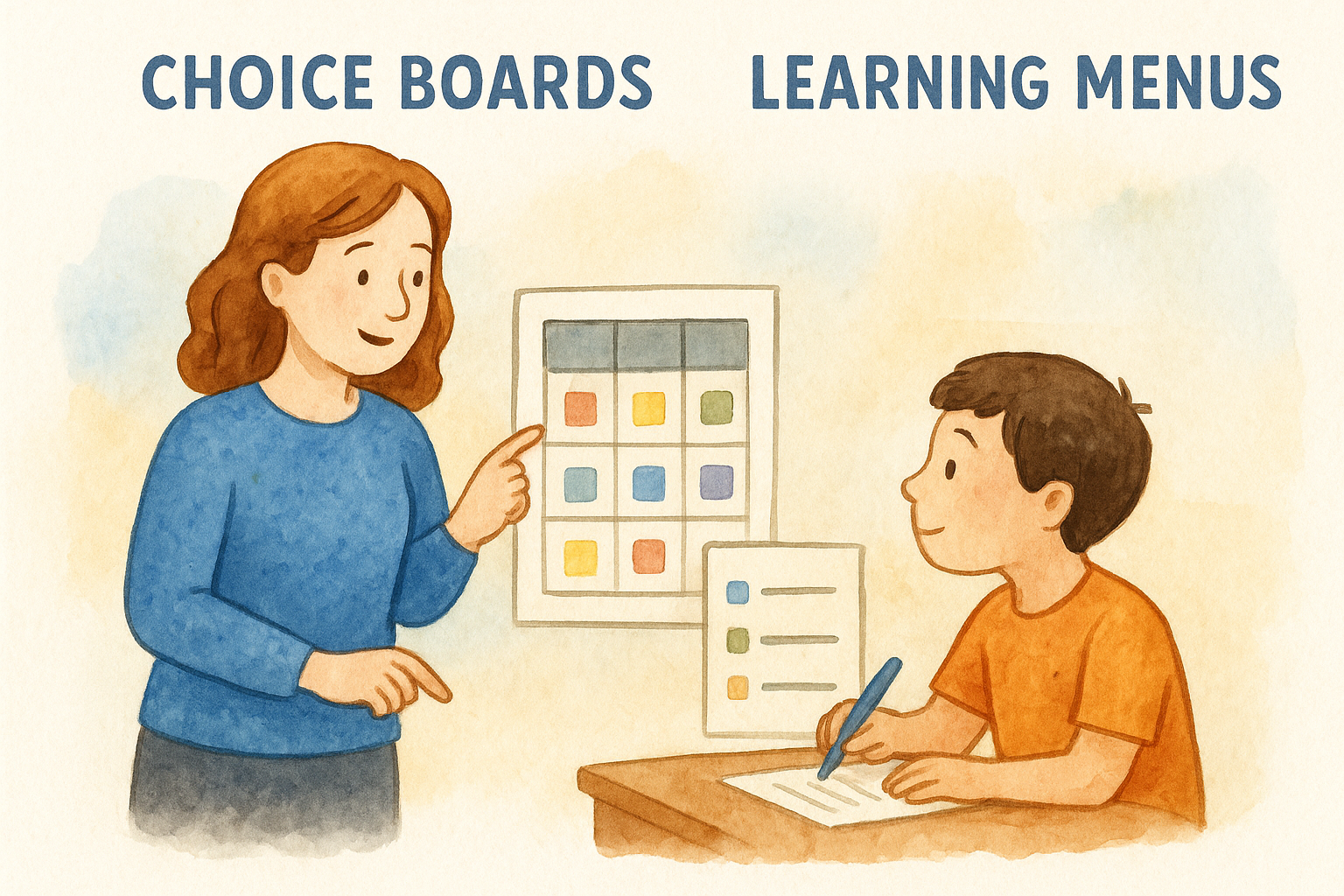
Building in choice doesn’t mean giving up rigor. Every option on the board should require the same depth of thinking, just through a different format or modality.
Common differentiation pitfalls and quick fixes
Even teachers who understand how to differentiate instruction in the classroom run into the same recurring problems when they start putting it into practice. Knowing what those pitfalls look like ahead of time, and how to correct them quickly, keeps your differentiation efforts from creating new problems while solving old ones.
Differentiation fails most often not because the strategy is wrong, but because it gets applied in ways that label students rather than support them.
Treating groups as permanent
Flexible grouping loses all its value the moment it becomes fixed. When students stay in the same group for an entire semester, they start to see that placement as a label, and their effort and self-image drop accordingly. Rotate your groupings regularly, at least every two to three weeks, and base your groupings on the specific demands of each task rather than overall ability. A student who struggles with reading fluency might lead a strong discussion group. Keeping your groups fluid sends a clear message that placement is about the task, not a permanent judgment about the student.
Differentiating everything at once
Trying to adjust content, process, product, and environment in every single lesson is a fast path to burnout. Pick one element per lesson to differentiate, then build from there once you have a steady rhythm. Most of the time, adjusting your process, like adding a graphic organizer or offering a sentence frame, handles a significant portion of your students’ needs without requiring you to rebuild the whole lesson from scratch. Start small, stay consistent, and layer in complexity gradually as your planning process becomes more automatic.
Lowering expectations instead of scaffolding
This is one of the most common and most damaging mistakes in differentiation. Giving struggling students simpler work instead of supported access to grade-level content doesn’t close gaps; it widens them over time. The fix is scaffolding, not simplifying. Provide sentence starters, worked examples, or chunked instructions so students still work toward the same rigorous standard, just with structured support that gradually fades as their confidence and skill grow. If the learning goal itself is lower, you’re tracking, not differentiating.
Next steps for your classroom
You now have a solid foundation for how to differentiate instruction in the classroom, from the four core pillars to practical strategies and the pitfalls that trip up even experienced teachers. The next move is straightforward: pick one strategy from this guide and apply it to a lesson you’re already planning this week. Don’t wait until everything feels perfect or fully mapped out. Starting small and staying consistent is how differentiation becomes a natural part of your teaching practice rather than an extra layer of work stacked on top of everything else.
When you’re ready to plan smarter and save real time, The Cautiously Optimistic Teacher has the tools to help. Our AI-powered Differentiated Instruction Helper takes the heavy lifting out of adapting lessons for diverse learners, so you spend less time building materials from scratch and more time actually moving your students forward. Head over and explore what’s available for your classroom.