10 High Yield Strategies Every Teacher Should Be Using
If you’ve been teaching for any length of time, you know this truth: not all strategies are created equal.
Some activities feel engaging but don’t move learning very far. Others may look simple, but they dramatically increase understanding and retention. That’s where high yield strategies come in.
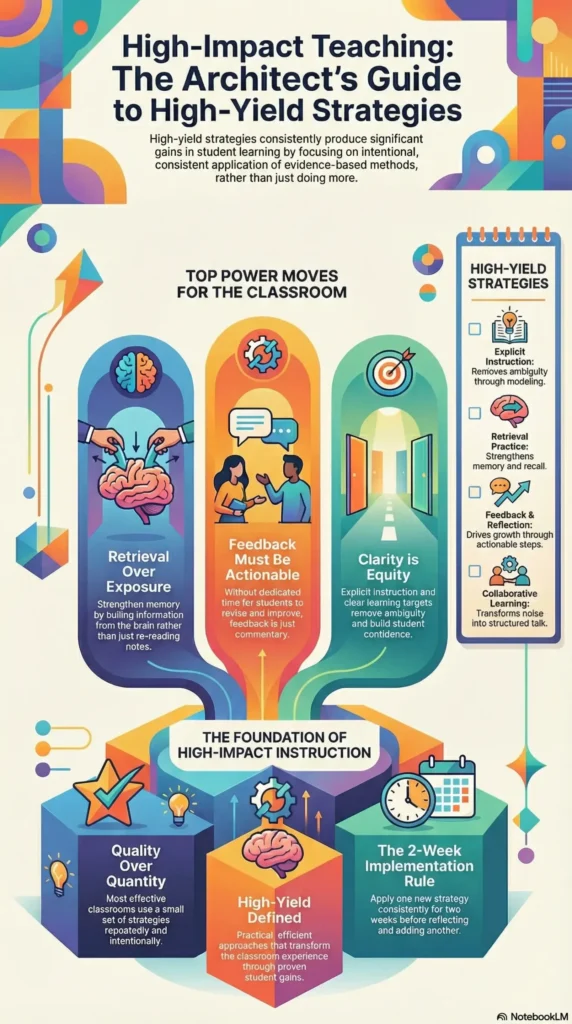
High yield strategies are instructional approaches that consistently produce strong gains in student learning. They are efficient. They are practical. And when used intentionally, they can completely transform the classroom experience.
Below is a curated top-10 list of the best high yield strategies — along with clear guidance on how to use them effectively in your classroom.
1. Explicit Instruction
Explicit instruction is one of the most powerful high yield strategies available to teachers.
It includes:
Clear learning targets
Teacher modeling
Guided practice
Gradual release to independence
How to use it well:
State the objective in student-friendly language.
Model the exact skill or process.
Think aloud as you demonstrate.
Provide structured guided practice before independent work.
Students learn best when we remove ambiguity. Clarity is not over-scaffolding — it’s equity.
2. Retrieval Practice
Retrieval practice strengthens memory by requiring students to pull information from their brains rather than re-reading notes.
How to use it well:
Begin class with 3–5 review questions.
Use exit tickets focused on prior learning.
Incorporate low-stakes quizzes weekly.
Use mini whiteboards for quick recall checks.
Learning isn’t strengthened by exposure — it’s strengthened by retrieval.
3. Spaced Practice
Cramming feels productive. It isn’t.
Spacing learning over time dramatically increases retention.
How to use it well:
Spiral review into warm-ups.
Revisit key concepts weeks later.
Mix old and new questions in assessments.
Build cumulative quizzes.
Think of spacing as exercise for long-term memory.
4. Feedback (That Students Actually Use)
Feedback is only high yield if students act on it.
How to use it well:
Keep feedback specific and actionable.
Focus on one or two growth areas.
Build time for revision into lessons.
Use verbal micro-feedback during practice.
Feedback without time to improve is just commentary.
5. Worked Examples
Students benefit from seeing completed examples before trying independently.
How to use it well:
Provide annotated examples.
Compare strong vs. weak responses.
Gradually remove steps in subsequent examples.
Ask students to explain why the example works.
This reduces cognitive overload and builds confidence.
6. Collaborative Learning (With Structure)
Group work is only high yield when it’s intentional.
How to use it well:
Assign clear roles.
Provide specific discussion prompts.
Use accountable talk stems.
Hold individuals responsible for learning.
Structure transforms noise into learning.
7. Questioning Techniques
The quality of our questions determines the depth of student thinking.
How to use it well:
Ask open-ended “why” and “how” questions.
Use cold calling respectfully and predictably.
Provide wait time (at least 3–5 seconds).
Ask students to build on each other’s answers.
Great questions stretch thinking without overwhelming students.
8. Visual Anchors and Graphic Organizers
Visual supports reduce cognitive load and increase clarity.
How to use it well:
Keep anchor charts visible.
Refer to them frequently.
Teach students how to use organizers (don’t just hand them out).
Gradually fade supports as mastery develops.
Visual structure builds independence.
9. Clear Learning Targets
Students perform better when they know exactly what success looks like.
How to use it well:
Post daily objectives.
Share success criteria.
Model what “proficient” looks like.
Use exemplars.
When expectations are invisible, performance suffers.
10. Metacognitive Reflection
Students need to think about their thinking.
How to use it well:
Ask students what strategy they used.
Have them explain mistakes.
Use reflection prompts after assessments.
Teach goal-setting explicitly.
Metacognition transforms passive learners into strategic learners.