
Explicit Instruction: A Practical Guide for Teachers Who Want Real Results
If you’ve ever taught a lesson that felt clear in your head — but confusing to your students — you already understand why explicit instruction matters.
Explicit instruction isn’t about lecturing more.
It isn’t about removing creativity.
And it definitely isn’t about “spoon-feeding.”
It’s about clarity.
When we use explicit instruction, we reduce cognitive overload, eliminate ambiguity, and give students a clear path toward success. In classrooms where attention is divided, stress levels fluctuate, and executive function skills are still developing, clarity is a gift.
Let’s unpack why explicit instruction works — and how you can use it in your daily lesson plans immediately.
What Is Explicit Instruction?
Explicit instruction is a structured, teacher-led approach where learning goals, processes, and expectations are clearly stated, modeled, practiced, and reviewed.
At its core, it follows a predictable structure:
Clear learning intention
Direct modeling
Guided practice
Independent practice
Feedback and review
Students are never left guessing:
What are we learning?
Why are we learning it?
What does success look like?
How do I do this correctly?
Explicit instruction answers those questions before confusion begins.
Why Explicit Instruction Is So Powerful
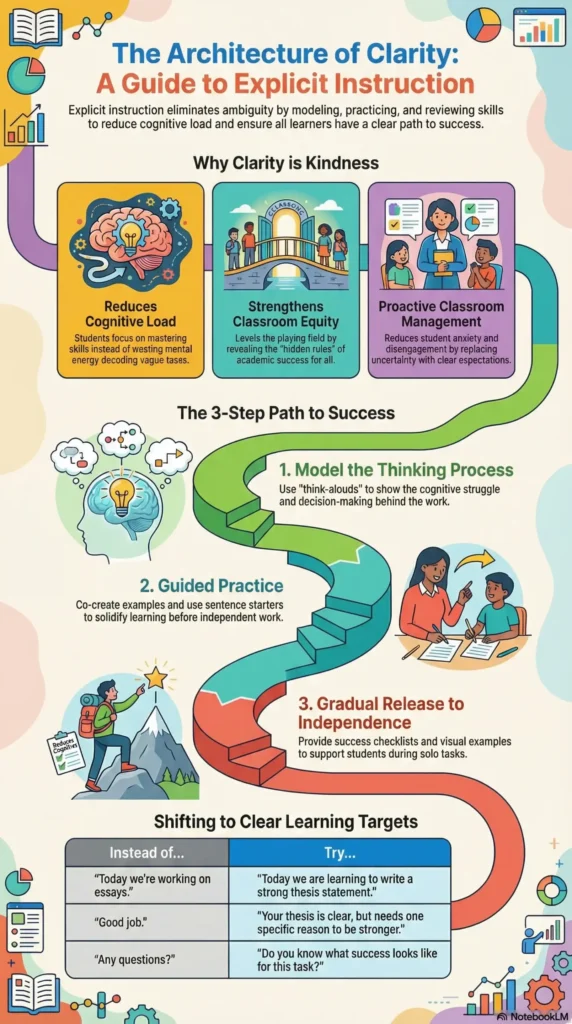
1. It Reduces Cognitive Load
Students can only hold so much information in working memory at once. When directions are vague or multi-layered, students use mental energy figuring out what to do instead of actually learning.
Explicit instruction removes that friction.
When steps are broken down clearly and modeled, students can focus on mastering the skill — not decoding the task.
2. It Strengthens Equity
Some students infer expectations naturally. Others do not.
Explicit instruction levels the playing field. It ensures:
Neurodivergent learners are supported.
English language learners have clarity.
Students with executive function challenges aren’t left behind.
All students understand the “hidden rules” of academic success.
Clarity is inclusive.
3. It Improves Classroom Management
Many behavioral issues stem from uncertainty.
When students are unsure:
They stall.
They ask repeated questions.
They disengage.
They disrupt.
Explicit instruction reduces ambiguity, which reduces anxiety, which reduces behavior issues.
Clear teaching is proactive classroom management.
4. It Builds Confidence
When students see exactly how to approach a task, they experience success sooner. That success builds motivation.
Students are far more willing to attempt challenging work when they believe they know how to begin.
What Explicit Instruction Looks Like in a Daily Lesson Plan
Here’s how to integrate explicit instruction into a typical lesson without making it feel rigid or scripted.
Step 1: State the Learning Target Clearly
Instead of:
“Today we’re working on essays.”
Try:
“Today we are learning how to write a strong thesis statement that clearly answers a prompt.”
Be specific.
Then explain why:
“A clear thesis helps your reader understand your argument right away.”
Students should always know the purpose.
Step 2: Model the Thinking Process
Modeling is the heart of explicit instruction.
Think aloud.
Show the process — not just the final product.
For example:
Read the prompt aloud.
Highlight key words.
Verbalize how you decide what your claim will be.
Write a thesis in real time.
Revise it in front of them.
Students need to see the cognitive process behind the work.
Step 3: Provide Structured Guided Practice
Before releasing students independently, practice together.
You might:
Co-create a second example.
Use sentence starters.
Ask students to identify strong and weak samples.
Complete part of the task collaboratively.
Guided practice is where most of the learning solidifies.
Step 4: Gradual Release to Independence
Only after modeling and guided practice should students attempt independent work.
Even then, provide:
Clear written instructions
Visual examples
Criteria for success
A checklist
Explicit instruction does not disappear during independent work — it becomes structured support.
Step 5: Immediate Feedback
Feedback should be:
Specific
Timely
Focused on the learning target
Instead of:
“Good job.”
Try:
“Your thesis clearly answers the prompt, but it needs a more specific reason to strengthen your argument.”
Feedback reinforces clarity.
Common Misunderstandings About Explicit Instruction
“It’s Too Teacher-Centered.”
Explicit instruction is teacher-directed at first — but it builds independence. Students cannot think deeply about content they don’t understand.
Clarity enables creativity.
“It Kills Inquiry.”
Actually, explicit instruction and inquiry work beautifully together.
You can:
Explicitly teach research skills.
Explicitly model questioning strategies.
Explicitly demonstrate how to analyze sources.
Then release students into inquiry with strong foundational tools.
“It’s Only for Younger Students.”
High school students benefit just as much — especially when tackling complex writing, advanced math, or abstract concepts.
The more cognitively demanding the task, the more valuable explicit instruction becomes.
How to Start Using Explicit Instruction Tomorrow
If you want a simple starting point, try this:
Before your next lesson, ask yourself:
Have I clearly stated the learning goal?
Have I shown students exactly how to do this?
Have I broken the task into manageable steps?
Have I provided guided practice?
Do students know what success looks like?
If the answer to any of those is no — that’s your starting place.
Blending Explicit Instruction with Flexibility
Explicit instruction works best when it’s consistent but not robotic.
It should feel:
Predictable
Calm
Structured
Clear
Students thrive in environments where they know how learning works.
And here’s the key: structure actually increases freedom. When students understand expectations deeply, they are more capable of independent thinking, problem solving, and creative risk-taking.
Final Thoughts
Explicit instruction is not about controlling learning.
It’s about removing unnecessary barriers.
When students understand:
What to do
How to do it
Why it matters
What success looks like
They perform better. They behave better. They feel better.
Clarity is kindness in teaching.
And explicit instruction is one of the most powerful clarity tools we have.
If you’re building daily lesson plans, refining your classroom management, or trying to support diverse learners more effectively, explicit instruction deserves a central place in your practice.
Start small. Model clearly. Practice together. Release gradually.
Your students will notice the difference.