GRAMMAR LESSONS
From capitals to prepositional phrases, check out these grammar lessons.
Capital Letters Lesson and Practice Worksheet
Learning when and how to use capital letters is one of the most important writing skills students develop in English class. Capitalization gives clarity, shows respect for names and places, and signals the start of new ideas. Without it, even strong writing can look sloppy or confusing. In this lesson, students will explore the rules…
Comma Rules: A Lesson with Practice and Worksheets
Commas may be small, but they pack a big punch in writing! Used correctly, commas can make your sentences clear and polished; used poorly, they can cause chaos and confusion. In this lesson on comma rules, we’ll break down the essential guidelines, practice together, and then try it out on your own with a printable…
Colons Lesson: Mastering the Pause of Emphasis
Colons may look like two little dots, but they pack a punch in writing. They announce, emphasize, and introduce. In this lesson, we’ll go through the main rules of using colons, practice together, and then try some exercises on your own. 📘 Rules for Using Colons Use a colon to introduce a list after a…
Semicolon Lesson: How to Use Semicolons with Confidence
Semicolons A semicolon (;) is used to connect two closely related independent clauses. Example: I have a big test tomorrow; I can’t go out tonight. Use a semicolon before a conjunctive adverb (however, therefore, moreover, consequently, etc.) when it connects two independent clauses. Example: She didn’t see the step; therefore, she tripped. Use semicolons to…
Mastering Coordinating Conjunctions: A Simple Lesson for Students
What are Coordinating Conjunctions? Coordinating conjunctions are used to connect words, phrases, or clauses of equal importance. Think of them as the glue that holds ideas together. The seven coordinating conjunctions are: for, and, nor, but, or, yet, so. You can remember them with the acronym FANBOYS. They are always placed between the words or…
Mastering Subordinating Conjunctions: A Complete Lesson
Subordinating conjunctions are the secret ingredient that make writing more sophisticated and connected. They link ideas so readers can see how one thought depends on another—showing cause, time, condition, or contrast. Without them, writing can feel flat or disconnected. In this lesson, students will learn how to use subordinating conjunctions to create complex sentences that…
Correlative Conjunctions: How to Use Them Correctly
Correlative conjunctions work in pairs to create balance and rhythm in writing. They connect equal parts of a sentence, helping writers emphasize relationships between ideas in a smooth, coordinated way. Common pairs like either/or, both/and, and not only/but also bring clarity and variety to sentence structure. In this lesson, students will explore how to use…
Understanding the Verb “To Be”
Grammar Notes: Rules of the Verb “To Be” The verb “to be” shows a state of being or existence. It changes form depending on the subject and the tense. ✅ Present Simple Forms Subject Form Example I am I am a teacher. You are You are my friend. He / She / It is She…
Simple Present Tense Lesson
Simple Present Tense Lesson The simple present tense is one of the most commonly used verb tenses in English—and one of the first that every writer and speaker should master. It’s used to describe habits, routines, facts, and universal truths—anything that happens regularly or is always true. Understanding how to form and use the simple…
Mastering the Simple Past Tense: A Complete Lesson with Practice and Worksheet
The simple past tense is one of the most useful and commonly used verb tenses in English. It allows us to talk about actions, events, or situations that began and ended in the past. Whether describing what you did yesterday, telling a story, or recalling an experience, the simple past helps make your communication clear…
Mastering Linking Verbs: A Complete Lesson with Examples and Practice
What Are Linking Verbs? Linking verbs connect the subject of a sentence to additional information about that subject. Instead of showing action, they link the subject to a state of being or description. 🔹 Common Linking Verbs: Forms of to be: am, is, are, was, were, be, being, been Seem, become, appear, feel, look, sound,…
Imperative and Interrogative Verbs Lesson
Imperative and interrogative verbs help shape two of the most common sentence types we use every day: giving commands and asking questions. Understanding the difference between them strengthens both writing and communication skills. Imperative verbs tell someone what to do, while interrogative verbs guide us in forming clear, effective questions. In this lesson, students will…
Understanding Direct and Indirect Objects
Direct and Indirect Objects What is a Direct Object?A direct object is the noun or pronoun that receives the action of a verb. It answers the question “what?” or “whom?” after the verb. Example: She kicked the ball.→ “The ball” is the direct object (it receives the action “kicked”). What is an Indirect Object?An indirect…
Mastering Predicate Nouns: Definition, Examples, and Practice
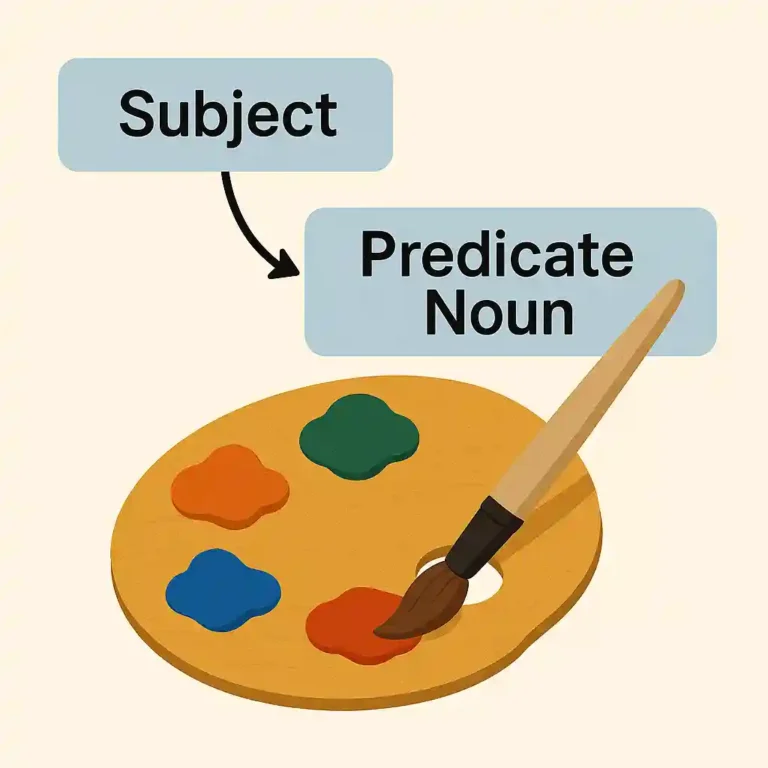
Predicate nouns are one of those grammar elements that sound complicated but are actually pretty simple once you see how they work. In this lesson, we’ll explore what predicate nouns are, how to find them in sentences, and how they differ from predicate adjectives. Then, we’ll practice identifying and using them correctly. Grammar Notes: Predicate…
Gerunds Lesson Plan and Practice Worksheet
What Is a Gerund? A gerund is a verb form that ends in -ing and functions as a noun within a sentence. Even though a gerund begins as a verb, it no longer shows action—instead, it names an activity, idea, or experience. This means a gerund can take on the same roles as any other…
Understanding the Types of Pronouns: A Practical Classroom Lesson
Pronouns may be tiny words, but they do so much heavy lifting in our sentences. Without them, our writing becomes clunky, repetitive, and — let’s be honest — mildly exhausting. In today’s lesson, I guide students through the essential types of pronouns, how to use them correctly, and how they can transform awkward sentences into…
Active vs Passive Voice Examples: A Complete Classroom Lesson
Some grammar rules feel like they belong in a dusty museum. But active vs. passive voice is not one of them—it’s a powerhouse tool for clarity, confidence, and strong writing. Today’s lesson helps students understand the difference between who is acting and who is being acted upon, and why that distinction matters for effective communication….
Prepositional Phrases Examples: A Clear Grammar Lesson for Students
Prepositional phrases are one of those grammar concepts students use all the time — without realizing it. They quietly add detail, description, and clarity to sentences by telling us where, when, how, or which one. In this lesson, I break prepositional phrases down into simple parts, show students how to spot them quickly, and give…
Participles in English Grammar (With Practice Activities)
Participles are one of those grammar concepts students use all the time without realizing it. They show up in descriptions, actions, and sentence variety — especially when students are trying to make their writing sound more vivid. In this lesson, I break participles down into clear, manageable rules, show students how they actually function in…
Predicate Adjectives Explained (With Practice & Worksheets)
Predicate adjectives sound fancy, but students usually understand them quickly once they see how they work. These adjectives don’t sit next to the noun like most adjectives do. Instead, they appear after a linking verb and describe the subject from the other side of the sentence. Once students learn to spot linking verbs, predicate adjectives…
Adverbial Phrases: Clear Rules, Examples, and Practice
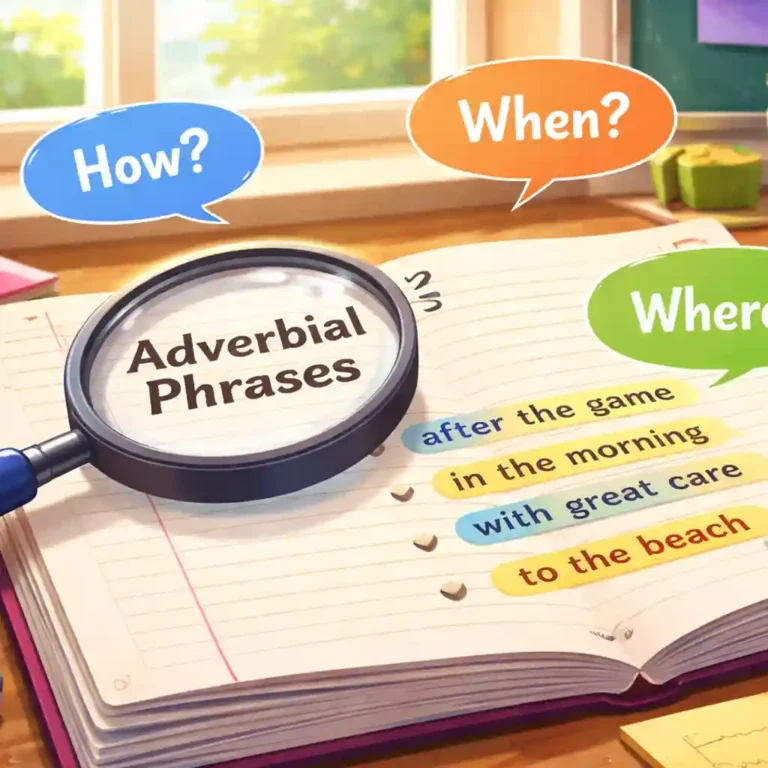
Adverbial phrases are one of those grammar concepts students already use constantly—they just don’t know the name yet. When students write phrases like in the morning, with great care, or after the game, they’re already working with adverbial phrases. This lesson helps students recognize, understand, and confidently use adverbial phrases to make their writing clearer…
Independent and Dependent Clauses: A Clear Lesson Plan
Independent and dependent clauses are one of those grammar topics that quietly shape everything students write—yet they’re often misunderstood. Once students grasp the difference, sentence structure suddenly makes sense: fragments disappear, commas become purposeful, and writing flows more clearly. In this lesson, I break independent and dependent clauses down in a way that’s simple, practical,…
Compound Sentences: How to Join Ideas Clearly and Correctly
At some point, every student starts writing sentences that feel… stuck. Choppy. Short. Like they’re afraid to talk to each other. That’s usually the moment I introduce compound sentences. Compound sentences help students connect ideas that belong together — without creating run-ons or comma disasters. Once students understand how they work, their writing immediately becomes…
Complex Sentences Explained (With Examples and Practice)
At some point, students realize that short, simple sentences can only take their writing so far. If everything sounds choppy or underdeveloped, it’s usually because they haven’t mastered complex sentences yet. Complex sentences allow writers to explain why, when, because, and although ideas happen. They help students move from basic statements to more thoughtful, connected…
Compound-Complex Sentences: Rules, Examples, and Practice
Once students understand compound sentences and complex sentences, it’s time to level up. Enter the compound-complex sentence — the multitasker of the grammar world. A compound-complex sentence combines coordination and subordination, which sounds intimidating but is actually very logical. In this lesson, I walk students through the structure step by step, practice together, and then…
Run-On Sentences Explained (and Fixed!)
Run-on sentences are one of those grammar issues that sneak into student writing when ideas are flowing faster than punctuation. Students often know what they want to say, but their sentences forget to stop. The result? Writing that feels rushed, confusing, or overwhelming to read. The good news: run-on sentences are easy to fix once…
Sentence Fragments: What They Are and How to Fix Them
Have you ever read something that felt like a sentence… but also felt unfinished?That’s usually a sentence fragment. Sentence fragments are one of the most common grammar issues I see in student writing—not because students don’t understand sentences, but because fragments sound right in conversation. In writing, though, they can confuse readers and weaken clarity….