
Lord of the Flies Pre-Reading: Getting to Know the Book
Introduce William Golding’s Lord of the Flies with this pre-reading lesson for secondary English. Students examine the novel’s key characters, symbols, and themes, listen to an author interview, and respond in a short journal entry before discussing Golding’s choices as a class.
← All Lord of the Flies unit lessons
Learning Goals
- I will be able to identify and describe key aspects of Lord of the Flies.
- I will be able to understand and articulate William Golding’s perspective.
- I will be able to critically engage with Golding’s viewpoints.
- I will be able to effectively communicate and discuss my thoughts and opinions in a group setting.
Materials
Lord of the Flies Note
William Golding Interview
Process
- Have students copy down the pre-reading note.
- Watch the William Golding video together.
- Ask students to journal their thoughts about Golding’s comments.
- Engage in a large-group discussion about Golding’s comments.
Note on Lord of the Flies
- Written by William Golding
- Born in Britain, 1911
- Died: 1993
- Published in 1954
- The Title “Beelzebub” is a Hebrew word for Lucifer. However, the literal translation of “Beelzebub” into English is Lord of the Flies!
- The book is heavily influenced by the wars that Golding witnessed.
- He was a child during WWI.
- He was in the navy during WWII
- He wrote Lord of the Flies during the Korean War.
Golding’s Central Theme
- Through LOTF, Golding is
making the statement that we
cannot escape our savage,
violent tendencies. - Without social order, we
devolve into a state of chaos.
Symbols
- Piggy’s Glasses = The last
surviving evidence of the lawful,
structured world. - Conch Shell = New democracy on the island; when the shell is shattered, all order disappears.
- Snake = Evil…reference to the serpent in the garden of Eden
Important Images
- The Beast = The imaginary evil that is projected onto the island by the boys’ paranoia.
- Lord of the Flies = A pig’s head on a stick that becomes the physical acceptance of evil on the island.
Central Character #1 – Ralph
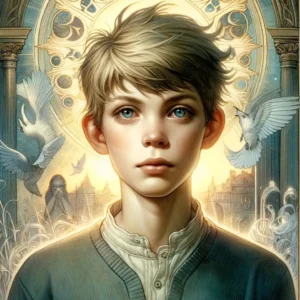
- Ralph: Main character. Described as “fair haired,” having “broad shoulders…[like a] boxer’s,” and has a face that “proclaims no devil”
- Committed to civilization and morality
Central Character #2 – Piggy

- Piggy: Described as “fat,” “intellectual,” asthmatic, and needs glasses.
- Represents scientific, rational side of civilization, and social order.
Central Character #3 – Jack
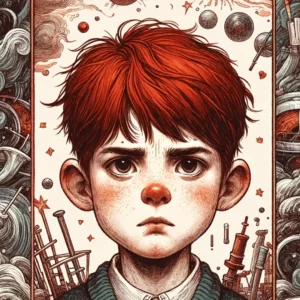
- Jack: Described as having red hair, wears black with a snake clasp, ugly. Cruel and manipulative.
- Represents our savage instincts and some of our evil tendencies.
Central Character #4 – Simon

- Simon: Described as a skinny, vivid little boy, who “meditates;” and he faints, which some cultures have believed is a sign of connecting with the spiritual world.
- Seems to be connected with nature, and he
has an innate, spiritual goodness.
Central Character #5- Roger
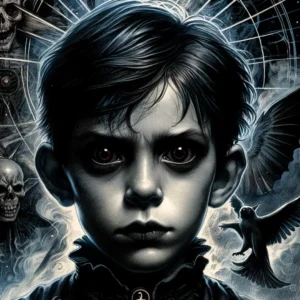
- Roger: “Silent” and sadistic. Targets the “littluns.” The only one to premeditate murder.
- Kills without conscience. Pure evil.
More Themes
- The Need for Social Order
- Power
- Vision
- Fear of the Unknown
- Loss of Identity
- Loss of Innocence
For Consideration:
- Simon as a “Christ figure.”
- Simon goes alone into the jungle and confronts evil. Simon comes down from the mountain bringing news that will save the boys from their fear. Instead of listening to Simon, they ignore him.
- Golding has said that Lord of the Flies is “an attempt to trace the defects of society back to the defects of human nature.”
- He acknowledges evil as a force that lurks within every person.
- That’s why we will read this book with a focus on the psychological critical lens.
William Golding Interview
Journal question:
What do you think about Golding’s claims in this interview?
Curriculum Connections
Ontario Grade 9 English (ENL1W)
- C2.1: Activate relevant prior knowledge to support comprehension of a new text.
- C2.3: Make and refine predictions using background knowledge and textual information.
- C3.2: Make inferences using explicit and implicit evidence.
- D1.2: Generate and develop ideas using a range of strategies and resources.
Common Core State Standards (Grades 9–10)
- RL.9-10.1: Cite strong and thorough textual evidence to support analysis.
- RL.9-10.2: Determine and analyze themes or central ideas.
- SL.9-10.1: Participate effectively in collaborative discussions.
Differentiation and Extensions
Differentiation: Preview the character and symbol notes in small chunks, provide the interview questions before viewing, and allow students to respond to the journal prompt orally or with sentence starters before writing independently.
Extension: Ask students to record two predictions about the novel based on the introductory material and return to those predictions after several chapters to evaluate how their thinking changed.
Frequently Asked Questions
Should students have read the novel before this lesson?
No. This lesson is designed as an entry point to the unit and builds useful background knowledge before students begin close reading.
Can the author interview be assigned independently?
Yes. Students can view the interview individually and bring a brief response or discussion note to class.
How can I support students who find the introductory notes overwhelming?
Chunk the notes by character, symbol, and theme, and ask students to focus on a small number of ideas that they can revisit as the novel develops.
A FREE CLASSROOM GAME FOR ENGLISH TEACHERS
Make your next English review a Plot Twist!
Bring some unexpected fun to your next lesson. Get a free game of Plot Twist!, the ultimate classroom review game, and discover fresh ideas for teaching English.
Subscribe for English teaching ideas and occasional resource updates, plus your free Plot Twist! game. You can unsubscribe from emails at any time.