Explicit Instruction: What It Is and How to Teach It
You’ve heard the term tossed around in staff meetings and PD sessions, but if someone asked you to define explicit instruction in one sentence, could you do it? Most teachers know it when they see it, a clear model, guided practice, then independent work, but naming the actual components is trickier than it sounds.
Explicit instruction is a teaching method where you tell students exactly what you want them to learn, show them how to do it step by step, and give them structured practice before letting go. It’s the opposite of hoping students will discover a skill on their own. Research on reading and math instruction keeps pointing back to this approach because it removes guesswork for kids who need clear steps, not vague hints.
In this article, you’ll get a straightforward breakdown of what explicit instruction actually involves: the core components like modeling and checking for understanding, the difference between this method and discovery-based teaching, and concrete classroom examples you can adapt tomorrow, whether you teach algebra, grammar, or a mythology unit.
Why explicit instruction matters for student success
Students who struggle need it most
Kids who struggle with reading, math, or executive functioning benefit disproportionately from explicit instruction because it strips away the guesswork that discovery-based lessons leave in place. A student with a learning disability, or one still building English proficiency, often can’t infer an unstated rule the way a stronger reader can. Direct instruction teaching strategies hand that student the scaffolding to reach grade-level work instead of quietly falling further behind while classmates figure things out on their own.
When you teach explicitly, you’re not lowering the bar, you’re building the stairs to reach it.
What the research actually shows
Decades of classroom research back this up, most famously Barak Rosenshine’s Principles of Instruction, which the Institute of Education Sciences has cited repeatedly in its practice guides for struggling readers and math learners. Meta-analyses on reading intervention consistently find that explicit, systematic phonics instruction outperforms incidental or embedded approaches, especially for kids below grade level. The pattern shows up across subjects:
- Early reading: explicit phonics instruction produces stronger decoding gains than whole-language or embedded approaches.
- Math: step-by-step modeling of problem-solving strategies reduces procedural errors more than pure inquiry-based tasks.
- Writing: explicit teaching of sentence and paragraph structure improves composition quality faster than open-ended prompts alone.
- Vocabulary: direct definition and practice beats hoping students absorb word meaning from context alone.
It’s not just for kids who struggle
Advanced students gain from this method too, particularly when the content itself is abstract or layered, like literary analysis or multi-step equations. Complex material benefits from a clear model even when the learner is capable, because nobody intuits an unfamiliar structure on the first try. Teachers who assume their strongest students will pick up nuance through exposure often find those students plateau, missing precision they’d have gained from a well-modeled example.
What happens when you skip it
Skipping explicit teaching in favor of pure discovery tends to widen the gap between students who arrive with background knowledge and those who don’t. Students from homes with more academic exposure often reconstruct missing steps on their own; kids without that exposure get stuck, and the lesson becomes a sorting mechanism rather than instruction. Over a school year, that gap compounds, which is part of why explicit teaching shows up so often in intervention plans for struggling learners and differentiation frameworks, including the kind of scaffolding built into our own UDL Lesson Plan Template. Equity in the classroom starts with making the invisible rules of a skill visible to everyone, not just the students who’d have figured it out anyway.
How to teach using explicit instruction
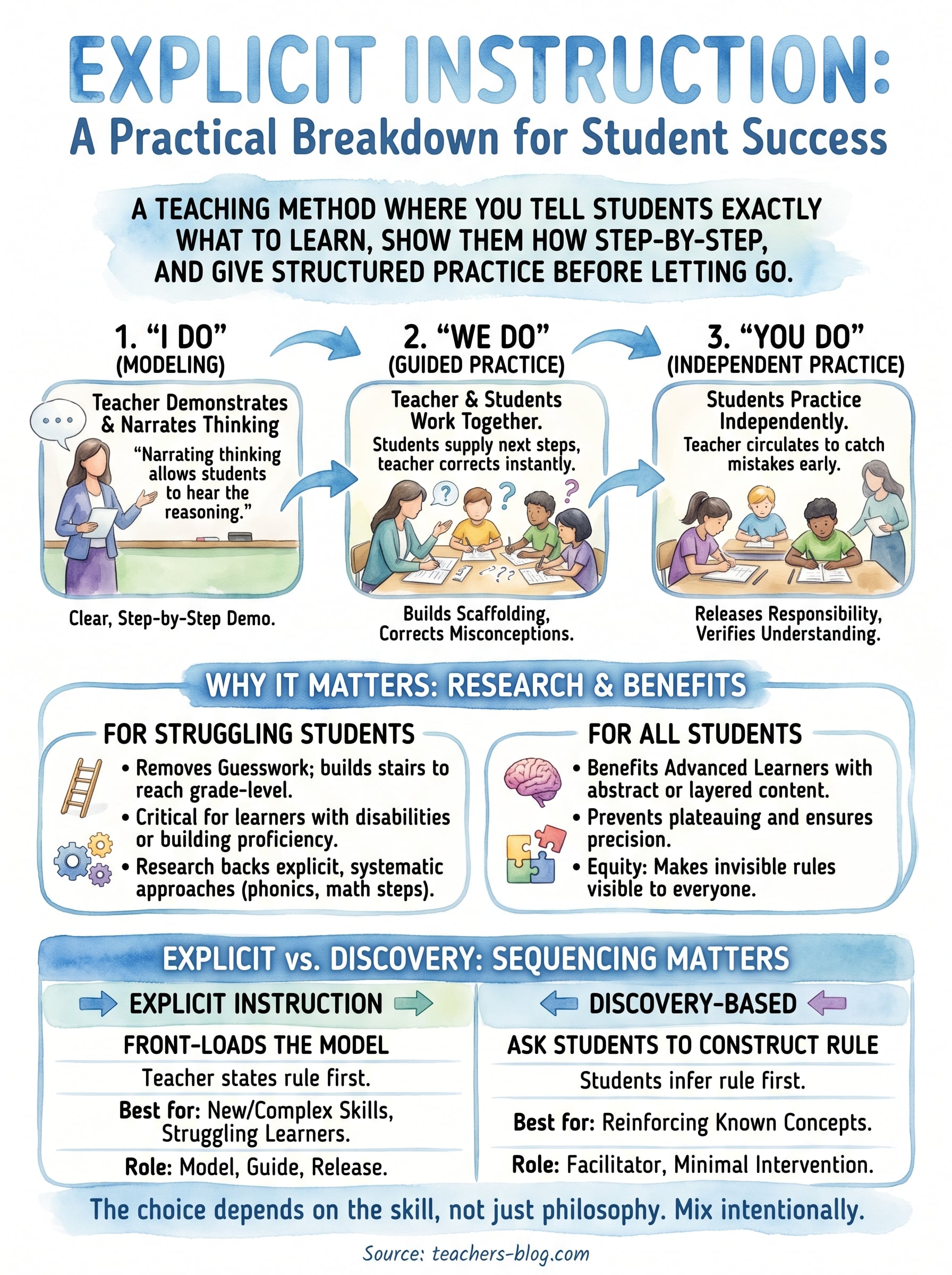
Teaching this way follows a predictable rhythm, and once you internalize it, planning gets faster, not slower. The classic model breaks into three phases: I do, we do, you do. You model the skill first, then practice it together, then release students to try it alone. Skipping a phase, especially the guided practice in the middle, is the most common reason explicit lessons fall flat.
The three-part structure in practice
Here’s what each phase actually looks like in a real lesson:
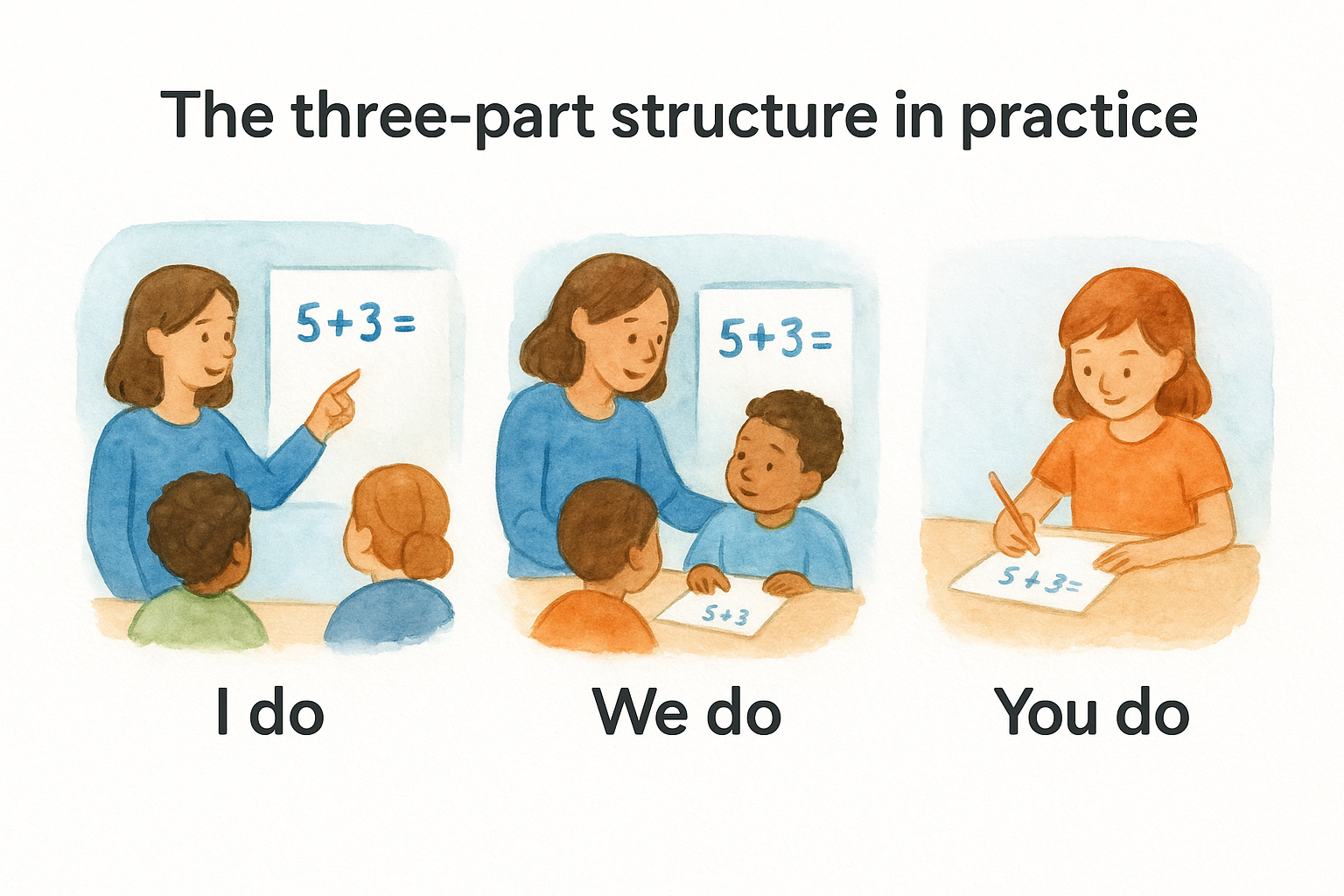
- I do: You demonstrate the skill aloud, narrating your thinking so students hear the reasoning, not just see the answer.
- We do: You work a similar problem together, calling on students to supply the next step while you correct errors immediately.
- You do: Students practice independently on similar items, with you circulating to catch mistakes before they calcify.
If students can’t do it with you, they definitely can’t do it without you.
That’s why rushing the middle phase backfires. Guided practice, one of the core scaffolding techniques for every classroom, is where misconceptions surface and get corrected while the stakes are still low.
Checking for understanding along the way
Explicit instruction only works if you’re actually checking whether it landed, not just assuming it did because you explained clearly. Build in frequent, low-stakes checks rather than waiting for a quiz at the end of the week, and keep a few quick ways to check comprehension ready for any lesson. Simple techniques include:
- Cold-calling students to restate the step in their own words
- Quick whiteboard responses you can scan in five seconds
- Thumbs-up/thumbs-down checks before moving to independent work
Using these checks lets you catch confusion in real time and reteach on the spot instead of discovering the gap on a graded assignment. Verifying understanding this way also tells you which students need another round of guided practice before you release them, which is exactly the kind of tailored, differentiated teaching our Differentiated Instruction Helper is built to support.
Examples of explicit instruction in the classroom
Seeing the model in one subject rarely translates automatically to another, so it helps to look at how the same three-part structure plays out across different content areas. Below is a quick snapshot of what "I do, we do, you do" looks like when the skill changes but the framework doesn’t.
| Subject | Skill being taught | I do | We do | You do |
|---|---|---|---|---|
| Grammar/writing | Writing a claim sentence in an opinion essay | You write a claim aloud, naming why it’s arguable | Class drafts a claim together on a shared topic | Students write their own claim using our Essay Writing Tools unit |
| Math | Solving a two-step equation | You solve one, narrating each move | Students supply the next step as you write | Students solve similar problems, checked in real time |
| Literature | Identifying a character’s motivation | You model finding textual evidence in a To Kill a Mockingbird passage | Class finds a second example together | Students find and cite their own evidence |
A complete example: teaching a mythology archetype
Suppose you’re introducing the "hero’s journey" during a Greek mythology unit. Naming the pattern explicitly matters here, since students rarely notice a recurring structure across myths on their own, no matter how many stories they’ve read. You start by mapping the stages onto a familiar myth on the board, thinking aloud about why Perseus’s call to adventure counts as stage one and not stage two.
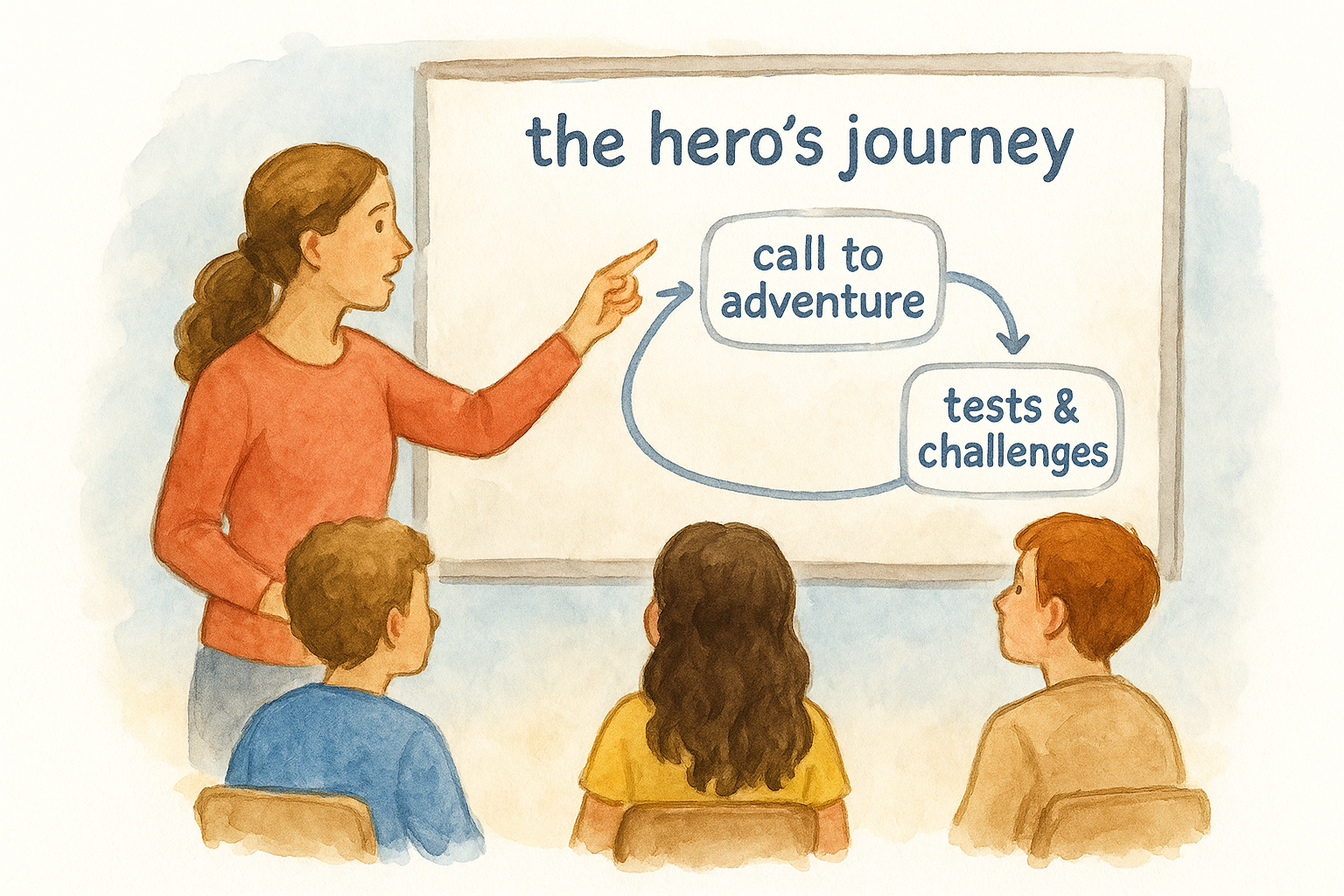
Students don’t discover patterns from exposure alone; you have to point at the pattern and name it.
Next, the class maps a second myth together, with you prompting rather than lecturing. Only after that guided round do students map a third myth solo, using our Question Generator to check their own reasoning against critical-thinking prompts tied to the unit.
Explicit instruction vs. other teaching methods
Comparing explicit instruction to discovery-based and inquiry-based teaching helps clarify what makes it distinct, because on the surface all three claim to build understanding. The real difference is sequencing: explicit instruction front-loads the model, while discovery and inquiry ask students to construct the rule themselves before you confirm it. Neither approach is wrong in every context, but they solve different problems, and mixing them up wastes instructional time.
Where the approaches diverge
Understanding the contrast gets easier with a side-by-side look at how each method handles the same lesson goal.
| Feature | Explicit instruction | Discovery-based learning | Inquiry-based learning |
|---|---|---|---|
| Who states the rule first | Teacher | Students infer it | Students investigate, teacher guides |
| Best for | New or complex skills, struggling learners | Reinforcing known concepts | Open-ended exploration, motivated learners |
| Risk if misused | Feels rigid if overused with advanced content | Leaves gaps for students without background knowledge | Time-intensive, uneven mastery |
| Teacher role | Model, guide, release | Facilitator, minimal intervention | Facilitator, structured questioning |
Pick the method based on what the skill demands, not on which one sounds more modern.
Why the choice depends on the skill, not your teaching philosophy
Discovery-based learning works well when students already have enough background knowledge to reconstruct a pattern, like noticing a grammar rule from several correct examples. Explicit instruction wins when the content is new, abstract, or has no obvious entry point, think logarithms or MLA citation format. Inquiry-based approaches shine for open research projects where the goal is the process itself, not a single correct procedure.
Blending methods without diluting them
Good teachers rarely stick to one method all year, and mixing different teaching strategies, with examples, is fine as long as the blend is intentional. You might explicitly teach the mechanics of a five-paragraph essay, then hand students an inquiry project once they’ve internalized the structure enough to experiment with it. Layering methods this way respects both the research on explicit teaching and the value of student-driven exploration, without forcing one framework to do a job it wasn’t built for.
Bringing explicit instruction into your classroom
You don’t need a schoolwide mandate to start using explicit instruction tomorrow. Pick one lesson, model it out loud, walk students through guided practice, then release them with a quick check for understanding. That single shift, naming the steps instead of hoping students infer them, changes outcomes fastest for the kids who’ve been quietly lost the longest.
Start small: one skill, one clear model, one round of guided practice before you let go. Struggling students benefit most, but nobody loses from a well-modeled lesson, including your strongest kids working through abstract material. Save discovery and inquiry for the moments they actually fit, and lean on the three-part structure everywhere else.
If you want more classroom-ready ideas, differentiated planning tools, and AI-powered resources built for teachers doing exactly this kind of work, start with these 12 research-backed teaching strategies and see what fits your next lesson.