HIP4O Personal Life Management course: This complete high school Life Management course is organized around the practical skills students need as they move toward greater independence. Rather than treating adulthood as a collection of worksheets and definitions, the course uses realistic decisions, challenges, discussions, simulations, and hands-on tasks to help students practise skills they can actually use beyond school.
This page is the central course hub. It contains the full 82-class sequence organized into six units. As each daily lesson is published on The Teachers’ Blog, its title will become a link to a complete teacher-ready lesson page. Those individual pages are designed to contain enough detail to teach the lesson directly, while the corresponding Teachers Pay Teachers resources provide the polished presentation slides, student handouts, teacher guides, answer keys, and other ready-to-use materials.
How to use this page: Published lessons are linked below. Lesson titles without links are part of the planned course sequence and will be added as the course develops. You can also browse all published Life Management lessons here.
For teachers who want the complete ready-to-use packages, the Personal Life Management collection on Teachers Pay Teachers includes the classroom resources as they are released.
What Students Learn in This Life Management Course
The course begins with identity, independence, goals, support systems, and decision-making. From there, students move into communication and conflict resolution, employment skills, financial literacy, independent living, and consumer decision-making. The emphasis throughout is on practical application: students compare choices, solve realistic problems, explain their reasoning, and reflect on how their decisions affect themselves and other people.
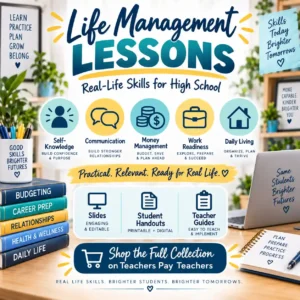
Major course themes include personal strengths and goals, responsible decision-making, assertive communication, workplace readiness, budgeting and credit, housing and food skills, household responsibilities, consumer protection, and knowing how to find appropriate support when a problem is larger than one person can manage alone.
Unit 1 — Adulting 101: Becoming Independent
10 classes | Main curriculum: B1, C1 + A1–A4
The opening unit establishes the tone of the course. Students examine what independence and responsibility actually look like, identify their strengths and priorities, practise goal-setting and persistence, and learn a practical approach to decision-making. The unit closes with a personal planning challenge that asks students to think realistically—but flexibly—about the future.
- Welcome to Adulting: What Does It Actually Mean to Be an Adult?
- Who Am I Right Now? Strengths, Interests, Skills & Values
- Needs, Wants & Personal Resources
- Where Am I Going? Short- and Long-Term Goals
- Motivation, Initiative & Persistence
- Why We Make Bad Decisions
- A Better Way to Make Decisions: Decision-Making Models
- Decision Lab: Real-Life Adult Dilemmas
- Building Your Adult Support Network
- My Life at 25: Personal Roadmap Challenge
Unit 1 Signature Activity: My Life at 25
Students create a realistic personal roadmap that considers employment, education, housing, relationships, money, and personal growth. The purpose is not to lock students into a fixed future. Instead, the task gives them practice turning broad hopes into possible goals, resources, and next steps.
Unit 2 — People Skills: Communication & Conflict
11 classes | Main curriculum: B3 + A1–A4
This unit focuses on the communication skills students will use in relationships, workplaces, shared living situations, and everyday adult interactions. Students examine communication styles and barriers, practise active listening and assertiveness, consider cultural perspectives, and apply conflict-resolution strategies to realistic situations.
- How Humans Communicate: Verbal & Non-Verbal Messages
- Passive, Aggressive, Passive-Aggressive & Assertive Communication
- Say It Better: Practising Assertiveness
- Why Communication Breaks Down
- Active Listening & “I” Messages
- Communication Across Cultures & Perspectives
- Why People Fight: Causes of Interpersonal Conflict
- Conflict-Resolution Strategies
- Conflict Lab: Which Strategy Works Best?
- Texts, Emails & Digital Communication
- Communication Challenge: Solve the Situation
Unit 2 Signature Activity: Communication Challenge
Students respond to realistic situations such as a roommate who will not clean, a manager scheduling someone outside their stated availability, a friend who owes money, an angry customer, a coworker who is not contributing, or a neighbour creating excessive noise. The goal is to choose an appropriate communication strategy and explain why it fits the situation.
Unit 3 — Getting Hired & Surviving the Workplace
13 classes | Main curriculum: B2, D2, E3 + B3
Students connect their strengths and interests with possible occupations and then work through the practical steps involved in finding and keeping employment. The unit includes job searching, résumés, applications, cover letters, interviews, paycheques, workplace expectations, ethics, and employee and employer responsibilities.
- What Kind of Work Fits Me?
- Finding Careers That Match Your Skills & Interests
- How People Actually Find Jobs
- Building a Strong Résumé
- Job Applications & Cover Letters
- References, Portfolios & Your Digital Footprint
- Interview Skills
- Mock Interview Day
- Your First Paycheque: Income, Deductions & Costs of Working
- Workplace Attitude, Reliability & Professionalism
- Ethics & Honesty at Work
- Employee & Employer Rights and Responsibilities
- Workplace Survival Challenge: What Would You Do?
Unit 3 Signature Activities
Mock interviews give students a chance to practise answering questions, presenting themselves professionally, and responding under mild pressure in a supportive setting. The Workplace Survival Challenge then shifts the focus from getting a job to keeping one by asking students to make decisions about scheduling, lateness, customer problems, workplace conflict, dishonesty, and shared responsibilities.
Unit 4 — Money: Survive, Save & Stay Out of Trouble
18 classes | Main curriculum: C2, E1, E2, E3 + D3
Financial literacy is one of the largest parts of the course because it is also one of the most immediately useful. Students move from financial habits and budgeting into banking, saving, credit, debt, borrowing, inflation, unexpected financial problems, and fraud. The focus is not simply on knowing financial vocabulary; students repeatedly make decisions with limited money and explain the trade-offs involved.
- Money & Me: Financial Habits and Goals
- Understanding Your Paycheque
- Needs, Wants & Financial Priorities
- Budgeting Basics
- Build a Real Monthly Budget
- Banks, Credit Unions & Financial Institutions
- Chequing, Savings, Debit & Bank Fees
- Saving & Emergency Funds
- How Credit Works
- Credit Cards & Interest
- The Minimum Payment Trap
- Credit Ratings & Credit History
- Loans, Lines of Credit & Borrowing
- Debt: When Borrowing Becomes a Problem
- Inflation, Interest Rates & the Cost of Living
- Job Loss & Unexpected Financial Problems
- Fraud, Identity Theft & Protecting Your Money
- The Budget Survival Challenge
Unit 4 Signature Activity: Budget Survival Challenge
Students receive a job, take-home income, housing situation, transportation situation, and financial obligations. As the simulation continues, unexpected “Life Happens” events change their circumstances: a repair, reduced work hours, a roommate moving out, a broken phone, an unexpected refund, or another realistic financial change. The aim is not simply to finish with the most money. Students succeed by making defensible choices and adjusting their plans when circumstances change.
Unit 5 — Living on Your Own
20 classes | Main curriculum: C3, D1, D3 + C1/C2
This is the most hands-on unit in the course. Students explore housing choices and affordability, leases, tenant and landlord responsibilities, utilities, insurance, home safety, maintenance, cleaning, food costs, grocery shopping, meal planning, food safety, clothing, and laundry. Many lessons are built around practical challenges rather than traditional note-taking.
- Where Are You Going to Live? Housing Options
- Home, Residence, Roommates or Your Own Place?
- How Much Housing Can You Actually Afford?
- Apartment Hunt Challenge
- Understanding a Lease
- Tenant & Landlord Responsibilities
- Utilities, Internet, Insurance & Hidden Housing Costs
- Creating a Safe Home
- Basic Household Maintenance
- Cleaning, Waste, Energy & Household Responsibilities
- Furnish Your First Apartment Challenge
- How Much Does Food Actually Cost?
- Grocery Shopping & Unit Pricing
- Understanding Food Labels
- Meal Planning on a Budget
- Kitchen & Food Safety
- Cooking Lab: Low-Cost Healthy Meal
- Clothing Needs vs Fashion Wants
- Laundry, Clothing Care & Labels
- Adulting Skills Challenge: Household Edition
Unit 5 Signature Activities
The unit includes several practical challenges that can become memorable anchor activities: students compare rental options in an Apartment Hunt, furnish a first apartment within a fixed budget, plan groceries for a week with limited money, and prepare a genuinely useful low-cost meal rather than focusing on elaborate cooking.
Unit 6 — Smart Consumer, Responsible Adult
10 classes | Main curriculum: D1, D3 + C1
The final unit helps students become more careful and confident consumers. Students examine advertising and consumer psychology, comparison shopping, contracts, warranties, subscriptions, scams, complaint strategies, important records and documents, community supports, work-life balance, and consumer rights.
- Why We Buy Things: Advertising & Consumer Psychology
- Comparison Shopping
- Contracts, Warranties & The Fine Print
- Subscriptions, Online Shopping & Hidden Costs
- Scams & Misleading Offers
- How to Complain Effectively
- Adult Paperwork: Records, Insurance & Important Documents
- Where Do You Go When You Need Help? Community Resources
- Work-Life Balance, Stress & Managing Your Time
- Consumer Rights Challenge: Solve the Case
A Practical Approach to Teaching Life Skills
The course is intentionally built around application. Students are asked to make choices, communicate, compare options, solve problems, and explain their reasoning rather than simply memorize lists of adult responsibilities. That makes the lessons suitable not only for a formal Personal Life Management course, but also for teachers looking for high school life skills activities, transition education, career-readiness lessons, financial literacy activities, or practical independent-living instruction.
As the course grows, this hub will be updated continuously. Each linked lesson page will provide the teaching sequence, learning goals, discussion prompts, student task, differentiation ideas, and exit ticket. Where a complete no-prep package is available, the lesson page will also include a direct link to the corresponding Teachers Pay Teachers resource.
Start with Lesson 1.01: Welcome to Adulting: What Does It Actually Mean to Be an Adult?
Bookmark this page if you are following the course in sequence, or visit the Life Management category to see the newest lessons as they are published.