
High School Life Skills Lesson Plan: Welcome to Adulting
High school life skills lesson plan: The first day of a Life Management course should feel practical right away. Instead of beginning with a long course outline or a list of rules, this lesson asks students a more interesting question: What does it actually mean to be an adult?
The goal is not to decide who is or is not mature. It is to help students recognize that adult independence is built through everyday actions: keeping commitments, comparing choices, communicating when plans change, managing limited resources, and knowing when to ask for appropriate help.
This one-period lesson is designed for approximately 75 minutes, although a shortened 60-minute version works well too. It combines discussion, individual reflection, a brief mini-lesson, a realistic scenario challenge, and an exit ticket. Teachers can run the entire lesson from this page with only a board or projector and student paper.
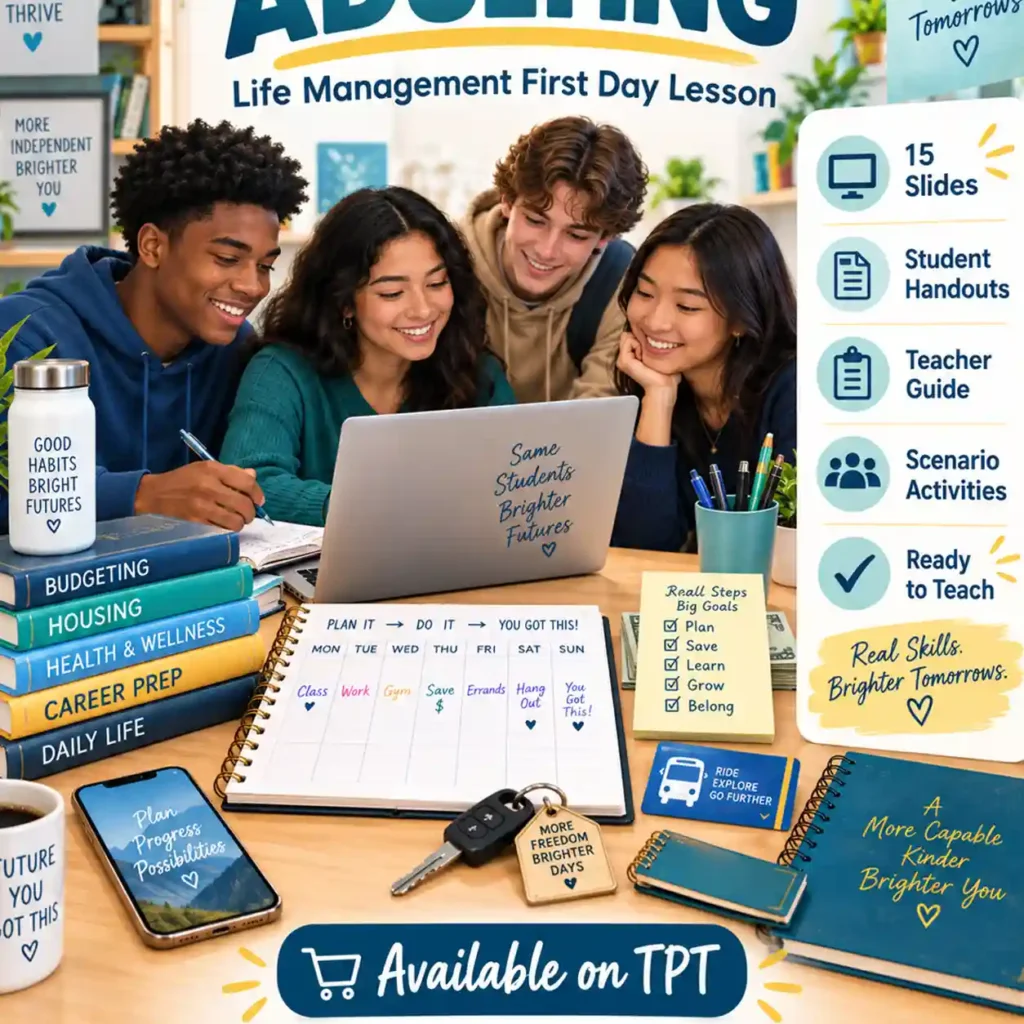
Prefer a ready-to-teach version? The complete Welcome to Adulting Life Skills First Day Lesson includes the presentation, student handouts, teacher guide, model responses, and assessment support.
Learning Goals and Standards
By the end of this high school life skills lesson plan, students will be able to:
- Compare adolescent and adult responsibilities without judging a person’s living arrangement or family situation.
- Identify a personal strength, a skill they want to develop, and one realistic next step.
- Compare two possible choices and explain the likely effect of each.
- Select a responsible action and justify the choice.
- Explain how asking for appropriate support can strengthen independence rather than weaken it.
Ontario curriculum connections: This lesson primarily supports expectations connected to comparing adolescent and adult roles and responsibilities, while introducing goal-setting, support networks, and decision-making. Relevant connections include B1.1, B1.2, B1.5, and C1.2.
Common Core connections: CCSS.ELA-LITERACY.SL.11-12.1 for collaborative discussion, SL.11-12.4 for clearly presenting a decision and supporting reasoning, and W.11-12.4 for clear short-form writing suited to purpose and audience.
Materials
You can teach this lesson with very little preparation. Students need a notebook or paper and something to write with. A projector is helpful but not required. The three opening scenarios, reflection prompts, decision-making routine, and main challenge can all be written or displayed one section at a time.
Bell Ringer: What Actually Shows Responsibility?
Begin by telling students that being an adult is not simply about age, income, or living alone. Then present these three short situations:
- Alex: Alex has a birthday and says, “Now I should be able to do whatever I want.” Alex then misses an agreed task and ignores the reminder.
- Sam: Sam lives with family, helps with a shared responsibility, communicates when plans change, and asks for help with an unfamiliar form.
- Jordan: Jordan earns some money and spends all of it on something fun, then realizes there is no money left for a bus ride already planned for work.
Ask students to discuss which actions show responsibility. Keep the emphasis on behaviour rather than labeling one person as “more adult” than another.
Useful discussion prompts include:
- Which action shows responsibility? What makes it useful?
- Could a teenager show the same behaviour? Explain.
- How might a responsibility become larger after high school?
- How can someone take responsibility after making a mistake?
- What additional information could change your interpretation?
Suggested time: 8 minutes.
Introduce the Course Through Real-Life Skills
Rather than spending too long on course procedures, give students a quick picture of where the course is going. Explain that Life Management is about practising decisions and skills they will actually use outside school.
A simple course route is:
- Independence: strengths, goals, priorities, responsibilities, and support.
- People skills: communicating needs, listening, and working through disagreements.
- Employment: applications, interviews, workplace communication, and expectations.
- Money: spending, saving, budgeting, and financial choices.
- Daily living: housing, food, clothing, household responsibilities, and practical routines.
- Consumer choices: comparing options, identifying problems, and finding appropriate help.
- Final task: bringing the course skills together in an independent culminating activity.
Ask students which area they are most interested in learning about and invite a few quick responses.
Suggested time: 7 minutes.
Getting-to-Know-You Activity: The Adulting Snapshot
The first-day reflection should feel useful, not invasive. Tell students they may keep personal answers private and may use an imagined example whenever a question feels too personal.
Have students respond briefly to the following prompts:
- Something I enjoy or am interested in is…
- One strength I bring to a class, team, job, or household is…
- One responsibility I already practise or help with is…
- Learning to ______ would help me ______.
- During this course, I want to become more confident at…
- One small step I could take this week is…
- One skill or piece of knowledge I will need is…
You can also ask students to choose the two learning conditions that help them most: seeing an example, trying something themselves, talking it through, reading short steps, or having time to think.
After about ten minutes, students share only an interest and one selected response with a partner. Partners identify one strength each person could bring to a team and one skill they would both like to develop.
Teacher note: Treat this as diagnostic information, not as a maturity test. Avoid asking students to disclose household income, family conflict, medical information, or other private personal history.
Suggested time: 15 minutes.
Mini-Lesson: A Four-Step Routine for Responsible Decisions
Introduce a simple decision routine students can reuse throughout the course:
1. Notice
Identify the responsibility, the facts you know, and who is affected.
2. Compare
Name at least two realistic choices. Consider what could happen after each choice.
3. Act
Choose a realistic next step. Be specific about what should happen and when.
4. Support
Identify a useful person, service, tool, or resource. Explain exactly what help would be useful.
Emphasize that independence does not mean doing everything alone. A responsible person often recognizes when another person’s knowledge or support can help.
Model the Routine
Use this quick example: Riley promised to send a group summary today but forgot. The group needs it before class ends.
Think aloud through the four steps. Riley should notice that the group is affected, compare ignoring the problem with communicating immediately, act by acknowledging the missed commitment and completing the most urgent part, and ask a teammate which section is needed first.
A useful model sentence is: “I missed our plan. I can finish the opening section now. Which part does the group need first?”
Suggested time: 10 minutes.
Main Activity: Adulting Scenario Challenge
Place students in pairs or groups of three. Each team chooses one scenario. In groups of three, one student can read the scenario, one can check the choices and consequences, and one can summarize the group’s plan.
Scenario A: The Missed Task
Riley forgot a promised group task that is due today.
Scenario B: The Spending Decision
Casey has $40 until Friday, needs $15 for planned bus trips, and wants to buy a $30 game.
Scenario C: The Shared Household Problem
Morgan and a housemate each thought the other person was going to wash the shared dishes. The sink is now full.
For the chosen scenario, students work through the four-step routine:
- Notice: What responsibility needs attention? Who is affected?
- Compare: What are two realistic choices? What might happen after each?
- Act: Which choice is strongest? What is the first specific action, and when should it happen?
- Support: Who or what could help? What could the person respectfully say?
Add a Change
Once teams have a plan, add one new piece of information:
- Scenario A: A teammate can help for ten minutes, but the deadline does not change.
- Scenario B: A friend suggests a free activity instead of buying the game.
- Scenario C: The housemate works late tonight but is free tomorrow morning.
Students decide what should change in their plan and what responsibility still remains. This is an important part of the activity because real-life decisions often need to be adjusted when circumstances change.
Suggested time: 25 minutes.
Debrief Questions
Bring the class back together and ask two or three groups to briefly explain their thinking. Avoid turning the activity into a contest for the “correct” answer. There may be several responsible choices if students can explain the consequences and show that the main responsibility is being addressed.
- Which part of the routine was most useful?
- What changed when new information appeared?
- Which responsibilities remained even after the plan changed?
- When does asking for help make someone more independent?
Exit Ticket
Finish with two short prompts:
- Being responsible means ______. One example from today is ______.
- One skill I want to build is ______. Asking ______ for help could help because ______.
These responses give you a quick picture of how well students understand responsibility, decision-making, and support. They also create a natural bridge into the next lesson on strengths, interests, skills, and values.
Assessment
I would keep the first day formative and ungraded. Look for evidence that students can identify a responsibility, compare realistic choices, explain a next step, and identify useful support. Do not evaluate students on how much personal information they disclose or on how much independent-living experience they already have.
Differentiation
Students should be able to demonstrate the reasoning without being limited by reading or writing demands. Read scenarios aloud when helpful, allow point-form responses, and accept oral responses, speech-to-text, or a scribe. Sentence frames can also reduce unnecessary language barriers:
- The responsibility is ______.
- If the person chooses ______, then ______ might happen.
- We choose ______ because ______.
- ______ could help by ______.
For students who struggle to generate options, offer two starting choices and ask them to improve on those choices. For students who need an extension, ask what additional information could change the decision rather than simply assigning more work.
First-Hand Teaching Suggestions
On the first day, I would resist the temptation to define adulthood for students. The stronger discussion comes from asking what responsible behaviour looks like in different circumstances. A student can live with family and show excellent independence skills; another person can earn money or live alone and still struggle with planning or communication. Keeping the focus on actions makes the lesson more respectful and much more realistic.
I would also save the Adulting Snapshot rather than treating it as a one-day icebreaker. It becomes much more valuable when students revisit the same goals later during the money, employment, and independent-living units and notice where their confidence has changed.
Want the Complete Ready-to-Teach Version?
This page gives you everything you need to teach the lesson, but the complete packaged version is designed to remove the setup work. The full resource includes a 15-slide presentation, a five-page student handout packet, a detailed teacher guide, scenario models, suggested answers, pacing guidance, differentiation supports, and assessment notes.
Get the complete Welcome to Adulting lesson on Teachers Pay Teachers.
High School Life Skills Lesson Plan FAQ
Is this lesson only for a specific Life Management course?
No. The activities work well in high school life skills, advisory, career education, family studies, transition planning, or other courses focused on independence and practical decision-making.
Can this lesson fit into a 60-minute period?
Yes. Limit the bell ringer and course overview to five minutes each, give about twelve minutes for the snapshot and partner exchange, eight minutes for the model, twenty minutes for the scenario, and five minutes each for the debrief and exit ticket. Discuss the scenario change orally instead of asking for a written response.
Should the Adulting Snapshot be graded?
No. It works best as a private diagnostic tool that helps you learn about student interests, strengths, goals, and preferred supports.
What comes next?
The next Life Management lesson is Who Am I Right Now? Strengths, Interests, Skills & Values. It builds directly from the Adulting Snapshot by helping students distinguish among four kinds of self-knowledge and use those ideas to make more intentional choices.