
Beginning of School Year Tips for Teachers: 4 Priorities for a Strong Start
The beginning of the school year can feel like a strange mix of excitement and pressure. Teachers are meeting new students, learning names, setting up routines, introducing course expectations, solving technology problems, communicating with families, and trying to create a positive classroom culture—all at once.
It is tempting to treat the first few days as a race to cover the syllabus and get into the curriculum. But the strongest beginning-of-year classrooms usually do something different: they slow down just enough to build the systems and relationships that make the rest of the year run more smoothly.
These beginning of school year tips for teachers focus on four priorities that have a long-term payoff: build relationships, teach routines, set expectations, and create early academic wins.
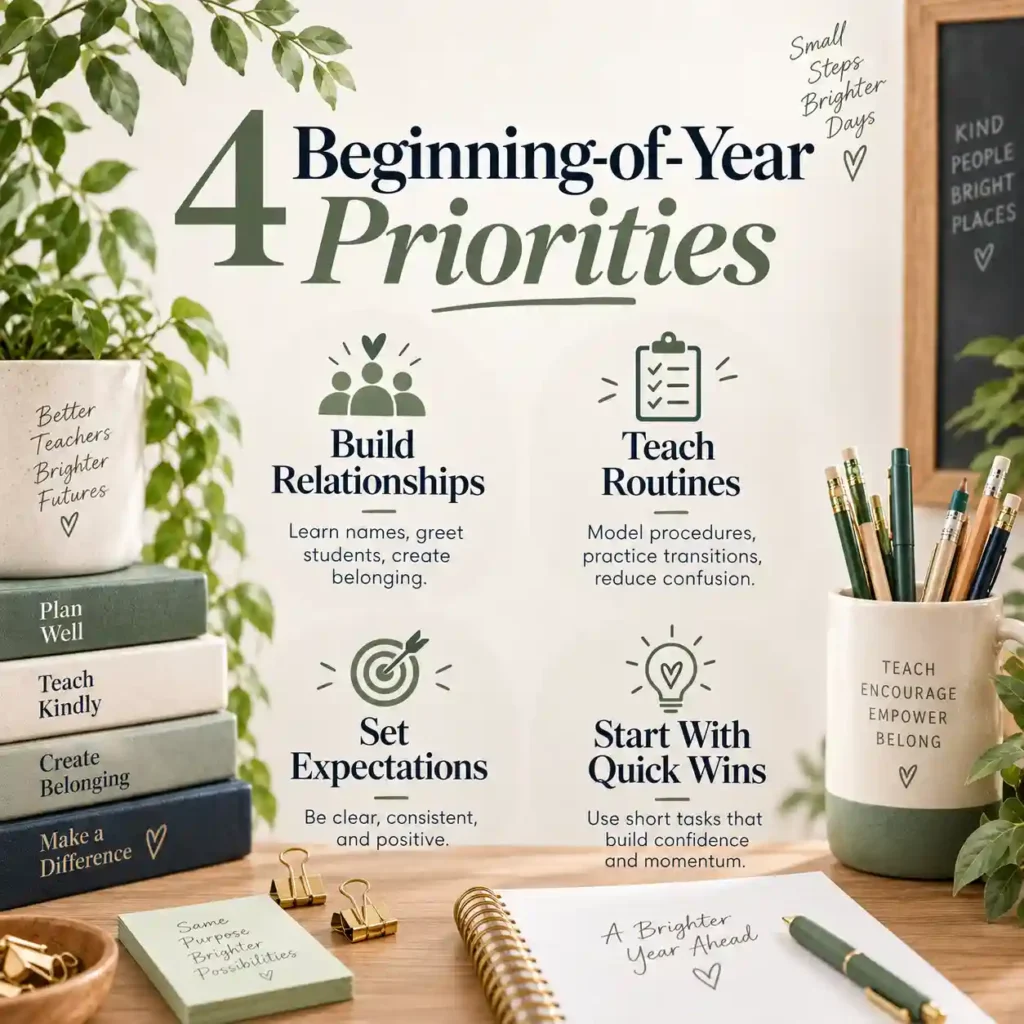
1. Build Relationships Before You Need Them
One of the most important things teachers can do at the start of the year is make students feel noticed, known, and welcome. That does not require elaborate icebreakers or hours of community-building activities. It starts with simple, repeatable actions: learning names quickly, greeting students, asking small questions about their interests, and showing genuine interest in their progress.
This matters for more than classroom atmosphere. The CDC defines school connectedness as the feeling that adults and peers at school care about students as individuals and about their learning. Students who feel more connected to school are more likely to have stronger attendance, higher grades and test scores, and better long-term school outcomes. The CDC’s school-connectedness guidance also emphasizes that teacher caring and support are central to that sense of belonging.
The practical lesson is simple: relationship-building is not separate from academic success. It supports it.
A strong first-week goal is to make sure every student has at least one positive interaction with you. For quieter students, that may be a quick comment about their work. For students who arrive guarded or unsure, it may simply be a calm greeting that communicates, You belong here.
2. Teach Routines Like They Are Part of the Curriculum
Teachers often tell students what they expect and assume students know what that looks like. The first week is the ideal time to turn expectations into concrete routines.
Instead of saying, “Be ready to learn,” show students what ready looks like. Where do they sit? What should be on the desk? What happens when they enter? Where do they find missed work? What should they do if they finish early? How does a class discussion begin? What happens when devices are needed—and when they are not?
Routine instruction can feel slow in September, but it saves enormous amounts of instructional time later. Every repeated question that students can answer through a routine is one less interruption in October, November, and beyond.
This is especially important during transitions. Entry routines, handing in work, moving into partner activities, accessing materials, and ending class are small moments that can create either calm or chaos. Model them, let students practice them, and reteach them when needed without turning every mistake into a confrontation.
If you want to go deeper on this area, see 11 Instructional Strategies for Teaching Every Classroom Needs for broader ways to structure learning effectively.
3. Set High Expectations—Then Make Them Reachable
Students quickly figure out what a classroom values. The first week sends signals about whether effort matters, whether mistakes are recoverable, whether discussion is respectful, and whether the teacher actually believes students can succeed.
Strong expectations are not the same thing as harsh rules. In fact, expectations work best when they are clear, predictable, and connected to a purpose.
Instead of presenting a long list of rules, organize expectations around a few understandable ideas: respect the learning, respect the people, be prepared, participate, and repair problems when they happen. Then connect those expectations to real classroom situations.
The CDC’s classroom-management guidance notes that teacher expectations, caring and support, peer connection, and positive behavior management all contribute to stronger school connectedness. Its classroom-management overview reinforces an important point: good management is not simply about control. It is about creating conditions where students can participate, belong, and learn.
That means correcting problems consistently, but also showing students how to succeed. If the expectation is productive discussion, model what productive discussion sounds like. If the expectation is independent work, teach students what to do when they are stuck. If the expectation is responsible technology use, be explicit about what responsible use looks like.
4. Give Students an Early Academic Win
The first week should not be all rules, forms, and introductions. Students also need to experience what learning in your classroom will feel like.
Choose an early task that is meaningful but accessible. It should let students think, create, discuss, solve, or write without requiring weeks of prior instruction. The goal is to create momentum.
A good early task does three things at once: it gives students a quick success, it gives you useful diagnostic information, and it introduces the kind of thinking your course values.
For an English classroom, that might be a short inference task, a brief personal response, or a low-stakes analysis of an image or short text. In science, it might be a prediction or observation challenge. In math, it could be a problem-solving task where more than one strategy is possible. In social studies, students might evaluate a source or defend a position using evidence.
Early success matters because students begin building a story about themselves in your classroom almost immediately. A student who thinks, I can do this, is more likely to take the next academic risk.
For ELA teachers specifically, the First Week of School ELA Activities article includes a five-day structure designed to help teachers learn about students while collecting useful diagnostic information.
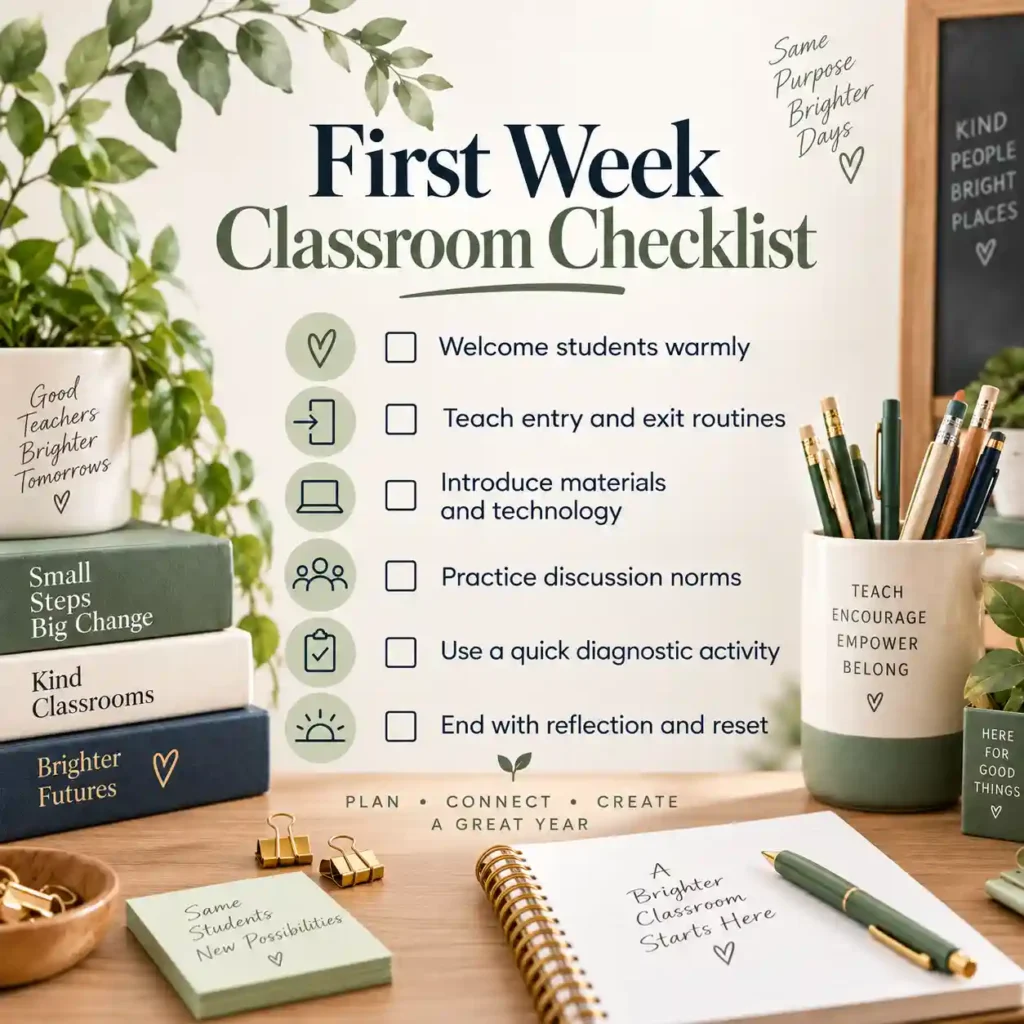
A Practical First-Week Classroom Checklist
When the first week gets busy, it helps to focus on a short list of essentials rather than trying to perfect everything at once.
- Welcome students warmly. Learn names and create at least one positive interaction with each student.
- Teach entry and exit routines. Make the beginning and end of class predictable.
- Introduce materials and technology. Show students where things are and how they should be used.
- Practice discussion norms. Teach what listening, responding, disagreeing, and participating look like.
- Use a quick diagnostic activity. Gather information without making the task feel like a high-stakes test.
- End with reflection and reset. Ask what worked, what students still need, and what you need to reteach tomorrow.
What Not to Worry About Yet
One of the easiest mistakes at the beginning of the year is trying to solve every classroom problem before it exists.
You do not need a perfect seating plan on day one. You do not need every classroom procedure memorized by Friday. You do not need to know every student’s learning profile immediately. You do not need every bulletin board finished before students arrive.
You need a classroom that is functional, welcoming, predictable, and ready to improve.
The first week is a starting point, not a final product. Good classrooms are built through observation and adjustment. You will learn which routines need more practice, which students need more connection, which expectations need clearer language, and which activities help your particular group engage.
The Best Beginning-of-Year Strategy Is Consistency
The strongest beginning of the school year is rarely the flashiest one. It is the one that establishes trust and clarity.
Students know where to go, what to do, how to ask for help, and what kind of classroom community they are joining. They experience an early academic success. They see that expectations are real but reasonable. Most importantly, they begin to believe that the adults in the room notice them and want them to succeed.
That is why these beginning of school year tips for teachers are deliberately simple. Relationships, routines, expectations, and early wins may not be as exciting as a perfectly decorated room or an elaborate first-day activity, but they create the foundation for everything that comes next.
Start small. Be consistent. Adjust as you learn. A strong school year does not have to be created on the first day—it just has to be started well.