
25 Growth Mindset Photos to Inspire Your Classroom
You need a visual that sells the message before you say a word. A blank bulletin board, a slide deck that needs one more image, a worksheet header that feels flat: these small gaps are where growth mindset photos actually earn their keep in a classroom. Text alone rarely sticks with students the way a striking image does, especially when you’re trying to make an abstract idea like effort and persistence feel real.
This roundup gives you exactly what you came for: a curated set of growth mindset pictures you can pull for bulletin boards, slides, worksheets, and parent newsletters without spending an hour scrolling stock sites. Every image here connects to a concrete classroom use, whether that’s illustrating the brain as a muscle, showing a mistake turning into progress, or capturing a student pushing through a hard problem.
Below you’ll find 25 growth mindset images, organized so you can quickly spot the ones that fit your grade level and setup. We’ll also flag where to find free, classroom-safe sources and how to pair each picture with language your students will actually remember.
1. Tree and plant growth mindset photos
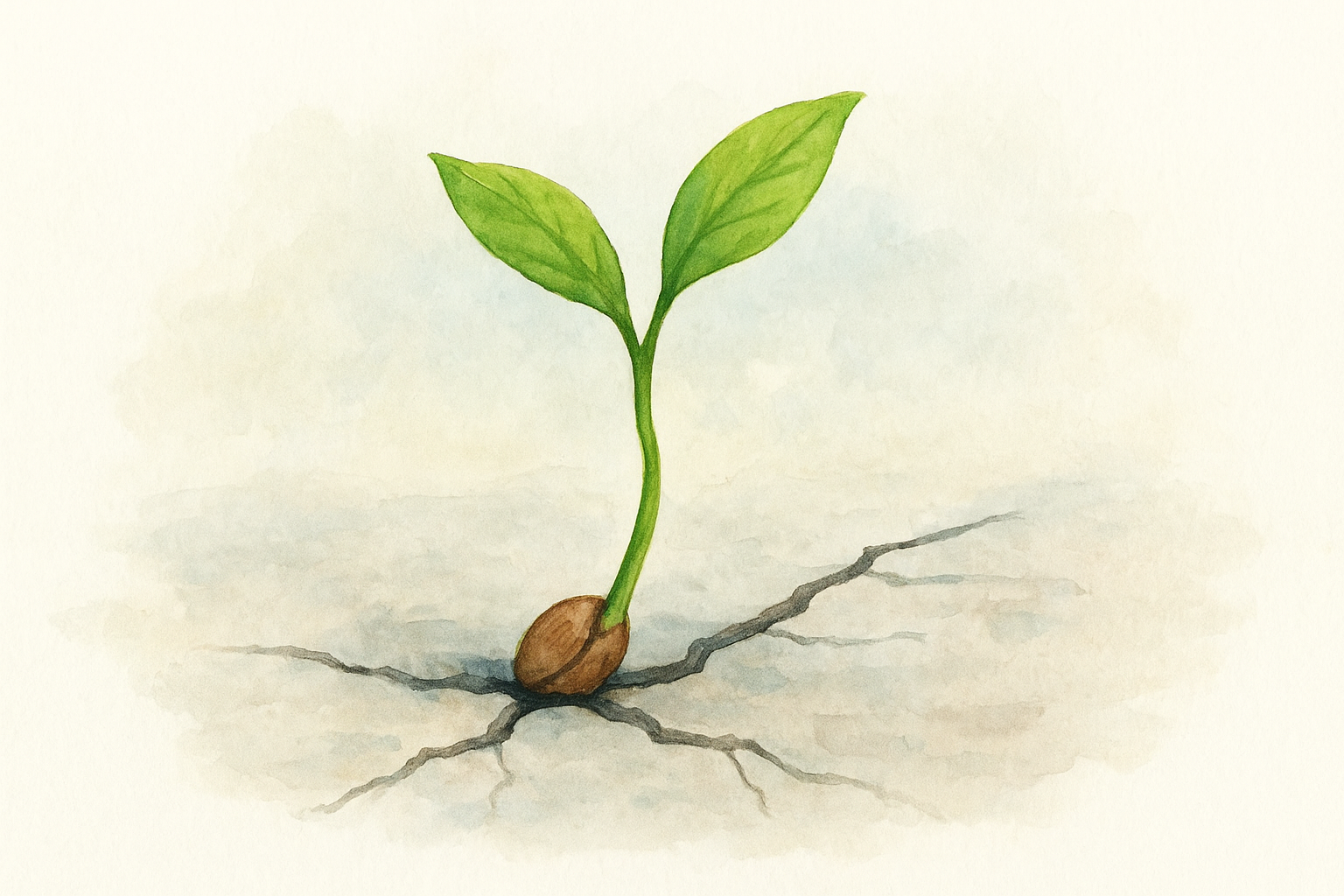
Seeds cracking open, saplings bending in the wind, roots pushing through cracked concrete: these growth mindset photos turn an abstract idea into something a seven-year-old and a seventeen-year-old both understand instantly. Growth takes time, and it isn’t always visible while it’s happening. A single image of a tiny sprout next to a full-grown oak does more to explain "progress over perfection" than a paragraph of explanation ever will.
What it depicts
Most images in this category fall into a few recognizable scenes: a seed splitting open, a sapling growing sideways around an obstacle, a tree with visible rings marking years of growth, or roots breaking through rock or pavement. Some growth mindset pictures pair the plant imagery directly with text overlays like "bloom where you’re challenged" or "roots grow in the dark." Others leave the photo clean so you can add your own caption in Canva or Google Slides.
Why it works
Plant growth is slow, uneven, and often invisible until it isn’t, which is exactly how skill-building and learning actually work. Students see the metaphor without you having to explain it twice. A tree that grew around a fence post or through a crack in a sidewalk shows resilience without a single word of dialogue.
A cracked-sidewalk sapling teaches persistence faster than any lecture on effort ever will.
This category also holds up across grade levels. Elementary teachers use seed-to-sprout sequences for social-emotional learning units, while middle and high school teachers lean on the cracked-concrete tree for units on resilience, To Kill a Mockingbird, or personal narrative writing.
Where to find it
For free, classroom-safe options, start with Unsplash and Pexels; search "sapling growth" or "seedling" rather than "growth mindset" directly, since the literal keyword returns mostly cluttered infographics. Both sites offer commercial-use licenses with no attribution required, which matters if you’re printing posters or publishing to a school website.
- Unsplash: search "seedling crack concrete" or "tree rings"
- Pexels: search "sapling" or "sprout growing"
- Pixabay: good for simple, clean plant graphics without busy backgrounds
Check each platform’s license page before printing anything for sale or district-wide distribution, since terms occasionally shift between free and extended licenses.
2. Brain and neuroplasticity growth mindset images
Wires lighting up, synapses firing, a brain rendered like a muscle mid-flex: these growth mindset images give students a literal picture of what happens when they struggle through a hard problem. Neuroplasticity is the actual science behind growth mindset, and a visual of neurons connecting makes that science tangible instead of abstract.
What it depicts
Expect glowing synapse illustrations, brain outlines filled with branching neural pathways, or split images showing a "before" brain with sparse connections next to an "after" brain dense with new ones. Some growth mindset pics show a literal muscle flexing inside a brain outline, a blunt but effective way to say effort physically changes the brain. Others use MRI-style scans or simplified diagrams built for classroom slides rather than medical accuracy.
Why it works
Students believe intelligence is fixed until someone shows them otherwise, and a neuron image does that work fast, especially alongside a neuroplasticity lesson plan for middle school. According to the National Institutes of Health, practice and repetition genuinely strengthen neural connections, so this category isn’t just a metaphor, it’s a fact you can cite.
A picture of a strengthening neuron tells students their brain changes shape every time they try again.
Pair this image with a one-line caption like "every mistake grows a new connection" and you’ve turned a science fact into a daily classroom mantra.
Where to find it
Search "neuroplasticity illustration" or "neural pathway diagram" on Pixabay and Freepik’s free tier for clean, printable graphics. Avoid overly clinical stock photos labeled "MRI scan," since they read as sterile rather than inspiring on a bulletin board.
3. Fixed vs growth mindset comparison photos
Side-by-side visuals do the heavy lifting when you need students to spot the difference between two mindsets in one glance, so it helps to have growth mindset vs fixed mindset explained before you hang them. These growth mindset pictures work like a mirror, letting kids see their own self-talk reflected back so they can name it and change it.
What it depicts
Most images in this set use a two-column or two-panel layout: a closed door versus an open one, a locked brain versus an unlocked one, or a list of fixed-mindset phrases ("I can’t do this") stacked against growth phrases ("I can’t do this yet"). Some growth mindset image sets use color coding, red for fixed and green for growth, so younger students can sort statements without reading every word.
Why it works
Comparison forces a decision, and decisions stick better than passive reading. When a student sees "this is too hard" next to "this may take time and effort," they’re not just absorbing a slogan, they’re practicing the exact reframe you want them to use during a test or a tough assignment.
Side-by-side phrasing turns a vague idea into a choice a student can actually make.
Teachers report that these charts work especially well taped to a desk or glued inside a notebook, since students glance at them mid-struggle rather than only during a lesson.
Where to find it
Search "growth mindset vs fixed mindset chart" on Canva’s free template library or Pinterest for printable versions, or start from a free fixed vs. growth mindset worksheet. Pixabay also carries simpler graphic versions if you want to build your own chart from individual icons rather than a pre-made layout.
4. Effort and mistakes mindset pictures
A crumpled piece of paper next to a finished draft, an eraser worn down to a nub, a scoreboard showing a losing streak before a comeback: these growth mindset pics put mistakes front and center instead of hiding them. Most classroom decor skips over failure entirely, which sends the wrong message. This category corrects that by showing the messy middle, not just the polished result.
What it depicts
Expect images of scratched-out math problems, students mid-struggle over a worksheet, a paper airplane collection of failed folds before one finally flies, or a hand erasing and rewriting. Some pictures of growth mindset in this set pair a torn draft with a clean final copy to show the actual distance between attempt one and attempt five.
Why it works
Students hide mistakes because they think mistakes mean failure, not process, which is exactly what changes in students who read errors as information. Seeing a photo that normalizes the eraser marks and the crossed-out lines tells them everyone’s path looks messy before it looks finished.
A crumpled first draft on the wall says more about growth than any finished A-paper ever could.
This works especially well near a writing center or math corner, where students are actively producing drafts you can reference in real time.
Where to find it
Search "crumpled paper" or "eraser worn down" on Pexels and Unsplash. Pixabay carries simple icon sets showing a pencil breaking and a new one appearing, useful for a minimalist bulletin board.
5. Motivational growth mindset quote images
Bold text over a simple background, a single sentence doing all the work: these growth mindset quote images are the fastest decor you’ll ever hang. Teachers reach for them when a bulletin board needs filling by Friday or a slide needs a closing thought. They’re not flashy, but they’re the workhorse of any classroom mindset wall.
What it depicts
Most of these growth mindset pics pair a short phrase like "mistakes help me grow" or "yet" in large type against a plain color, gradient, or blurred nature backdrop. Some layer the quote over a subtle photo, a mountain trail or a sunrise, to add mood without competing with the text. Others come as clean templates with no quote at all, letting you drop in your own wording from a list of growth mindset quotes for students and teachers.
Why it works
Short, repeated phrases stick with kids the way jingles do. A single word like "yet" attached to a clean image gets referenced back to all year, long after a wordy poster gets ignored, especially if you’ve spent a lesson teaching the power of yet.
One word on a clean background outlasts a paragraph nobody reads twice.
Quote images also give you something quick to swap monthly, keeping the wall fresh without redesigning the whole space, and a set of printable mindset posters makes the rotation easier.
Where to find it
- Canva: free templates under "growth mindset quote"
- Pinterest: search "growth mindset poster" for printable inspiration
- Pixabay: plain backgrounds you can caption yourself in any editor
6. Famous failure-to-success mindset photos
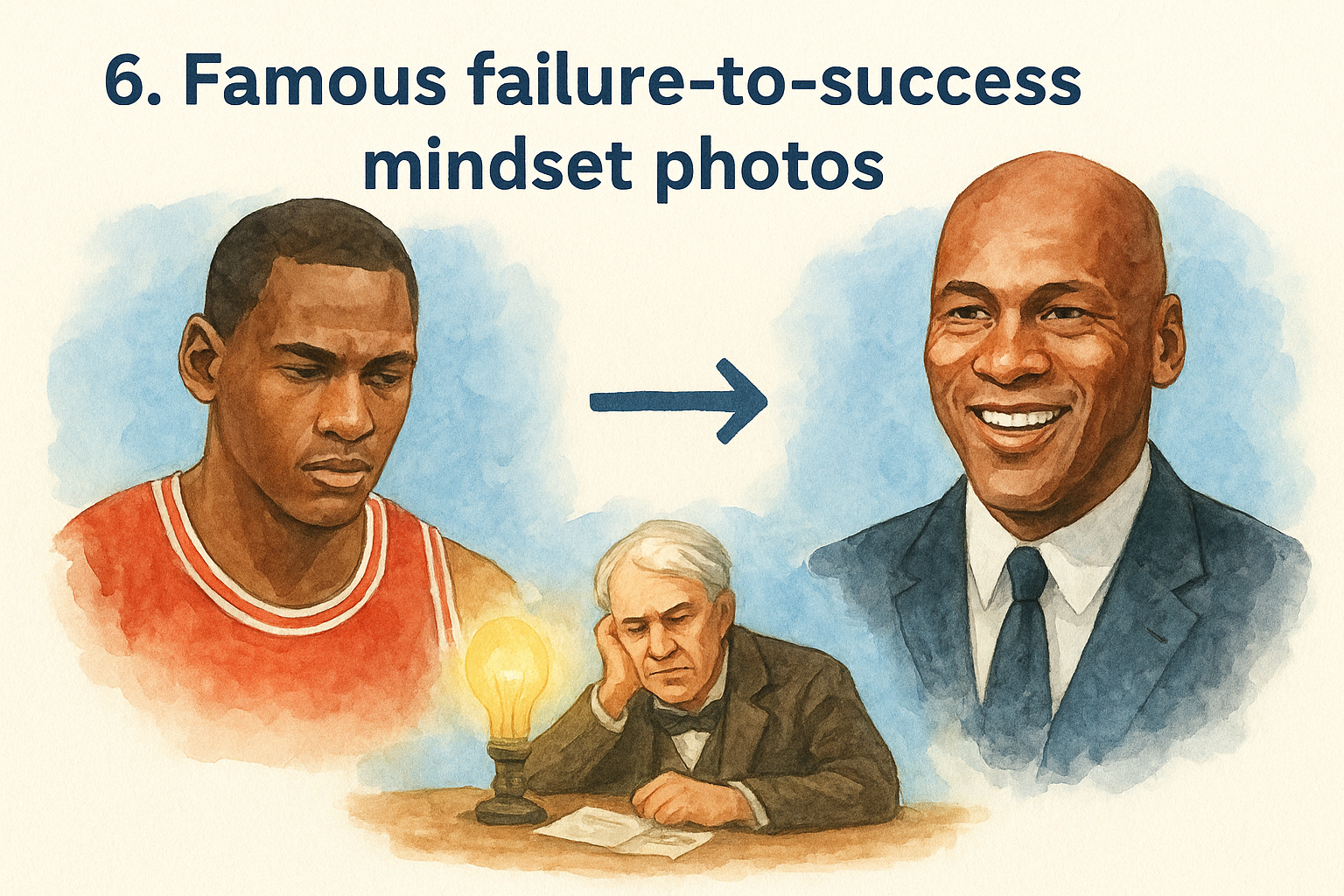
Portraits of well-known figures paired with a lesser-known fact about their early failures make up this final category of growth mindset photos. Michael Jordan cut from his high school team, Thomas Edison’s thousand failed light bulb attempts, J.K. Rowling’s stack of rejection letters: these images give students proof that struggle precedes almost every success story they admire, and they pair well with a lesson plan built around Edison’s persistence.
What it depicts
Most growth mindset images here use a split layout: a photo of the person during their obscure or failed period next to a photo of them at the height of their success, with a short caption bridging the two. Others use a single portrait with a quote about persistence layered underneath, turning a biography lesson into a one-glance poster.
Why it works
Students assume successful people got there in a straight line, and these growth mindset pics correct that assumption fast. Seeing a famous face tied to a documented failure removes the shame around struggling in class.
A cut basketball player and a rejected manuscript prove that failure is a normal stop on the way to mastery.
This category pairs naturally with biography units, career day, or a power of effort lesson plan where students need a real name attached to the idea of persistence rather than an anonymous stock photo.
Where to find it
Search Wikimedia Commons for public-domain portraits of historical figures, since usage rights are clearly labeled there. For modern athletes or authors, check the Library of Congress archives before pulling images from general web searches, which often carry unclear licensing.
Putting these images to work in your classroom
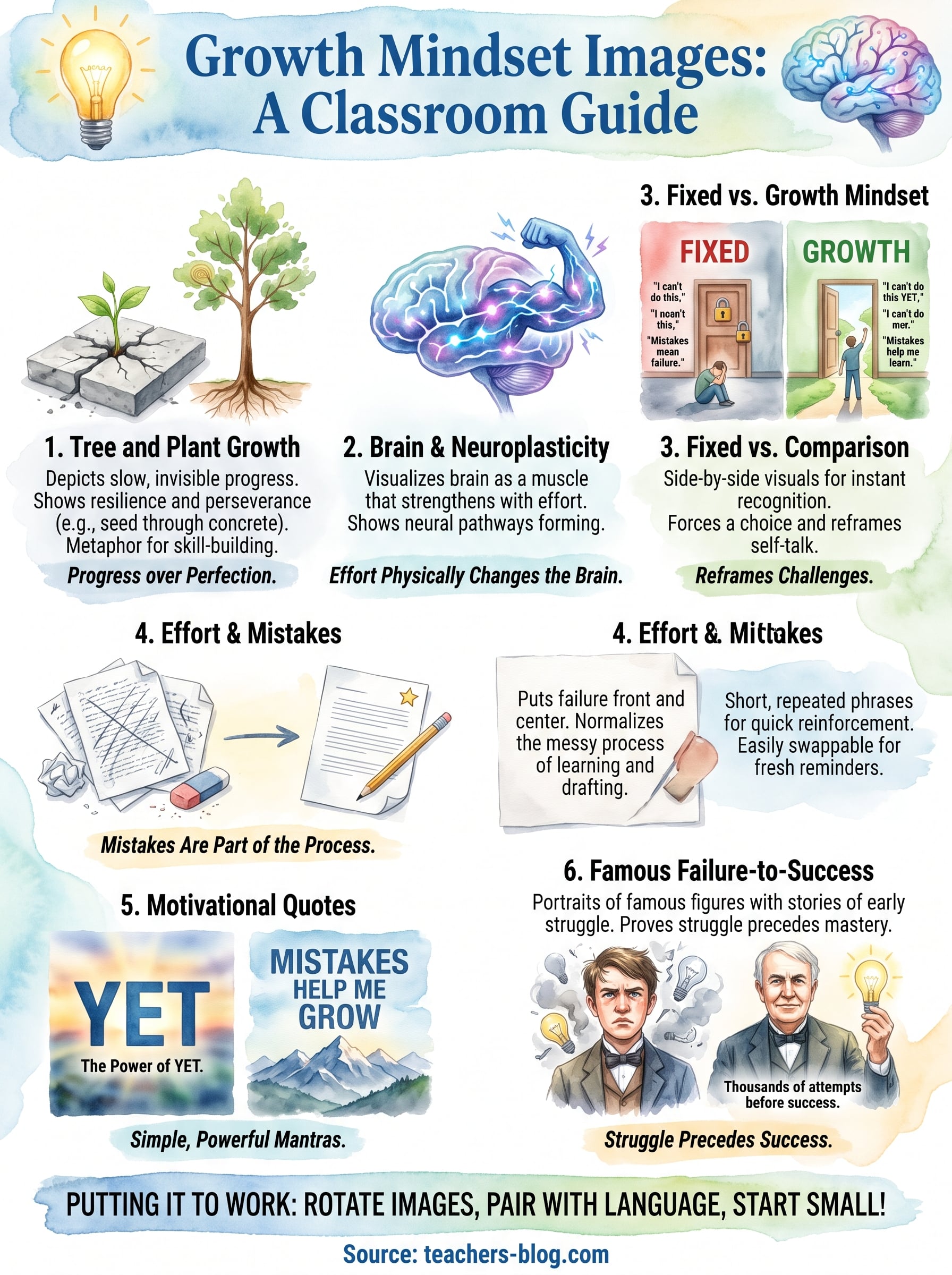
A bulletin board full of growth mindset photos only works if you rotate it. Pick one category this month, seedlings for September, brain science for October, and swap the images before students stop noticing them. Pairing a picture with a short phrase your class repeats out loud does more than any poster hung alone ever could.
Start small. Grab one tree image, one quote graphic, and one famous-failure portrait, then build from there once you see which ones your students actually reference during a hard assignment. The goal isn’t a perfect wall, it’s a visual reminder that struggle is part of the process, not proof they’ve failed.
If you want more classroom-ready tools beyond images, from unit plans to bell ringers and SEL activities, browse these growth mindset resources for teachers and build out the rest of your toolkit.