
First Week of School ELA Activities: A 5-Day Plan That Actually Helps You Get to Know Your Students
Planning the first week of an English class is harder than it seems.
I want students to enjoy coming to class. I want them to get comfortable talking to one another. I want to begin building a classroom community. But I also don’t want to spend an entire week doing icebreakers that have very little connection to what we will actually be doing in English.
Most importantly, I want to learn something about my students.
Can they explain an idea clearly? Can they support an opinion? What happens when they have to make an inference? How comfortable are they speaking in a group? What kind of stories do they tell? What are their interests? What does their writing look like before I have taught them anything?
That is the thinking behind these first week of school ELA activities.
Rather than separating “getting to know you” activities from academic work, I like activities that can do both. Students should feel like the first week is relatively low-pressure and enjoyable, while I quietly gather a surprising amount of information about them as readers, writers, speakers, collaborators, and thinkers.
Here is one way to structure all five days.
Day 1: Get Students Talking, Creating, and Writing
I don’t want the first thing students do in English class to be filling out a long information sheet.
I would rather get them doing English.
A simple Would You Rather? English Edition activity is an easy place to begin. Give students two choices, ask them to choose a position, and then require one reason beginning with something as simple as, “I choose ___ because…”
The academic demands are deliberately light. What I’m really watching is how willing students are to participate, whether they can explain their thinking, and whether they can listen respectfully when someone else disagrees.
Suggested slideshow image: “Would You Rather? English Edition.”
From there, I would move into an activity I call The Story of Me: Six Things.
Students select six things that represent them. These could be hobbies, skills, important people or places, songs, movies, games, sports, books, objects, goals, or experiences. They can represent each choice with a word, sketch, or symbol and briefly explain the connection.
There is an important rule here: students should never be required to share private information. Fictional or less personal examples are perfectly acceptable.
This gives me a much more useful introduction to my students than a standard questionnaire because I start discovering what they may actually want to read, write, discuss, or create during the year.
The final activity turns toward writing: Tell a Complete Story in Six Words.
Students can experiment first with funny, mysterious, or surprising six-word stories. Then they select their strongest one and write a paragraph explaining the larger story they imagine happening behind those six words.
And just like that, I have my first small writing sample.
I haven’t announced a diagnostic test. Students haven’t spent the period completing a formal assessment. But I can already see how they generate ideas, organize a paragraph, develop details, construct sentences, and use conventions.
Day 2: Find Out How Students Build an Argument
On the second day, I would move from personal expression to argument.
Start with Take a Side — and Stay Open.
Give students a statement and ask them to position themselves somewhere between strongly agree and strongly disagree. The important part isn’t which position they choose. It is explaining why.
Students listen across the room, respond to ideas rather than people, and are allowed to move if somebody else’s argument persuades them.
That last part matters. Changing your mind should be evidence that you listened and thought—not evidence that you “lost.”
Next comes Convince Me in One Minute.
Students choose a light topic, make one clear claim, develop three different reasons, and then give a short pitch to a partner or group. Their goal is not simply to repeat the same idea three times using different words. Each reason should add something new to the argument.
The day can finish with Rank It: Survive for Seven Days.
Give students a collection of possible survival items and tell them they can keep only five. They have to agree on their choices and rank them from most to least important.
The conversation can become lively, but the final piece is individual: students identify which item matters most and give two reasons.
Now I have another useful piece of baseline information. Can this student make a claim? Can they distinguish between a claim and a reason? Can they support their choice? Can they respond when somebody challenges their thinking?
These are skills I will return to repeatedly in English class.
Day 3: Introduce Evidence and Inference Through a Mystery
Day 3 is one of my favourite parts of this first-week structure because students begin doing something that feels much closer to literary analysis without needing to know any literary terminology yet.
Start with a strange scene.
An empty classroom. A chair knocked over. A backpack open. A window open. A half-eaten sandwich. A note that says, “Don’t tell anyone.”
Ask students: What happened here?
Then give them a simple 3-2-1 structure. Identify three observations that are directly visible, make two inferences based on the evidence, and develop one theory explaining what most likely happened.
The crucial question is: What makes you think that?
That question can become one of the most useful phrases in an English classroom.
Students quickly discover the difference between something they actually know and something they are assuming.
Suggested slideshow image: “What Happened Here?”
From there, I would move into a short reading activity built around the same idea: Read Like a Detective.
On the first read, students simply try to understand what is happening. On the second, they start looking for clues, repeated details, and assumptions they may have made.
Their response can distinguish between what is certain and what has merely been assumed before asking them to make an inference or prediction and identify their strongest supporting evidence.
Finish with a larger mystery such as The Missing Jar Case. Students reconstruct events using statements, logs, photographs, details, or messages. They build a timeline, test possible conclusions against all the available evidence, and decide which details are strongest or potentially misleading.
At the end, each student independently explains what most likely happened using at least three pieces of evidence.
That final response tells me an enormous amount.
When we eventually begin talking about textual evidence, inference, characterization, conflict, or literary analysis, I already know something about how naturally each student makes the connection between an idea and the evidence supporting it.
Day 4: Let Students Create Something
By Day 4, I want to change the energy.
Students have talked, argued, read, inferred, and explained. Now I want them to create.
Begin with Build a Story from Four Random Elements.
Give students a character, setting, problem, and object—or allow them to generate the four elements randomly. Their challenge is to connect all four pieces into a story that makes sense.
They need to decide who the character is, what that character wants, what goes wrong, why the object matters, and how the story will end.
The randomness is what makes this work. Students can’t spend forever trying to invent the perfect premise. They simply have to start solving the storytelling problem in front of them.
Next, put students into groups and let each group Choose a Creative Challenge.
One group might perform a scene. Another could create a movie pitch. Another might develop a character for a ridiculous imaginary product. Others might create a comic, storyboard, complete plot, or opening scene.
Each creation needs a clear central idea, some kind of story element, a contribution from every member, and something that can be shared with the class.
The goal isn’t polish.
The goal is creation.
Groups then get about two minutes to present, perform, explain, read, or display what they made.
I like ending this lesson with an individual reflection: What did you contribute? What would you improve if you had ten more minutes?
That gives quieter students a chance to explain their contribution and gives me another piece of individual writing even though most of the lesson has been collaborative.
Day 5: Turn the Final Day Into an ELA Challenge
The final day can bring everything together.
I would begin with an English Challenge: Six Quick Stations.
Instead of one long assignment, students move through short ELA challenges involving words, editing, interpretation, creativity, and argument.
A Word Detective challenge might ask them to solve a language problem. A Fix It activity can introduce editing. A What’s Really Happening? station can revisit inference. A Story Starter checks creativity. A Headline Challenge requires precision. An One Doesn’t Belong task makes students defend a classification.
Suggested slideshow image: “English Challenge: Six Quick Stations.”
There is enough variety here that almost every student finds something they are good at—and I get one final chance to see students working across several different English skills.
Then try Describe and Draw.
One student can see a simple design while a partner cannot. The speaker has to describe the design using words only—no gestures—while the other student attempts to reproduce it.
Then they compare the two designs, switch roles, and discuss which words helped and which assumptions caused problems.
It is a deceptively simple speaking-and-listening activity that reinforces one of the most important lessons students can learn about communication: saying something is not necessarily the same as communicating it clearly.
Finally, I would end the entire week with Help Design This English Class.
Ask students about their reading and writing preferences, how comfortable they are speaking or working in groups, topics that interest them, supports that help them learn, and one goal they have for the year.
Then have them write one final paragraph about something they care about, know about, enjoy, understand, or hope to accomplish.
The instruction is simple: develop one clear idea using specific details.
That is the piece I want to finish with.
After five days of activities, conversation, collaboration, and creativity, students show me what they can do independently.
What Have You Learned After the First Week?
This is why I prefer this kind of first-week plan to five days of disconnected icebreakers.
I still get the relationship-building benefits of back-to-school activities, but by Friday I also have a surprisingly detailed picture of the class.
I know which students are eager to speak and which may need more time. I have seen students explain opinions, support claims, make inferences, use evidence, collaborate, create stories, present ideas, listen to one another, and write independently.
I also know more about their interests and the kinds of support they believe will help them succeed.
None of these activities needs to be graded.
The information is the value.
It gives me a much better starting point for planning the weeks that follow.
You Can Build This First Week Yourself
Everything above can absolutely be created from scratch.
You can make the prompts, design the mysteries, prepare the station activities, create the student instructions, develop the writing pages, organize the group challenges, and put everything into a slideshow.
And if you enjoy doing that, use the ideas in this article and make them your own.
But August and September also have a habit of producing a fairly intimidating teacher to-do list.
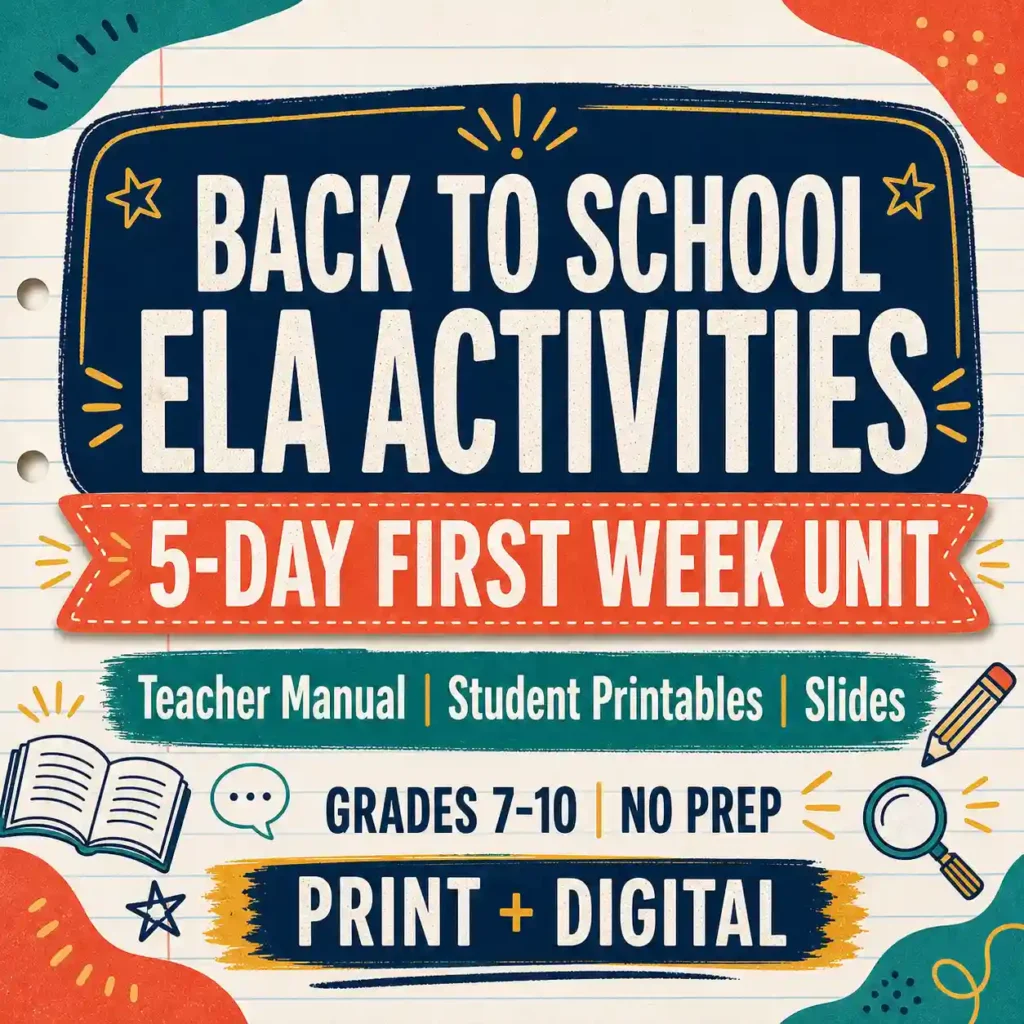
So I have also put the complete First Five Days English resource together for teachers who like this approach but would rather have the first week organized and ready to use.
The resource follows the same five-day progression outlined here, with three activities each day and student-facing slides that make it easy to move from one activity to the next.
[View the First Five Days English Resource on Teachers Pay Teachers →]
The important part, whether you use my version or create your own, is the purpose behind the week.
I don’t think the first five days of English need to be a choice between “fun activities” and “real learning.”
They can be both.
Students can meet one another, laugh, argue about ridiculous questions, solve mysteries, invent stories, work in groups, and start feeling comfortable in the room.
At the same time, I can begin learning how they think.
And that gives me something much more useful than simply surviving the first week of school.