
9 Strategies for Co-Teaching That Actually Work
You walked into co-teaching excited about two brains solving one classroom’s problems, and then reality hit: mismatched pacing, one of you doing all the talking, students who can’t tell who to ask for help. If you’re searching for strategies for co teaching that hold up past the first week of school, you’re not alone. Most co-teaching advice sounds great on paper and falls apart the moment 30 kids walk in the door.
This article skips the theory and gets straight to what actually works between two adults sharing one room. You’ll get concrete co-teaching models you can rotate through the week, ways to divide planning time so it doesn’t eat your evenings, and communication habits that stop small friction from turning into resentment by October.
Below are nine strategies pulled from real classrooms, not textbooks. Each one addresses a specific pain point: unclear roles, uneven workloads, or students who play one teacher against the other. Whether you’re pairing a general ed teacher with a special ed co-teacher or two content specialists sharing a block, you’ll find practical adjustments and role-clarity tips you can start using tomorrow.
1. Build a shared vision and mutual respect
Before you write a single lesson plan together, sit down and answer one question honestly: what does a well-run classroom look like to each of you? One teacher might value silence during independent work while the other thrives on productive noise. One might see late homework as a teachable moment about consequences, while the other sees it as a chance to problem-solve with the student. Skip this conversation and you’ll spend the semester contradicting each other in front of kids, which is the fastest way to lose a class’s trust in both of you. Shared vision isn’t a soft skill you get to later. It’s the foundation everything else in this list depends on.
What it looks like in the classroom
Picture two teachers who’ve agreed on a discipline approach before the first bell rings, so when a student pushes back on an assignment, either adult can respond the same way without a sideways glance for approval. Students see one unified authority instead of two competing ones. You’ll notice it in small moments too: both teachers referring to the room as "our class," both names on the syllabus, both voices used equally during whole-group instruction instead of one teacher standing at the front while the other hovers near the back like an aide. That visual matters more than most co-teaching pairs realize.
Why this strategy works
Students, especially middle and high schoolers, are experts at spotting cracks between adults and exploiting them. When two teachers operate from a genuinely shared vision, there’s no crack to find. Research on co-teaching consistently points to parity and mutual respect as the strongest predictors of whether a partnership survives the year, according to guidance published by the U.S. Department of Education’s Office of Special Education Programs. Beyond classroom management, this kind of alignment also protects the relationship itself. Co-teaching fails more often over unspoken resentment than actual pedagogical disagreement.
When students can’t find a crack between two teachers, they stop looking for one.
Tips to make it stick
Don’t leave this to chance or assume it’ll sort itself out by November. Build the conversation into your first week together, and revisit it whenever friction pops up.
- Schedule a values conversation before day one. Ask each other directly: what does respect look like, what does a fair workload look like, how do we want to handle disagreements in front of students?
- Write down your non-negotiables. Two or three shared rules, posted somewhere both of you can reference, prevent "I thought we agreed" arguments later.
- Use "we" language publicly. Refer to shared decisions, shared students, and a shared classroom, even in emails home to parents.
- Check in monthly, not just when something breaks. A five-minute pulse check keeps small annoyances from becoming semester-long grudges.
2. Protect time for joint planning
Good co-teaching dies in the gap between two teachers’ schedules. You get five minutes in the hallway before the bell, maybe a rushed text the night before, and then you’re improvising in front of 30 students who can tell exactly how prepared you both are. Joint planning time isn’t a luxury you fit in when things slow down. It has to be protected on the calendar like any other non-negotiable part of the school day, or it simply won’t happen.
What it looks like in the classroom
A co-teaching pair that plans together shows up with a lesson that actually reflects two perspectives, not one teacher’s plan with the other person added as an afterthought. You’ll see it in the transitions: both adults know what’s coming next without whispering "wait, what are we doing now?" mid-lesson. Materials get split ahead of time, accommodations get built in before the lesson starts instead of improvised on the spot, and neither teacher looks surprised by what the other says.
Why this strategy works
Without dedicated planning time, one teacher inevitably defaults to the lead role while the other becomes a support act, regardless of what you agreed on in strategy one. Consistent planning keeps the partnership balanced and keeps both of you accountable for the content, not just the classroom management.
A lesson planned by one teacher and delivered by two rarely feels like true co-teaching.
Tips to make it stick
Protecting this time takes deliberate structure, not good intentions.
- Request a shared planning period during scheduling, even if it means trading a preferred prep slot.
- Use a shared document so planning survives even when a face-to-face meeting falls through.
- Set a recurring 20-minute check-in, separate from full lesson planning, just to preview the week.
- Treat cancelled planning time as a red flag, not a minor inconvenience, and reschedule it the same week.
3. Define clear roles and responsibilities
Ambiguity kills co-teaching partnerships faster than almost anything else. When neither teacher knows who grades what, who calls parents, or who leads which part of a lesson, one person quietly absorbs the extra work while the other coasts, often without either realizing it’s happening. Clear roles don’t limit flexibility. They give you a baseline to work from, so improvisation happens on purpose instead of by default.
What it looks like in the classroom
A well-defined partnership has a written breakdown of who handles grading for which assignments, who manages behavior interventions, who contacts parents about IEP progress, and who leads instruction on which days. Students see both teachers actively involved, not one grading in the corner while the other teaches every single day. You’ll also notice both teachers know what accommodations fall under whose responsibility, so nothing slips through the cracks during a busy week.
Why this strategy works
Defined roles prevent the quiet resentment that builds when one teacher feels like an assistant instead of a partner. This is especially important in special education co-teaching, where one teacher often carries legal responsibility for IEP compliance and needs the other to understand exactly where that responsibility sits.
A partnership without defined roles quietly becomes one teacher and one helper.
Tips to make it stick
Revisit your role breakdown often, since responsibilities shift as the year progresses and students’ needs change.
- Create a simple roles chart listing grading, behavior, parent contact, and lesson delivery, and update it monthly.
- Rotate the lead-teaching role deliberately so neither person defaults to background support.
- Name IEP and accommodation ownership explicitly, especially when one teacher has certification the other doesn’t.
- Revisit roles after report cards or progress reports, since workload often shifts unevenly during those weeks.
4. Rotate through different co-teaching models
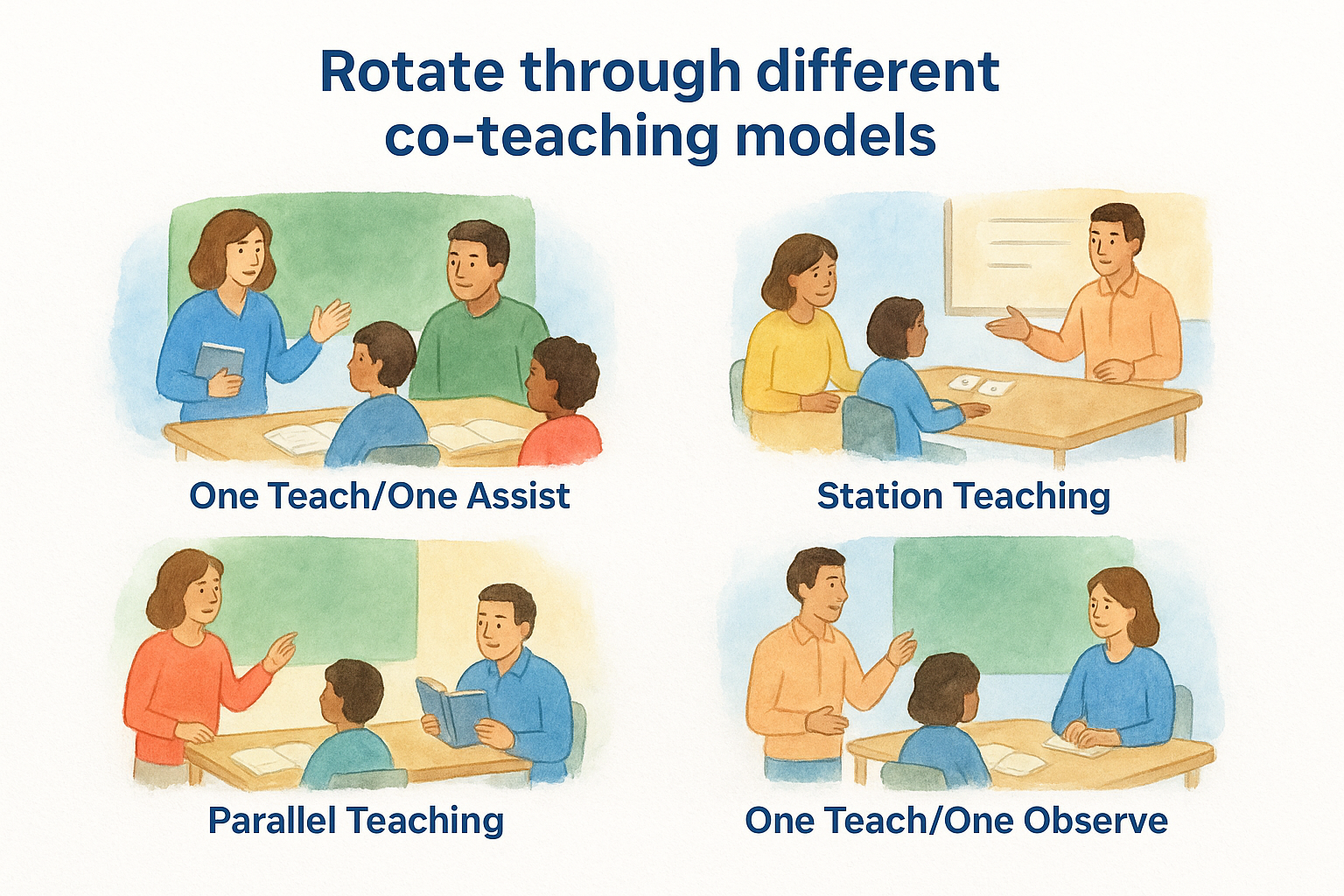
Most co-teaching pairs default to one model, usually one teach/one assist, and stay there all year because it’s the easiest to fall into. That’s a mistake. Co-teaching models like station teaching, parallel teaching, and alternative teaching each solve different classroom problems, and sticking to just one wastes the flexibility that having two adults in the room actually offers. Rotating through models is one of the most overlooked strategies for co teaching pairs looking to break out of a rut.
What it looks like in the classroom
On a Monday, you might split the class into two groups for parallel teaching, each teacher covering the same content to a smaller group so quieter students get more airtime. Wednesday might call for station teaching, with three rotating groups and one station running independently while both teachers lead small-group instruction. Thursday could be one teach/one observe, with one teacher delivering direct instruction while the other collects data on specific students for an upcoming IEP meeting.
Why this strategy works
Different lessons demand different structures, and no single model fits a research project, a test review, and a new-skill introduction equally well. Rotating models also keeps both teachers visibly active and prevents the "lead and helper" dynamic that creeps in when one approach becomes the permanent default.
The best co-teaching model is the one that matches today’s lesson, not the one you used yesterday.
Tips to make it stick
Build model selection into your planning routine so it doesn’t get skipped when time runs short.
- Match the model to the lesson goal, not to habit or comfort.
- Try one new model per week until both teachers feel confident with all six.
- Note which models work for which content in your shared planning document.
- Ask students informally which formats help them focus best.
5. Keep communication constant, not just scheduled
Your scheduled planning period covers lessons, but it won’t catch the small stuff that actually derails a school day, like a student who had a rough morning or a parent email that landed in one teacher’s inbox and not the other’s. Ongoing communication fills that gap. Without it, one teacher walks into class blind to something the other already knows, and students notice the disconnect immediately.
What it looks like in the classroom
Effective co-teaching pairs text between periods, leave sticky notes on shared desks, or keep a running note in their phones for anything that can’t wait until the next planning meeting. Before class starts, a thirty-second huddle covers who’s absent, who’s struggling, and what changed since yesterday. Neither teacher gets blindsided by a parent conference, a behavior incident, or a grading question because information moves both directions constantly, not just when the calendar says so.
Why this strategy works
Gaps in communication create the exact cracks that strategy one warned about. A teacher who’s out of the loop looks unprepared in front of students, even when it’s not their fault. Constant, informal communication keeps both partners equally informed and equally credible as authority figures in the room.
The partnership breaks down in the gaps between meetings, not during them.
Tips to make it stick
Informal habits work best when they’re low-effort enough to actually happen every day.
- Create a shared messaging thread just for quick, time-sensitive updates.
- Build a 30-second huddle into your routine before students enter the room.
- Copy each other on parent and IEP emails so nobody learns about a conversation secondhand.
- Flag urgent issues immediately, rather than saving them for the next scheduled planning session.
6. Design lessons with universal design for learning
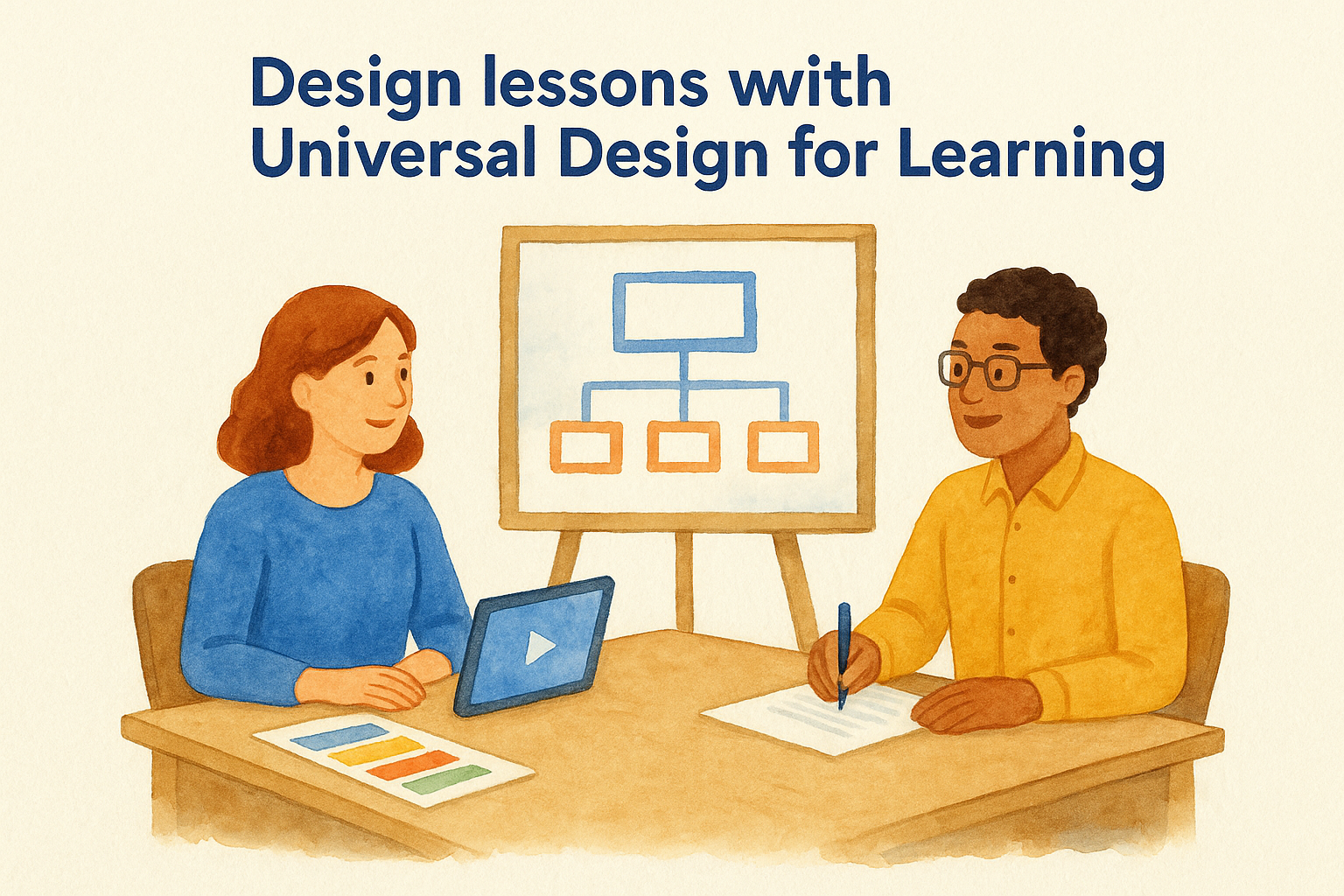
Two teachers in one room give you the horsepower to plan lessons that reach more learners than either of you could manage alone, so use it. Universal design for learning, or UDL, means building in multiple ways to access content, multiple ways to show understanding, and multiple ways to stay engaged, from the start rather than bolting on accommodations after the fact. This is one of the most practical co-teaching strategies because it turns your partnership into a planning advantage instead of just an extra set of hands during instruction.
What it looks like in the classroom
During a novel unit, one teacher might offer the text in audio form while the other prepares a graphic organizer for students who need a visual structure, and both options sit on the same table for any student to grab. Assessment looks flexible too: some students write an essay, others record a video response, others build a slideshow, all covering the same standard. Neither version is labeled as the "modified" one, which matters more than it sounds.
Why this strategy works
Planning through a UDL lens, as outlined by CAST’s UDL guidelines, removes the stigma of separate "special ed" materials because every student chooses from the same menu of options. It also spreads the planning workload naturally, since each teacher can own a different access point without one person carrying the entire differentiation burden.
Build flexibility into the lesson itself, and you stop scrambling to accommodate students after the plan is already set.
Tips to make it stick
UDL sticks best when it’s built into your planning template, not treated as an extra step.
- Add a UDL checklist to your shared planning document with columns for representation, action, and engagement.
- Divide access points by strength, letting each teacher design the options they’re most confident building.
- Offer choice in assessment format at least once per unit.
- Ask students which options they used, and adjust future lessons based on what actually got picked.
7. Let student data guide your grouping decisions
Guessing which students need reteaching, enrichment, or a completely different approach wastes the exact advantage co-teaching gives you. Data-driven grouping means pulling exit tickets, quiz scores, and quick formative checks before you decide who sits where tomorrow, instead of grouping by habit or by who happens to sit near each other. This is one of the more overlooked co-teaching techniques because it requires both teachers to actually look at the numbers together, not just teach and move on.
What it looks like in the classroom
After a Tuesday quiz, both teachers spend ten minutes sorting scores into three rough bands: students who need direct reteaching, students ready for practice, and students ready to extend the skill. Wednesday’s groups reflect that split exactly, with one teacher reteaching a small group at the back table while the other runs an extension activity for students who already showed mastery. Groups shift again the following week once new data comes in, so no student gets stuck in a low group by default.
Why this strategy works
Flexible, evidence-based grouping keeps instruction targeted instead of generic, and it prevents the common trap where the same five students always end up in intervention regardless of what the data actually shows. Sharing this analysis between two teachers also catches patterns one person might miss alone, like a student who’s strong on paper but struggles with verbal explanation.
Group by what the data says this week, not by what worked last month.
Tips to make it stick
Build a quick, repeatable routine so data review doesn’t become another task you skip when the week gets busy.
- Review one data point weekly, even if it’s just an exit ticket, rather than waiting for a formal assessment.
- Keep groups visibly temporary, so students understand placement can change.
- Split the analysis work, with one teacher sorting scores while the other plans the next day’s stations.
- Track movement between groups to confirm the system is actually working.
8. Reflect together and adjust your approach
Most co-teaching pairs reflect only when something goes wrong, which means you’re always reacting instead of improving. Regular reflection flips that pattern. It’s a short, honest conversation about what worked this week, what didn’t, and what you’ll change before the same lesson rolls around again next unit. Skipping this step means repeating the same mismatched pacing or awkward transition for an entire semester without either of you naming it out loud.
What it looks like in the classroom
Picture two teachers spending the last five minutes of Friday’s planning period asking each other three questions: what worked, what fell flat, and what needs adjusting for Monday. One might admit the station rotation ran too long, while the other flags that a student group needs re-sorting based on this week’s quiz scores. Neither treats the conversation as criticism. It’s a quick debrief, not a performance review, and it happens whether or not the week went smoothly.
Why this strategy works
Teaching pairs that never pause to reflect tend to repeat the same friction points without realizing a pattern exists. A structured debrief catches small issues, like one teacher consistently running out of time or one voice dominating whole-group instruction, before they calcify into habits neither of you likes. It also reinforces the shared vision from strategy one, since regular check-ins keep both teachers accountable to the same standards.
A partnership that never reflects just repeats its mistakes with more confidence.
Tips to make it stick
Keep the reflection short and consistent, or it’ll get skipped the moment the week gets busy.
- Set a recurring five-minute debrief at the end of each week, separate from lesson planning.
- Ask the same three questions every time: what worked, what didn’t, what changes next.
- Write down one adjustment per week and check whether it actually stuck.
- Treat feedback as data, not personal criticism, the same way you treat student scores.
9. Get administrative support and ongoing training
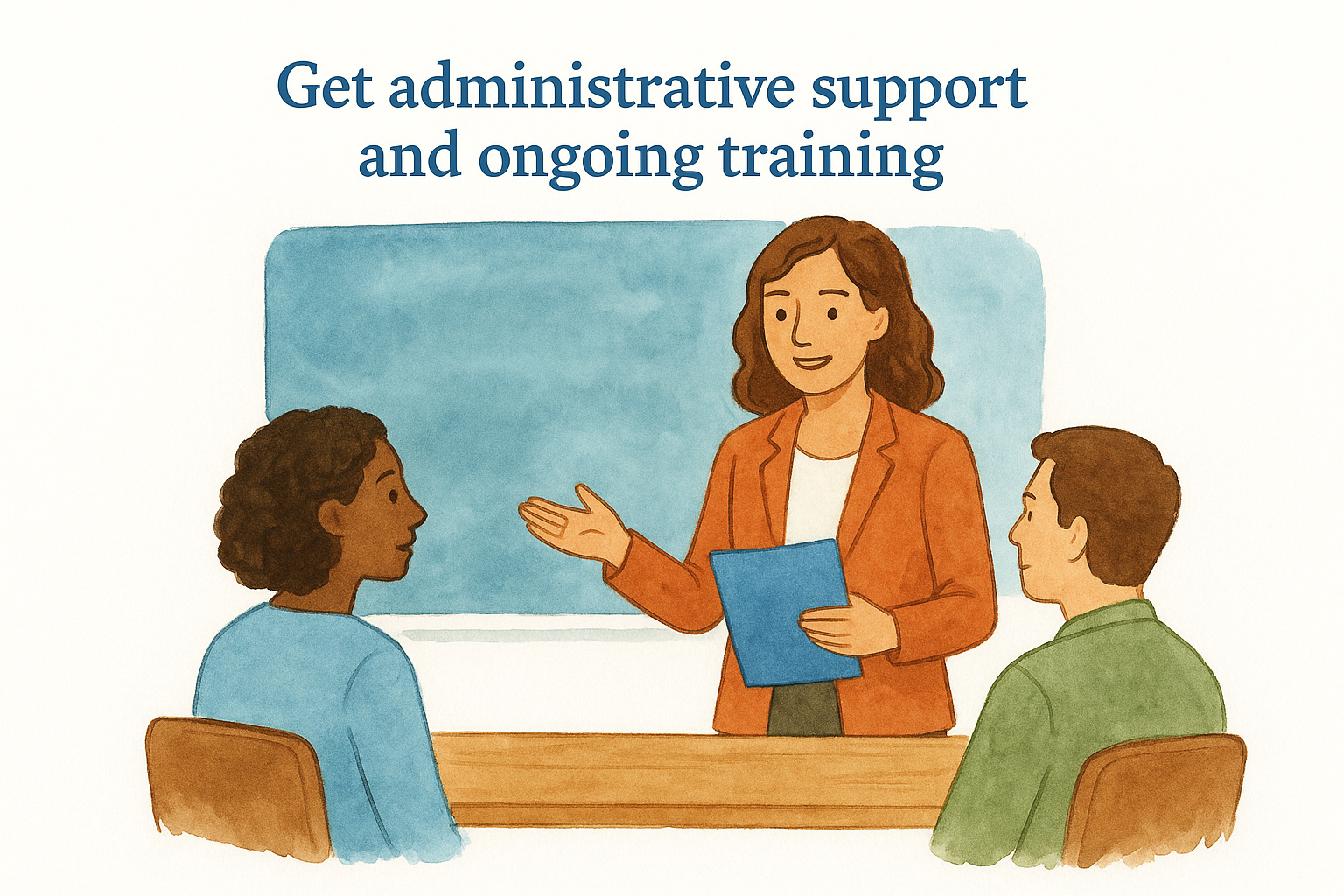
Even the best-matched co-teaching pair can’t fix a master schedule that pairs them for one period a week or a principal who treats co-teaching as an afterthought. Administrative support covers the practical stuff you can’t control alone: shared planning time built into the schedule, a manageable caseload, and access to training on the models covered in strategy four. Without that backing from above, everything else on this list gets harder to sustain past a few months.
What it looks like in the classroom
A well-supported co-teaching pair has planning periods scheduled together on purpose, not by accident, and a principal who checks in on the partnership the same way they’d check in on any other program. You’ll see both teachers attending the same professional development sessions on co-teaching, rather than one teacher learning a new strategy and trying to explain it to the other secondhand. Substitute coverage, room assignments, and class sizes all reflect the reality that two adults are sharing the instructional load, not just splitting a single teacher’s job in half.
Why this strategy works
Co-teaching pairs that lack administrative backing tend to burn out fast, since they’re managing classroom instruction and scheduling roadblocks at the same time. The Council for Exceptional Children points to administrative buy-in and sustained training as key factors separating co-teaching programs that last from ones that quietly dissolve after a year.
A co-teaching partnership can survive a rocky start, but it can’t survive a schedule that never gives it a chance.
Tips to make it stick
Advocate for support early, before scheduling decisions lock in for the year.
- Request shared planning time in writing before the master schedule finalizes.
- Ask for joint training sessions, not separate PD tracks for each teacher.
- Bring specific scheduling conflicts to administrators, not vague complaints.
- Document what’s working to justify continued support next year.
Finding your co-teaching rhythm
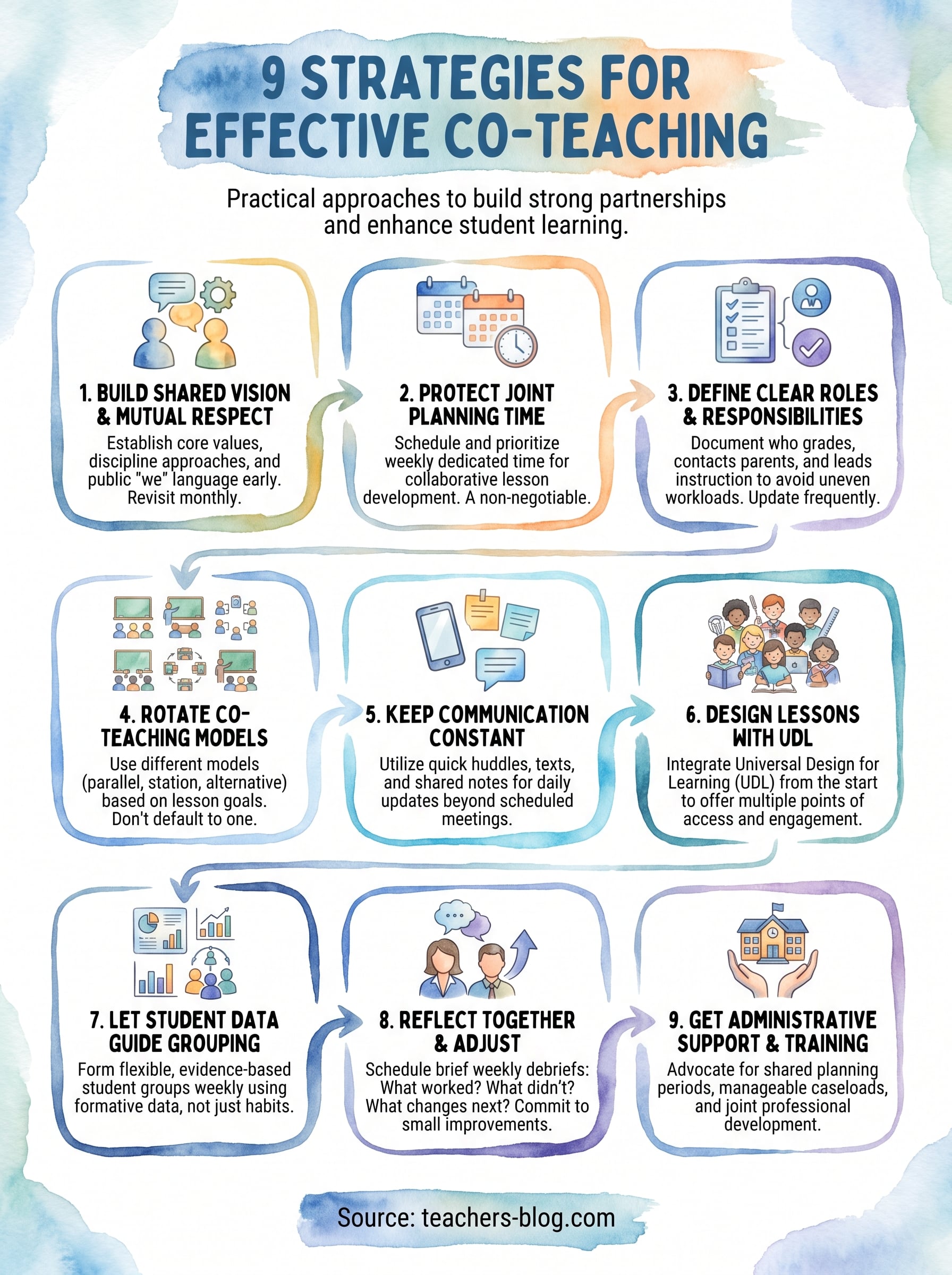
None of these nine strategies work in isolation. Shared vision means nothing without protected planning time, and rotating co-teaching models falls apart without honest reflection along the way. Strategies for co teaching only stick when you treat them as a system, not a checklist you tackle once and forget. Give it real time. Most partnerships need a full semester before the pacing, the roles, and the unspoken cues finally click into place.
Start small this week. Pick one strategy from this list, maybe the shared values conversation or a recurring five-minute debrief, and build it into your routine before adding another. Small consistent habits outlast ambitious overhauls that fizzle out by October. Your students will notice the difference long before you do, in fewer contradictions, tighter transitions, and two adults who actually look like partners.
For more classroom strategies, unit plans, and AI tools built for teachers juggling exactly this kind of workload, visit The Cautiously Optimistic Teacher and see what’s waiting in the archive.