Learned Helplessness: What It Is and How to Overcome It
You’ve seen it in your classroom: the student who says "I’m just bad at math" before even trying the problem, or who shuts down the moment an assignment looks hard. That’s not laziness. It’s learned helplessness, and it’s one of the most misunderstood behaviors in education today.
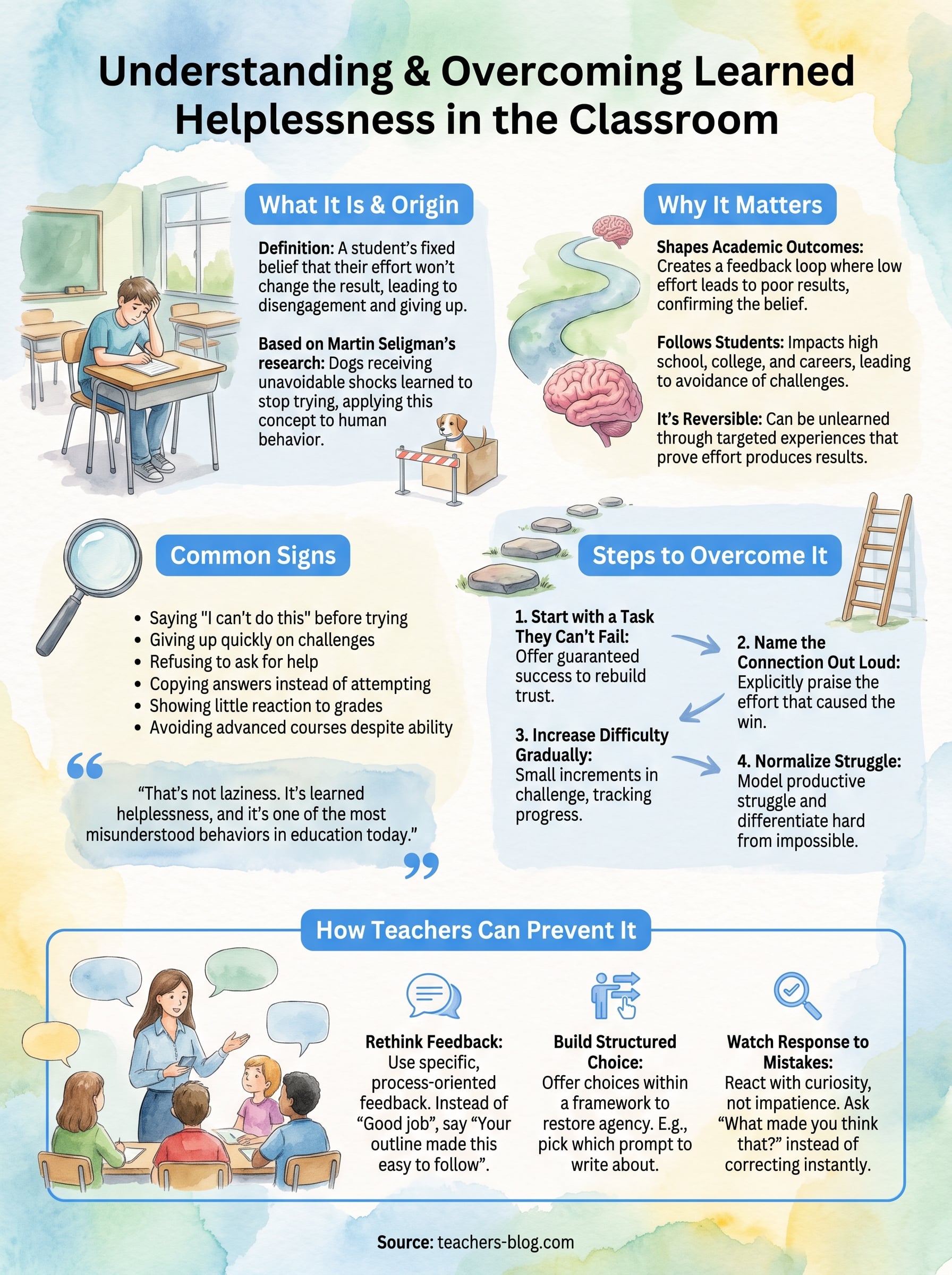
Learned helplessness happens when a student experiences repeated failure or lack of control over outcomes, and eventually stops trying altogether, even when success becomes possible. It shows up as giving up quickly, avoiding challenges, and a fixed belief that effort won’t change the result. Understanding the psychology behind it, from Martin Seligman’s original experiments to how it plays out in a real classroom, is the first step toward reversing it.
In this article, we’ll break down what learned helplessness actually looks like day to day, walk through the common causes and warning signs teachers should watch for, and share practical strategies you can use tomorrow to rebuild a student’s confidence. We’ll also connect this to growth mindset work, since the two are closely linked and often need to be addressed together for lasting change.
Why learned helplessness matters more than you think
Martin Seligman’s 1967 experiments with dogs laid the groundwork for this whole concept, and the findings still hold up decades later. Dogs that received unavoidable shocks eventually stopped trying to escape, even after researchers removed the barrier and escape became easy. The dogs had learned that their actions didn’t matter, so they quit acting. Seligman later applied this same framework to humans, and the parallel to classrooms is almost too on the nose. A student who bombs test after test despite studying, or who gets told they’re "just not a math person" enough times, reaches the same conclusion those dogs did: nothing I do changes the outcome. You can read more about Seligman’s original research through the American Psychological Association, which still cites this work as foundational to understanding depression and motivation.
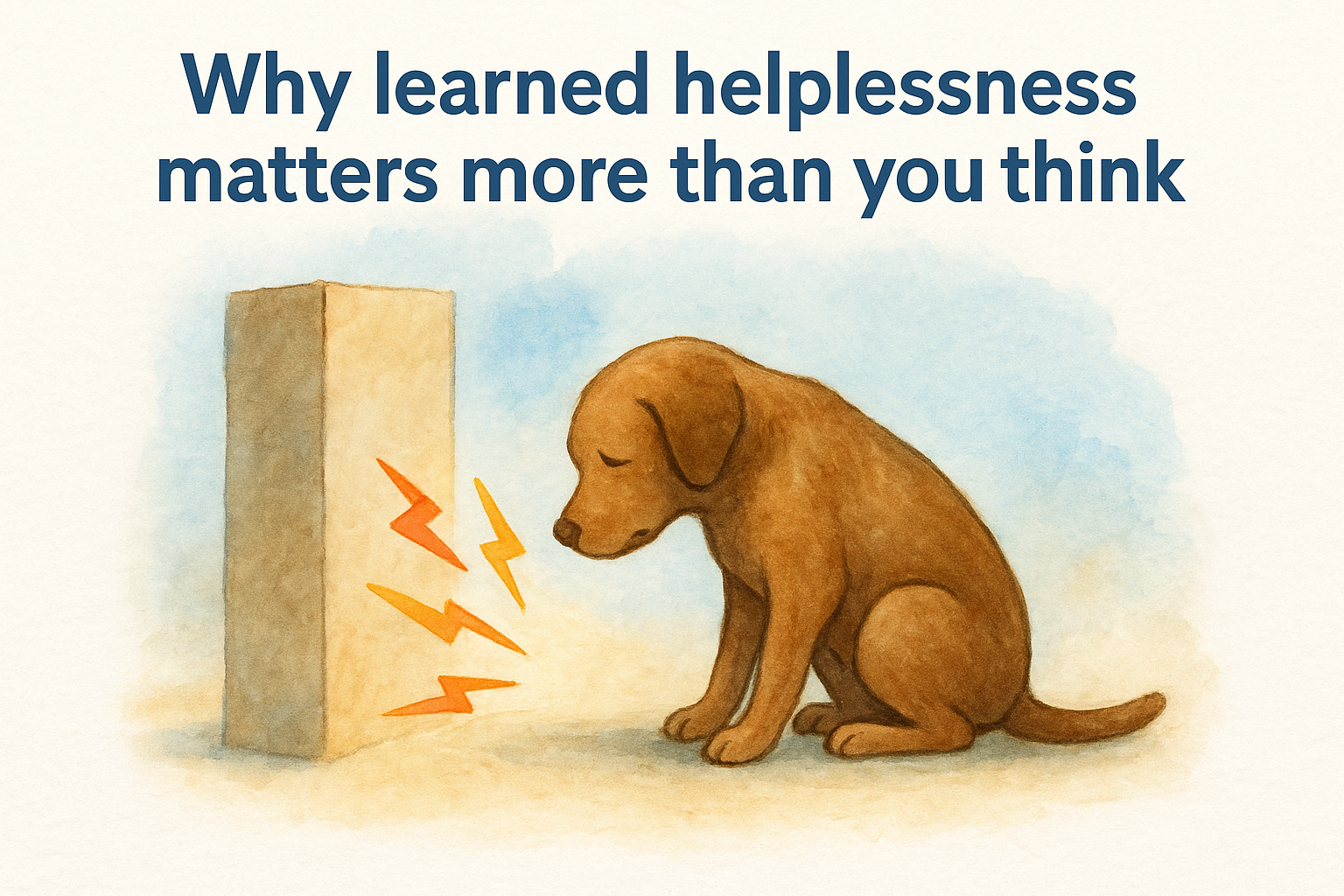
Learned helplessness isn’t about ability. It’s about a student’s belief that effort has stopped mattering.
It quietly shapes academic outcomes
Here’s what makes this pattern so dangerous: it doesn’t look like a crisis. It looks like disengagement, a shrug, a kid who’s "just not motivated." But academic motivation and learned helplessness are directly connected. Research consistently shows that students who believe their effort doesn’t influence results perform worse over time, not because they’re less capable, but because they stop trying in ways that would actually help them improve. This creates a feedback loop. Low effort leads to poor results, poor results confirm the belief that trying is pointless, and the cycle deepens with every graded assignment.
It follows students far beyond your classroom
Once this mindset takes hold in one subject, it tends to spread. A kid who feels helpless in math class often starts avoiding challenges in science, writing, even social situations. That’s because learned helplessness isn’t really about the subject matter. It’s about a student’s core belief in their own agency. Left unaddressed, this pattern follows kids into high school course selection, college applications, and eventually workplace behavior. Adults with a history of unaddressed learned helplessness are more likely to avoid promotions, skip difficult conversations, or stay in situations that don’t serve them, simply because some part of them still believes effort won’t change the outcome.
It’s reversible, and that’s the part that matters most
Despite how entrenched it can look, learned helplessness responds well to targeted intervention. Seligman himself spent much of his later career studying resilience training and how to "unlearn" helplessness, work that eventually became the foundation of positive psychology. The key insight for teachers is that this isn’t a fixed personality trait. It’s a learned response to a pattern of experiences, which means it can be unlearned through a different pattern of experiences. Every time a student tries something hard and sees their effort produce a real result, even a small one, you’re rewriting that internal narrative. This is exactly why catching the signs early and responding with the right strategies makes such a difference, both for how a student performs this year and for the beliefs they’ll carry into every classroom after yours.
Common signs and real-world examples of learned helplessness
Spotting learned helplessness early makes intervention much easier, but the signs often get mistaken for laziness or poor attitude. Recognizing the pattern is the first step, and once you know what to look for, you’ll start seeing it in students you might have overlooked before.
What it looks like day to day
A student experiencing learned helplessness rarely announces it outright. Instead, you’ll notice a cluster of behaviors that show up consistently across assignments and subjects:
- Saying "I can’t do this" before reading the full problem or instructions
- Giving up within seconds of hitting a difficult step
- Refusing to ask for help, because they’ve decided help won’t work either
- Copying answers instead of attempting the work themselves
- Showing little reaction to both good and bad grades, since neither feels earned
- Avoiding advanced or elective courses despite showing ability in that subject
If a student stops trying before they even start, that’s not defiance. That’s helplessness talking.
Real classroom examples
Brianna, a 9th grader, used to raise her hand constantly in math. After three straight quarters of failing grades despite tutoring, she stopped participating entirely. Her teacher assumed she’d checked out. In reality, Brianna had concluded that effort and outcome had no connection for her in that class, so she quit trying to find one.
Another common version: a student who excels in English but freezes during science labs. The fixed mindset here isn’t about intelligence in general. It’s subject-specific, built from a string of experiences where nothing they tried seemed to move the needle. You’ll also see it in students who once loved reading aloud but now refuse, because a single embarrassing correction in third grade convinced them they’re "bad readers," a belief no amount of contrary evidence has since undone.
Why these examples matter
Each of these students has the capability to improve, but capability isn’t the problem. Their belief system is. That distinction matters because it changes the entire approach: you’re not remediating a skill gap, you’re rebuilding trust between effort and result, one small win at a time.
How to overcome learned helplessness step by step
Breaking learned helplessness takes more than a pep talk. You need a repeatable process that rebuilds the connection between effort and outcome, one small win at a time. Below is a sequence you can apply with an individual student starting this week.
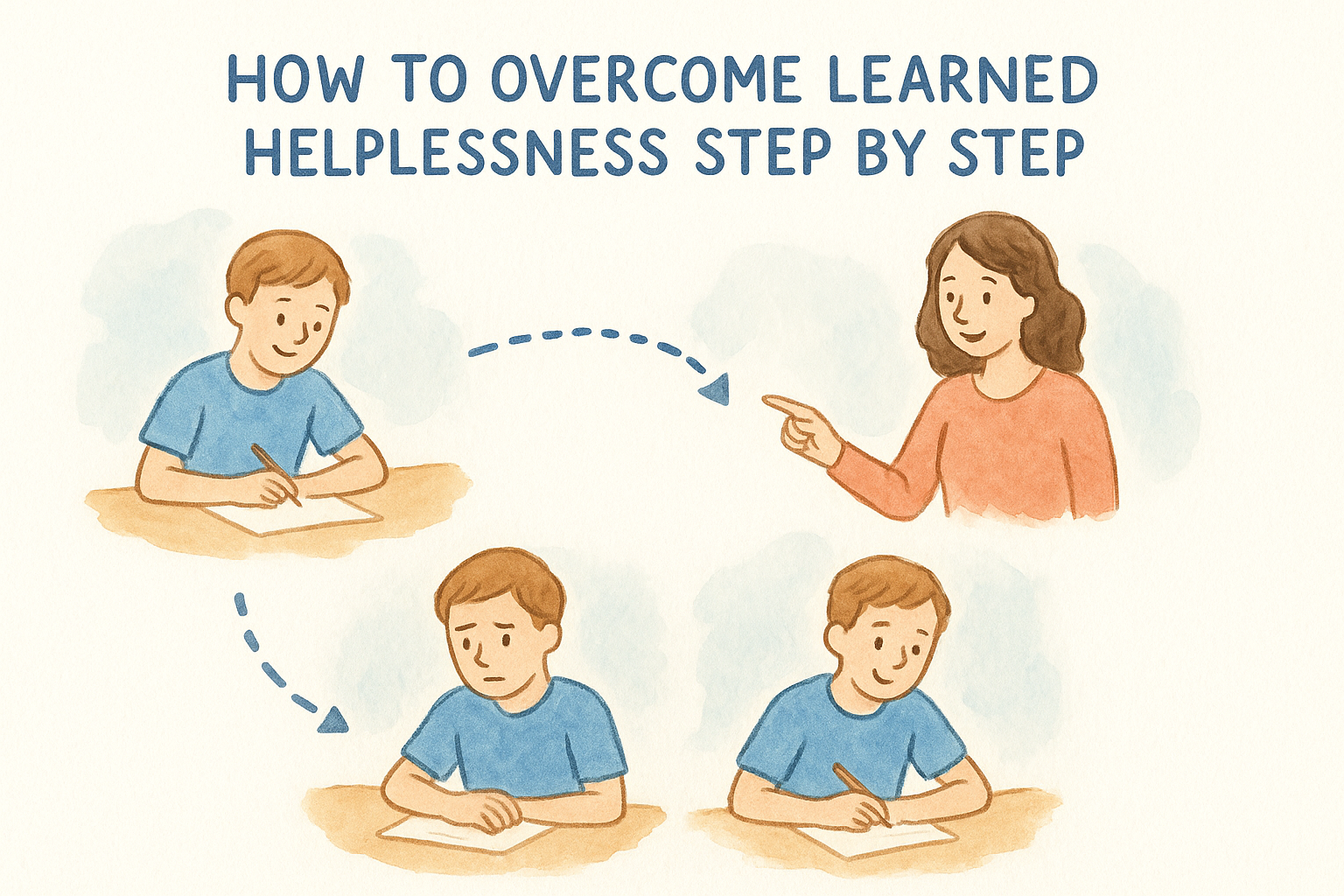
Start with a task they can’t fail
Give the student something slightly below their current level, not their grade level. The goal isn’t rigor right now, it’s proof that effort produces results. Guaranteed success at this stage matters more than challenge, because the student needs at least one experience where trying actually worked before they’ll risk trying again on something harder.
Name the connection out loud
When a student succeeds, don’t just praise the outcome. Point directly at the cause: "You checked your work twice, and that’s why you caught the mistake." This step is where attribution retraining happens, a technique researchers have found effective at reversing the helplessness pattern because it forces students to notice their own agency instead of crediting luck or the easiness of the task.
The fastest way to rebuild motivation is to make the link between effort and result impossible to ignore.
Increase difficulty gradually
Once a student trusts that effort matters on easy tasks, raise the bar in small increments. Track this progression so both you and the student can see it:
- Task slightly below current level, guaranteed success
- Task at current level, high likelihood of success
- Task slightly above current level, with scaffolded support
- Task at grade level, minimal support
- Independent work at grade level
Moving too fast at any stage resets the cycle, so resist the urge to skip steps even when a student seems ready.
Normalize struggle without normalizing giving up
Teach the difference between a problem being hard and a problem being impossible. Students with learned helplessness often can’t tell the two apart, so explicit modeling helps: talk through your own thinking when you hit a hard problem, including the part where you feel like quitting but keep going anyway. Watching an adult struggle productively, rather than just succeed effortlessly, gives students a script they can copy the next time they want to give up before they’ve really started.
How teachers can prevent learned helplessness in the classroom
Prevention beats intervention every time, and most of the classroom habits that cause learned helplessness are ones you can change without a special program or budget line. Small shifts in how you give feedback, structure tasks, and respond to mistakes determine whether a struggling student develops resilience or gives up. The goal isn’t to remove all difficulty from your classroom. It’s to make sure every student experiences enough wins to trust that their effort still counts.
Rethink how you give feedback
Generic praise like "good job" teaches nothing about cause and effect. Specific feedback that names the exact behavior that led to success helps students build an internal map between what they did and what happened. Try swapping vague comments for language that points directly at the process:
- Instead of "Nice work," say "Your outline made this essay easy to follow."
- Instead of "Try harder," say "Rereading the second paragraph will show you where the argument breaks down."
- Instead of marking an answer wrong with no comment, show which step introduced the error.
Feedback that names the cause teaches a student they have control. Feedback that only judges the result teaches them they don’t.
Build in structured choice
Students who feel they have zero control over their work are far more prone to shutting down. Offering structured choice, like picking which of three prompts to write about or choosing the order they complete tasks, restores a sense of agency without sacrificing rigor. This doesn’t mean removing standards. It means giving students small decisions within a fixed framework, which is often enough to interrupt the belief that nothing they do matters.
Watch your response to mistakes
How you react to a wrong answer in front of the class shapes whether students risk trying again. Publicly correcting a mistake with impatience, even unintentionally, teaches the whole room that errors are dangerous. Responding instead with curiosity, asking "What made you think that?" before explaining the right answer, keeps the risk of trying low. Over a school year, this consistency does more to prevent learned helplessness than any single lesson or intervention could.
Taking the first step toward change
Learned helplessness isn’t a character flaw, and it isn’t permanent. It’s a pattern built from repeated experiences where effort seemed to go nowhere, which means it can be rebuilt with a new pattern of experiences that prove the opposite. You don’t need a special curriculum to start. You need one task a struggling student can’t fail, feedback that names exactly what they did right, and enough patience to let that trust rebuild in small steps rather than one dramatic turnaround.
Start with a single student this week. Pick one who’s shut down, give them a task set slightly below their current level, and name the cause when they succeed. That’s the whole first move, and it’s often enough to crack the cycle open. For more classroom-tested strategies on building student motivation and a lasting growth mindset, visit The Cautiously Optimistic Teacher for resources you can put to use tomorrow morning.