UDL Multiple Means of Representation: What It Is, With Examples
You explain a concept one way, and half your class still looks lost. That’s not a teaching failure, it’s a representation problem, and UDL multiple means of representation is the framework built to solve exactly this. It’s one of the three core principles of Universal Design for Learning, and it asks a simple question: are you giving students more than one way to access the content?
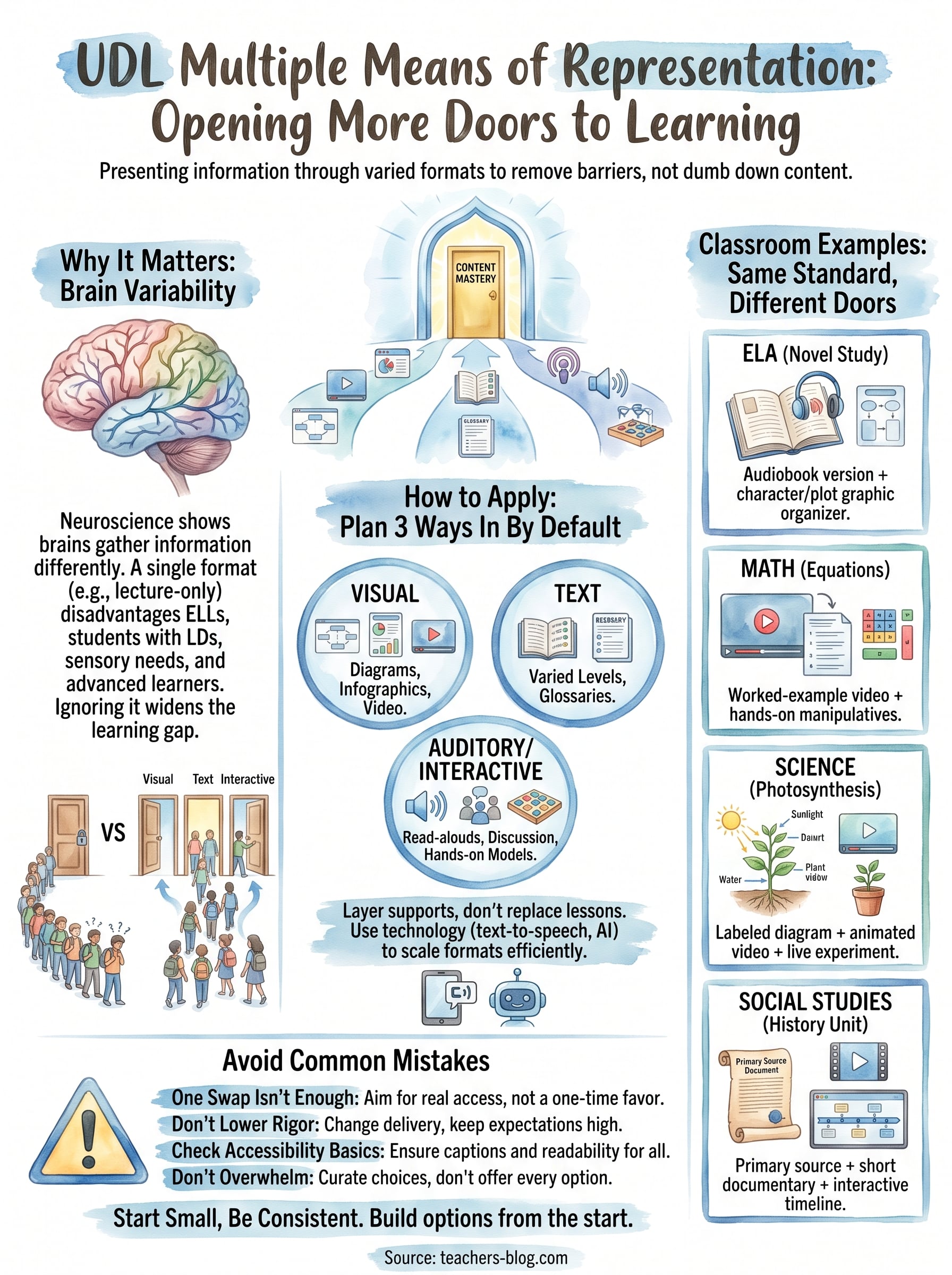
At its core, this principle means presenting information through varied formats like text, audio, visuals, and hands-on models, so students with different learning needs, language backgrounds, or processing styles can actually reach the material. It’s not about dumbing down your lesson. It’s about removing barriers before they cost you instructional time and student confidence.
In this article, you’ll get a clear breakdown of what multiple means of representation actually looks like in a real classroom, not just in theory. We’ll cover concrete examples across subjects, practical strategies you can use tomorrow, and how this principle fits into the bigger UDL picture. If you’ve ever wondered whether your lesson delivery is leaving students behind, this is where you start fixing it.
Why multiple means of representation matters for your students
When you rely on a single format, you’re betting that every student’s brain processes information the same way. It doesn’t. Neuroscience research behind Universal Design for Learning shows that students use different "recognition networks" in the brain to gather facts and ideas, and those networks vary from kid to kid based on language, disability, prior knowledge, and even mood on a given day. A lecture-only lesson works great for auditory processors and falls apart for a student with an auditory processing disorder or a kid who’s still building English vocabulary. This isn’t a niche accommodation issue. It’s the default reality of every classroom you’ll ever teach.
The students who need it most
Some students hit representation barriers harder than others, and you can usually name them before the lesson even starts. Consider who’s sitting in your room right now:
- English language learners who need visual and contextual support to access grade-level content
- Students with learning disabilities like dyslexia, who struggle with dense text but thrive with audio or graphic organizers
- Students with sensory or physical disabilities, including hearing or vision impairments
- Struggling readers who understand concepts fine once they’re not fighting the text itself
- Advanced learners who get bored with one entry point and disengage from lack of challenge
Every one of these students can access the same content, the same standards, the same rigor. They just need a different door into it.
What happens when you skip it
Ignoring representation doesn’t just inconvenience a few students, it actively widens the gap between who succeeds and who doesn’t. Picture a science lesson on photosynthesis taught only through a textbook chapter. Your strong readers move forward. Everyone else spends the period decoding vocabulary instead of learning the actual concept. By the time the unit test rolls around, you’re not measuring science knowledge anymore, you’re measuring reading stamina. That’s a hidden bias baked into your instruction, and it shows up in your data as an achievement gap that looks like a learning problem when it’s really a delivery problem.
If a student can’t access how you’re presenting information, you’re not testing their knowledge, you’re testing their ability to work around your teaching.
The engagement payoff
Representation also drives something teachers care about daily: engagement. Students disengage fast when content feels inaccessible, and disengagement snowballs into behavior issues, missed work, and the kind of blank stares that make you repeat yourself for the third time. Offering multiple entry points to the same material keeps more students in the game longer. A student who can watch a short video, read a summarized handout, or examine a diagram alongside your explanation has three chances to connect with the content instead of one. That redundancy isn’t wasted time, it’s insurance against the moment your primary format doesn’t land.
It’s not extra work, it’s front-loaded work
Teachers often assume representation means building three separate lessons. It doesn’t. Most of the heavy lifting happens once, during planning, when you build in flexible formats from the start rather than scrambling to differentiate after a lesson flops. The Universal Design for Learning framework, developed by CAST, was built on exactly this premise: design for variability up front instead of retrofitting accommodations later. Get this right, and you’ll spend less time reteaching and more time moving your class forward together.
How to apply multiple means of representation in your lessons
Applying UDL multiple means of representation starts before you ever open a slide deck. Look at your learning objective first, then ask how many different ways a student could reach that objective. If your goal is "students understand the causes of World War I," the format is negotiable. The content mastery isn’t. Separate the two, and you’ll stop treating your original lesson plan as the only valid path.
Build in three access points by default
Giving one alternative format when a student struggles is reactive. Building in options from the start is proactive, and it’s the difference UDL is designed to create. A practical rule: plan every core lesson with at least three ways in, so no single barrier stops learning cold.
- A visual option: diagrams, infographics, slides, or video
- A text option: readings at varied lexile levels or with embedded glossaries
- An auditory or interactive option: read-alouds, podcasts, discussion, or hands-on modeling
Plan for three ways in, not one way that sometimes needs backup.
Layer supports instead of replacing your lesson
Most teachers overestimate how much extra material this requires. You’re not writing three separate lessons, you’re layering supports around the one you already have. Pair your lecture with a visual anchor chart students can reference later. Add closed captions to any video you show, which helps English language learners and students with hearing differences without singling anyone out. Chunk dense text into smaller sections with headings, and read the trickiest paragraph aloud before students tackle it independently. Each layer costs you a few minutes of prep and pays off in fewer confused hands raised mid-lesson.
Use technology to multiply formats without multiplying your workload
Technology makes this principle far more sustainable than it was a decade ago. Text-to-speech tools convert any reading into audio in seconds. Speech-to-text lets students who struggle with writing get ideas down verbally first. AI tools can help too. Generating a simplified summary, a set of guiding questions, or a visual outline from the same source material takes minutes instead of an entire planning period. The U.S. Department of Education’s Office of Educational Technology has pushed districts toward exactly this kind of flexible, tech-supported access for years, and it’s worth building that habit now rather than waiting until a student’s IEP forces the issue.
Classroom examples of multiple means of representation
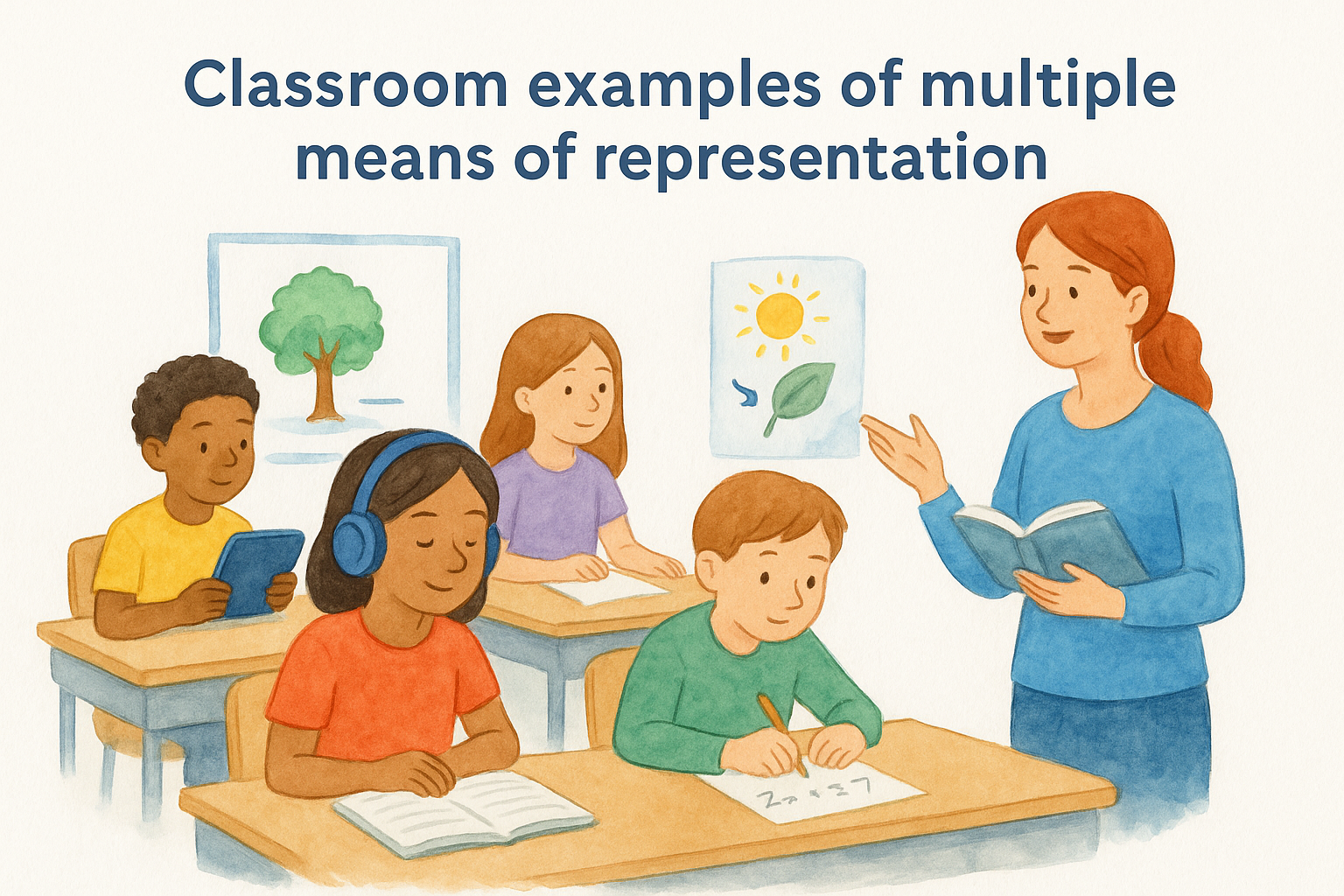
Seeing this principle in a real lesson plan makes it click faster than any definition. Below are examples from core subjects that show how the same standard can reach students through different formats without watering down the content.
English Language Arts
Teaching To Kill a Mockingbird doesn’t have to mean cover-to-cover silent reading for every student. Pair the novel with an audiobook version for students who process language better by ear, and supplement dense courtroom chapters with a simplified summary or graphic organizer that tracks characters and plot. Students still analyze the same themes and write the same essay. They just get there through a format that matches how their brain takes in information.
Math
A lesson on solving equations can include a worked-example video, a printed step-by-step guide, and a hands-on manipulative like algebra tiles for students who need to physically move pieces to understand the logic. Some students grasp the concept the moment they see it modeled visually; others need to touch it before it sticks.
The goal isn’t three lessons, it’s three doors into the same room.
Science
Explaining photosynthesis works better with a labeled diagram, a short animated video showing the process in motion, and a live plant experiment students can observe over a week. Reading a textbook page is one entry point, not the only one. Layering in a visual and a hands-on option means your English language learners and your struggling readers aren’t stuck decoding vocabulary before they even reach the science.
Social Studies
A unit on the causes of World War I can combine a primary source document, a short documentary clip, and an interactive timeline students build themselves. Comparing formats side by side helps you see how quickly representation options multiply without extra planning time:
| Format | Best For | Quick Prep Tip |
|---|---|---|
| Text/reading | Independent processors, advanced readers | Chunk into sections with headings |
| Video/visual | Visual learners, ELLs | Add captions automatically |
| Audio | Auditory processors, struggling readers | Use text-to-speech tools |
| Hands-on/interactive | Kinesthetic learners | Reuse manipulatives across units |
Notice that none of these examples require rewriting your curriculum. You’re reformatting existing content, not creating new material from scratch. That distinction is what makes multiple means of representation sustainable across a full school year instead of a one-off lesson you never repeat.
Common mistakes that undermine representation efforts
Even teachers who genuinely believe in UDL multiple means of representation trip over the same handful of mistakes. Knowing them ahead of time saves you from building habits that look inclusive on paper but fail students in practice.
Treating one format swap as "done"
Many teachers add a single video or one audio option and consider the job finished. That’s not multiple means of representation, that’s a single substitution. Real access means students consistently have more than one path available, not a one-time alternative you offer when someone complains. If your "backup" format only appears once a semester, it isn’t a system, it’s a favor.
Confusing representation with lowering rigor
Some educators assume that offering a simplified text or a visual summary means watering down the standard. It doesn’t. The content mastery stays identical across formats; only the delivery changes. A student who watches a video on cell division should walk away with the same depth of understanding as the student who read the textbook chapter. If your alternative format skips content instead of reformatting it, you’ve created a separate, weaker lesson, not a representation option.
Changing the format is not the same as changing the expectation.
Ignoring accessibility basics
Adding video without captions, using color-coded charts that colorblind students can’t read, or handing out scanned text that screen readers can’t process, these gaps undercut your effort before it starts. Quick checks catch most of this:
- Do videos have accurate captions, not just auto-generated guesses?
- Do handouts use enough color contrast and avoid color as the only signal?
- Is digital text compatible with screen readers and text-to-speech tools?
- Are fonts and spacing readable for students with visual processing differences?
Skipping these details means your extra formats exclude the very students they were meant to help.
Overloading students with too many options at once
More isn’t automatically better. Handing a student five formats for the same concept can overwhelm them instead of helping, especially students who already struggle with executive function or decision fatigue. Curated choice works better than an open buffet. Offer two or three well-chosen formats rather than every option you can think of, and let students settle into what works instead of shopping through a pile of alternatives every class period.
Forgetting to check if it’s actually working
Finally, teachers sometimes roll out multiple formats and never circle back to see if students are using them effectively. A quick exit ticket, a show of hands, or a glance at which resources students actually open tells you more than assuming your setup is working. Representation without feedback loops is just guesswork with extra steps.
Making representation part of your everyday teaching
Multiple means of representation isn’t a one-time overhaul, it’s a habit you build lesson by lesson. Start small: pick one unit and add a second format to whatever you’re already teaching. A captioned video here, a graphic organizer there. You don’t need to rebuild your curriculum to give students real access to it.
What matters most is consistency. Students shouldn’t have to wait for a struggle or an IEP meeting before they get a format that works for them. Build the options in from the start, check whether they’re actually helping, and adjust as you go. That’s the whole framework in practice: fewer barriers, more doors in.
If you want ready-made tools that make this easier, from worksheet generators to differentiated unit plans, explore the resources at The Cautiously Optimistic Teacher and start layering representation into your lessons this week.