
What Is Universal Design for Learning? A Teacher’s Guide
You have 28 students, five IEPs, three English language learners, and one lesson plan. Something has to bend, and it shouldn’t always be your standards. What is Universal Design for Learning, and why do so many veteran teachers swear by it? At its core, UDL is a teaching framework built on a simple idea: design lessons flexibly from the start instead of retrofitting them for struggling learners after the fact.
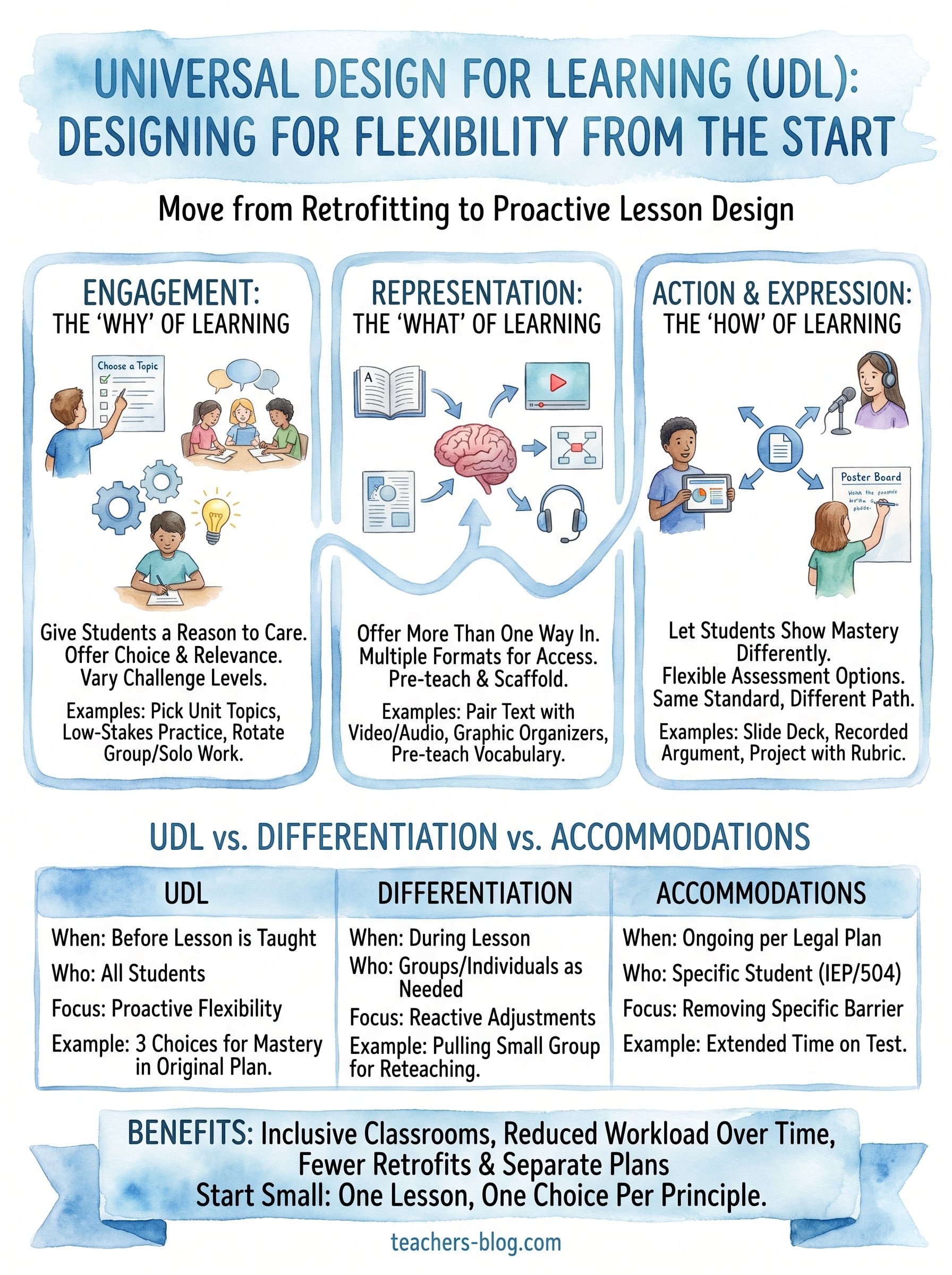
UDL rests on three core principles, engagement, representation, and action and expression, each addressing a different piece of how students take in and show learning. Rather than a single script to follow, it’s a set of guardrails that push you to offer choices: multiple ways to access content, multiple ways to demonstrate mastery, and multiple ways to stay motivated. Applied well, it reduces the need for separate accommodations because the lesson already works for more learners.
In this guide, you’ll get a plain-language breakdown of each principle, real classroom examples, and practical starting points you can use this week, no full curriculum overhaul required.
Why universal design for learning matters in today’s classroom
Walk into any classroom in 2026 and you’ll find a mix of learners that would have seemed unusual twenty years ago. Inclusive classrooms are now the default, not the exception. Students with IEPs and 504 plans sit next to English language learners, gifted kids who finish early and get bored, and quiet strugglers who never raise their hands to ask for help. UDL exists because a single lesson delivered one way, one pace, one format, simply can’t reach all of them. The framework grew out of research from CAST (Center for Applied Special Technology), which studied how the brain processes information and found that learner variability is the rule, not the exception.
The legal and practical push behind UDL
Schools aren’t adopting UDL out of trend-chasing. Federal policy has pushed it forward for over a decade. The Every Student Succeeds Act (ESSA) explicitly names Universal Design for Learning as an approach states can use to meet accountability goals, and IDEA requires that students with disabilities get access to the general curriculum, not a watered-down version of it. That means UDL isn’t just a nice-to-have strategy for differentiation-minded teachers. It’s increasingly baked into how districts write curriculum guidelines and evaluate instruction.
UDL exists because no single lesson format can reach every learner in a room of 28 different brains.
Beyond the legal mandate, there’s a practical reason UDL sticks: it cuts your workload over time. Building flexibility into the original lesson means you spend less time afterward writing individual accommodation plans, retrofitting worksheets, or creating parallel versions of the same assignment for different students. You do the flexible design work once, upfront, and it pays off every time you teach that lesson again.
What happens without it
Without UDL, the default classroom model assumes an "average" student, one who reads at grade level, sits still for 45 minutes, and shows understanding best through a written test. That student is rare. Traditional lesson design quietly sorts students into those who can keep up and those who can’t, then treats the second group as a problem to solve after the fact through pull-out services or modified assignments. That approach isn’t just inefficient, it can be demoralizing for kids who spend years being told they need something "extra" just to access what everyone else gets by default.
The classroom makeup has changed
Consider what a typical secondary classroom looks like today compared to a generation ago. The numbers tell the story clearly.
| Classroom factor | Then (roughly 1995) | Now |
|---|---|---|
| Students with identified disabilities | About 11% of enrollment | About 15% of enrollment (NCES data) |
| English language learners | Concentrated in a few districts | Present in nearly every district nationwide |
| Access to devices/technology | Rare, computer lab only | 1:1 devices common in many schools |
| Expectation for inclusion | Separate special education classrooms common | Inclusive general education classrooms standard |
That shift alone explains why the old model of "teach to the middle and remediate the rest" doesn’t hold up anymore. Learner variability isn’t a special education issue you hand off to a resource teacher. It’s a general education reality that shows up in every single period of your day.
Zoom out, and the case for UDL becomes less about compliance and more about basic classroom math. When you design for flexibility from the start, fewer students fall through the cracks, fewer parents call asking why their kid is falling behind, and you spend less energy managing behavior that often stems from frustration or disengagement rather than defiance. UDL isn’t a favor you do for a handful of struggling students. It’s a structural fix that makes the whole room work better, which is exactly why it’s worth understanding the mechanics behind it before you try to apply it.
How to apply the three UDL principles in your lessons
Each UDL principle answers a different question about how students learn: why they engage, what they perceive, and how they show what they know. CAST’s framework ties these to the brain’s affective, recognition, and strategic networks, but you don’t need the neuroscience to use them well. You just need to build choice into each stage of a lesson, from the hook at the start to the assessment at the end.
Engagement: give students a reason to care
Start with why students would want to do the work at all. Student motivation drops fast when every assignment looks the same, week after week. Offer choice in how students approach a task, connect it to something relevant to their lives, and vary the level of challenge so kids aren’t bored or drowning.
- Let students pick a topic within a unit theme instead of assigning one text to everyone
- Build in low-stakes practice before graded work so mistakes feel safer
- Rotate group work, independent work, and partner work across the week
Representation: offer more than one way in
This principle covers how students take in new information. Multiple representation formats matter because reading ability, background knowledge, and language proficiency vary wildly in the same room. A single textbook chapter locks out kids who need audio, visuals, or pre-taught vocabulary to access the same content.
If a student can’t access the content, they can’t be expected to master it, no matter how clear your lecture was.
Pair written text with a short video or diagram, pre-teach key vocabulary before a reading, and provide notes or graphic organizers alongside verbal instruction. None of that waters down the material. It just opens more doors to it.
Action and expression: let students show mastery differently
The last principle governs how students demonstrate what they’ve learned. Flexible assessment options don’t mean lowering the bar, they mean measuring the same standard through different formats. A student who struggles to write a five-paragraph essay might explain the same argument clearly in a recorded response or a slideshow.
| Traditional format | UDL alternative |
|---|---|
| Written essay | Recorded oral argument or podcast |
| In-class timed test | Take-home project with rubric |
| Poster board | Slide deck or short video |
| Handwritten notes | Typed notes with speech-to-text option |
Start small. Pick one lesson this week and add one option to each principle, not a full overhaul. That’s how UDL actually sticks in a real classroom instead of staying a theory on a PD slide.
Universal design for learning in action: real classroom examples
Theory only gets you so far. Seeing UDL show up in an actual lesson plan makes the framework click in a way that reading definitions never does. Real classroom examples below cover three subjects and three grade bands, but the pattern underneath each one is the same: build in options before you teach, not after a student struggles.
A middle school science lab
Before a photosynthesis lab, a seventh-grade teacher records a two-minute video walking through the steps, posts written instructions with labeled diagrams, and sets up the actual lab station as a third option. Multiple entry points mean a student with a reading disability watches the video twice, an English language learner follows the labeled diagram, and everyone ends up at the same lab table doing the same experiment. For the write-up, students choose between a lab report, a labeled diagram with captions, or a short recorded explanation of what happened and why.
A high school English unit
Instead of assigning one novel to the whole class, a tenth-grade teacher offers three books at different reading levels, all built around the same theme of identity and belonging. Choice-based reading units like this let every student engage with grade-level thinking even if their decoding skills differ. For the final assessment, students can write a traditional essay, record a video essay, or build an annotated slide deck, but every option gets graded against the identical rubric measuring argument, evidence, and analysis. The standard doesn’t move. The path to it does.
The standard stays the same across every format, only the path students take to reach it changes.
An elementary math lesson
A third-grade teacher introducing multiplication skips the single worked example on the board and instead sets up three stations: one with manipulatives like counters and arrays, one with a short animated video, and one with a worksheet showing the standard algorithm step by step. Hands-on math stations let kinetic learners build understanding with objects while visual learners watch the pattern unfold on screen. Students rotate through all three over the week, which also means struggling learners get repeated exposure to the same concept through different channels instead of one shot at one method.
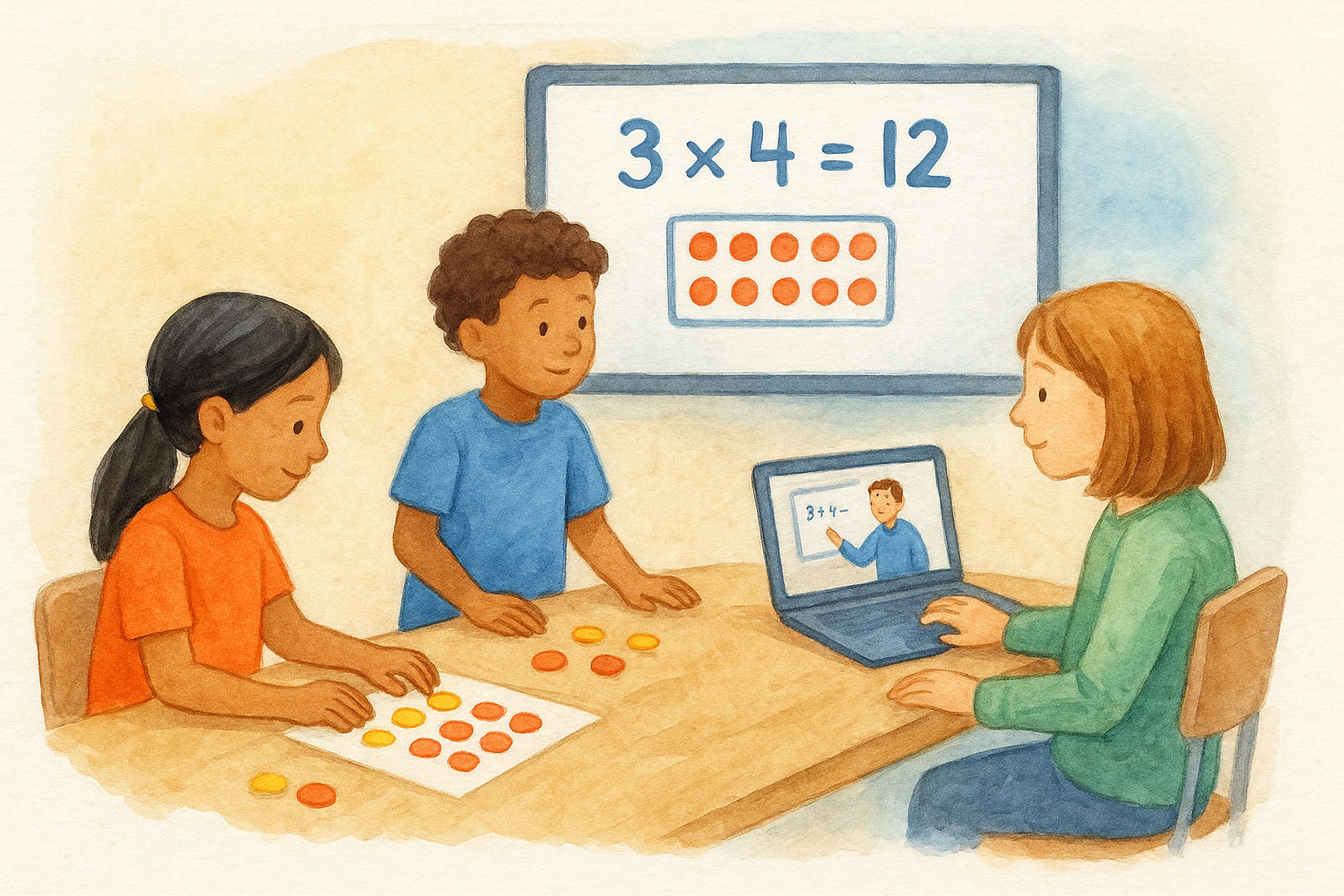
Notice what none of these examples require: a separate lesson plan for five different students, a pull-out session, or an aide standing next to one child all period. The flexibility lives in the original design, which is the entire point of UDL and the piece most teachers underestimate until they try it themselves.
UDL vs. differentiation and accommodations: what’s the difference
Teachers often use UDL, differentiation, and accommodations interchangeably, and that mix-up causes real confusion in staff meetings and IEP discussions. Distinct frameworks actually serve different purposes, even though they overlap in practice. Knowing which one you’re using, and when, changes how you plan a lesson and how you talk about it with colleagues, parents, and administrators.
Differentiation happens during the lesson
Differentiation means adjusting instruction after you’ve already planned the lesson, usually in response to how students are performing in real time. Reactive adjustments like pulling a small group for reteaching, giving an advanced student a harder text, or shortening an assignment for a struggling reader all count as differentiation. It’s a valuable skill, but it depends on you noticing a gap and fixing it on the fly, lesson by lesson, student by student.
Accommodations target individual students
Accommodations are formal, individualized changes tied to a specific student’s IEP or 504 plan, things like extended time, a scribe, or preferential seating. Legal accommodations exist to remove a specific barrier for a specific student, and they’re required by law once documented. They don’t change the lesson design itself, they change how one student accesses it.
UDL builds flexibility into the lesson for everyone; accommodations bolt flexibility onto the lesson for one student.
Where UDL fits differently
UDL sits earlier in the process than either of these. Instead of reacting mid-lesson or adjusting for one student’s documented need, you build multiple pathways into the original design before you teach it at all. Proactive lesson design means fewer students need an individual fix later, because the lesson already offers choices in how they engage, take in information, and show what they know.
| Approach | When it happens | Who it targets | Example |
|---|---|---|---|
| UDL | Before the lesson is taught | All students | Offering three ways to demonstrate mastery from the start |
| Differentiation | During the lesson | Groups or individuals, as needed | Pulling a small group for extra support mid-activity |
| Accommodations | Ongoing, per legal plan | One specific student | Extended time on a test per an IEP |
Grasping this distinction matters because it changes your planning habits. When you design with UDL first, differentiation becomes the exception you use for the few students who still need something extra, not the daily scramble it often turns into when lessons are built for one type of learner by default.
Common challenges and criticisms of UDL
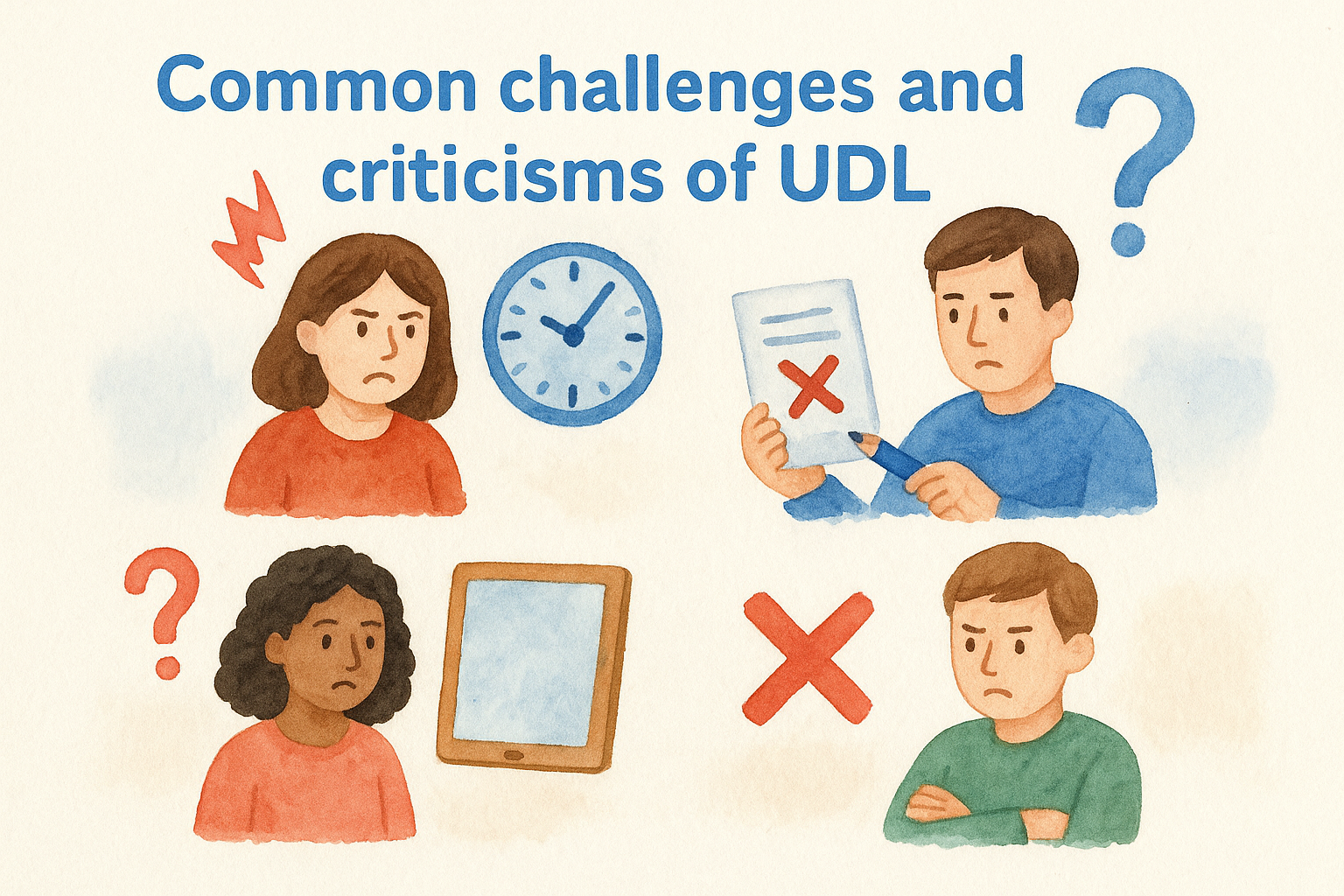
UDL sounds great on paper, but teachers who’ve actually tried to implement it run into real friction fast. Honest limitations deserve just as much attention as the benefits, because pretending the framework is frictionless sets teachers up to abandon it after one rough week.
Time and workload upfront
Building three ways into a reading, three options for demonstrating mastery, and a menu of engagement choices takes real planning time. Upfront planning costs are the single biggest complaint from teachers trying UDL for the first time, especially when you’re already juggling grading, IEP meetings, and five different preps. The payoff comes later, once a lesson is built and reusable, but that first version takes longer than writing a single worksheet ever did.
UDL saves time in the long run, but nobody warns you about the extra hours it costs the first time through.
Grading gets more complicated
When students turn in a podcast, a slide deck, and a traditional essay for the same assignment, grading consistency gets harder. Rubric design challenges show up quickly here, because a rubric written for written essays doesn’t automatically translate to a recorded argument or a visual project. You need rubrics built around the standard itself, not the format, and that takes more thought than a single-format assignment ever demanded.
Not every school has the resources
UDL leans on technology, in the form of recorded videos, text-to-speech tools, and varied materials. Resource gaps between schools mean a teacher with a 1:1 device classroom has a much easier time offering multiple formats than one working with a single classroom computer and a cart of shared laptops. Critics point out that UDL’s promise of flexibility assumes a baseline of resources that not every district can guarantee.
Some argue it dilutes rigor
A smaller but persistent criticism claims that offering choice lowers the academic bar, especially when students gravitate toward the easiest option every time. Rigor concerns aren’t baseless if a teacher builds weak rubrics or offers formats that don’t actually assess the same skill. The fix isn’t abandoning choice, it’s holding every format to the identical standard, the same discipline that keeps differentiation from turning into lowered expectations.
None of these challenges are reasons to skip UDL. They’re reasons to start small, build one flexible lesson at a time, and expect the first attempts to feel clunky before they feel efficient.
Bringing UDL into your own teaching
Universal Design for Learning isn’t a mandate to rebuild your entire curriculum this weekend. It’s a mindset shift: design for the range of students actually sitting in front of you, not an imaginary average one. Start with one lesson, add one choice to each principle, engagement, representation, action and expression, and see how it lands. You’ll stumble at first. Rubrics will need rewriting, some formats will flop, and planning will take longer than you expect. That’s normal. Small, consistent changes compound faster than a full overhaul you never finish.
The teachers who stick with UDL treat it as an ongoing practice, not a checklist to complete once. Every lesson you redesign this way is one less accommodation plan you’ll scramble to write later. If you want ready-made tools to make that first lesson easier, from AI-powered differentiation helpers to unit plans built with flexibility in mind, explore more classroom resources at The Cautiously Optimistic Teacher and start building from there.