
15 Teacher Interview Tips To Stand Out And Get Hired
You’ve spent years learning how to teach, but nobody taught you how to sell yourself in a 30-minute interview. That’s the frustrating reality for most educators. You know your stuff, you care about your students, and yet walking into an interview room can make even the most confident teacher feel like a first-year all over again. The right teacher interview tips can bridge the gap between what you know you’re capable of and what a hiring panel actually sees.
Here’s the thing: teaching interviews aren’t like other job interviews. Principals and hiring committees aren’t just listening to your answers, they’re imagining you in front of their students. They want proof that you can manage a classroom, differentiate instruction, build relationships, and handle the chaos of a Tuesday in March. Your job is to make that vision crystal clear, and that takes more than rehearsing generic responses the night before. It takes deliberate, strategic preparation.
At The Cautiously Optimistic Teacher, helping educators succeed at every stage of their career, including landing the job, is what we do. Our teacher interview resources have helped aspiring and experienced teachers walk into interviews ready to stand out. This article breaks down 15 actionable tips that cover everything from researching the school to answering tough behavioral questions to following up after the interview. Whether you’re chasing your first teaching position or switching districts, these strategies will help you show up prepared, confident, and memorable.
1. Use The Cautiously Optimistic Teacher to prep fast
One of the most practical teacher interview tips you can act on right now is to start your prep with a resource built for educators. The Cautiously Optimistic Teacher has a dedicated section of interview resources that walk you through common questions, what hiring panels actually look for, and how to frame your experience so it lands with the people doing the hiring.
What to do
Go to the Teacher Interview Strategies section on The Cautiously Optimistic Teacher and work through the materials before your interview. The resources cover common interview questions with coaching on how to answer them, resume guidance tailored to teachers, and strategies for presenting yourself with confidence. Don’t just skim the content passively.
Write out your answers, connect them directly to your actual classroom or student teaching experience, and practice saying them out loud at least twice before you walk into the interview room. The more specific and personal your answers sound, the stronger the impression you leave.
Why it works
Most teachers prepare in a scattered, unfocused way, pulling advice from random sources and hoping something sticks. The Cautiously Optimistic Teacher puts structured, educator-specific guidance in one place, so you spend less time searching and more time actually rehearsing.
Targeted preparation beats broad cramming every time – knowing exactly what panels look for lets you rehearse the right things.
When you practice with questions built around what principals and hiring committees care about, your answers become focused and memorable rather than generic and forgettable.
How to say it in the interview
You don’t need to mention the resource directly, but the preparation will show. When the panel asks about classroom management, differentiation, or your approach to student relationships, you’ll have clear, confident answers ready instead of fumbling for the right words.
Candidates who come in with specific, well-structured responses consistently stand out from those who give vague generalities. That level of deliberate readiness signals to the panel that you’re the kind of teacher who shows up prepared for students too, which is exactly what they’re hiring for.
2. Research the school like you already work there
Walking into an interview without knowing the school is like showing up to class without a lesson plan. Before your interview, spend 30 to 60 minutes digging into the school’s website, mission statement, and any recent news about the district. Check their student demographics, academic priorities, and any public initiatives they’re currently running.

What to do
Look up the school’s website and read everything: their vision statement, department pages, and any visible strategic plans. Search the district name in Google News to catch recent announcements, awards, or challenges they’ve faced publicly. Write down two or three specific details you can reference naturally during your answers.
Pay attention to language the school uses repeatedly, like "restorative practices" or "culturally responsive teaching." Panels often use that same language in their questions, and mirroring it back signals that you’re already aligned with their culture.
Why it works
Panels interview many candidates who deliver polished but generic answers. When you name something specific about the school, like a literacy initiative or a push toward project-based learning, you instantly separate yourself from everyone else in the candidate pool.
Specificity signals investment, and hiring committees notice when a candidate has done their homework.
How to say it in the interview
Weave the detail in naturally rather than announcing it. For example, if you noticed the school emphasizes student-led conferences, connect it directly to how you build student ownership in your classroom. That kind of alignment tells the panel you’re not just looking for any teaching job, but this one specifically. It’s one of the simplest teacher interview tips that most candidates skip entirely.
3. Write a tight tell me about yourself answer
"Tell me about yourself" opens almost every teacher interview, and most candidates treat it like a warm-up question. It isn’t. This is your first real impression and your chance to frame everything that follows. A rambling, unfocused answer signals disorganization before you’ve tackled a single substantive question.
What to do
Structure your answer around three clear beats: who you are as an educator, what you bring to this specific grade level or subject, and why you’re excited about this school. Keep it to 90 seconds maximum. Write it out word for word first, then practice it until it sounds natural rather than memorized. Cut anything that doesn’t connect your background directly to the classroom.
Resist the urge to start with where you grew up or your entire academic timeline. Panels want to know what kind of teacher you are and what impact you create for students, not your life story.
Why it works
A well-structured opening answer sets the tone for the entire interview. When you lead with clarity and confidence, the panel starts seeing you immediately as someone who can communicate effectively with students, parents, and colleagues.
Your first 90 seconds shape how the panel interprets everything you say for the rest of the interview.
How to say it in the interview
One of the most underused teacher interview tips is treating this question as a positioning statement rather than a biography. Try something like: "I’m a middle school ELA teacher with five years of experience building writing skills and reading stamina in diverse classrooms. I’ve focused heavily on student-led discussion, and I was drawn to this school because of your emphasis on student voice." That approach is specific, confident, and memorable.
4. Match your answers to the school’s priorities
Generic answers describe a generic teacher. Every school has specific priorities, and the candidates who win the job are the ones who show they fit those priorities directly. Before you walk in, take what you found during your research and map it to your actual experience. This is one of the most impactful teacher interview tips because it moves you from answering questions to having a real conversation.
What to do
Read through the school’s mission, their current academic initiatives, and any available improvement plans. Then list two or three of your own classroom practices that align with what they’re focused on. For example, if the school prioritizes intervention and academic support, pull a specific story about how you identified a struggling student and adjusted your approach to meet their needs. Write those connections down before the interview so they’re ready to use.
Why it works
Principals aren’t just hiring a teacher, they’re hiring someone who will move their school forward. When your answers reflect their actual goals, it signals cultural and strategic alignment rather than just general competence.
A candidate who answers in the school’s own language demonstrates they’ve listened before they’ve even started.
How to say it in the interview
Try framing your answers with a direct connection: "I noticed your school focuses on restorative practices, which fits how I approach conflict in my classroom." That kind of specificity tells the panel you’ve done your homework and that you’re genuinely interested in this community, not just the next available position.
5. Bring specific stories, not general claims
Saying "I’m a strong classroom manager" tells a panel nothing. Saying "I had a student who refused to engage until I restructured my seating and gave him a specific role in every group activity, and his participation completely turned around within two weeks" tells them everything. Concrete stories stick. Vague claims disappear the moment the next candidate walks in. One of the most effective teacher interview tips is to swap every general statement for a real, specific example from your teaching experience.
What to do
Build a bank of five to seven short stories before your interview. Each story should cover a real classroom situation: a student you supported, a lesson that flopped and what you changed, a conflict you resolved, or a skill gap you addressed. Use the STAR format (Situation, Task, Action, Result) to keep each story tight and structured. Write them out, practice them, and know which ones fit common questions like classroom management, differentiation, and parent communication.
Why it works
Hiring panels interview multiple candidates in a single day. Specific stories create vivid mental pictures that generic answers cannot. When you describe a real student or a real classroom moment, the panel starts seeing you in action rather than just hearing talking points.
The teacher who tells a real story always outlasts the teacher who lists qualities in the panel’s memory.
How to say it in the interview
Lead with the context, then move quickly to what you did and why. Keep each story under two minutes. End with the result or what you learned, so the panel walks away with a clear picture of how you think and act inside a real classroom.
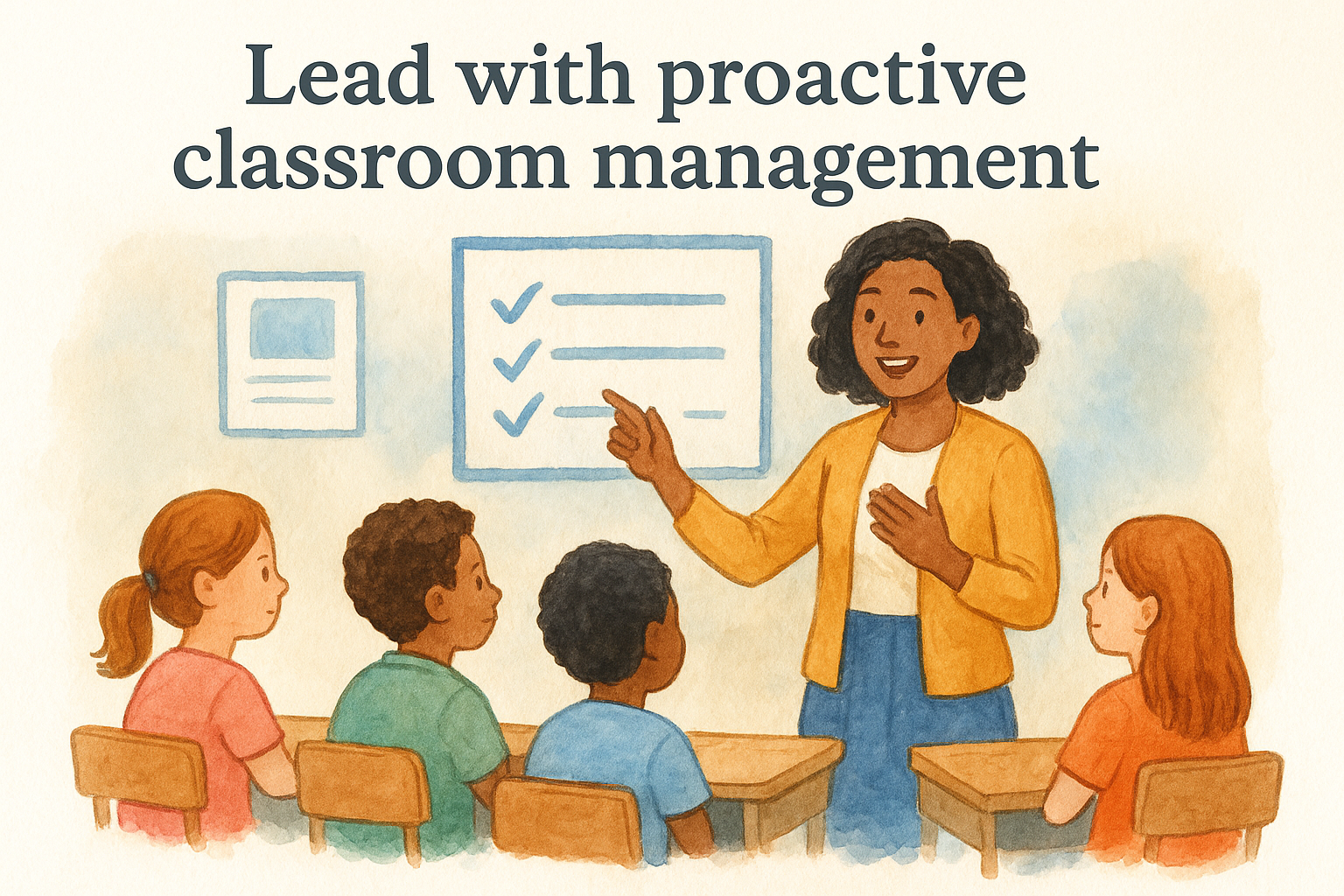
6. Lead with proactive classroom management
Classroom management is one of the first things every panel evaluates, but most candidates answer reactively. They describe what they do when behavior breaks down, not what they do to prevent it. Shifting your answers to focus on proactive systems tells the panel you think like an experienced teacher, even if you’re newer to the profession. This is one of the teacher interview tips that separates candidates who sound prepared from those who sound like they’re still figuring it out.
What to do
Build two or three examples that show prevention-focused strategies: how you structure your first weeks, how you set routines, and how you design your physical and instructional environment to minimize disruption. Think about specific systems you’ve used, like visual schedules, entry routines, or clear behavioral expectations posted and reinforced daily. Know the difference between a consequence and a relationship-based response, and be ready to explain both.
Why it works
Principals hear reactive management answers all day. When you describe the structures you put in place before problems start, you signal that you understand student behavior at a deeper level. Proactive management reduces lost instructional time, and hiring committees know it.
The teacher who prevents the problem is more valuable than the teacher who handles it well after it happens.
How to say it in the interview
Frame your answer around routine and relationship. For example: "I spend the first two weeks building norms with students rather than handing them down, so they feel ownership over the classroom environment." That kind of answer shows intentionality and makes the panel picture a calm, productive room with you at the front.
7. Explain how you build relationships and culture
Building relationships is something every candidate claims to do well, but few can explain with any specificity how they actually do it. Panels want to hear concrete practices and real evidence that you connect with students in ways that drive learning outcomes, not just a warm classroom atmosphere. This is one of the teacher interview tips that reveals whether you understand the link between culture and academic performance.
What to do
Think about the specific actions you take to build trust with students: how you greet them, how you check in beyond academics, and how you handle conflict in ways that preserve the relationship. Come prepared with a story that shows a student who struggled to connect and how your consistent effort shifted that dynamic. Make sure your example connects culture-building to learning outcomes so the panel sees you’re not treating relationships as separate from instruction.
Why it works
Hiring committees know that students learn better when they feel safe and valued. A candidate who can articulate the mechanics of culture-building rather than just claiming to care demonstrates a level of professional awareness that stands out.
Panels hire teachers who build the kind of room students want to come back to every day.
How to say it in the interview
Lead with action over attitude. Instead of saying you care about your students, describe what you do each week to build that connection. For example, try: "I run a brief weekly check-in with every student using a simple written prompt so no one falls through the cracks, and I adjust my approach based on what they share."
8. Show how you differentiate for real classrooms
Differentiation is one of the most common topics in any teaching interview, and it’s also one of the most mishandled. Panels aren’t looking for a textbook definition of differentiated instruction. They want to hear how you actually handle a room where some students read three grade levels below and others finish early every day.
What to do
Come in with two or three real examples of how you adjusted content, process, or product for different learners in the same classroom. Be specific about the student need you identified, the adjustment you made, and how it affected learning. Avoid vague descriptions like "I modify assignments." Instead, say you reduced the reading load for struggling readers while extending the task for advanced students in the same activity.
Why it works
Principals know that every classroom has a wide range of learners, and they need confidence that you can serve all of them. When you describe real adjustments you’ve made, it tells the panel you can handle the full spectrum, not just the middle of the bell curve. Generic answers about "meeting students where they are" don’t build that kind of concrete confidence.
Specificity proves competence in a way that general claims about flexibility never will.
How to say it in the interview
One of the strongest teacher interview tips for this topic is to connect your differentiation directly to assessment. Explain how you used a quick pre-assessment to group students before a unit and then adjusted your materials based on what you found. That tells the panel you respond to real student data rather than guessing at needs.
9. Talk assessment and data without sounding robotic
Assessment questions trip up many candidates because they go either too vague or too technical. Panels want to hear how you use data to adjust your teaching, not just that you collect it. The goal is to sound like a reflective teacher who responds to student needs, not someone reciting evaluation frameworks.
What to do
Come in with a specific example of a time you used student data to change your instruction. Maybe an exit ticket revealed that half the class misunderstood a key concept, so you redesigned the next day’s lesson entirely. Know the difference between formative and summative assessment, but frame your answers around what you actually did with the information rather than listing assessment types.
Why it works
Principals want teachers who close the loop between gathering data and acting on it. Anyone can administer a quiz. The teacher who looks at the results and adjusts their approach before the next lesson is the one who drives real student growth.
Describing how you changed your teaching based on student results is far more powerful than listing the tools you use to collect data.
How to say it in the interview
Keep your answer grounded in a real classroom moment rather than abstract practice. One of the strongest teacher interview tips for assessment questions is to walk the panel through your thinking: what you noticed, what you changed, and what happened next. That sequence shows you’re data-informed without sounding like you’re reading from a policy document.
10. Prove you can support literacy and language needs
No matter what subject you teach, every panel expects you to support reading comprehension and academic language development in your classroom. This is especially true in schools with English language learners or students reading below grade level. If you walk in without a clear answer on this, you’ll lose ground fast.
What to do
Think about the specific literacy strategies you’ve embedded into your instruction: vocabulary pre-teaching, text annotation routines, sentence frames for academic writing, or read-alouds with structured discussion. If you’ve worked with ELL students, prepare a specific example that shows how you modified language demands while keeping the cognitive rigor intact. Panels want to see that you build access without lowering expectations.
Why it works
Schools across the country are dealing with widening reading gaps and growing multilingual student populations. When you demonstrate concrete literacy practices, you show the panel you can serve students who often get left behind without the right instructional support.
A teacher who builds language into every lesson reaches students that a content-only approach misses entirely.
How to say it in the interview
This is one of those teacher interview tips that works best when you ground your answer in a real classroom moment. Describe a specific lesson where you scaffolded a complex text for struggling readers while still pushing the whole class to think critically about the content. For example: "I used tiered sentence starters during a Socratic seminar so every student could participate in the discussion regardless of their reading level." That answer tells the panel you design for access without sacrificing rigor.
11. Describe engaging lessons with student thinking
Panels ask about lesson design because they want to see how you structure learning around student thinking, not just information delivery. When you answer questions about your teaching approach, the goal is to show that students in your room are doing the cognitive heavy lifting, not just passively receiving content.
What to do
Build two or three lesson examples that show high student engagement and visible thinking before your interview. Focus on lessons where students debated, investigated, created, or solved something rather than copied notes. Be ready to describe your specific instructional choices: how you opened the lesson, what students were doing at each stage, and how you kept them thinking throughout. The more concrete your example, the stronger your answer will be.
Why it works
Hiring committees picture you in a classroom while you talk. When you describe a lesson where students are talking to each other, questioning assumptions, or defending ideas, you paint a picture of active learning that principals want to see. Generic answers about keeping students engaged don’t create that image the way a real, specific example does.
The teacher who can describe a lesson in vivid detail signals they design instruction with intention, not habit.
How to say it in the interview
This is one of those teacher interview tips that rewards preparation. Walk the panel through the structure: what the entry task was, how you transitioned into the main activity, and what students produced or discussed by the end. For example: "I opened with a provocative question and gave students five minutes to debate in pairs before we unpacked the text together." That kind of answer is clear, confident, and memorable.
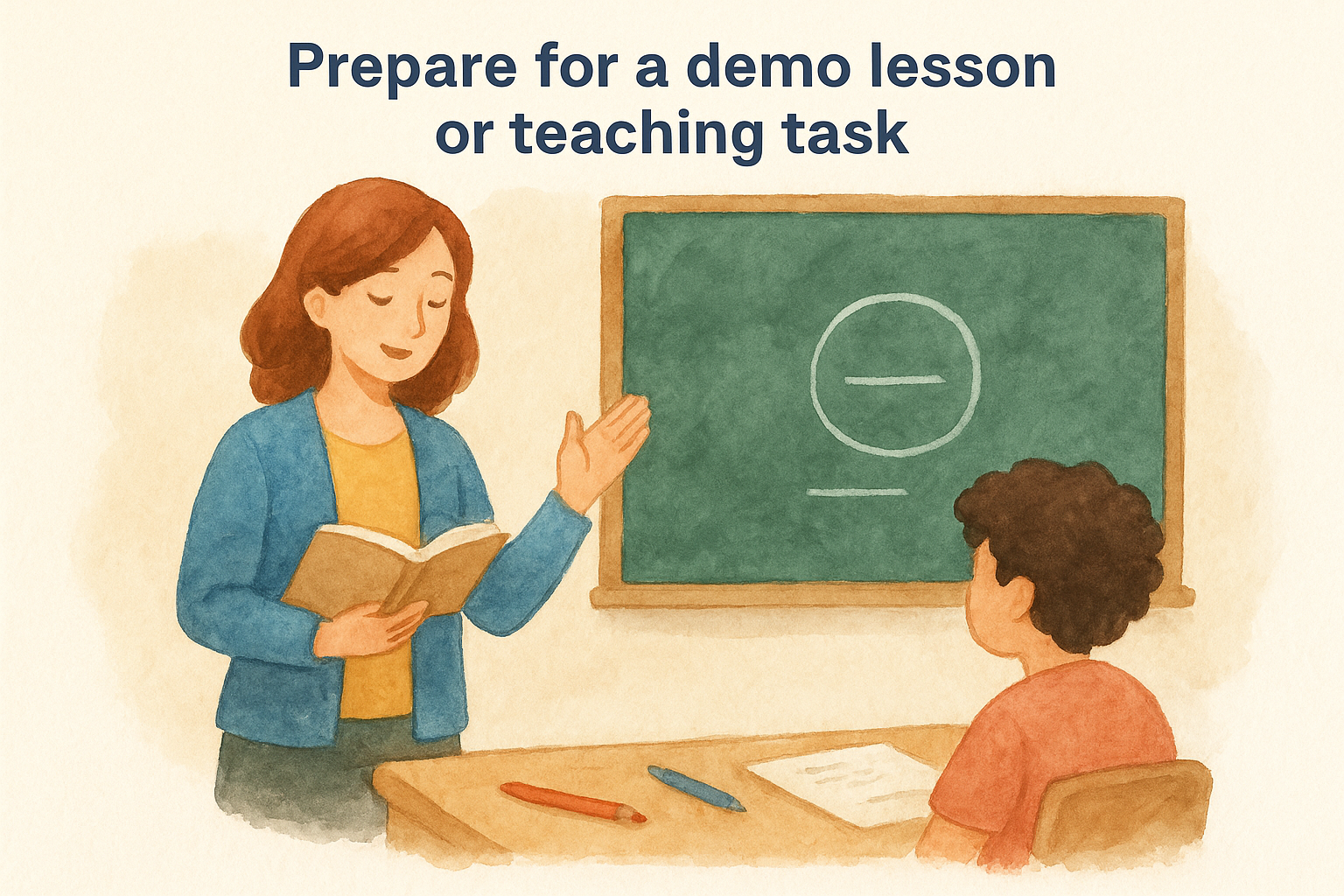
12. Prepare for a demo lesson or teaching task
Some schools ask you to teach a short lesson during the interview, and this step separates candidates who talk about teaching from those who can actually demonstrate it. If you receive a demo request, treat it as the highest-priority part of your preparation, not an afterthought. A strong demo lesson can carry the entire interview.
What to do
Ask the school in advance for any available details: the grade level, topic, time limit, and student context. Then plan a tight lesson with a clear objective, a brief opening hook, one focused instructional move, and an exit activity that shows student thinking. Keep your lesson within the time limit with two or three minutes to spare so you don’t rush the ending.
Practice the lesson out loud at least once before the interview, ideally in front of someone who can give you honest feedback. Know your transitions, your timing, and what you’ll do if the panel wants to stop you early.
Why it works
A demo lesson gives the panel direct evidence of how you teach rather than just how you describe teaching. It removes all the guesswork and shows your instructional choices in real time.
Candidates who execute a clean, focused demo lesson make the hiring decision easy for the panel.
How to say it in the interview
After the lesson, expect a brief debrief. This is one of those teacher interview tips that rewards self-awareness. When the panel asks how it went, reflect honestly on what worked and what you’d adjust. That response tells them you evaluate your own practice, which is exactly what effective teachers do every day.
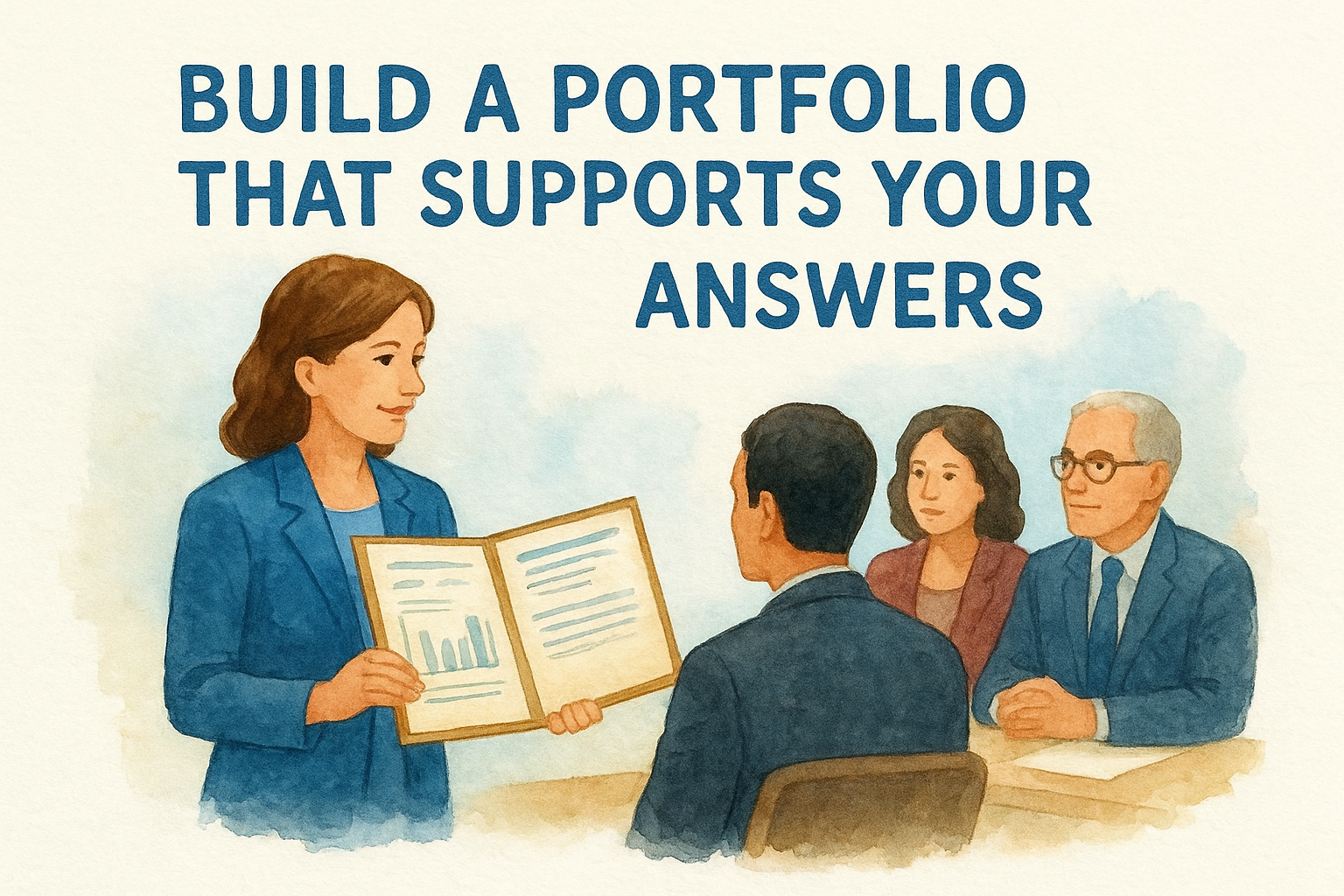
13. Build a portfolio that supports your answers
A teaching portfolio gives the panel something concrete to hold onto after the interview ends. Most candidates walk out leaving only a verbal impression. When you bring a well-organized portfolio, you give the hiring committee physical evidence that backs up every claim you make in the room.
What to do
Keep your portfolio tight and purposeful, not exhaustive. Include a one-page teaching philosophy statement, two or three sample lesson plans with student work attached, evidence of differentiation or assessment data you’ve acted on, and any letters of recommendation or professional development certificates. Organize it so you can flip to a specific section quickly when a question invites it. Bring two printed copies so the panel can pass one around while you walk them through it.
Why it works
Panels interview many candidates in a short window, and memory fades fast. A portfolio anchors your answers to real artifacts from your classroom, which makes your claims significantly harder to dismiss. It also signals that you approach your own practice with the same organizational intentionality you’d bring to your students.
A portfolio doesn’t just support your answers, it makes them visible.
How to say it in the interview
This is one of those teacher interview tips that works best when it feels natural rather than scripted. Don’t hand the portfolio over immediately. Instead, wait for a relevant question and say: "I actually have an example of that here, if you’d like to see it." That approach tells the panel you prepared strategically and specifically for this interview, not just generally for any interview.
14. Ask questions that help you spot a good fit
The end of an interview isn’t just a formality. When the panel asks if you have any questions, they’re still evaluating you, and the questions you ask reveal as much about your priorities as any answer you gave. Strong candidates treat this moment as a genuine opportunity to assess the school, not just a chance to seem engaged.
What to do
Prepare three to five thoughtful questions before the interview and choose the most relevant ones based on how the conversation goes. Focus on questions that reveal how the school actually operates: how teachers collaborate, how administration supports professional development, and how the school handles challenges like chronic absenteeism or academic gaps. Avoid questions about salary, vacation, or anything easily found on the school website. Those signal that your preparation stopped short.
Why it works
Asking sharp, specific questions tells the panel you are evaluating this opportunity seriously, which is exactly the mindset a strong hire brings to every professional decision. It also gives you real information you need to decide whether this school is somewhere you’ll thrive.
The questions you ask reveal whether you’re looking for any job or the right job.
How to say it in the interview
This is one of the teacher interview tips that works best when your questions connect back to your own values. Try asking: "How does your team support new teachers during their first year?" or "What does collaboration between departments look like here?" Both questions signal professionalism and give you honest insight into whether this school actually matches what you’re looking for.
15. Follow up well and close with confidence
Most candidates treat the interview as finished the moment they shake hands and walk out the door. The follow-up is part of the interview, and how you handle it shapes the final impression you leave with the panel. This is one of the quietest teacher interview tips, but it consistently makes a difference when a hiring decision comes down to two strong candidates.
What to do
Send a brief, specific thank-you email within 24 hours of the interview. Address it to the hiring contact or principal by name, reference one specific topic from the conversation, and restate in one sentence why you’re excited about this particular school. Keep it to three or four sentences. Long emails lose the panel fast, and a focused message signals that you communicate with precision, which is exactly what they want in a classroom teacher.
Why it works
A well-timed follow-up keeps your name visible at the exact moment the panel is comparing candidates. More importantly, a message that references a specific moment from the interview proves you were fully present during the conversation, not just waiting for your next turn to talk.
The candidate who follows up with specificity tells the panel they’ll bring that same attention to their students.
How to say it in the interview
Before you leave the room, close with a direct, confident statement rather than trailing off. Try: "I’m genuinely excited about this role, and I’d love the opportunity to contribute to your team." That kind of clean, clear close reinforces the same intentionality you showed throughout the entire interview.
Next steps
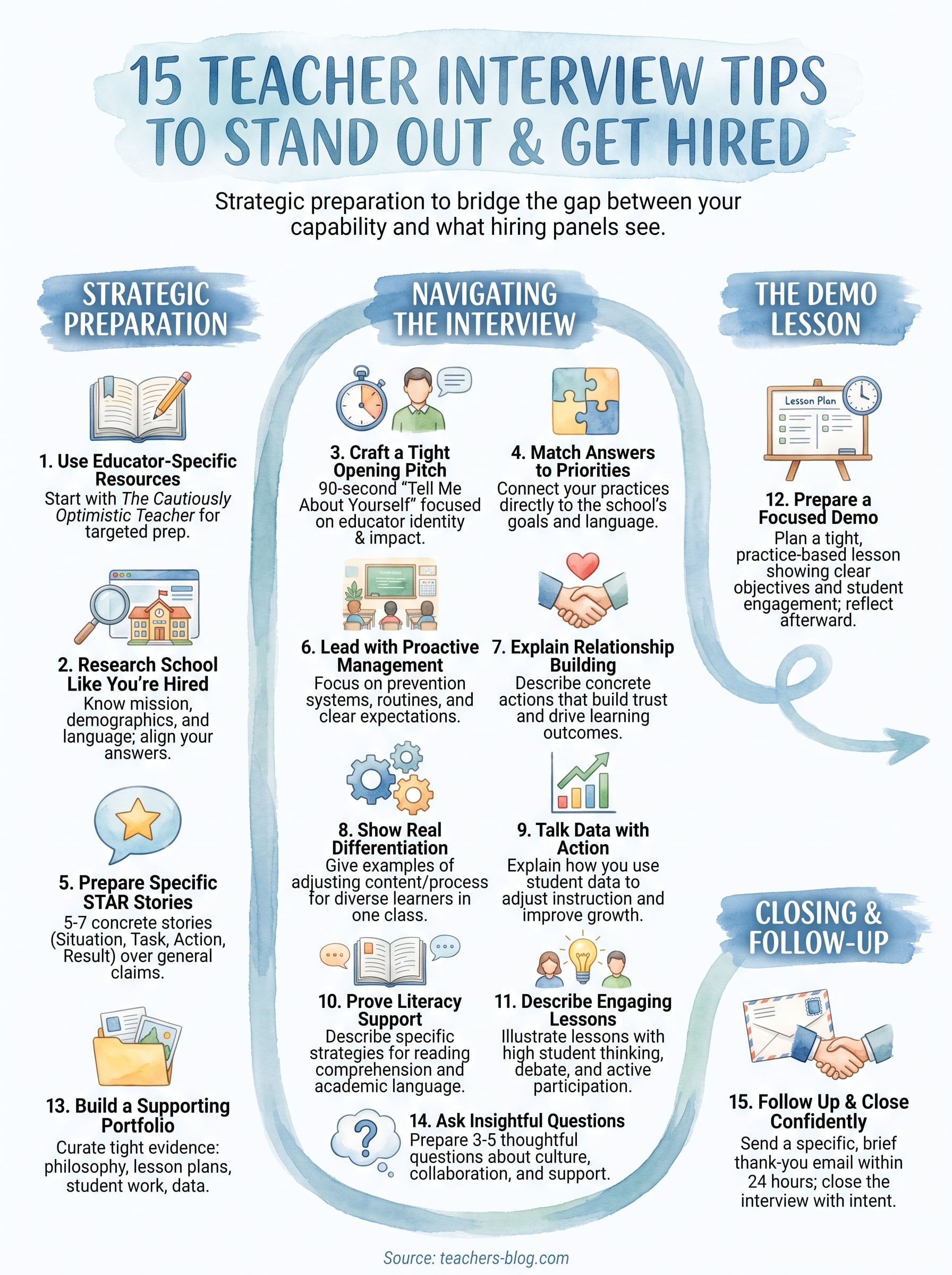
These 15 teacher interview tips give you a complete framework to walk into any interview room prepared, confident, and memorable. The difference between candidates who get called back and those who don’t usually comes down to deliberate preparation rather than raw talent or experience. You already have the teaching skills. Your job now is to make sure the panel can actually see them.
Start by picking two or three tips from this list that feel like your weakest spots right now. Work on those first, then build outward. Don’t try to tackle everything at once or your preparation will stay shallow across the board.
When you’re ready to go deeper, The Cautiously Optimistic Teacher has resources built specifically for educators at every stage of this process, from resume guidance to common interview questions with real coaching on how to answer them. Use them, and walk in ready.