
Teaching Research Paper Writing: A Step-by-Step Framework
Ask a room full of teachers what assignment makes their students shut down fastest, and teaching research paper writing will land near the top of the list. It’s not hard to see why. Students face a tangle of skills all at once, finding credible sources, organizing arguments, citing evidence, and producing a polished draft, often with little idea of where to start or how the pieces fit together.
The problem usually isn’t a lack of effort. It’s a lack of structure. When students receive a research paper assignment as one massive, intimidating task, many freeze. But when you break the process into clear, manageable steps, something shifts. They stop dreading the paper and start actually writing it. That’s the kind of practical, classroom-tested thinking we build everything around here at The Cautiously Optimistic Teacher, strategies that work with real students, not hypothetical ones.
This guide gives you a step-by-step framework you can adapt for your own classroom, from topic selection through final revision. Each stage includes specific teaching moves and checkpoints so your students build skills progressively instead of scrambling at the end. Whether you teach middle school or high school, you’ll walk away with a repeatable structure that makes the research paper less painful for everyone involved.
What good research writing looks like
Before you can teach students to write a strong research paper, you need a clear picture of what you’re working toward. A finished research paper isn’t just a collection of facts pasted together. It’s a piece of writing where the student takes a clear stance or explores a focused question, supports every claim with credible evidence, and communicates ideas in a logical, organized way. When you can describe that target clearly, students know what they’re building toward.
The marks of strong student research writing
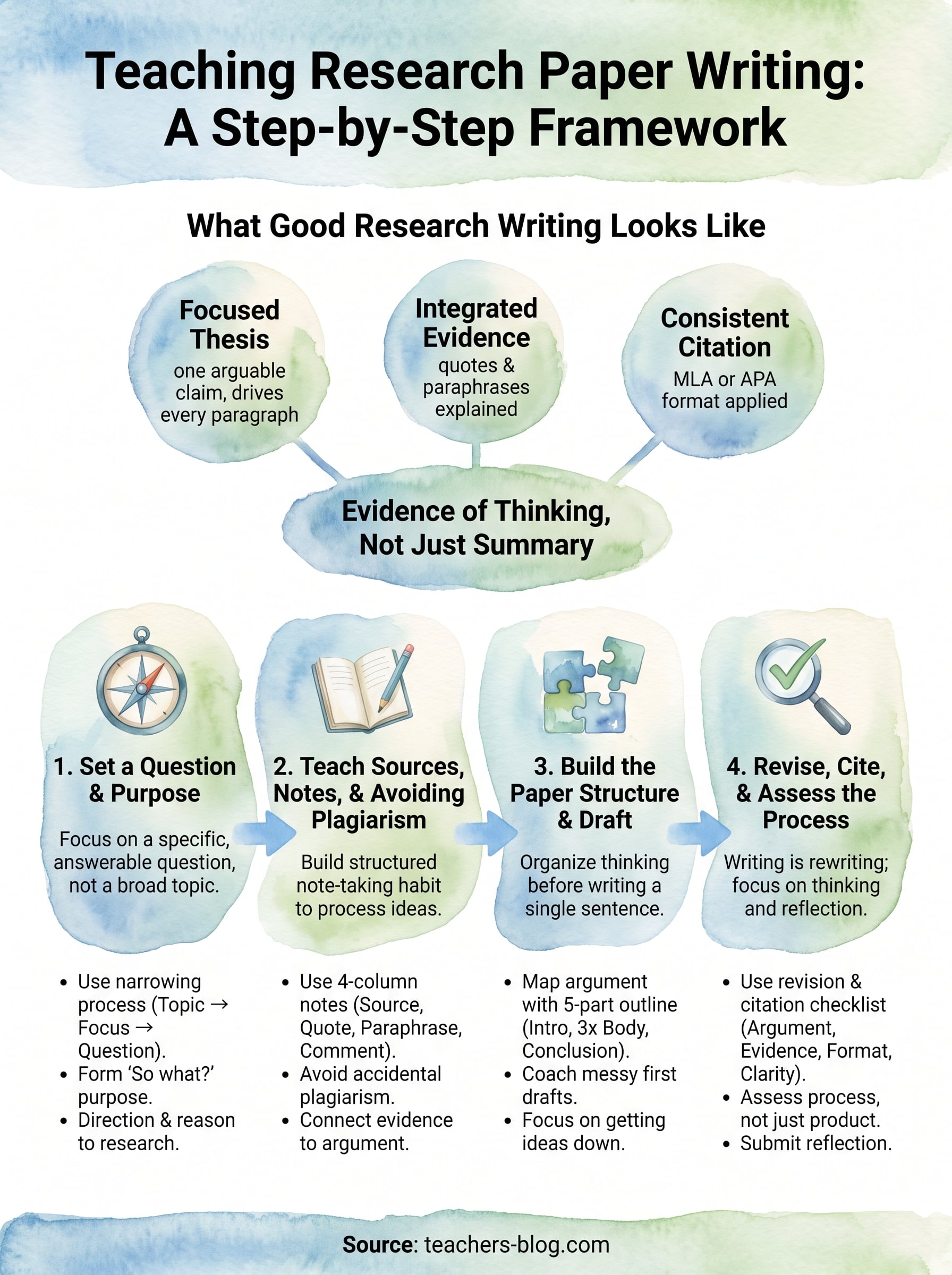
Strong research writing shares a few consistent traits regardless of grade level. First, the thesis or central question drives every paragraph; nothing in the paper exists just to fill space. Second, sources are not just dropped in but integrated and explained so the reader understands why the evidence matters. Third, the paper follows a consistent citation format, MLA and APA being the most common in K-12 settings. When you’re teaching research paper writing, pointing to these three traits early gives students a concrete checklist rather than a vague standard.
A strong research paper is evidence of thinking, not just a summary of sources.
| Trait | What it looks like in student writing |
|---|---|
| Focused thesis | One arguable claim that all paragraphs support |
| Integrated evidence | Quotes and paraphrases with explanation |
| Consistent citation | MLA or APA format applied throughout |
Setting the bar with mentor texts
One of the most effective moves you can make is showing students a real example of good research writing before they write a single word of their own. Pull a short, well-organized research article and annotate it together as a class, pointing out where the author makes a claim, introduces evidence, and explains its relevance. This gives students a mental model they can refer back to throughout the entire process.
Step 1. Set a question and a purpose
Every strong research paper starts with a specific, answerable question, not a broad topic. When students pick "climate change" as their topic, they have nothing to argue or investigate. When they ask "How have rising ocean temperatures affected coral reef ecosystems in the last decade?", they have direction and a reason to research. Teaching research paper writing effectively means slowing students down at this stage before they sprint toward Google.
The research question is the compass. Without it, every source looks equally useful.
From topic to research question
Walk students through a simple narrowing process using their initial topic as raw material. Push them to ask "So what?" and "Who cares?" until the topic becomes a specific, workable question. This four-step template works well in any classroom and gives students a written record to reference throughout the entire unit:
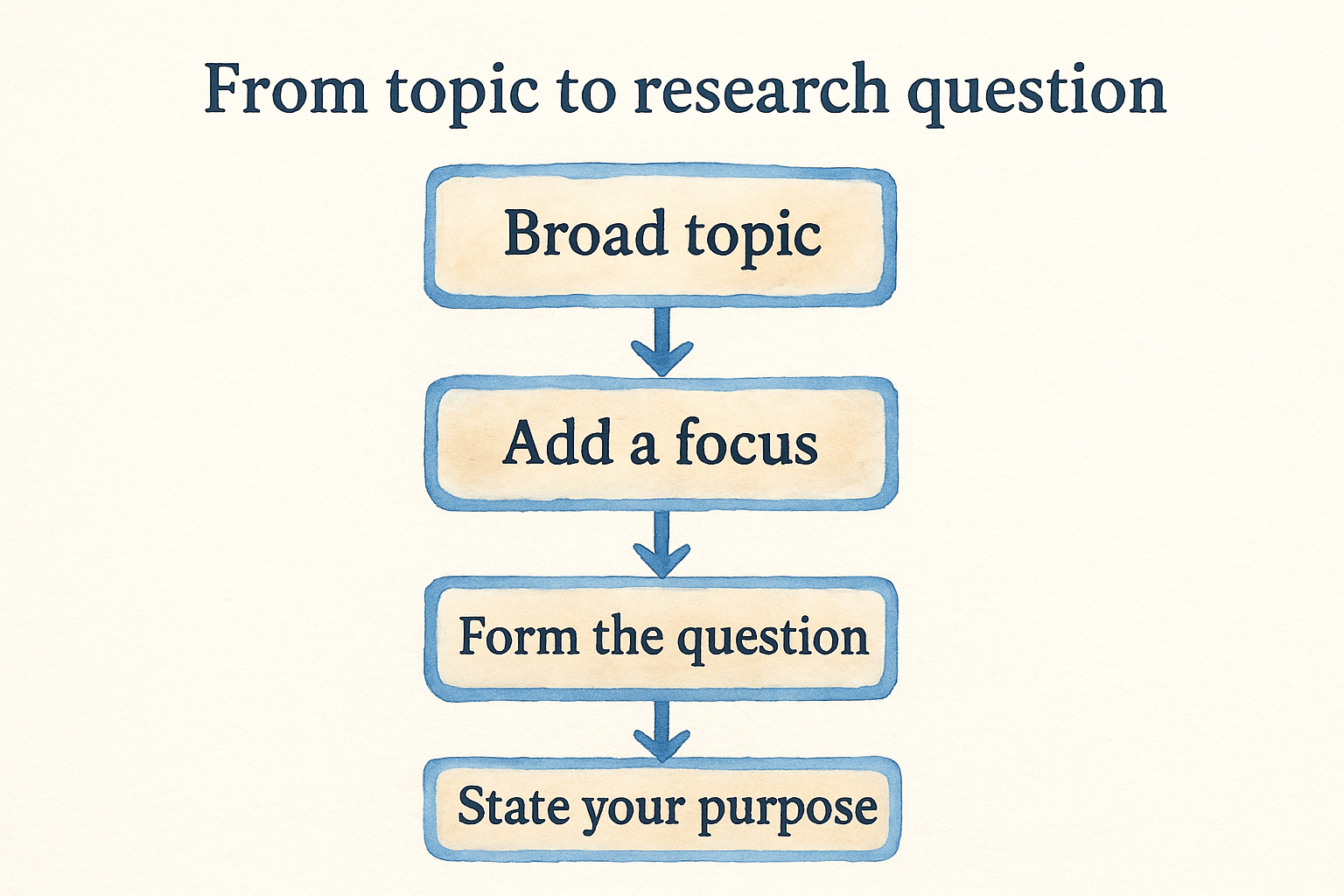
- Start broad: Write your general topic in one sentence.
- Add a focus: Identify a specific angle, time period, population, or problem.
- Form the question: Turn that narrowed focus into a question your research will answer.
- State your purpose: Write one sentence explaining why this question matters to a real audience.
Step 2. Teach sources, notes, and avoiding plagiarism
Once students have a research question, they need to know how to find reliable information and what to do with it. This step is where teaching research paper writing gets messy if you skip the fundamentals. Students default to the first result they see and copy sentences directly into their notes, which leads to accidental plagiarism before they’ve written a single word.
The notes students take at this stage become the raw material for their entire paper, so quality matters more than speed.
Building a source and notes system
Give students a structured note-taking template that captures source information alongside their own thinking. This forces them to process ideas rather than just copy them, and it prevents the frantic "where did I find this?" panic that derails drafts. Use this four-column format:
| Column | What to record |
|---|---|
| Source citation | Author, title, publication, date, URL |
| Direct quote | Exact text in quotation marks |
| Paraphrase | The idea in your own words |
| Your comment | Why this evidence supports your thesis |
When students fill in the "Your comment" column consistently, they build the habit of connecting evidence to argument instead of treating sources as decorations.
Step 3. Build the paper structure and draft
With a research question and solid notes in hand, students are ready to organize their thinking into a structure before they write a single sentence of the draft. Skipping the outline stage is where most student papers fall apart. When you teach them to map their argument first, they write faster and produce more coherent drafts.
An outline is not busywork; it is the architecture that holds the paper together.
From outline to first draft
Walk students through a simple five-part outline template before they open a blank document. This gives every paragraph a job and prevents the common problem of evidence with no explanation attached. Use this structure as your starting point:

- Introduction: Hook, background context, and thesis statement
- Body paragraph 1: First supporting point + evidence + explanation
- Body paragraph 2: Second supporting point + evidence + explanation
- Body paragraph 3: Third supporting point or counterargument + rebuttal
- Conclusion: Restate thesis, synthesize evidence, closing thought
Teaching research paper writing at this stage means coaching students to write messy first drafts without stopping to fix every sentence. Remind them that revision comes later; the goal of the draft is to get ideas onto the page.
Step 4. Revise, cite, and assess the process
The final stage of teaching research paper writing is where students learn that writing is rewriting. Most students treat their first draft as their final product, so build revision into your schedule as a required step with a dedicated class period, not an afterthought they do the night before they submit.
Revision without a clear focus produces surface-level edits; a checklist turns it into a real thinking exercise.
Using a revision and citation checklist
Give students a concrete checklist before they return to their draft. This focuses their attention on what matters most and removes the guesswork from the editing process so they make real improvements instead of just fixing typos.
- Argument: Does every paragraph connect back to the thesis?
- Evidence: Is every quote or paraphrase explained and cited?
- Citation format: Does the Works Cited or References page follow MLA or APA consistently?
- Clarity: Are any sentences unclear or repetitive?
Assessing the process, not just the product
Your final assessment should evaluate how students worked, not only what they handed in. Ask them to submit a one-paragraph reflection using this prompt template:
- What was the hardest part of this process?
- What would you do differently next time?
- What did you learn about how to research?
This reflection builds metacognitive habits that carry directly into the next writing assignment.
Wrap it up and plan the next cycle
Teaching research paper writing becomes easier every time you run the cycle. The first time through, you’re building the framework alongside your students. By the second assignment, they already know what a research question looks like and how to set up their notes. That familiarity compounds. Each paper they write builds on the habits they formed in the last one.
After you finish your first round, take ten minutes to note what broke down and where students struggled most. Was it narrowing the research question? Integrating evidence? Use those patterns to adjust your next unit before you launch it. One small fix each cycle makes a noticeable difference over a semester.
If you want more classroom-tested strategies and ready-to-use resources to support your students through complex writing tasks, visit The Cautiously Optimistic Teacher and explore what’s there. Your next unit is closer than you think.