CAST UDL Framework: Principles, Guidelines, And Examples
Every student processes information differently, yet most lesson plans still follow a one-size-fits-all structure. The CAST UDL framework was built to change that. Developed by the nonprofit organization CAST, Universal Design for Learning gives teachers a research-backed approach to designing flexible lessons that reach all learners, not just the ones who happen to fit the mold.
Here at The Cautiously Optimistic Teacher, we’ve built tools and resources around this exact idea, that differentiated instruction isn’t a bonus, it’s a baseline. Our AI-powered Differentiated Instruction Helper and UDL Lesson Plan Template both draw on UDL principles because they work. But to use the framework well, you need to actually understand how it’s structured and why each piece matters.
This article breaks down the three core principles of UDL, walks through the official CAST guidelines, and gives you concrete examples of what implementation looks like in a real classroom. Whether you’re encountering UDL for the first time or revisiting it with fresh eyes, you’ll leave with a clear, practical understanding of the framework and how to put it to use.
What the CAST UDL framework includes
The CAST UDL framework isn’t a single strategy or a lesson template you fill out once. It’s a comprehensive instructional design system organized into principles, guidelines, and specific checkpoints that give teachers a practical path toward inclusive teaching. Understanding the full structure helps you use it intentionally rather than applying a surface-level interpretation that misses most of its value.
The origin and mission of CAST
CAST, which stands for Center for Applied Special Technology, was founded in 1984. The organization originally focused on students with disabilities but quickly recognized that rigid curriculum design was the real barrier, not the students themselves. That shift in perspective led to the development of UDL as a framework that benefits every learner, not just those with identified needs.
When you design for the edges of the learning spectrum, you improve the experience for everyone in the middle too.
CAST published the first formal UDL guidelines in 2008, and updated versions have continued to refine the framework based on neuroscience and education research. The guidelines are freely available through CAST’s official site, so you have direct access to the source material without relying on secondhand interpretations.
The three pillars that organize everything
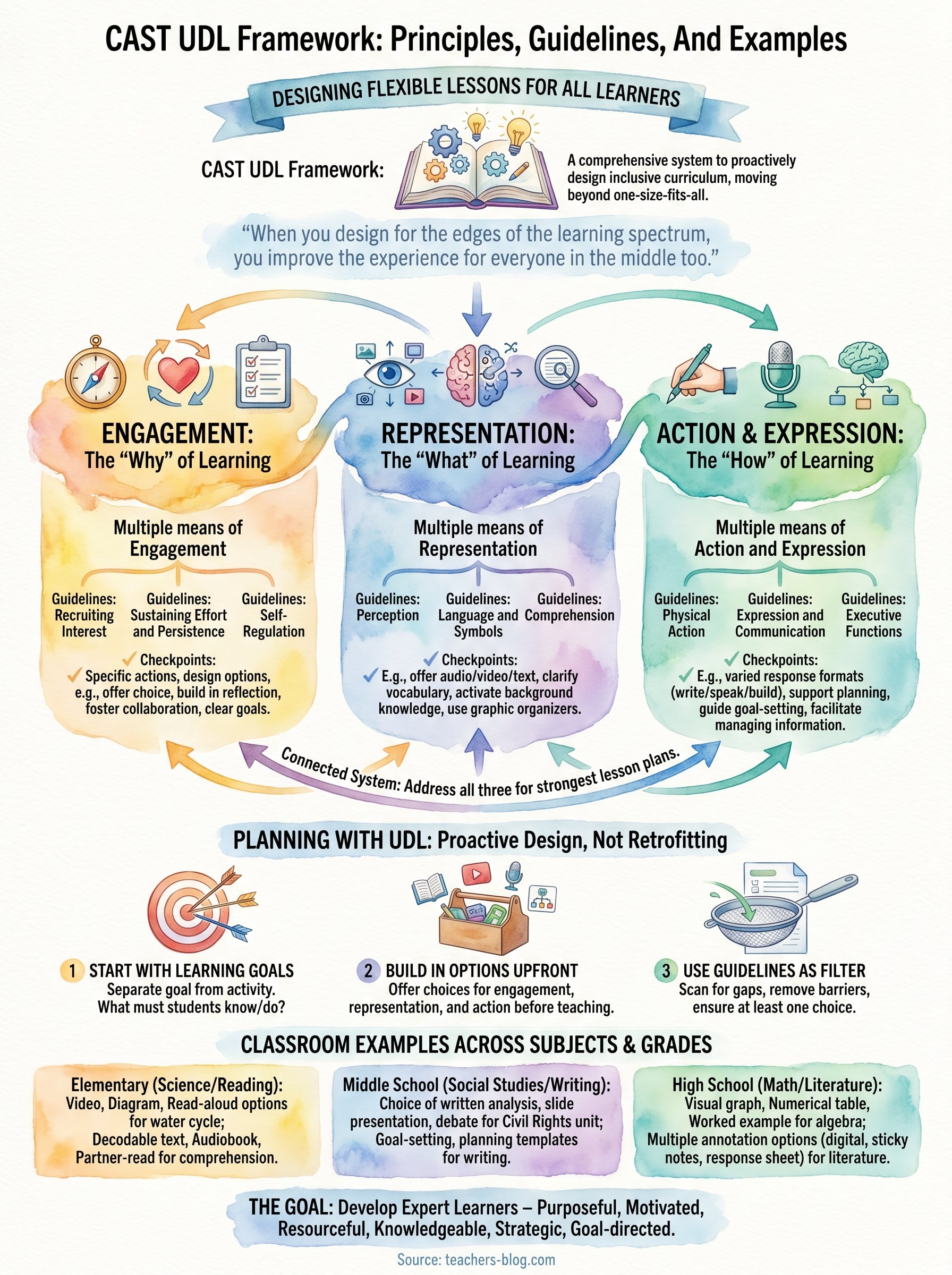
The framework organizes all its guidance around three core principles: Engagement, Representation, and Action and Expression. Each principle corresponds to a specific brain network involved in learning. Together, they address the "why" of learning, the "what" of learning, and the "how" of learning.
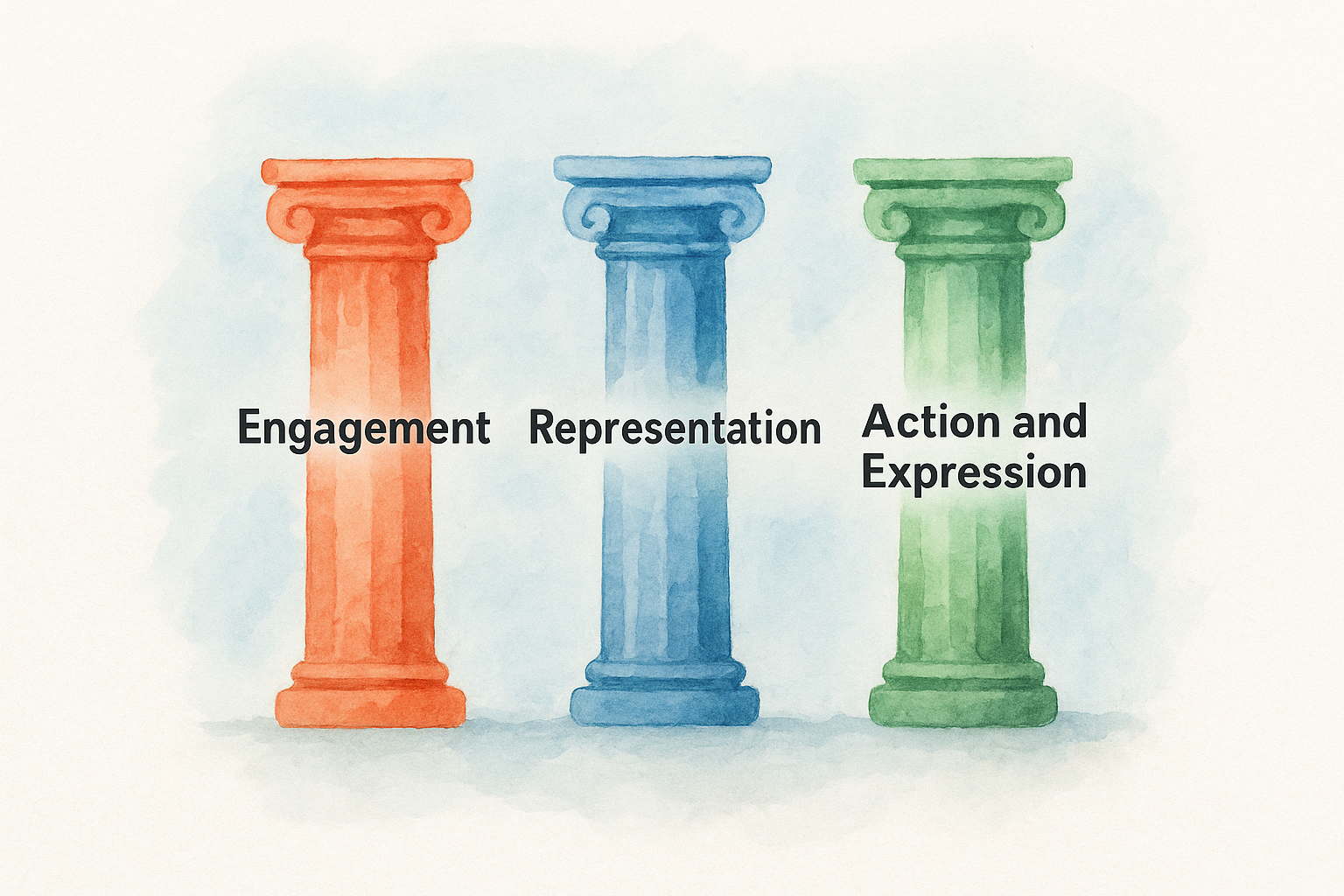
These three principles aren’t independent checklists you work through one at a time. They function as a connected system, and the strongest UDL lesson plans address all three at once. When you focus on only one, you risk leaving gaps that prevent some students from fully accessing the content or demonstrating what they know.
How the guidelines and checkpoints fit in
Under each of the three principles, CAST provides specific guidelines that describe what flexible design looks like in practice. Under each guideline, there are checkpoints that get more granular, giving you concrete actions and design decisions to work with. Think of the principles as the "why," the guidelines as the "what," and the checkpoints as the "how."
The current framework includes nine total guidelines spread across the three principles. Each guideline contains two to four checkpoints, which means the full framework gives you dozens of specific, actionable design options to consider when building a lesson. You don’t need to implement every checkpoint at once. The checkpoints function more like a menu of possibilities that you draw from based on your students’ actual needs in a given unit.
The goal: expert learners
Everything in the framework points toward one overarching outcome: developing expert learners. CAST defines expert learners as students who are purposeful and motivated, resourceful and knowledgeable, and strategic and goal-directed. These aren’t just abstract descriptors. They describe students who can direct their own learning, adapt when things get difficult, and stay engaged even when the material challenges them.
That goal matters because it repositions UDL away from being a compliance-based accommodation tool. You’re not retrofitting lessons for specific students after the fact. Instead, you’re building in flexibility from the start so every student has a genuine opportunity to become a capable, self-directed learner. That’s a fundamentally different design philosophy, and it’s what separates UDL from traditional differentiation approaches.
The three UDL principles explained
The three principles sit at the core of the CAST UDL framework, and each one targets a different aspect of how students learn. CAST grounds each principle in a specific brain network: the affective network drives engagement, the recognition network handles representation, and the strategic network manages action and expression. Knowing what each principle targets helps you make sharper design decisions during lesson planning.
Multiple means of engagement
Engagement addresses the "why" of learning. This principle recognizes that motivation, interest, and self-regulation vary significantly across students. Some learners thrive with autonomy and open-ended tasks, while others need clear routines and structured goals before they can focus.
When you design for multiple means of engagement, you’re building options that sustain motivation and lower barriers to participation. That might look like letting students choose their research topic, establishing explicit goals before a task begins, or building in checkpoints for self-reflection. The principle is not about making everything entertaining; it’s about giving students genuine reasons to stay involved.
Multiple means of representation
Representation targets the "what" of learning, meaning how you present information to students. Text-heavy instruction works well for some learners and creates a significant barrier for others, particularly students with dyslexia, visual impairments, or limited English proficiency.
When you offer the same content in multiple formats, the format stops being the obstacle and the actual learning can happen.
Designing for multiple means of representation means providing access to content through varied modalities. A concept introduced through video, supported by a graphic organizer, and reinforced through discussion builds more pathways to understanding than a single textbook passage. You’re not reducing expectations; you’re removing friction that was never a useful part of the learning challenge.
Multiple means of action and expression
This principle covers the "how" of learning, specifically how students demonstrate what they know. A traditional essay works for students who write with ease, but it’s often a poor measure of understanding for students who struggle with written expression.
Offering multiple ways for students to show their thinking might include accepting a recorded explanation, a visual presentation, or a labeled diagram alongside written work. The goal is not to make assessment easier; it’s to make sure the evidence you collect reflects actual understanding, not just performance under a single, narrow set of conditions.
The UDL guidelines and checkpoints
The CAST UDL framework organizes its practical guidance through nine guidelines, each sitting beneath one of the three core principles. These guidelines translate the broad principles into specific design targets you can actually plan against. Knowing what each guideline covers helps you identify where your current lessons are strong and where they leave students without enough support.
The nine guidelines at a glance
Each of the three principles contains three guidelines, giving you a structured map across the full framework. The guidelines under Engagement focus on recruiting interest, sustaining effort and persistence, and self-regulation. The guidelines under Representation address perception, language and symbols, and comprehension. The guidelines under Action and Expression cover physical action, expression and communication, and executive functions.
The nine guidelines aren’t a checklist you complete once; they’re a design lens you return to each time you plan a new unit.
Here’s a quick reference that maps each guideline to its principle:
| Principle | Guidelines |
|---|---|
| Engagement | Recruiting interest / Sustaining effort and persistence / Self-regulation |
| Representation | Perception / Language and symbols / Comprehension |
| Action and Expression | Physical action / Expression and communication / Executive functions |
How checkpoints work in practice
Under each guideline, CAST provides two to four checkpoints that describe specific, concrete design decisions. For example, under the guideline for perception, a checkpoint asks you to offer information in multiple sensory formats, such as audio, visual, and tactile options. Under the guideline for self-regulation, checkpoints prompt you to support goal-setting and build in structured opportunities for students to reflect on their own progress. These checkpoints function as a menu of options rather than a fixed prescription, so you select what fits your students and your content.
Working with checkpoints doesn’t mean redesigning every lesson from scratch. Start by auditing one unit against the checkpoints for a single guideline and building from there. If you notice that your materials consistently rely on dense written text, that’s a signal to apply checkpoints under perception or language and symbols. If students regularly disengage mid-task, look at the checkpoints under sustaining effort and persistence.
Small, targeted adjustments at the checkpoint level often create meaningful improvements in how many students can access and engage with the material. The checkpoints make the framework practical rather than theoretical, which is exactly what turns UDL from an abstract set of ideas into something you can actually use on Monday morning.
How to apply UDL in lesson planning
Applying the CAST UDL framework to lesson planning isn’t about adding more work to an already full plate. It’s about shifting the order of your design decisions so that flexibility is built in from the start rather than added on afterward. Most teachers plan activities first and then scramble to accommodate individual students after the fact. UDL reverses that sequence entirely.
Start with your learning goals, not your activities
The first step is separating your actual learning goal from the activity you’d normally use to teach it. Ask yourself: what do I need students to know or be able to do by the end of this lesson? Once that goal is clear, you can evaluate whether your planned activity is the only path to that outcome or simply the most familiar one.
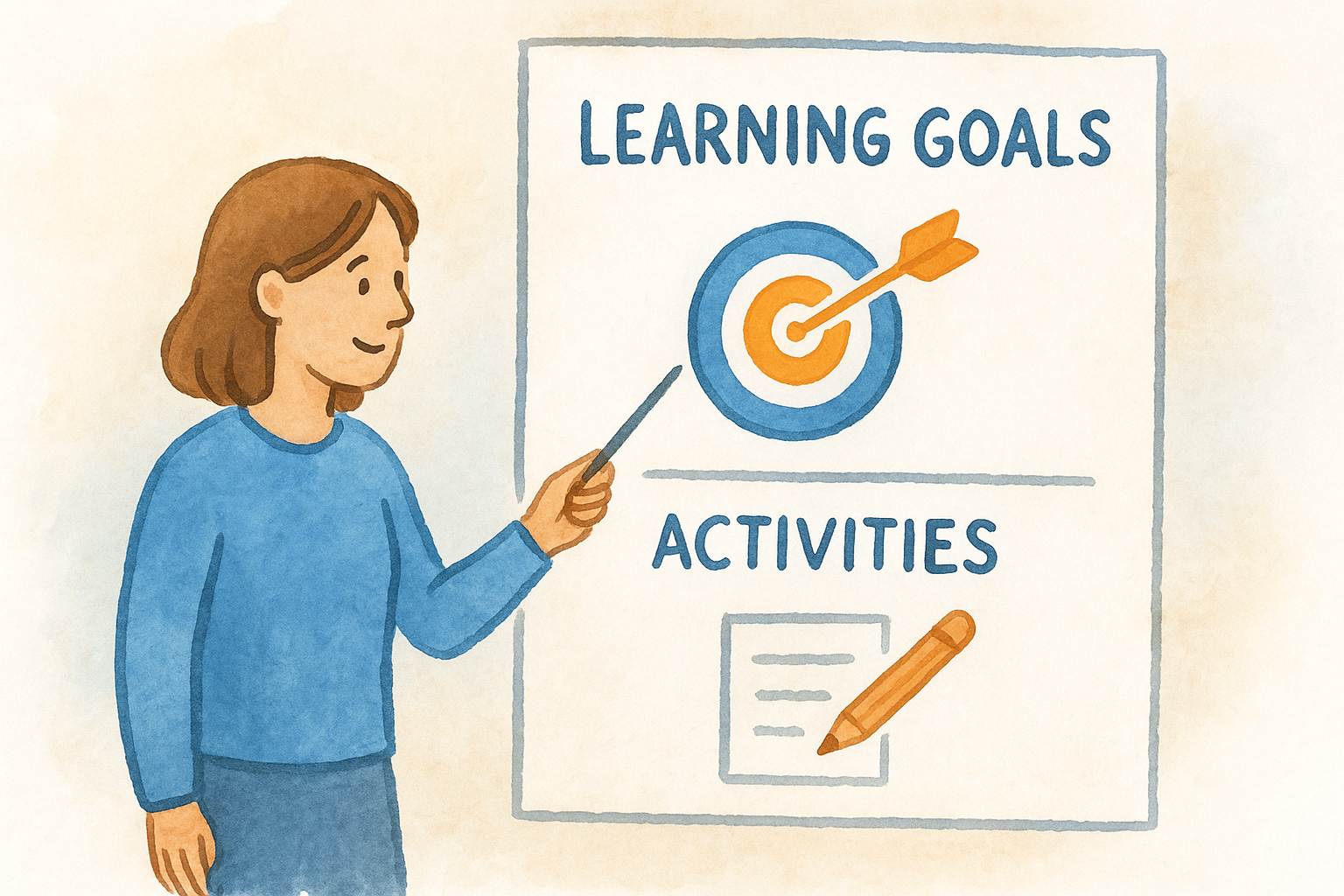
When you anchor your design to the goal rather than the activity, you open up far more options for how students can access and demonstrate their learning.
Most lessons have narrower constraints than necessary once you examine them this way. A goal like "students will analyze an author’s argument" doesn’t require a printed article and a written response. It could be met through audio, video, discussion, or structured annotation, depending on what actually serves your students.
Build in options before you teach, not after
Once your goal is clear, plan your options proactively. Think through the three principles: how will you sustain engagement, how will you present the content in more than one format, and how will students show what they’ve learned? You don’t need to create three entirely separate lessons. Often, small structural choices like offering a graphic organizer alongside a reading or giving students two options for a final task are enough to widen access meaningfully.
Think of your lesson plan template as having built-in flexibility slots rather than fixed activity boxes. Where can you offer choice? Where can you reduce format-based barriers without reducing the cognitive demand of the task itself?
Use the guidelines as a planning filter
Run your draft lesson through the nine UDL guidelines as a quick audit before you finalize it. You’re not checking off every checkpoint. You’re scanning for obvious gaps, places where all students must navigate the material in exactly one way with no alternatives. Use these questions to guide your review:
- Can every student access the content, or does format block some of them?
- Do students have at least one choice in how they engage or respond?
- Have you built in any self-monitoring or goal-setting support?
These gaps are where access breaks down for the students who need flexibility most, and catching them at the planning stage costs far less time than retrofitting a lesson that’s already underway.
Classroom examples across subjects and grades
The CAST UDL framework becomes easier to apply once you see it working in actual classrooms. Abstract principles land differently when you can point to a specific subject, grade level, and design decision. The examples below aren’t idealized scenarios; they reflect the kinds of practical adjustments teachers make when they commit to flexible design from the start.
Elementary: science and reading
A third-grade science teacher introducing the water cycle can apply UDL by presenting the concept through three different entry points: a short animated video, a physical diagram students label by hand, and a read-aloud with paired images. All three versions target the same learning goal, but each one removes a different barrier. Students choose the format that helps them build initial understanding, and then the whole class discusses together.
When students choose their entry point, they take more ownership of the material from the first minute of the lesson.
For reading in an early elementary classroom, a teacher might offer a decodable text, an audiobook version, and a partner-read option alongside the same comprehension questions. The questions stay consistent across all formats, which means the assessment still measures reading comprehension, not just the ability to decode print independently.
Middle school: social studies and writing
A seventh-grade social studies teacher building a unit on the Civil Rights Movement can design for multiple means of action and expression by offering students three options for their final product: a written analysis, a narrated slide presentation, or a structured debate response. All three require students to use evidence and make an argument. The format differs; the cognitive demand stays the same.
For a writing unit, a teacher might support engagement by letting students choose their own argumentative topic within a defined category. Pairing that choice with clear goal-setting checkpoints and a structured planning template addresses both the motivation and the executive function guidelines at once without requiring separate lesson plans for different groups.
High school: math and literature
A high school math teacher can apply representation guidelines by presenting the same algebraic concept through a visual graph, a numerical table, and a worked example with written steps. Students who process symbolically can start with the equation; students who need a concrete anchor can start with the graph.
In a literature class, offering students multiple ways to annotate a shared text, including digital comments, sticky notes, or a structured response sheet, lowers the barrier to engagement without lowering expectations for critical thinking.
Next steps for implementing UDL
The cast udl framework gives you a clear structure, but knowing the framework and using it are two different things. Start small: pick one upcoming unit and run it through the nine guidelines as a planning filter. Look for one or two specific gaps where all students are forced through the same narrow format, then build in alternatives before you teach the lesson. That single audit will teach you more about flexible design than reading another overview ever could.
From there, build the habit of anchoring every lesson to a clear learning goal before you choose your activities or formats. That sequence shift is what makes UDL sustainable over time rather than a one-time redesign effort. You already have the knowledge to move forward. What you need now are tools that make implementation faster and more practical. Explore the UDL resources and AI-powered planning tools designed to help you put these principles into action right away.