
Growth Mindset Professional Development: Practical PD Ideas
Most teachers already believe their students can grow. The problem isn’t buy-in, it’s that growth mindset professional development often stops at a single workshop with a motivational poster and a Carol Dweck quote. Then everyone goes back to their classrooms, and nothing actually changes. That gap between understanding growth mindset and putting it into daily practice is where PD sessions tend to fall apart.
Here at The Cautiously Optimistic Teacher, we build resources that help educators move past theory and into action, whether that’s through our Brain Builders Workshop materials or strategies for fostering genuine student motivation. Growth mindset PD deserves the same treatment: less inspiration, more implementation.
This article breaks down practical professional development ideas you can actually use, activities, discussion frameworks, and session structures that help teaching teams internalize growth mindset principles and apply them consistently. Whether you’re leading PD for your department or looking for something to bring to an admin meeting, you’ll walk away with concrete options ready to adapt to your school’s needs.
What growth mindset professional development includes
Growth mindset professional development covers more than a definition of fixed vs. growth mindset. It spans self-awareness practices, instructional language shifts, feedback protocols, and systems for sustaining the work over time. When done well, it helps teachers examine their own mindset patterns first, then transfer those insights directly into how they respond to students every day.
The core components of effective growth mindset PD
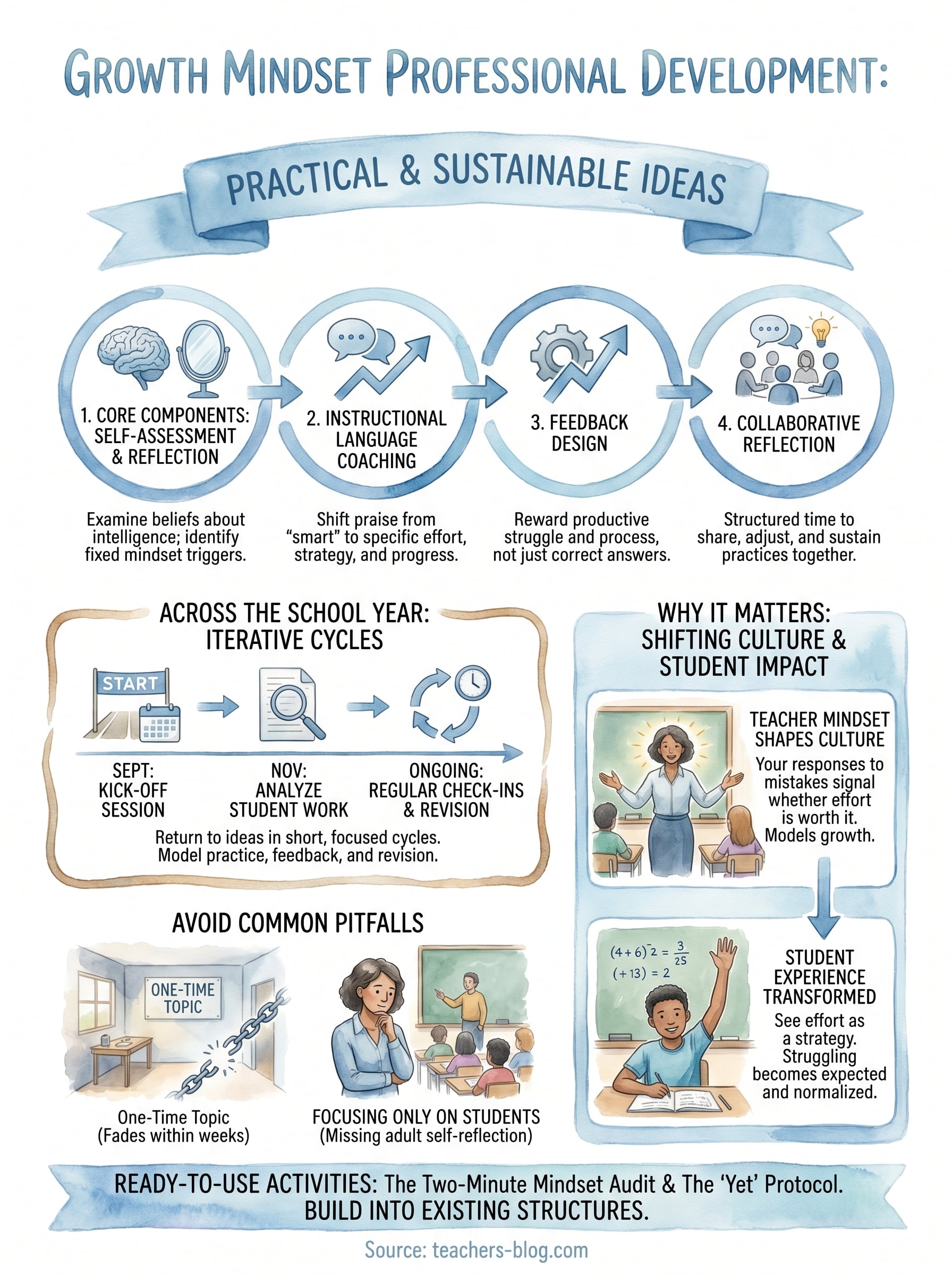
Strong growth mindset PD typically includes four interconnected areas. Mindset self-assessment comes first: teachers examine their own beliefs about intelligence and effort before they can meaningfully teach those beliefs to students. Instructional language coaching comes next, helping educators replace praise like "you’re so smart" with feedback that targets specific effort, strategy, and progress.
The third component is feedback design, where teachers learn to build assignments and responses that reward productive struggle rather than just correct answers. Fourth, and often skipped, is collaborative reflection: structured time for teachers to share what’s working, what isn’t, and how they’re adjusting. Without this last piece, individual teachers tend to revert to old habits when the session ends.
Growth mindset PD that skips collaborative reflection tends to fade within weeks, because teachers have no accountability structure to sustain new practices.
What it looks like across a school year
A single training day does not build a growth mindset culture. Effective programs spread the work across the school year, returning to core ideas in short, focused cycles rather than cramming everything into one sitting. You might run a 90-minute kick-off session in September focused on mindset language, then a 45-minute protocol in November where teams analyze student work samples through a growth mindset lens.
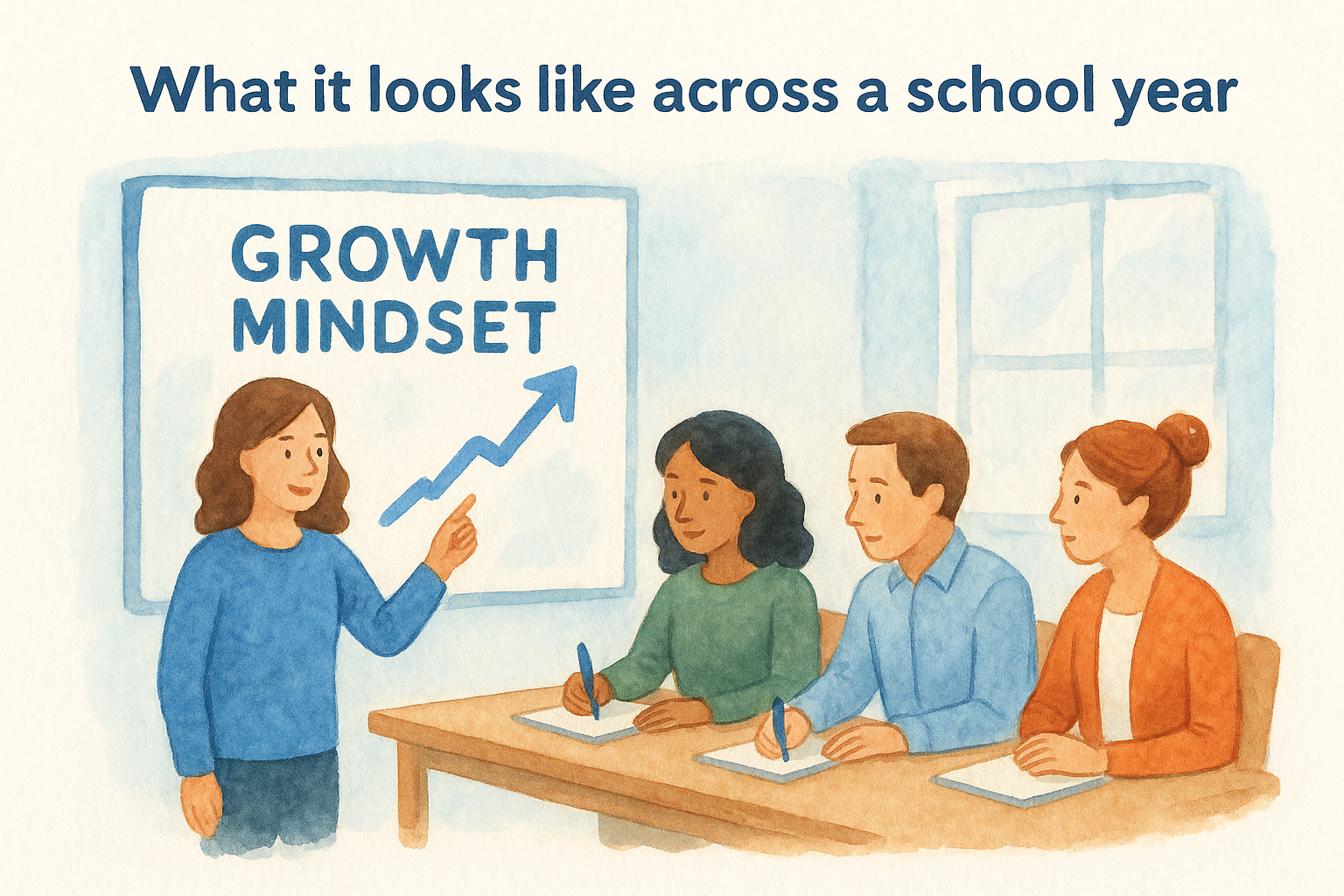
Returning to the material in regular intervals keeps ideas alive and gives teachers time to try something in their classroom, report back, and refine their approach. This iterative structure mirrors how good teachers actually ask students to learn: through practice, feedback, and revision. Your professional development process should model the very mindset it’s trying to build.
The role of individual reflection alongside group work
Group sessions matter, but individual reflection is what makes new habits personal. Journaling prompts and self-assessments give teachers a private space to examine their own fixed mindset triggers without the pressure of a group audience. Some educators find it easier to acknowledge that they struggle with mistakes or criticism when they’re writing in a notebook rather than speaking in front of colleagues.
Pairing individual reflection with group discussion produces the strongest results: teachers process privately first, then bring more honest, considered responses to collaborative conversations. This combination separates surface-level PD from professional development that actually shifts classroom practice over time.
Why this PD matters for teachers and students
Teachers set the tone for how students understand effort, failure, and ability. When your language and feedback consistently signal that intelligence is fixed, students internalize that message, regardless of what your posters say. Growth mindset professional development changes the baseline: it gives teachers concrete tools to model the beliefs they want students to adopt, which makes a measurable difference in how students approach challenging work.
How teacher mindset shapes classroom culture
Your own mindset shows up in dozens of small moments each day: the way you respond to a wrong answer, how you frame a hard assignment, what you say when a student gives up. Students notice those signals, and they use them to decide whether effort is worth it. Research from Carol Dweck’s lab at Stanford has repeatedly shown that students who believe their abilities can grow through effort achieve at higher levels than those who believe talent is fixed.
When teachers actively model a growth mindset, students are more likely to treat mistakes as part of learning rather than evidence of failure.
The gap between believing in growth mindset and actually demonstrating it is wide for most educators. That gap is exactly what structured PD closes.
The student impact when teachers shift their practice
When teachers adjust their feedback language and assignment design, students experience school differently. They start to see effort as a strategy rather than a sign they’re not smart enough. Struggling with a problem becomes expected, not embarrassing, because the classroom culture has normalized productive difficulty.
You cannot build that culture through a single staff meeting. It requires consistent practice from teachers who have had real time to examine their own habits, try new approaches, and reflect on what shifted. That is why this work belongs in sustained professional development cycles, not a one-time event.
How to run growth mindset PD that sticks
Running PD that actually changes practice starts with session design, not content selection. Before you choose an activity or a video clip, you need a clear structure that gives teachers time to process, discuss, and commit to a specific next step. Without that structure baked in from the start, even the best growth mindset content becomes something teachers nod at and immediately forget.
Make the session structure mirror the mindset
Your PD format should reflect the same principles you want teachers to carry into their classrooms. That means building in opportunities for productive struggle, honest reflection, and revision rather than delivering a polished lecture and calling it done. Start each session with a brief self-assessment prompt that asks teachers to recall one moment from the past week where they responded to a student from a fixed mindset place. That prompt does two things: it grounds the session in real classroom experience, and it builds the habit of noticing mindset patterns before trying to change them.
The most effective growth mindset professional development treats teachers as learners first, which means designing sessions where teachers actually have to think, not just listen.
After the self-assessment, move into a focused skill or protocol, keep it to one idea per session, and end with a specific classroom commitment: one thing each teacher will try before the next session. Writing that commitment down and sharing it with a partner raises follow-through significantly.
Build in accountability between sessions
Short check-ins between PD sessions do more for long-term habit change than any single workshop. A five-minute partner share at the start of the next staff meeting, where teachers report back on their classroom commitment, keeps the work active rather than archived. You do not need extra time on the calendar; you need a deliberate structure that treats follow-through as part of the PD itself, not an optional add-on.
Ready-to-use PD activities and protocols
Having a solid session structure is step one, but you also need specific activities to fill that structure with real substance. The protocols below work across grade levels and departments, which means you can adapt them without starting from scratch every time you plan a session.
The two-minute mindset audit
Start every session with this short written reflection: give teachers two minutes to write down one recent moment where they noticed themselves responding from a fixed mindset, whether in feedback, grading, or a hallway conversation. The prompt is deliberately low-stakes, so even skeptical teachers participate without resistance.
Once teachers finish writing, pair them up to share one sentence from what they wrote. This quick structure builds the habit of identifying mindset patterns in real time, which is exactly the skill that carries over into classroom interactions. You do not need extra materials or preparation, just a timer and a consistent commitment to running it at the start of each session.
The two-minute mindset audit works best when you run it consistently, because pattern recognition develops through repetition, not a single instance.
The yet protocol for teacher feedback
This growth mindset professional development activity focuses on one small word: "yet." Give each teacher three example student responses, including ones that reflect frustration or defeat, and ask them to rewrite each teacher reply using language that adds "yet" or its equivalent. Rewriting takes about ten minutes, and the discussion that follows is usually rich because teachers surface their own assumptions about student potential.

After the rewrite activity, ask each teacher to identify one graded assignment from the current unit where they could embed the same language shift. Tying the activity directly to real classroom materials rather than hypothetical examples makes the transfer from PD session to daily practice far more likely.
Common pitfalls and how to avoid them
Even well-intentioned growth mindset professional development fails when the design ignores a few predictable traps. Knowing where programs typically break down lets you sidestep those problems before they cost you time, staff goodwill, and momentum.
Treating mindset as a one-time topic
Most schools run one growth mindset session, check a box, and move on. Teachers walk away with a handout and genuine interest, but without repeated exposure and structured practice, the concepts fade within a month. Retention requires repetition, which means returning to growth mindset ideas across multiple sessions throughout the year rather than front-loading everything into a single event.
One-time PD creates one-time thinking. Sustained culture change requires sustained professional learning cycles.
Build a simple calendar before your first session. Identify four to six touchpoints across the year where your team will revisit, practice, and reflect on growth mindset principles. Even short 20-minute protocols during existing staff meetings count if they connect back to what teachers tried in their classrooms.
Focusing only on students, not staff
Many programs spend all their time on student-facing strategies while skipping the uncomfortable work of asking teachers to examine their own mindset. That approach produces shallow results, because teachers who have never reflected on their own fixed mindset triggers cannot model genuine growth mindset behavior consistently.
Your PD design should start with adults as learners, not immediately pivot to classroom application. Give teachers real space to sit with their own reactions to failure, criticism, and uncertainty before you ask them to coach students through the same experiences. A well-run self-assessment sequence at the beginning of each session takes only a few minutes but shifts the entire tone from information delivery to personal development.
Pair this with low-stakes sharing structures like partner conversations or anonymous sticky note responses so that teachers who feel resistant can participate without feeling exposed in front of peers.
Next steps for your staff
The pitfalls are avoidable and the activities are ready. What your team needs now is a starting point that is concrete enough to act on without feeling like another overwhelming initiative. Pick one protocol from this article, the two-minute mindset audit or the yet protocol, and run it at your next staff meeting. One small, consistent action builds more momentum than a perfectly planned program that never launches.
Growth mindset professional development works when it becomes part of how your team operates week to week, not a topic you revisit once a year. Set a simple four-session calendar before your first meeting so that you already know when the team will return to the work. If you want more resources built specifically for educators, The Cautiously Optimistic Teacher offers tools and strategies designed to help you turn mindset principles into consistent classroom practice. Start with what you have, run your first session, and adjust as you go.