11 Classroom Growth Mindset Posters To Inspire Resilience
A poster on the wall won’t magically rewire how a student thinks about failure. But the right message, placed where students see it every single day, can quietly reinforce something you’re already teaching, that struggle is part of learning. That’s exactly why classroom growth mindset posters matter more than most teachers give them credit for. They serve as visual anchors for the mindset work you do during lessons, conversations, and feedback.
Here at The Cautiously Optimistic Teacher, fostering a growth mindset in students sits at the core of what we do, from our Brain Builders Workshop resources to our differentiated unit plans. We know that building resilience takes more than a one-off lesson. It takes consistent reinforcement, and your classroom environment plays a direct role in that.
This list pulls together 11 growth mindset posters worth putting on your walls, including free printables, customizable templates, and ready-to-buy sets. Each one is selected for its ability to spark real reflection, not just fill empty space. Whether you teach middle school or high school, you’ll find options here that fit your classroom vibe and actually support the mindset shifts you’re working toward.
1. Brain Builders Workshop mindset posters
The Brain Builders Workshop mindset poster set is the one resource from this site worth putting at the top of any list of classroom growth mindset posters. These posters come bundled with the Brain Builders Workshop unit, which is built around teaching students how to think about their own learning. The posters aren’t decorative extras; they’re core components of a larger system designed to shift how students see effort, mistakes, and challenge.
Core message
The Brain Builders Workshop posters center on the idea that your brain grows stronger through effort and struggle, not through natural talent. Each poster in the set reinforces a specific mindset principle, from embracing mistakes to pushing through difficulty. Together, they give students a visual vocabulary for talking about their own thinking and learning.
Students who see these messages consistently throughout the school year build stronger connections between effort and growth than those who encounter the idea only once in a lesson.
Why it builds resilience
These posters work because they don’t stand alone. They’re directly tied to lessons and activities students complete during the workshop, so when a student looks at the poster, it triggers a memory of something they actually practiced. That connection between experience and reminder is what builds genuine resilience over time, not just a surface-level awareness of it.
How to use it in class
You can use the posters as anchor charts during lessons, referencing them directly when a student hits a difficult task. Point to the relevant poster when a student says they can’t do something and redirect the conversation using the specific language printed on the wall, keeping your feedback consistent and grounded.
- Introduce each poster during a lesson, not just as decoration
- Use the poster language in your own feedback and classroom conversations
- Return to the posters during reflection activities at the end of units
Design and placement tips
The Brain Builders Workshop posters are clean and classroom-ready, designed to print without eating into your prep time. Place them near where students do independent work so the messages are visible exactly when students need them most.
Cost and format options
The posters come as part of the Brain Builders Workshop resource, available directly on this site. You get printable PDF files that you can print at home or send to a print shop for larger, higher-impact versions.
2. The power of yet poster
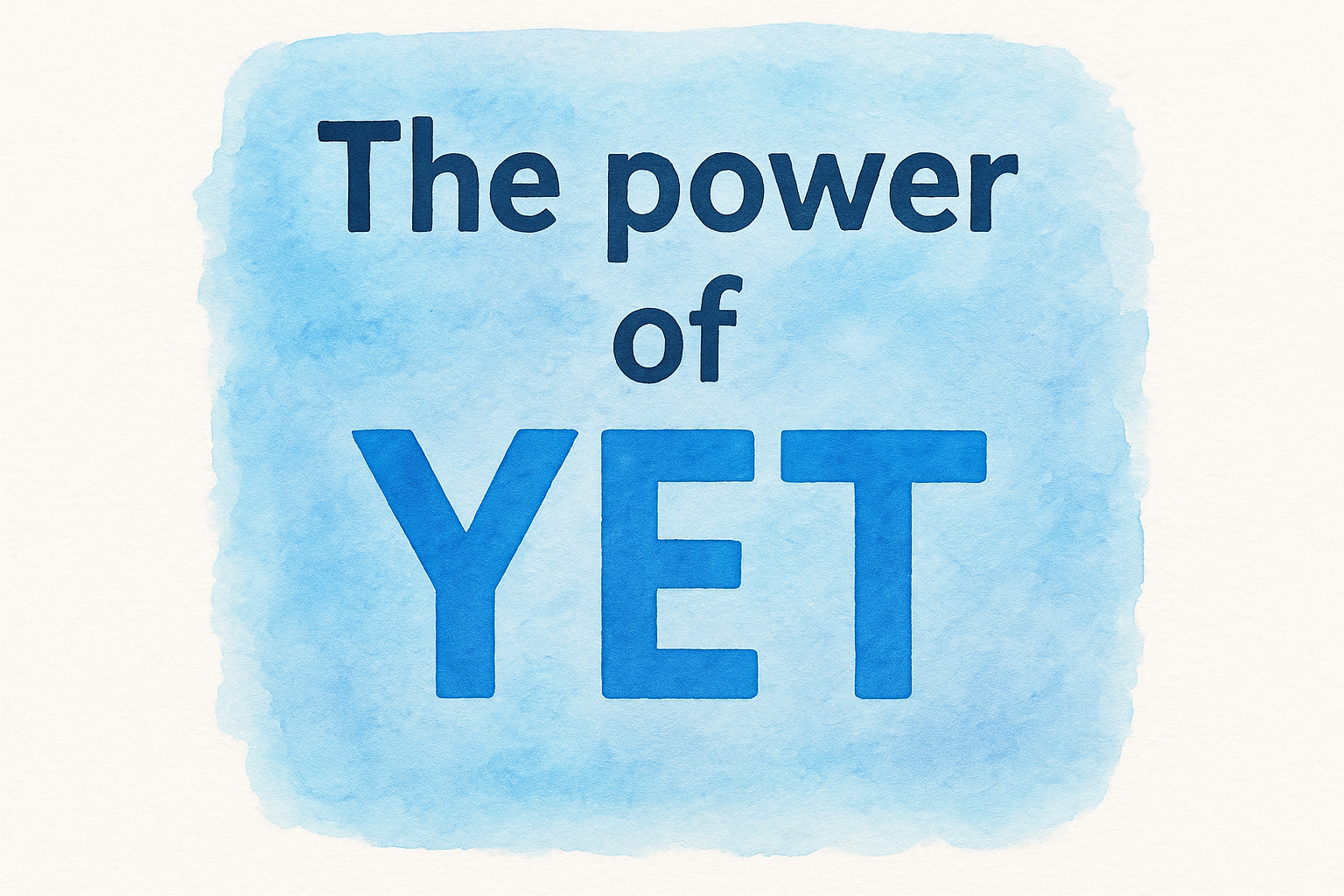
The "power of yet" concept comes directly from Carol Dweck’s research on growth mindset, and a well-placed poster turns this single word into a daily classroom reminder that learning is always in progress. Instead of saying "I can’t do this," students learn to say "I can’t do this yet," which shifts the entire framing of struggle from permanent to temporary.
Core message
This poster replaces fixed-mindset self-talk with one small but powerful word. "Not yet" signals that a skill is still developing, not permanently out of reach, giving students a concrete tool for reframing difficulty in real time.
Why it builds resilience
When students internalize "yet," they stop treating difficulty as evidence of failure. Struggle becomes a normal part of the process, which keeps students willing to try again instead of shutting down.
The word "yet" reframes a student’s current inability as a step in a longer journey, not a final verdict on their potential.
How to use it in class
Point to this poster directly whenever a student says they "can’t" do something. Correcting the language in the moment, consistently and without making it feel punitive, builds the habit faster than any single lesson can.
Design and placement tips
Place this poster near your classroom door or above the board so students see it entering and exiting. Bold, high-contrast text works best since the message needs to land quickly at a glance.
Cost and format options
Free printable versions of this poster are widely available through platforms like Teachers Pay Teachers, with paid sets offering more polished, print-shop-ready files that hold up better as part of a cohesive set of classroom growth mindset posters.
3. Mistakes help me learn poster
A "Mistakes Help Me Learn" poster tackles one of the most stubborn student beliefs head-on: that making an error means something is wrong with you, rather than being a normal step in the learning process. Hanging this message where students can see it daily works as a quiet but consistent reframe of what mistakes actually mean in your classroom.
Core message
This poster communicates that errors are data, not verdicts. Every mistake points to exactly where the brain needs more practice, making it one of the most practical messages you can keep on your walls as part of a strong set of classroom growth mindset posters.
Why it builds resilience
Students who fear mistakes avoid challenge. This poster gives them explicit permission to get things wrong, which lowers the emotional cost of trying difficult tasks and keeps them in the game longer.
When students stop equating mistakes with failure, they become more willing to take the risks that lead to real learning.
How to use it in class
Reference this poster during error analysis activities, where students look back at their own work and identify what went wrong. Framing corrections as learning moments rather than punishments makes the poster’s message feel lived-in rather than decorative.
Design and placement tips
Place this poster near your feedback station or grading area where students pick up returned work. Seeing it in that specific moment reinforces the message exactly when students need it.
Cost and format options
Free printable versions are available through Teachers Pay Teachers, and paid sets from that platform offer coordinated designs that pair well with other mindset posters in your room.
4. I can do hard things poster
The phrase "I can do hard things" is short, direct, and memorable, which is exactly what makes it one of the most effective classroom growth mindset posters you can hang up. Students who struggle with self-doubt need a simple statement they can reach for internally, and this poster gives them exactly that.
Core message
This poster tells students that difficulty is survivable and that they already have what it takes to push through challenging tasks. It is not a vague motivational slogan; it is a concrete affirmation students can repeat silently when a task feels overwhelming.
Why it builds resilience
Students who believe they can handle difficulty are more likely to stay engaged mentally when things get hard. Repeated exposure to this message builds a quiet confidence that reduces the likelihood of students shutting down at the first sign of struggle.
Self-belief is a skill students build through repetition, and seeing this message every day contributes directly to that process.
How to use it in class
Have students say this phrase aloud before starting a particularly challenging assignment. That small ritual connects the poster’s message to a real moment of difficulty, making the affirmation more than just words on a wall.
Design and placement tips
Place this poster at eye level near student workstations so students read it naturally before they begin working. Bold typography on a high-contrast background makes the message land immediately at a glance.
Cost and format options
Free printable versions exist on Teachers Pay Teachers, with paid sets offering more polished, print-shop-ready files that hold up better over a full school year.
5. Effort and strategy over talent poster
This poster directly challenges the belief that natural ability determines success. Students who think talent is fixed either coast on it or give up when it runs out. An effort-and-strategy poster pushes back on that idea every single day by keeping the real drivers of learning visible in your room.
Core message
The core message here is that how hard you work and how smart your approach is matters more than any raw ability you were born with. This is one of the most research-backed ideas in educational psychology, and it belongs on your walls as part of a strong set of classroom growth mindset posters.
Why it builds resilience
Students who attribute success to talent alone stop trying the moment something feels difficult. Shifting the focus to effort and strategy gives students something they can actually control, which keeps them engaged through difficult tasks instead of walking away.
When students believe their choices drive their outcomes, they stay in the fight longer than students who think results are predetermined by talent.
How to use it in class
Reference this poster during goal-setting activities where students identify not just what they want to achieve but how they plan to get there. Connecting strategy to outcome reinforces the poster’s message in a practical, memorable way.
Design and placement tips
Bold text with two distinct visual sections for "effort" and "strategy" helps students read the message clearly at a glance. Place it near your learning objectives board so students see it alongside the day’s goals.
Cost and format options
Free printable versions are available on Teachers Pay Teachers, while paid coordinated sets offer a more cohesive look across your entire classroom display.
6. Progress over perfection poster
A "Progress Over Perfection" poster directly counters one of the biggest barriers to student effort: the belief that anything less than a perfect result is not worth doing. Students who chase perfection often freeze up before they even start, because the gap between where they are and where they want to be feels too wide. This poster keeps the real goal, forward movement, visible every day.
Core message
This poster tells students that showing up and moving forward matters more than getting everything right on the first try. It shifts the measure of success from the final product to the effort and improvement happening along the way.
Why it builds resilience
Students who only value perfection quit the moment things get messy. Accepting progress as a win keeps students working through the messy middle of learning, which is exactly where the growth happens.
Resilience grows when students learn to value their own improvement rather than comparing their output to an impossible standard.
How to use it in class
Use this poster as a reference point during peer review and revision activities, reminding students that the goal of feedback is improvement, not perfection. Pointing to it during drafting stages helps normalize the iterative nature of learning.
Design and placement tips
Place this poster near your writing wall or revision station where students work on drafts and rewrites. A clear visual contrast between the words "progress" and "perfection" helps the message read quickly.
Cost and format options
Free printable options are available through Teachers Pay Teachers, and paid coordinated sets pair well with other classroom growth mindset posters you already have displayed.
7. Feedback helps me grow poster
A "Feedback Helps Me Grow" poster reframes one of the most emotionally charged moments in a student’s school day: receiving critical feedback on their work. Many students hear corrections as personal criticism rather than useful information. Keeping the right interpretation of feedback visible helps you build a classroom culture where critique is welcomed rather than feared.
Core message
This poster tells students that feedback is a tool, not a judgment. Outside perspective helps them improve in ways they cannot achieve by working alone, which is a message worth repeating consistently as part of your classroom growth mindset posters display.
Why it builds resilience
Students who reject feedback stay stuck. Seeing this message daily helps them build the habit of receiving critique with openness rather than shutting down defensively.
Students who learn to use feedback as fuel for improvement outperform those who treat it as a verdict on their ability.
How to use it in class
Reference this poster during peer review sessions and directly after returning graded work. Pointing to it connects the message to a real experience rather than leaving it as background decoration. You can anchor the habit further by:
- Asking students to identify one piece of feedback they will act on
- Using the poster’s language in your written comments on student work
Design and placement tips
Place this poster near your feedback station or discussion area. Clear typography with a forward-movement visual, like an upward arrow, reinforces the message at a glance.
Cost and format options
Free printable versions are available on Teachers Pay Teachers, with paid coordinated sets offering designs that match your existing classroom display.
8. Challenge zone poster
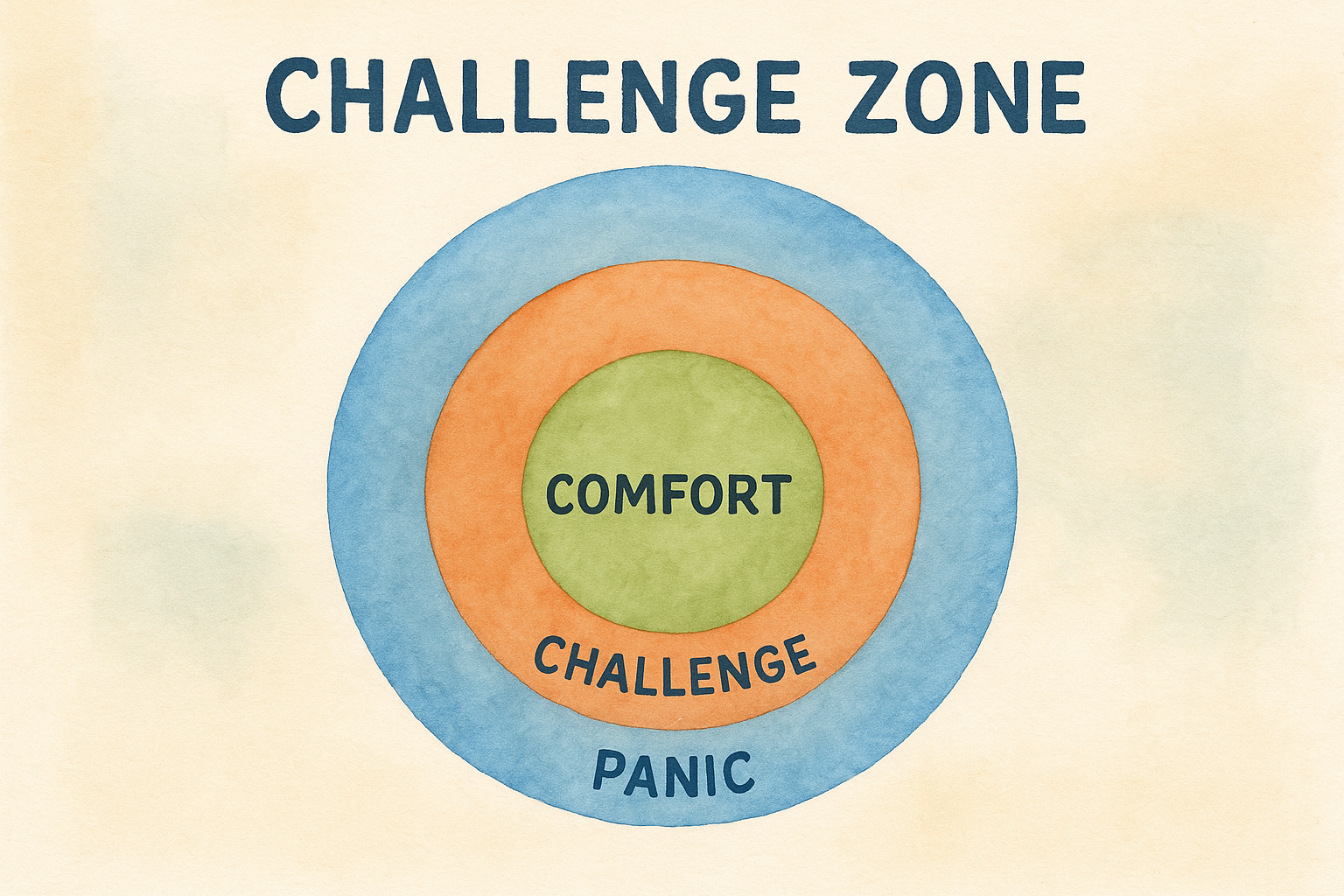
A challenge zone poster helps students understand that real growth only happens outside their comfort zone. Rather than avoiding difficult tasks, students learn to recognize the discomfort of challenge as a sign they’re exactly where they need to be as learners.
Core message
This poster typically uses a visual diagram showing three zones: comfort, challenge, and panic. The challenge zone is framed as the productive space where learning actually happens, giving students a clear mental model to reference during difficult tasks.
Why it builds resilience
Students who can name where they are in the moment handle frustration better. Recognizing "I’m in the challenge zone right now, and that’s okay" reduces the emotional spike that often leads to shutting down.
Students who understand challenge as a necessary part of learning push through difficulty longer than those who interpret struggle as a warning sign.
How to use it in class
Reference this poster when assigning harder tasks or when students express frustration. Ask students directly which zone they feel they’re in, then use that conversation to redirect their energy toward effort rather than avoidance.
Design and placement tips
A three-circle diagram with labeled zones works best visually. Place it somewhere central, like above your whiteboard, so you can point to it quickly during instruction.
Cost and format options
Free printable versions of this poster appear regularly on Teachers Pay Teachers. Paid coordinated classroom growth mindset posters sets offer more polished versions that print cleanly at larger sizes.
9. Practice makes progress poster
A "Practice Makes Progress" poster updates the tired "practice makes perfect" phrase into something more honest and more useful. Perfection sets an impossible bar; progress is always achievable. This shift helps students focus on the work itself rather than an outcome they may never reach.
Core message
This poster tells students that consistent practice is the actual mechanism of improvement, not some fixed level of talent they either have or don’t. Every repetition moves them forward, even when the steps feel small.
Why it builds resilience
Students who track progress stay motivated through difficulty far longer than those chasing a perfect result. Seeing incremental improvement as a win in itself keeps students putting in effort even when mastery feels distant.
Resilience builds when students connect their daily practice to real, visible movement forward rather than measuring themselves against a standard they haven’t reached yet.
How to use it in class
Reference this poster during skill-building activities where students practice the same type of task repeatedly, like grammar drills, math problem sets, or writing exercises. Ask students to compare earlier work to current work so the progress becomes visible and concrete rather than abstract.
Design and placement tips
Place this poster near your skills practice area or wherever students do repetitive drills. Clean, simple typography works best so the message reads immediately without visual clutter competing for attention.
Cost and format options
Free printable versions appear regularly on Teachers Pay Teachers, and paid coordinated classroom growth mindset posters sets offer sharper designs that hold up better when printed at larger sizes for display.
10. Positive self-talk swap poster
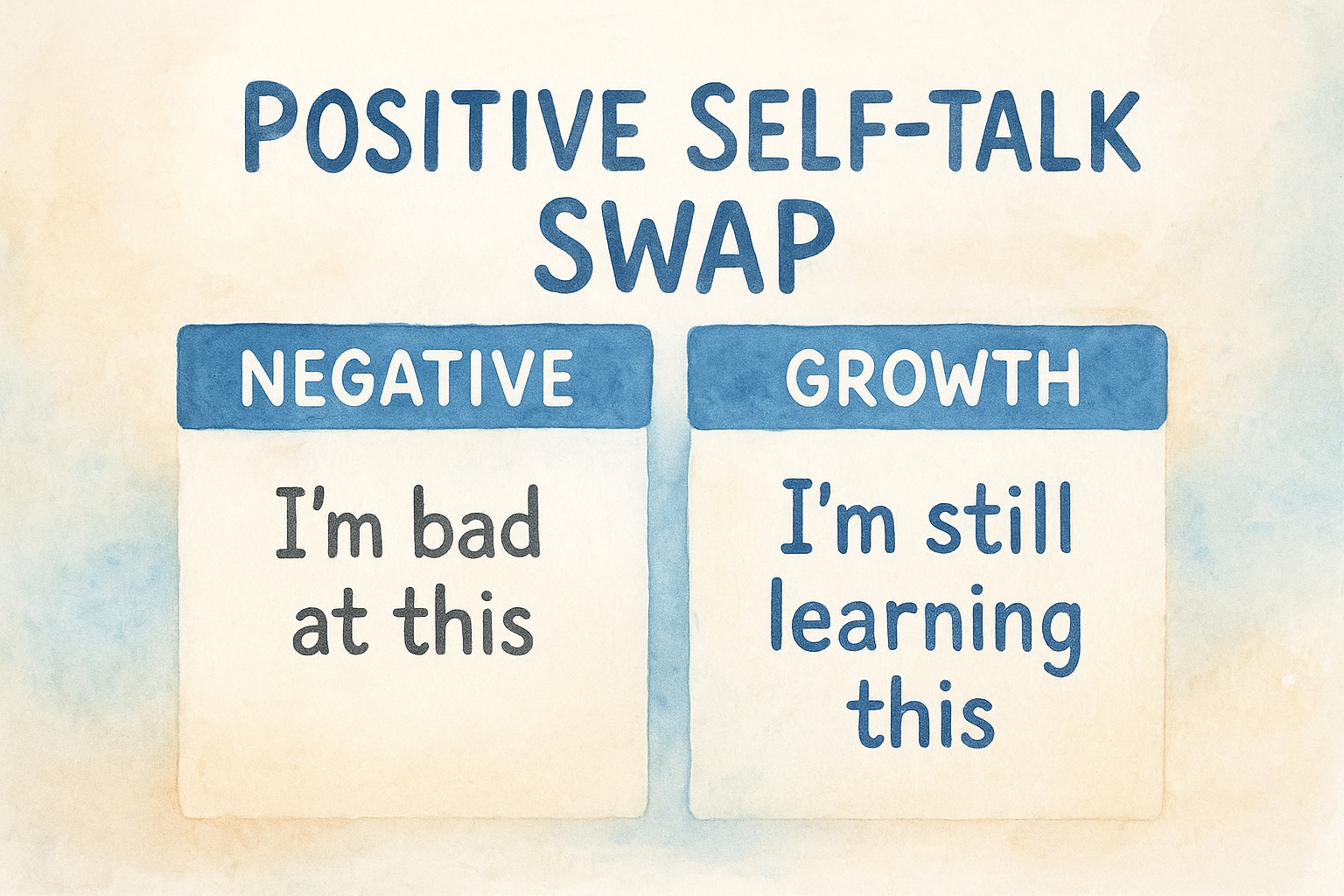
A "Positive Self-Talk Swap" poster gives students a concrete tool for catching and redirecting the negative inner voice that shuts down effort before it starts. Instead of offering vague motivation, this type of poster shows two columns side by side: the fixed-mindset phrase on one side and the growth-mindset replacement on the other.
Core message
This poster teaches students that their internal dialogue is something they can change, not something they’re stuck with. By showing specific swaps like "I’m bad at this" becoming "I’m still learning this," it hands students a practical script they can actually use.
A clear language swap is more actionable than any general pep talk.
Why it builds resilience
Students who catch negative self-talk early stay in the learning process longer than those who let it run unchecked. Redirecting a defeatist thought is a skill, and this poster keeps that skill visible.
Students who learn to redirect their own thinking recover from setbacks faster than those who let negative self-talk take over.
How to use it in class
Reference this poster during reflection activities where students identify a recent challenge. Ask them to locate their thought on the poster and write down the growth-mindset swap to reframe it.
Design and placement tips
A two-column layout with clear visual separation between fixed and growth phrases reads instantly from across the room. Place it near your independent work area where self-doubt tends to surface most often.
Cost and format options
Free printable versions are available on Teachers Pay Teachers. Paid sets offer coordinated classroom growth mindset posters that match your existing display without extra design work on your end.
11. Keep going through setbacks poster
A "Keep Going Through Setbacks" poster addresses the moment students are most likely to quit: right after something goes wrong. Setbacks feel personal, and students often interpret them as proof that they don’t belong in the challenge. Keeping a visible reminder to push forward holds that interpretation in check on the hardest days.
Core message
This poster tells students that setbacks are part of every learning journey, not signals to stop. The message reframes difficulty not as a dead end but as a temporary obstacle that forward motion can clear.
Why it builds resilience
Students who expect a smooth path fall apart when the road gets rough. Normalizing setbacks through repeated exposure to this message helps students treat obstacles as expected rather than catastrophic.
Students who see setbacks as part of the process recover faster and try again more readily than those who treat every stumble as a reason to stop.
How to use it in class
Reference this poster after tests, failed drafts, or frustrating class discussions where students visibly shut down. Pointing to it in the moment gives you a shared language for redirecting energy back toward effort rather than defeat.
Design and placement tips
Choose a design with strong forward-movement imagery, like a path or upward line, to reinforce the message visually. Place it somewhere students see after receiving difficult feedback or returning graded work.
Cost and format options
Free printable versions appear on Teachers Pay Teachers, and paid coordinated classroom growth mindset posters sets offer sharper files that print cleanly at display size.
Quick recap and next steps
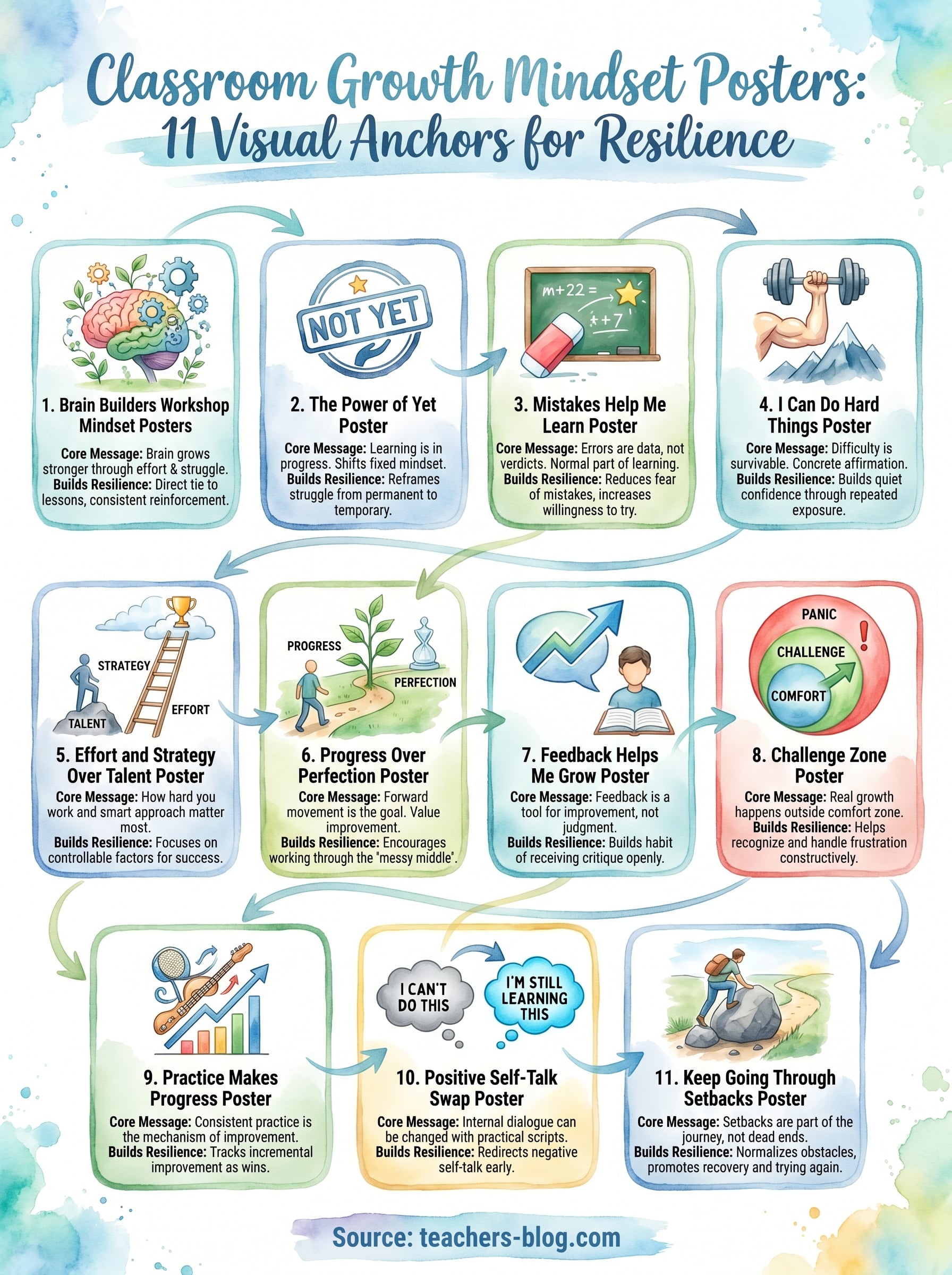
Each of the 11 classroom growth mindset posters on this list targets a specific mindset barrier your students face, from fearing mistakes to avoiding challenge to quitting after setbacks. No single poster does the work on its own, but together, displayed consistently and referenced regularly during instruction, they build the kind of visual reinforcement that makes your mindset teaching stick beyond a single lesson.
The most important step you can take now is to stop treating posters as decoration and start treating them as active teaching tools you point to, reference, and connect to real student experiences. Start with one or two that address the biggest mindset blocks in your classroom, then expand from there.
If you want a structured, ready-to-use system behind those posters, explore the Brain Builders Workshop resources at The Cautiously Optimistic Teacher, where the mindset lessons and activities tie directly to the messages you put on your walls.