
6 Edutopia Formative Assessment Strategies That Work Daily
You gave a lesson, students nodded along, and then the quiz results came back looking like they’d never heard of the topic. Sound familiar? The gap between teaching and actual understanding is where formative assessment lives, and Edutopia formative assessment strategies have become a go-to reference for teachers who want to close that gap in real time, not after it’s too late.
At The Cautiously Optimistic Teacher, we spend our days digging through classroom strategies so you don’t have to. We build tools and resources that help educators work smarter, and formative assessment is one of those non-negotiable skills that every teacher needs in their back pocket. It’s not about adding more to your plate, it’s about getting better data from what you’re already doing.
This article breaks down six Edutopia-inspired formative assessment strategies you can realistically use every day. No elaborate prep, no expensive tech. Just proven techniques that give you a clear read on where your students actually are, so you can adjust before the unit test becomes a disaster. Let’s get into what makes each one work and how to put them into practice tomorrow.
1. Exit tickets and quick questions
Exit tickets and quick questions are the backbone of daily formative assessment, and they appear consistently in Edutopia formative assessment research for a simple reason: they work. You ask students one to three focused questions at the end of a lesson or during a transition, and their answers tell you exactly where the class stands before you plan your next move.
What it is
An exit ticket is a short, targeted prompt that students complete in the final two to five minutes of class. Quick questions follow the same logic mid-lesson: you pause, pose a question verbally or on the board, and students write their response on a slip of paper, a sticky note, or a digital form. The simplicity of the format is exactly what makes it repeatable every single day.
Steps to use it daily
Getting this into your daily routine takes very little prep time:
- Write one or two questions tied directly to your lesson objective before class starts.
- Give students three minutes to respond independently, with no discussion allowed.
- Collect responses at the door or in a designated spot.
- Sort them quickly into three groups: got it, almost there, not yet.
What evidence it gives you
Exit tickets hand you a class-wide snapshot of understanding in minutes. You can see which students grasped the concept, who is close but needs a nudge, and whether a significant portion of the class missed something entirely that requires a full reset.
Review the results the same evening, before you finalize your plan for the next day, so the data actually changes what you teach.
Quick variations
You can rotate the format to keep students engaged. Try a two-sentence summary prompt, a "what still confuses me" card, or a true-or-false question about a common misconception from the lesson. Google Forms works well if you want responses collected and sorted automatically.
How to respond to results
Look at your piles and adjust your opening activity for the next day based on what you find. If more than a third of your students land in the "not yet" group, you reteach before moving forward. When only a few students struggle, pull them for a short small-group session while the rest of the class practices independently.
2. Yes no chart
The yes/no chart is one of the simplest diagnostic tools you can add to your daily routine, and Edutopia formative assessment research highlights it specifically because it gives you instant whole-class data without interrupting your lesson flow.
What it is
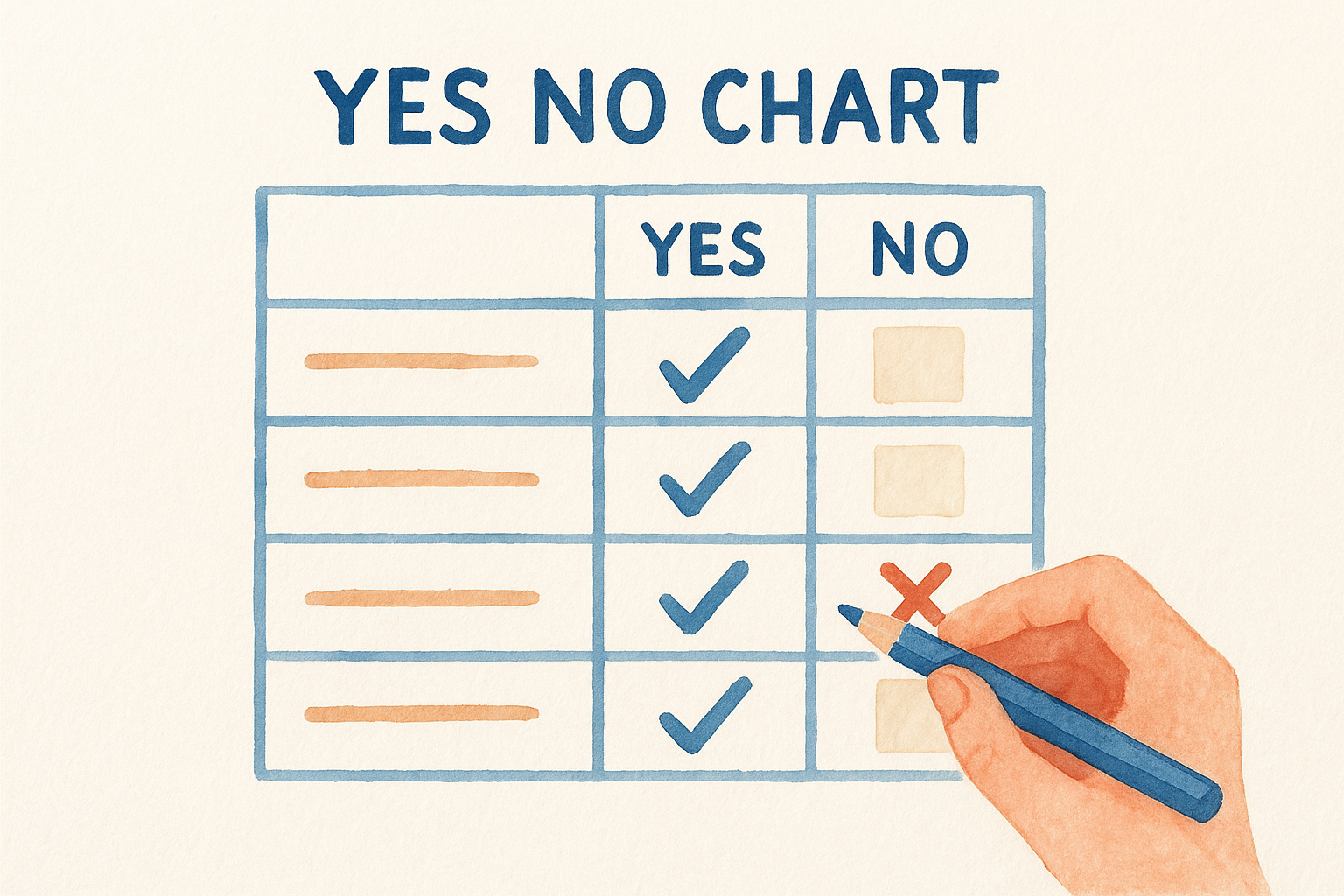
A yes/no chart is a visual tracking tool where students indicate whether they understand a concept, can perform a skill, or feel ready to move on. You display a short list of learning targets, and students mark yes or no next to each one on paper or a shared digital document.
Steps to use it daily
Running this check takes under three minutes of class time:
- List two to four specific skills or concepts tied to the day’s objective.
- Ask students to mark honestly, without discussion or looking at neighbors.
- Collect or photograph the charts before they leave.
What evidence it gives you
A quick scan of the charts reveals which targets your class feels confident about and which ones are creating widespread uncertainty. You see a class-wide pattern instantly, not just isolated individual gaps.
If more than half the class marks no on a skill, address it before you introduce new content.
Quick variations
Add a "sort of" column to capture partial understanding instead of forcing students into a binary choice.
How to respond to results
Use the results to group students by confidence level for the next activity, and target your reteaching toward the specific skills that generated the most no responses.
3. Muddiest point
The muddiest point strategy appears regularly in edutopia formative assessment discussions because it targets confusion directly, rather than asking students to prove what they know. It invites students to name the thing that still isn’t clear, which gives you far more useful information than a thumbs-up survey.
What it is
At its core, the muddiest point is a single-question prompt: "What was the muddiest, or least clear, point from today’s lesson?" Students write one to two sentences in response. The format is deliberately open-ended so students can flag anything from a vocabulary term to a procedure they couldn’t follow.
Steps to use it daily
You can run this check in the final two minutes of class with zero prep:
- Ask students to write their muddiest point on a sticky note or index card.
- Set a one-minute timer so responses stay brief.
- Collect all cards as students exit the room.
What evidence it gives you
The responses give you specific language from your students, not your assumptions about where the lesson fell apart. When multiple students describe the same confusion, you have a clear signal that a specific part of your instruction needs attention before you move forward.
Read the cards before you plan the next day’s opener so you can address confusion while it’s still fresh.
Quick variations
Try running the muddiest point mid-lesson instead of at the end to catch confusion before it compounds into bigger misunderstandings.
How to respond to results
Sort the cards into common themes and address the top one or two during your next class opener. If confusion is widespread, build a brief re-explanation into the first five minutes rather than waiting for a formal reteach block later in the week.
4. Misconception check
The misconception check is a targeted formative assessment move that identifies wrong ideas before they harden into permanent gaps. Unlike other checks that measure what students know, this one focuses specifically on what students believe incorrectly, which is often more damaging to future learning than a simple gap in knowledge.
What it is
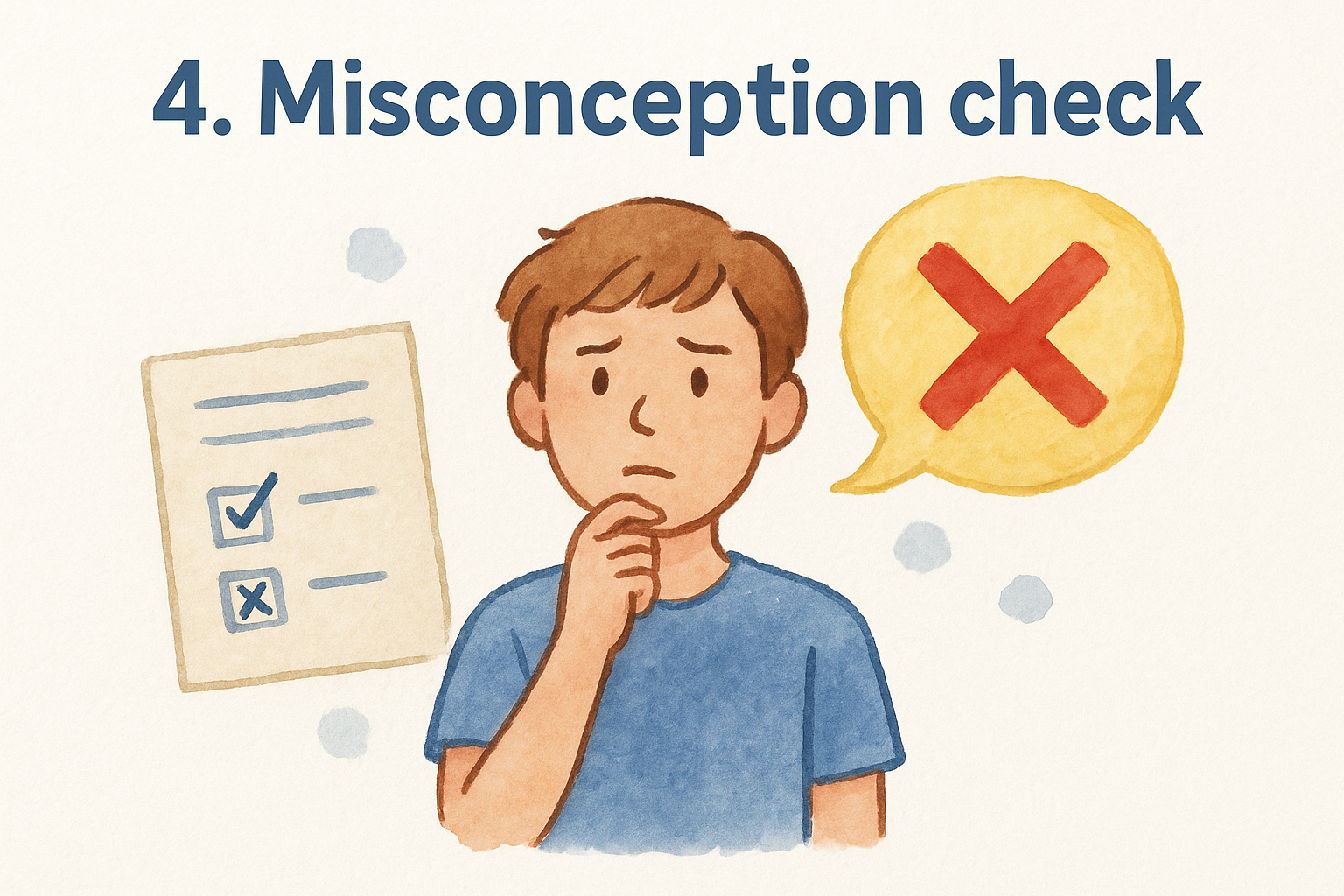
A misconception check presents students with a statement, scenario, or problem that contains a common error in thinking related to your lesson content. Students indicate whether the statement is correct or incorrect and explain their reasoning in one to two sentences.
Steps to use it daily
Running this check fits easily into any point in your lesson:
- Identify one common misconception tied to your current unit.
- Write a clear, plausible-sounding statement that reflects that error.
- Give students two minutes to respond and explain their thinking.
What evidence it gives you
The explanations students write reveal exactly how they are reasoning, not just whether they got the answer right. Edutopia formative assessment guidance consistently points out that surface-level correct answers can hide deep conceptual errors, and this strategy exposes those hidden problems directly.
If students can identify the error and explain why it is wrong, they have moved beyond memorization into genuine understanding.
Quick variations
Replace the written explanation with a partner discussion where students defend their reasoning to a classmate before you debrief as a whole group.
How to respond to results
When you spot a recurring misconception, address it directly at the start of your next class by showing students two contrasting examples and walking through the difference explicitly.
5. Brain dump
The brain dump gives you a raw, unfiltered look at what students actually retained from a lesson, without any prompting or multiple-choice scaffolding to guide their thinking. It shows up across edutopia formative assessment resources because it reveals the full picture of student understanding in one quick burst of writing.
What it is
A brain dump asks students to write down everything they remember about a topic in a set amount of time, with no notes and no structure required. The goal is volume and honesty, not polished answers.
Steps to use it daily
You can run this in under five minutes:
- Set a two-minute timer and tell students to write everything they know about the day’s topic.
- Let them write freely without stopping to organize their thoughts.
- Collect the papers or ask students to highlight their three strongest points before handing them in.
What evidence it gives you
The brain dump surfaces both confident knowledge and notable gaps in the same document. When students consistently leave out a key concept, that absence tells you exactly where your next lesson needs to focus.
What students do not write is often more instructive than what they do.
Quick variations
Run the brain dump at the start of a new unit as a pre-assessment to establish what prior knowledge your students are bringing to the table.
How to respond to results
Scan for missing concepts across the class and open your next lesson by filling in the most common gaps directly before introducing new material.
6. Four corners
Four corners gets students out of their seats and into a live conversation about their thinking, making it one of the most energizing edutopia formative assessment strategies you can run without any printed materials at all.
What it is
Each corner of your room becomes a response zone. You label the corners with choices like "strongly agree," "agree," "disagree," and "strongly disagree," then read a content-related statement aloud and ask students to walk to the corner that best matches their thinking.
Steps to use it daily
Running this check takes about three to four minutes of class time:
- Post a corner label in each area before students arrive.
- Read a clear statement tied to your lesson objective.
- Give students ten seconds to move to their chosen corner.
- Ask one student per corner to explain their reasoning aloud.
What evidence it gives you
The physical movement instantly separates students by understanding level, giving you a visual map of class-wide thinking without a single paper to collect.
When most students cluster in the same corner, you have a fast signal about whether the class is aligned or split on a key concept.
Scan the room to pinpoint exactly where confusion concentrates and which students hold minority positions worth probing before you debrief.
Quick variations
Replace opinion statements with factual claims from your lesson content to turn four corners into a rapid misconception check.
How to respond to results
Probe the outlier corners first when most students cluster together, because those minority positions often surface the exact misconceptions you need to address before moving on.
Next steps for tomorrow’s lesson
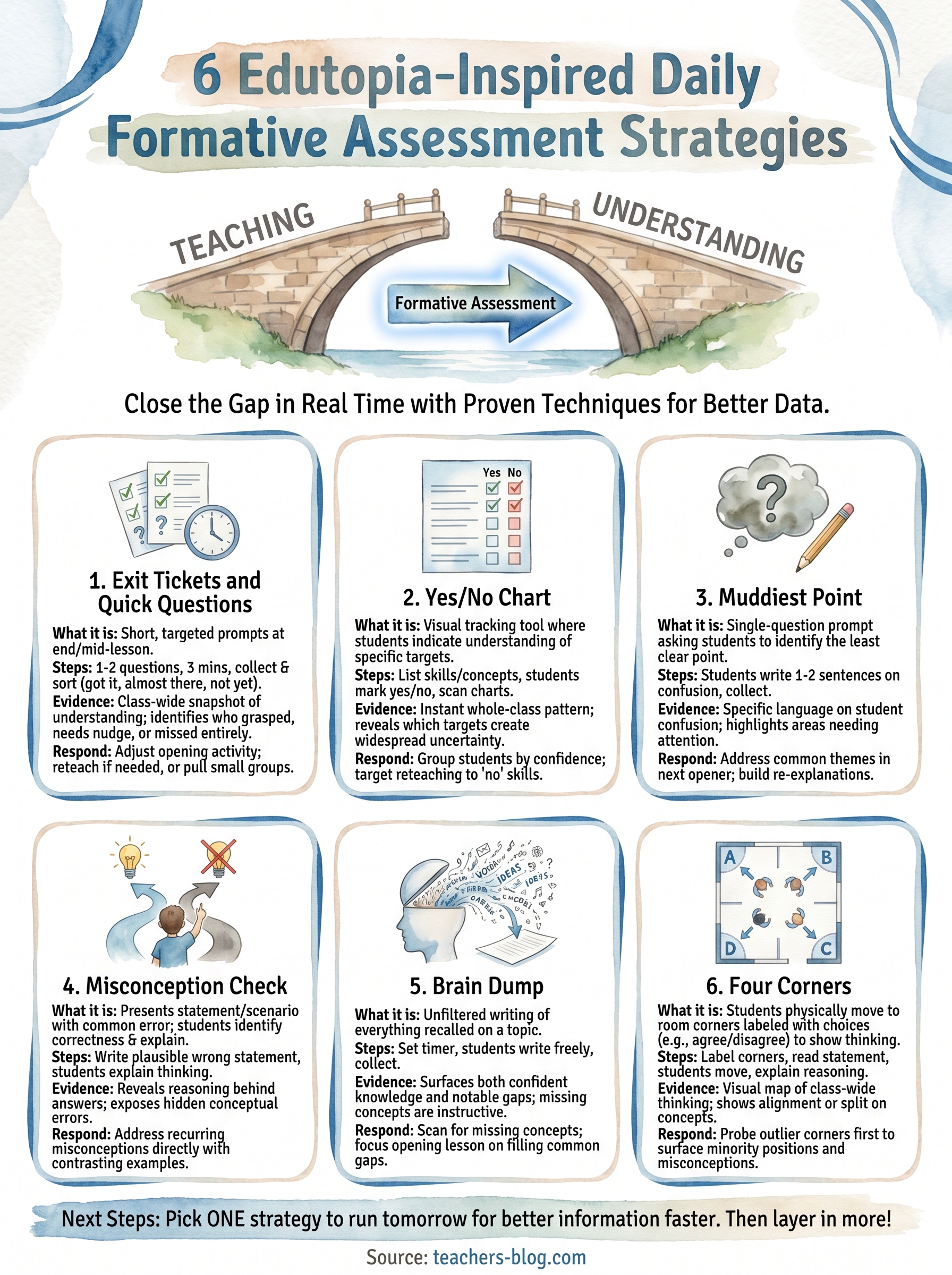
You do not need to overhaul your entire teaching practice to get meaningful data from your students every day. Pick one of these six edutopia formative assessment strategies and run it tomorrow. Just one. See what the results tell you, then adjust your next lesson based on what you find. That single habit, repeated consistently, will give you a clearer picture of student understanding than any end-of-unit test ever could.
Once that first strategy feels automatic, layer in a second. Mix a brain dump at the start of class with an exit ticket at the end, and you will have a clear baseline and a clear close every single day. The goal is not perfection, it is better information faster so you can teach more effectively. For more practical classroom strategies and ready-to-use tools built specifically for teachers, visit The Cautiously Optimistic Teacher and explore what fits your classroom next.